Drowning in debt

400dpiLogo

Macro Letter – No 60 – 02-09-2016

Drowning in debt

  • Central Banks are moving from quantitative to qualitative easing
  • The spread between Investment Grade and Government bond yields is narrowing
  • Issuing corporate debt rather than equity has never been so attractive
  • Corporate leverage is rising, share buy-backs continue but investment remains weak

I was always

Far out at sea

And not waving

But drowning

Stevie Smith

During August the financial markets have been relatively quiet, however, the Bank of England (BoE) cut interest rates on 4th and added Investment Grade Corporate bonds to their Asset Purchase Programme. The following day Vodafone (VOD) issued a 40yr bond yielding 3% – a week earlier they had issued a 33yr bond yielding 3.4%.

Meanwhile, at Jackson Hole the Kansas City Federal Reserve Symposium discussed a paper by Professor Jeremy Stein – a member Federal Reserve board member between 2012 and 2014 – and two other Harvard professors entitled The Federal Reserve Balance Sheet as a Financial Stability Tool – in which the authors argue that the Fed should maintain its balance sheet at around $4.5trln but that it “should use its balance sheet to lean against private-sector maturity transformation.” In layman’s terms this is a “call to arms” encouraging the Fed to seek approval from the US government to allow the purchase a much wider range of corporate securities. It would appear that the limits of central bank omnipotence have yet to be reached. The Bank of Japan has already begun to discover the unforeseen effect that negative interest rate policy has on the velocity of the circulation of money – it collapses. Now central bankers, who’s credibility has begun to be questioned in some quarters of late, are considering the wider use of “qualitative” measures.

As Bastiat has taught us, that which is seen from these policies is a reduction in the cost of borrowing for “investment grade” corporations. What is not seen, so clearly, is the incentive corporates have to borrow, not to invest, but to buy back their own stock. Perhaps I am being unfair, but, in a world which is drowning in debt, central bankers seem to think that the over-indebted are not “drowning” but “waving”.

One of the most cherished ideas, promulgated upon an unsuspecting world, is the concept of using fiscal and monetary stimulus to offset cyclical economic downturns. The aim of these “popular” policies is to soften the blow of economic slowdowns – all highly laudable provided the “punch bowl” is withdrawn during the cyclical recovery.

So much for business cycles: but what about the impact these policies may have on structural changes in economic performance relating to supply and demand for factors of production, such as labour, fixed assets or basic materials? I’m thinking here about the impact, especially, of technology and demographics.

Firstly, the cyclical stimulus extended during the downturn is seldom withdrawn during the upturn and secondly, long term structural changes in economies are seldom considered by governments, since these changes evolve over decades or generations, rather than the span of a single parliament. This is an essential weakness in the democratic process which has stifled economic growth for centuries. This excellent paper from Carmen M. Reinhart, Vincent R. Reinhart, and Kenneth S. Rogoff – The Journal of Economic Perspectives – Volume 26 – No 3 – Summer 2012 – Public Debt Overhangs: Advanced Economy Episodes Since 1800 makes this weakness abundantly clear.

The authors expand on their earlier research, this time looking at the impact of excessive public debt overhang on economic growth. They take as their “line in the sand” the point where the government debt to nominal GDP ratio remains above 90% for more than five years. They identify 26 episodes, 20 of which lasted more than a decade – the average was 23 years. It is worth noting that more than one third of these episodes occurred without interest rates rising above normal levels.

In 23 of the 26 episodes, over the 211 year sample, the pace of economic growth was lowered from 3.5% to 2.3% – in other words GDP was reduced by roughly one third. The long term secular impact of high debt and lower growth needs to be weighed against the short-term benefits of Keynesian stimulus. A lowering of the GDP growth rate of 1.2% for 23 years is equivalent to a 24.25% reduction in the potential size of the economy at the end of the debt overhang period – a tall price for any economy to pay.

The authors briefly examine the other types of outstanding debt, in order to arrive at what they dub “the quadruple debt overhang problem”, namely, private debt, external debt (and its associated currency risks) and the “actuarial” debt implicit in “unfunded” pension schemes and medical insurance programmes. This data is hard to untangle but the authors state:-

…the overall magnitude of the debt burdens facing the advanced economies as a group is in many dimensions without precedent. The interaction between the different types of debt overhang is extremely complex and poorly understood, but it is surely of great potential importance.

The 22 developed economies in their sample are now burdened with debt to GDP ratios above the levels seen in the aftermath of WWII. Their 48 emerging market counterparts had their epiphany in the debt crisis of the mid 1980’s, since when they have assumed a certain sobriety of character. This shows up even more glaringly in the divergence since 1986 in the public, plus private, external debt. In developed countries it has risen from around 75% of GDP to more than 250% whilst emerging economies external debt has fallen from a broadly similar 75% to less than 50% today. Governments, often bailout private external debt holders in order to protect the stability of their currencies.

Private domestic credit is another measure of total indebtedness which the authors analyse. For the 48 emerging economies this has remained constant at around 40% of GDP since the mid-1980s whilst in the developed 22 it has risen from 50% in the 1950’s to above 150% today. Since the bursting of the technology stock bubble in 2000 this trend has accelerated but the authors point out that these increases are often caused by cross border capital inflows.

The rise in the debt to GDP ratio may come from a slowing in growth rather than an increase in government debt but the correlation between rising debt and slowing GDP rises dramatically as the ratio exceeds 90%.

The authors draw the following conclusions:-

…First, once a public debt overhang has lasted five years, it is likely to last 10 years or much more (unless the debt was caused by a war that ends).

…it is quite possible to have a “no drama” public debt overhang, which doesn’t involve a rise in real interest rates or a financial crisis. Indeed, in 11 of our 26 public debt overhang episodes, real interest rates were on average comparable, or lower, than at other times.

…Another line of reasoning for dismissing concerns about public debt overhangs is the view that causality mostly runs from growth to debt. However, we discussed a body of evidence which argues runs from growth to debt. However, we discussed a body of evidence which argues that causality does indeed run from the public debt overhang to slower growth. There are counterexamples where a public debt overhang was accompanied by rapid growth, like the immediate period after World War II for the United States and United Kingdom, but these exceptions to the typical pattern do not seem to be the most relevant parallels for the modern world economy.

…The pathway to containing and reducing public debt will require a change that is sustained over the middle and the long term. However, the evidence, as we read it, casts doubt on the view that soaring government debt does not matter when markets (and official players, notably central banks) seem willing to absorb it at low interest rates—as is the case for now.

The Methadone of the Markets

The bull market in fixed income securities began in the early 1980’s. The price of “risk free” assets has always had a significant influence on the valuation of equities but, since the advent of quantitative easing, the principle driver of performance has become the level of interest rates. As the yield on fixed income securities has inexorably declined the spread between the dividend and bond yield has returned to positive territory after many years of inversion.

Companies with growing earnings from their operations can finance more cheaply than at any time in history. Provided they can sustain their growth, their bonds should, theoretically, begin to trade at a discount to government bonds. This would probably have happened before now had the central banks not embarked on quantitative easing revolving around the purchase of government bonds at already artificially inflated prices. The rules on capital weighting which favour “risk free” assets and regulations requiring pension funds and other financial institutions to hold minimum levels of “risk free” assets has further distorted the marketplace.

The unfunded government pension schemes of developed nations are at the mercy of the demographic headwind of a smaller working age population supporting a growing legion of retirees. Added to which, breakthroughs in medical science suggest that actuarial expectations of life expectancy may once again be underestimated.

Ways out of debt

There are a number of solutions other than fiscal austerity. For example, increasing the pensionable age steadily towards the average life expectancy. This may sound extreme but in January 1909, when the pension was first introduced in the UK, the pensionable age was 70 years and life expectancy was 50 years for men and 53.5 for women. The latest ONS data shows male life expectancy at 79 years whilst for females it is 82.8 years. The pensionable age for women has now risen to 63 years and will be brought in line with men (65 years) by 2018. There is still a long way to go, by 2030 the NHS estimate the male average will be 85.7 years, with females living an average of 87.6 years. Meanwhile the pensionable age will reach 68 years by 2028. In other words, the current, deeply unpopular, proposed increase in the pensionable age is barely keeping pace with the projected increase in life expectancy.

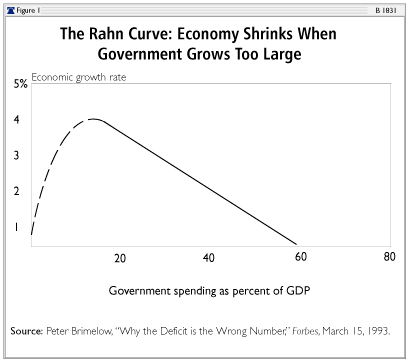
Another solution which would help to reduce the level of public debt is a structural policy of capping government spending at less than 40% of GDP. This could be relaxed to less than 50% during recessions as a temporary counter-cyclical measure. UK GDP averaged 2.47% since 1953 – if government spending only increased slightly less than 1% per annum we could steadily reduce the public sector debt burden towards a manageable 30% level over the next 40 years, after all, as recently as 2005 the ratio of government debt to GDP was at 38%. The chart below of the Rahn Curve shows the optimal ratio of government debt to GDP. Once government spending exceeds 15% it acts as a drag on the potential growth of an economy:-

1DFA0969D85ED690F4E4B05858404992

Source: The Heritage Foundation, Peter Brimelow

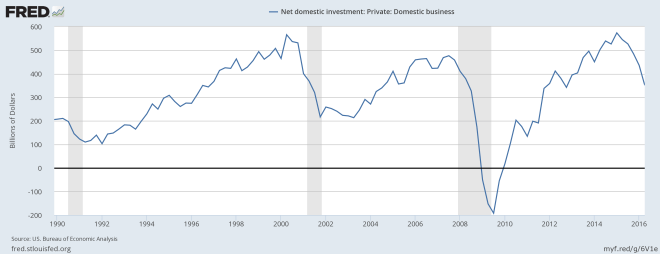
The interest paid on corporate debt and bank loans is tax deductible which creates an incentive to issue debt rather than equity. It is difficult to change this situation but mandating that equity may only be retired from after-tax profits would encourage leverage for investment purposes rather than to artificially enhance the return on equity. The chart below shows the decline in net domestic investment in the US despite historically low interest rates:-

fredgraph (1)

Source: Federal Reserve Bank of St Louis

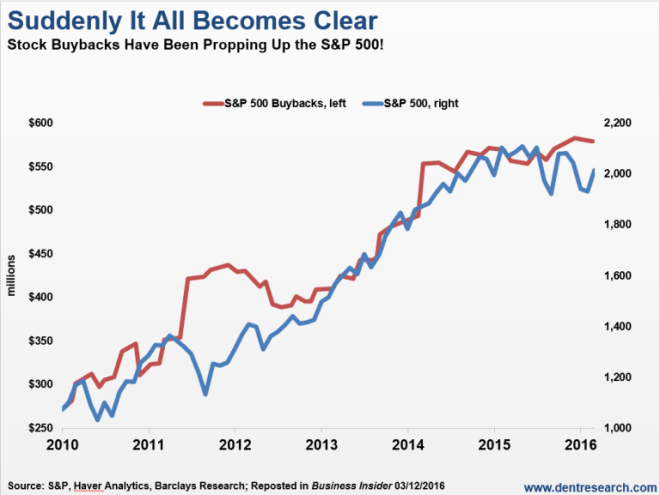
The next chart shows the level of share buybacks and the performance of the S&P500:-

SP-500-Buybacks-Versus-Stock-Index-768x577

Source: Dent Research, S&P, Haver Analytics, Barclays Research, Business Insider

Household debt is predominantly in the form of mortgages. In most developed countries a shortage of housing stock, due to planning restrictions, has encouraged individuals to speculate in the real estate market. In fact BoE Chief Economist Andy Haldane was quoted in The Sunday Times – Property is a better bet than pensions, says gold-plated Bank guru stating that pensions were complex and housing was a better investment:-

As long as we continue not to build anything like as many houses in this country as we need to … we will see what we’ve had for the better part of a generation, which is house prices relentlessly heading north.

The solution is planning reform. This will reduce house price inflation but it will not reduce the level of mortgage debt, however, once housing ceases to be a “one way bet” the attraction of leveraged speculation in property will diminish.

Conclusions and Investment Opportunities

The underlying problem which caused the great recession of 2009/2010 was excessive debt. The policy response has been to throw petrol on the fire. The first phase of unconventional monetary policy – reducing official interest rates towards zero – has more or less run its course. The next phase – qualitative easing – is now under way. This will start with corporate bonds and proceed to other securities ending up with common stock. Credit spreads will continue to narrow even if government bond yields rise. There will, of course, be episodes of panic when “safe haven” government bonds outperform but this will be temporary and the spread widening will present a buying opportunity.

The UK Investment Grade bond market is relatively small at £285bln and liquidity is therefore less robust than for Euro or US$ denominated issues but there is a £10bln “put” beneath the market. Other initiatives will be forthcoming from the central banks. Their actions will continue to be the dominant factor influencing asset prices in general.

Here comes summer – Did you sell in May?

400dpiLogo

Macro Letter – No 56 – 10-06-2016

Here comes summer – Did you sell in May?

  • Are Central Bankers approaching the limit of their power?
  • Individual stock volatility is reaching extremes relative to the indices
  • When dispersion of stock returns is high the risk relative to reward also rises
  • Some hedge fund strategies offer long-term benefits in this environment

This week’s letter is a departure from my normal format. Enclosed is a commentary on the prospects for the financial markets from my friend Allan Rogers whom I have been fortunate enough to know since the early 1990’s. Latterly the CIO of Loews Corporation’s Continental Assurance, Allan was a proprietary trader at Bankers Trust when the bank was in its heyday. Here is the note he kindly sent me on 14th May:-

Summer 2016 features a rising wave of frustration and voter antipathy toward most governing bodies and central banks, with good reason.  Ballot box dynamics threaten numerous incumbent government officials.  Demographic aging phenomena, technological innovation and minimum wage adjustments combine to thwart cyclical labor market improvement.  As post-war economic models fail to anticipate these rapid market adjustments, Central Banks cling desperately to their Milton Friedman monetary theory and Keynesian fiscal assumptions, relying on their imaginations, luck, and prayer to launch wave after wave of novel liquidity infusions.  So far, no good.  In their haste to revive growth after the financial crisis, they have handcuffed the dealer liquidity providers with ill-conceived regulations that endanger the liquidity network plumbing whenever expectations shift abruptly.  We have devolved into a nightmare of ZIRP, NIRP, QE, and God knows what’s next.  But, rather than wring our hands over this dilemma, let’s contemplate sensible portfolio management strategy for a few minutes.

As discussed last year, foreign exchange currency reserves still exceed $14 trillion.  Their potential deployment for economic stimulus remains intact.  Sovereign wealth funds, mostly invested in equity proxies, provide additional support for equity markets.  Central Banks are squeezing private investors as they desperately acquire dominant portions of the most liquid segments of risk-free(?) sovereign debt, corporate debt in Europe, and ETF’s and equities in Asia.  As a result, P/E ratios are elevated and yields bear little relationship to economic fundamentals.  As the political outlook befuddles the experts and aggravates voters, portfolio managers, facing new accountability regulations and third-quarter restrictions on Money Market Funds, need to become even more tactical in their asset allocation until clarity on Trump/Clinton, Brexit, etc. emerges later this year.  Until then, counter-trading the price action makes the most sense.  Even the hedge funds and private equity managers are struggling to perform in this turbulence as previous experience appears to provide useful insights.  The erratic price action reminds me of the late 1970’s when thirty years of fixed rates were followed by the oil price shocks that ushered in the Volcker era. Desperate pension funds and insurance companies might applaud such a development now as their yield assumptions fall 100’s of basis points short of any hope of meeting their forward liabilities.  In a market where the Yen and Euro rally despite explicit efforts to devalue them, one might surmise that their appreciation is only driven by the final unwinding of the massive Yen-carry trade by hedge funds facing redemptions after disappointing performance.

Amid all the chaos, do not expect central banks to abandon their printing presses. Syrian immigration issues in Europe and Trumpian nationalism will retard global trade and risk a replay of more intense competitive devaluation.  When we do reach the point of exhaustion for monetary stimulus, central banks have NO exit strategy. Bond markets will break down abruptly, but until then, US Treasuries should out-perform all other sovereigns. 10 year notes may well flirt with 1% as NIRP experimentation continues. Debates about the number of Fed “tightening” moves are irrelevant. The outlook, going forward, is all about liquidity management.  Although gold has rallied sharply so far this year, I suggest owning some gold, although one should heed the cautious brilliance of Stan Druckenmiller in conceivably buying a more significant percentage.

In this climate, equity markets offer the most promising net returns, IF one is willing to trade them actively.  “Buy and Hold” is a death wish. For over ten years, opportunistic equity traders have encountered volatile, but profitable equity markets. As we sit close to record high prices and valuations, why now? Amid illiquid markets, individual equities experience incredible price volatility despite the tame VIX market. The table below details the price ranges of the Dow Jones Industrials over the previous 52 weeks. If a money manager budgets an annual return of 7-8%, as many pension funds do, then opportunistic trading of these large-cap, blue chips makes achievement of those returns possible. Incremental usage of options and dividends sweeten the results.  But, you must trade these ranges, or, only buy weakness. I know this runs counter to indexing and most notions of prudent investment, but look at the table and draw your own conclusions. Incidentally, these ranges are not atypical, even in years where the averages experience only modest annual changes.

Stock  52 wk low 52 wk high 52 wk range % change
AAPL 89.47 132.97 43 48
AXP 50.27 81.92 31 63
BA 102.1 150.58 48 47
CAT 56.36 89.62 33 59
CSCO 22.46 29.9 7 33
CVX 69.58 109.3 40 57
DD 47.11 75.72 28 61
DIS 86.25 122.08 37 42
GE 19.37 32.05 12 65
GS 139.05 218.77 80 57
HD 97.17 137.82 40 42
IBM 116.9 174.44 57 49
INTC 24.87 35.59 11 43
JNJ 81.79 115 33 41
JPM 50.07 70.61 20 41
KO 36.56 47.13 10 29
MCD 87.5 131.96 44 51
MMM 134 171.27 37 28
MRK 45.69 61.7 16 35
MSFT 39.72 56.85 17 43
NKE 47.25 68.19 21 44
PFE 28.25 36.46 8 29
PG 65.02 83.87 19 29
TRV 95.21 118.28 23 24
UNH 95 135.11 40 42
UTX 83.39 119.66 36 43
V 60 81.73 22 36
VZ 38.06 54.49 16 43
WMT 56.3 79.94 24 42
XOM 66.55 90 23 35
         
Average       43
         
DIA 150.57 183.35 32 22
SPY 181.02 213.78 33 18


Source: Yahoo Finance

These data observations, while hardly profound, illustrate the range of possibility for trading profit, even in the largest stocks. Notice that the average price range of individual equities is more than twice the range of the large-cap averages, as reflected in their ETF’s. If you need to earn 8% per annum and the average Dow Industrial offers a 43% annual trading range, you don’t need to channel Jesse Livermore to achieve your objective. These results do not include dividends or option writing benefits.

This series of macro letters is entitled “In the Long Run” so you may, quite reasonably assume that I have “sold out”. I have not, but Allan, highlights the essence of the dilemma facing long-term investors looking ahead. During the past eight years interest rates have fallen in several countries to the lowest levels since records began. Being long government bonds below ones own rate of inflation (and there are few people whose living costs genuinely rise as slowly at RPI, HICP etc.) is irrational, since your real return will be negative – switching to “risker” assets makes sense.

With the Fed expected to tighten, if not this month then very soon, and other central banks contemplating how they may unwind the QE experiment, it seems likely that government yields may rise, credit spreads widen and equities decline.  As Mark Twain once proclaimed, “History doesn’t repeat but it rhymes” the aforementioned scenario occurred in January and February – this spooked central bankers who promptly enacted the secret “Shanghai Accord”. The next round of “risk off” will be different.

Strategies not Asset Classes

It is well documented that the average “long only” portfolio manager underperforms the benchmark over time. Unconstrained investing, either of a “long only” absolute return type or “long/short” makes sense, but make sure your expectations are realistic. Assets such as commodities have a structurally negative real-return, even if they can perform strongly on a cyclical basis. Even “risk free” government bonds can suffer restructuring or be subject to default.

Alternative investments may provide a solution but many liquid alternative strategies (by which I mean Hedge Funds) are highly correlated to equity or fixed income indices, although they offer similar returns with substantially lower volatility. Others, are either negatively or non-correlated. For example, the discipline of the short biased manager is undervalued, given that they actively bet against the long term trend of the stock market. As an addition to a portfolio they can offer a form of active risk management. At the end of April the Barclay Hedge – Equity Short Bias Index was +3.37% YTD whilst the Equity Long Biased Index was still languishing at -1.85%; that is 1.52% of Alpha if the general market is your index.

Two other strategies worth maintaining an exposure to are Global Macro and Managed Futures. Global Macro incorporates the widest array of approaches and exposures – at the index level it is unsurprising that it rarely does well, choose carefully and keep the faith. Managed futures is also diverse but there is still a concentration on systematic momentum and trend following strategies which provide negative correlation during equity bear markets and non-correlation during other periods. It also has the advantage that you can, usually, discover the investment process prior to investment. If style drift should subsequently occur this is your signal to redeem; otherwise you should not need to intervene. It can be a remarkably light touch investment.

I could describe a number of other strategies which have merit in the current market conditions but in the interests of brevity I will close with a recent assessment of the three main risks to financial markets according to Gavekal’s Anatoly Kelestsky:-

  • The June 23 “Brexit” vote in the UK
  • US elections on November 7th
  • German elections in mid-2017

Allan Rogers sees this as a traders market whilst ex-Dallas Fed President – Richard Fisher, speaking at the Mauldin SIC event last month, described his portfolio positioning as “Fetal”. Perhaps this year, more than most, the old adage “Sell in May and go away, return again St Leger’s day” (2nd October) may be apposite.

The levee gonna break – Debt, demographics, productivity and financialization

400dpiLogo

Macro Letter – No 55 – 20-05-2016

The levee gonna break – Debt, demographics, productivity and financialization

  • Debt and leverage since the financial crisis has continued to rise
  • Demographics trends in developed countries are not supportive of economic growth
  • Productivity growth has been rising much slower since the Great Recession
  • Financialization of the global economy has amplified the business cycle

If it keep on rainin’ the levee gonna break
Some people still sleepin’, some people are wide awake

 Bob Dylan

 In a March paper from the Kansas City Federal Reserve Bank – The Lasting Damage from the Financial Crisis to U.S. Productivity – the authors observe that total factor productivity in the US has not returned to its pre-financial crisis trajectory. They ascribe this to the tightness of credit conditions:-

Our empirical analysis shows the crisis indeed altered this relationship. During normal times, total factor productivity growth fluctuates over the business cycle along with changes in the intensity with which available labor and capital are used; credit conditions are unimportant.

During the crisis, however, distressed credit markets and tighter lending conditions were significant drags on total factor productivity growth. Because productivity’s sensitivity to credit conditions once again diminished after the crisis, the post-crisis easing of credit conditions did not boost productivity growth. As a result, the financial crisis left productivity, and therefore output, on a lower trajectory. Adverse credit conditions appear to have dampened total factor productivity growth by curtailing productivity-boosting innovation during the crisis rather than by hampering the efficient allocation of the economy’s productive resources through reduced creation and destruction of firms and jobs.

The conclusion is a telling indictment on the ability of the mainstream economics profession to unravel the conundrum total factor productivity:-

Our analysis does not explain the slow pace of productivity growth since the crisis, which has been a source of great concern among economists and policymakers. From 2010 to 2014, TFP growth averaged just 0.6 percent per year, well below its average growth rate of 1 percent from 1970 to 2010.

An attempt to counter this deficiency was undertaken by Mauldin Economics – Delta Force and summed up by this simple equation:-

The Greek letter delta (Δ) is the symbol for change. So the change in GDP is written as:-

ΔGDP = ΔPopulation + ΔProductivity

In other words, GDP growth can be achieved by an increase in the working age population or an increase in productivity. They go on to state that the problem of reduced investment is being exacerbated by low interest rates:-

Rather than encouraging businesses to compete by investing in productive assets and trying to take market share, excessive central bank stimulus encourages businesses to buy their competition and consolidate – which typically results in a reduction in the labor force. When the Federal Reserve makes it cheaper to buy your competition than to compete and cheaper to buy back your shares than to invest in new productivity, is it any wonder that productivity drops?

Mauldin go on to discuss demographics and labour force participation, they conclude:-

This demographic cast iron lid on growth helps explain why the Federal Reserve, ECB, and other central banks seem so powerless. Can they create more workers? Not really.

…What Fed policy is clearly not doing is to encourage businesses to invest in growth. Business loan availability is still a problem in many sectors

…Buyouts help shareholders but not workers, as they typically entail a consolidation of company workforces and a reduction in the number of “duplicated” workers. While this culling may be good for the individual businesses, it is not so good for the overall economy. It circumvents Joseph Schumpeter’s law of creative destruction.

…unless something happens to boost worker productivity dramatically, we’re facing lower world GDP growth for a very long time. Could we act to change that? Yes, but as I look at the political scene today, I wonder where the impetus for change is going to come from, absent a serious crisis.

…Given what we did in the last crisis, it is not clear that we still have that capacity.

For investors, this is reality: developed-world economies are going to grow slower. And companies, whose revenue is essentially a function of the growth of the overall economy, are going to grow slower, too…

The absolute level of debt is another factor which is impeding economic potential. Whilst credit creation in the private sector has been choked by continuous regulatory tightening of leverage rules for financial institutions, the capital requirements for investing in “risk-free” assets – ie. Bankrolling the state – has remained unchanged. Meanwhile the reduction of official interest rates to below the level of inflation has enabled governments around the world to dramatically expand deficit financing.

In September 2014 – Buttiglione, Lane, Reichlin and Reinhart produced the 16th Geneva Report on the World Economy – Deleveraging, What Deleveraging? Here is the chart of the growth of world debt to GDP – it caused something of a sensation:-

World Debt growth

Source: voxeu.com, CEPR

Contrary to widely held beliefs, the world has not yet begun to delever and the global debt-to-GDP is still growing, breaking new highs. At the same time, in a poisonous combination, world growth and inflation are also lower than previously expected, also – though not only – as a legacy of the past crisis. Deleveraging and slower nominal growth are in many cases interacting in a vicious loop, with the latter making the deleveraging process harder and the former exacerbating the economic slowdown. Moreover, the global capacity to take on debt has been reduced through the combination of slower expansion in real output and lower inflation.

McKinsey Global Institute – Debt and (not much) deleveraging February 2015 picked up the gauntlet:-

Global debt has grown by $57 trillion and no major economy has decreased its debt-to-GDP ratio since 2007. High government debt in advanced economies, mounting household debt, and the rapid rise of China’s debt are areas of potential concern.

They go on to highlight three areas of risk:- rise of government debt – which increased by $25trln between 2007 and 2015 – the continued rise in household debt (especially mortgages in Australia, Canada, Denmark, Sweden, the Netherlands, Malaysia, South Korea, and Thailand ) and the quadrupling of China’s debt to $28trln or 282% of GDP.

China has been attempting its own brand of regulatory tightening of late alongside the great rebalancing towards consumption, but even official measures of GDP suggest that the economy has stalled and stimulus has resumed during the last few months.

Global real-estate continues to benefit from the low interest rate environment, although planning restrictions in many prime locations is the principle driver of price appreciation, notwithstanding Chinese anti-corruption measures which have tempered demand recently.

The rise in government debt continues to crowd out the opportunities for private sector investment, whilst central bank quantitative easing (QE) programmes act as a natural buyer of these securities.

The BIS Working Papers No 559 A comparative analysis of developments in central bank balance sheet composition – provides an insight into the changing structure of the balance sheets of a variety of central banks. For a snapshot of the quantum, Yardeni Research – Global Economic Briefing: Central Bank Balance Sheets published on Monday, is more instructive. At end April Fed, ECB, BoJ and PBoC had a combined record total of $16.7trln, up from around $9trln at the beginning of 2010. The ECB and the BoJ have been the main drivers of growth this year, whilst the Fed and the PBoC balance sheets have marked time.

To summarise: the factors stifling economic growth are demographics, public sector crowding out of private investment, regulatory tightening of credit conditions and artificially low interest rates, however, I believe there is another factor to consider – the Financialization and the World Economy. As far as I can discern, the first academic work on this subject was published by Prof. Gerald Epstein in October 2005. Here is an extract from the introduction:-

Using the case of the US economy, Crotty argues that financialization has had a profound and largely negative impact on the operations of US nonfinancial corporations. This is partly reflected in the increasing incomes extracted by financial markets from these corporations.

…the payments US NFCs paid out to financial markets more than doubled as a share of their cash flow between the 1960s and the 1970s, on one hand, and the 1980s and 1990s on the other. As NFCs came under increasing pressure to make payments, they also came under increasing pressure to increase the value of their stock prices.

…Financial markets’ demands for more income and more rapidly growing stock prices occurred at the same time as stagnant economic growth and increased product market competition made it increasingly difficult to earn profits.

The authors conclude that the solution is redistributive taxation, I would counter that a better solution would be to reduce the tax and regulatory privileges associated with government debt, thus freeing the private sector from the yoke of unfair public sector competition. But this is a polemic for another time and place. What is clear is that the availability of credit and leverage amplifies business cycles in both directions.

Conclusions

Increasing debt and leverage for an economy with a diminishing working age population is not sustainable. Without the demographic windfall of immigration or procreation, increasing productivity is the only way to sustain real economic growth. The short term financial wizardry of the share buy-back is a function of the artificially low price of credit. The longer central bank sponsored largesse continues, the lower the trend rate of GDP growth will become. A combination of fiscal reform and gradual normalisation of monetary policy could redress the situation but I believe it is politically unachievable. Markets climb a wall of fear, even at these exalted levels, it still makes sense to be long bonds, stocks and real-estate but, once the limit of government intervention has been reached, thelevee gonna break”.


Quantitative to qualitative – is unelected nationalisation next?

400dpiLogo

Macro Letter – No 52 – 08-04-2016

Quantitative to qualitative – is unelected nationalisation next?

  • Negative interest rates are reducing the velocity of circulation
  • Qualitative easing is on the rise
  • Liquidity in government bond markets continues to decline
  • A lack of liquidity in equity markets will be next

Last year, in a paper entitled The Stock Market Crash Really Did Cause the Great Recession – Roger Farmer of UCLA argued that the collapse in the stock market was the cause of the Great Recession:-

In November of 2008 the Federal Reserve more than doubled the monetary base from eight hundred billion dollars in October to more than two trillion dollars in December: And over the course of 2009 the Fed purchased eight hundred billion dollars worth of mortgage backed securities. According to the animal spirits explanation of the recession (Farmer, 2010a, 2012a,b, 2013a), these Federal Reserve interventions in the asset markets were a significant factor in engineering the stock market recovery.

The animal spirits theory provides a causal chain that connects movements in the stock market with subsequent changes in the unemployment rate. If this theory is correct, the path of unemployment depicted in Figure 8 is an accurate forecast of what would have occurred in the absence of Federal Reserve intervention. These results support the claim, in the title of this paper, that the stock market crash of 2008 really did cause the Great Recession.

Central banks (CBs) around the globe appear to concur with his view. Their response to the Great Recession has been the provision of abundant liquidity – via quantitative easing – at ever lower rates of interest. They appear to believe that the recovery has been muted due to the inadequate quantity of accommodation and, as rates drift below zero, its targeting.

The Federal Reserve (Fed) was the first to recognise this problem, buying mortgages as well as Treasuries, perhaps guided by the US Treasury’s implementation of TARP in October 2008. The Fed was fortunate in being unencumbered by the political grid-lock which faced the European Central Bank (ECB). They acted, aggressively and rapidly, hoping to avoid the policy mistakes of the Bank of Japan (BoJ). The US has managed to put the great recession behind it. But at what cost? Only time will tell.

Other major CBs were not so decisive or lucky. In the immediate aftermath of the sub-prime crisis the Swiss Franc (CHF) rose – a typical “safe-haven” reaction. The SNB hung on grimly as the CHF appreciated, especially against the EUR, but eventually succumbed to “the peg” in September 2011 after the Eurozone (EZ) suffered its first summer of discontent. It was almost a year later before ECB President Draghi uttered his famous “Whatever it takes” speech on 26th July 2012.

Since 2012 government bond yields in the EZ, Switzerland, Japan and the UK have fallen further. In the US yields recovered until the end of 2013 but have fallen once more as international institutions seek yield wherever they can.

By 2013 CBs had begun to buy assets other than government bonds as a monetary exercise, in the hope of simulating economic growth. Even common stock became a target, since they were faced with the same dilemma as other investors – the need for yield.

In late April 2013 Bloomberg – Central Banks Load Up on Equities observed:-

Central banks, guardians of the world’s $11 trillion in foreign-exchange reserves, are buying stocks in record amounts as falling bond yields push even risk-averse investors toward equities.

In a survey of 60 central bankers…23 percent said they own shares or plan to buy them. The Bank of Japan, holder of the second-biggest reserves, said April 4 it will more than double investments in equity exchange-traded funds to 3.5 trillion yen ($35.2 billion) by 2014. The Bank of Israel bought stocks for the first time last year while the Swiss National Bank and the Czech National Bank have boosted their holdings to at least 10 percent of reserves.

…The SNB allocated 82 percent of its 438 billion Swiss francs ($463 billion) in reserves to government bonds in the fourth quarter, according to data on its website. Of those securities, 78 percent had the top, AAA credit grade and 17 percent were rated AA.

…The survey of 60 central bankers, overseeing a combined $6.7 trillion, found that low bond returns had prompted almost half to take on more risk. Fourteen said they had already invested in equities or would do so within five years.

…Even so, 70 percent of the central bankers in the survey indicated that equities are “beyond the pale.”

the SNB has allocated about 12 percent of assets to passive funds tracking equity indexes. The Bank of Israel has spent about 3 percent of its $77 billion reserves on U.S. stocks.

…the BOJ announced plans to put more of its $1.2 trillion of reserves into exchange-traded funds this month as it doubled its stimulus program to help reflate the economy. The Bank of Korea began buying Chinese shares last year, increasing its equity investments to about $18.6 billion, or 5.7 percent of the total, up from 5.4 percent in 2011. China’s foreign-exchange regulator said in January it has sought “innovative use” of its $3.4 trillion in assets, the world’s biggest reserves, without specifying a strategy for investing in shares.

Reserves have increased at a slower pace since 2012, but the top 50 countries still accounted for $11.4trln, according to the latest CIA Factbook estimates. The real growth has been in emerging and developing countries – according to IMF data, since 2000, in the wake of the Asian crisis, their reserves grew from $700bln to above $8trln.

By June 2014 the Financial Times – Beware central banks’ share-buying sprees was sounding the alarm:-

An eye-catching report this week said that “a cluster of central banking investors has become major players on world equity markets”. An important driver was revenues foregone on bond portfolios.

Put together by the Official Monetary and Financial Institutions Forum, which brings together secretive and normally conservative central bankers, the report’s conclusions have authority. Some equity buying was in central banks’ capacity as, in effect, sovereign wealth fund managers. China’s State Administration of Foreign Exchange, which has $3.9tn under management, has become the world’s largest public sector holder of equities.

The boundary, however, with monetary policy making is not always clear. According to the Omfif report, China’s central bank itself “has been buying minority equity stakes in important European companies”.

…Central bank purchases of shares are not new. The Dutch central bank has invested in equities for decades. The benchmark for its €1.4bn portfolio is the MSCI global developed markets index.

The Italian, Swiss and Danish central banks also own equities. Across Europe, central banks face pressures from cash-strapped governments to boost income. As presumably cautious and wise investors, they have also been put in charge of managing sovereign wealth funds – Norway’s, for instance.

…the Hong Kong Monetary Authority launched a large-scale stock market intervention in 1998, splashing out about $15bn – and ended up making a profit. Since the Asian financial crisis of that year, official reserves have expanded massively – far beyond what might be needed in future financial crises or justified by trade flows.

The article goes on to state that CB transparency is needed and that it should be made clear whether the actions are monetary policy or investment activity. Equities are generally more volatile than bonds – losses could lead to political backlash, or worse still, undermine the prudent reputation of the CB itself.

Here is an example of just such an event, from July last year, as described by Zero Hedge – The Swiss National Bank Is Long $94 Billion In Stocks, Reports Record Loss Equal To 7% Of Swiss GDP:-

…17%, or CHF91 ($94 billion) of the foreign currency investments and CHF bond investments assets held on the SNB’s balance sheet are foreign stocks…

In other words, the SNB holds 15% of Switzerland’s GDP in equities!

Zero Hedge goes on to remonstrate against the lack of transparency of other CBs equity investment balances – in particular the Fed.

The ECB, perhaps due to its multitude of masters, appears reluctant to follow the lead of the SNB. In March 2015 it achieved some success by announcing that it would buy Belgian, French, Italian and Spanish bonds, under its QE plan, in addition to those of, higher rated, Finland, Germany, Luxembourg and the Netherlands. EZ Yield compression followed with Italy and Spain benefitting most.

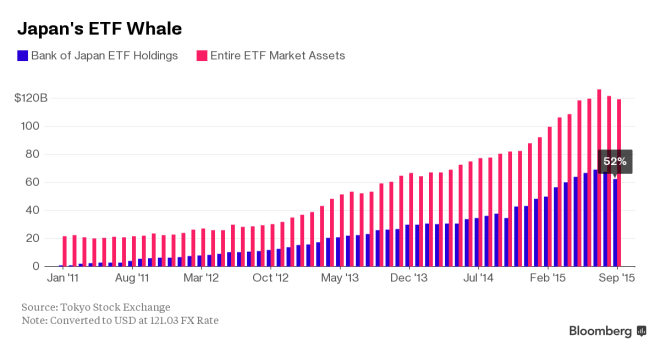
The leading exponent of this “new monetary alchemy” is the BoJ. In an October 2015 report from Bloomberg – Owning Half of Japan’s ETF Market Might Not Be Enough for Kuroda the author states:-

With 3 trillion yen ($25 billion) a year in existing firepower, the BOJ has accumulated an ETF stash that accounted for 52 percent of the entire market at the end of September, figures from Tokyo’s stock exchange show.

…Japan’s central bank began buying ETFs in 2010 to spur more trading and promote “more risk-taking activity in the overall economy.” Governor Haruhiko Kuroda expanded the program in April 2013 and again last October.

BoJ ETF holdings - October 2015 - Bloomberg

Source: Bloomberg, TSE

More ETFs can be created to redress the balance, or the BoJ may embark on the purchase of individual stocks. They announced a small increase in ETF purchases in December, focused on physical and human capital firms – also advising that shares they bought from distressed financial institutions in 2002 will be sold (very gradually) at the rate of JPY 300bln per annum over the next decade. At the end of January the BoJ decided to adopt negative interest rate policy (NIRP) rather than expand ETF and bond purchases – this saw the Nikkei hit its lowest level since October 2014 whilst the JYP shed more than 8% against the US$. I anticipate that they will soon increase their purchases of ETFs or stocks once more. The NIRP decision was half-hearted and BoJ concerns, about corporates and individuals resorting to cash stashed in safes, may prove well founded – So it begins…Negative Interest rates Trickle Down in Japan – Mises.org discusses this matter in greater detail.

In early March the ECB acted with intent, CNBC – ECB pulls out all the stops, cuts rates and expands QE takes up the story:-

…the ECB announced on Thursday that it had cut its main refinancing rate to 0.0 percent and its deposit rate to minus-0.4 percent.

“While very low or even negative inflation rates are unavoidable over the next few months as a result of movement in oil prices, it is crucial to avoid second-round effects,” Draghi said in his regular media conference after the ECB statement.

The bank also extended its monthly asset purchases to 80 billion euros ($87 billion), to take effect in April.

…the ECB will add corporate bonds to the assets it can buy — specifically, investment grade euro-denominated bonds issued by non-bank corporations. These purchases will start towards end of the first half of 2016.

…the bank will launch a new series of four targeted longer-term refinancing operations (TLTROs) with maturities of four years, starting in June.

The Communique from the G20 meeting in Shanghai alluded to the need for increased international cooperation, but it appears that a sub-rosa agreement may have been reached to insure the Chinese did not devalue the RMB – in return for a cessation of monetary tightening by the Fed.

In an unusually transparent move, a report appeared on March 31st on Reuters – China forex regulator buys $4.2 bln in stocks via new platform:-

Buttonwood Investment Platform Ltd, 100 percent owned by the State Administration of Foreign Exchange (SAFE), and Buttonwood’s two fully-owned subsidiaries, have bought shares in a total of 13 listed companies, the newspaper reported, citing top 10 shareholder lists in the companies latest earnings reports.

Shanghai Securities News said the investments are part of SAFE’s strategy to diversify investment channels for the country’s massive foreign exchange reserves.

Recent earnings filings show Buttonwood is among the top 10 shareholders of Bank of China, Bank of Communications , Shanghai Pudong Development Bank , Everbright Securities and Industrial and Commercial Bank of China.

Conclusions and investment opportunities

The major CBs are beginning to embrace the idea of providing capital to corporates via bond or stock purchases. With next to no yield available from government bonds, corporate securities appear attractive, especially when one has the ability to expand ones balance sheet, seemingly, without limit.

The CBs are unlikely to buy when the market is strong but will provide liquidity in distressed markets. Once they have purchased securities the “free-float” will be almost permanently reduced. The lack of, what might be termed, “trading liquidity”, which has been evident in government bond markets, is likely to spill over into those corporate bonds and ETFs where the CBs hold a significant percentage. In the UK, under our takeover code, a 30% holding in a stock would obligate the holder to make an offer for the company – the 52% of outstanding ETFs held by the BoJ already seems excessive.

The ECB has plenty of government, agency and corporate bonds to purchase, before it moves on to provide permanent equity capital. The BoE and the Fed are subject to less deflationary forces; they will be the last guests to arrive at the “closet nationalisation” party. The party, nonetheless, is getting underway. Larger companies will benefit to a much greater extent than smaller listed or unlisted corporations because the CBs want to appear to be “indiscriminate” buyers of stock.

As the pool of available bonds and stocks starts to dry up, trading liquidity will decline – markets will become more erratic and volatile. Of greater concern in economic terms, malinvestment will increase; interest rates no longer provide signals about the value of projects.

For stocks, higher earning multiples are achievable due to the rising demand for equities from desperate investors with no viable “yield” alternative. CBs are unelected stewards on whom elected governments rely with increasing ease. For notionally independent CBs to purchase common stock is de facto nationalisation. The economic cost of an artificially inflated stock market is difficult to measure in conventional terms, but its promotion of wealth inequality through the sustaining of asset bubbles will do further damage to the fabric of society.

Central Banks – Ah Aaaaahhh! – Saviours of the Universe?

400dpiLogo

Macro Letter – No 48 – 29-01-2016

Central Banks – Ah Aaaaahhh! – Saviours of the Universe?

Flash-Gordon-flash-gordon-23432257-1014-1600

Copryright: Universal Pictures

  • Freight rates have fallen below 2008 levels
  • With the oil price below $30 many US producers are unprofitable
  • The Fed has tightened but global QE gathers pace
  • Chinese stimulus is fighting domestic strong headwinds

Just in case you’re not familiar with it here is a You Tube video of the famous Queen song. It is seven years since the Great Financial Crisis; major stock markets are still relatively close to their highs and major government bond yields remain near historic lows. If another crisis is about to engulf the developed world, do the central banks (CBs) have the means to avert catastrophe once again? Here are some of the factors which may help us to reach a conclusion.

Freight Rates

Last week I was asked to comment of the prospects for commodity prices, especially energy. Setting aside the geo-politics of oil production, I looked at the Baltic Dry Index (BDI) which has been plumbing fresh depths this year – 337 (28/1/16) down from August 2015 highs of 1200. Back in May 2008 it touched 11,440 – only to plummet to 715 by November of the same year. How helpful is the BDI at predicting the direction of the economy? Not very – as this 2009 article from Business Insider – Shipping Rates Are Lousy For Predicting The Economy – points out. Nonetheless, the weakness in freight rates is indicative of an inherent lack of demand for goods. The chart below is from an article published by Zero Hedge at the beginning of January – they quote research from Deutsche Bank.
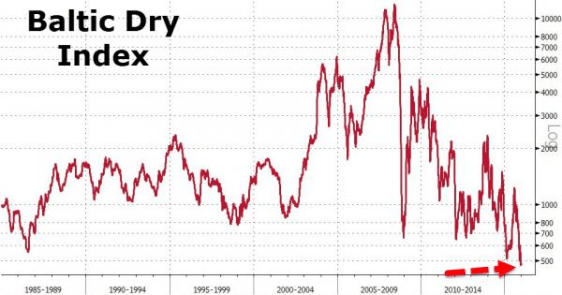
BDI_-_1985_-_2016 (4)

Source: Zerohedge

A “Perfect Storm Is Coming” Deutsche Warns As Baltic Dry Falls To New Record Low:

…a “perfect storm” is brewing in the dry bulk industry, as year-end improvements in rates failed to materialize, which indicates a looming surge in bankruptcies.

The improvement in dry bulk rates we expected into year-end has not materialized.

…we believe a number of dry bulk companies are contemplating asset sales to raise liquidity, lower daily cash burn, and reduce capital commitments. The glut of “for sale” tonnage has negative implications for asset and equity values. More critically, it can easily lead to breaches in loan-to-value covenants at many dry bulk companies, shortening the cash runway and likely necessitating additional dilutive actions.

Dry bulk companies generally have enough cash for the next 1yr or so, but most are not well positioned for another leg down in asset values.

China

The slowing and rebalancing of the Chinese economy may be having a significant impact on global trade flows. Here is a recent article on the subject from Mauldin Economics – China’s Year of the Monkees:-

China isn’t the only reason markets got off to a terrible start this month, but it is definitely a big factor (at least psychologically). Between impractical circuit breakers, weaker economic data, stronger capital controls, and renewed currency confusion, China has investors everywhere scratching their heads.

When we focused on China back in August (see “When China Stopped Acting Chinese”), my best sources said the Chinese economy was on a much better footing than its stock market, which was in utter chaos. While the manufacturing sector was clearly in a slump, the services sector was pulling more than its fair share of the GDP load. Those same sources have new data now, which leads them to quite different conclusions.

…Now, it may well be the case that China’s economy is faltering, but its GDP data is not the best evidence.

…To whom can we turn for reliable data? My go-to source is Leland Miller and company at the China Beige Book.

…China Beige Book started collecting data in 2010. For the entire time since then, the Chinese economy has been in what Leland calls “stable deceleration.” Slowing down, but in an orderly way that has generally avoided anything resembling crisis. 

…China Beige Book noticed in mid-2014 that Chinese businesses had changed their behavior. Instead of responding to slower growth by doubling down and building more capacity, they did the rational thing (at least from a Western point of view): they curbed capital investment and hoarded cash. With Beijing still injecting cash that businesses refused to spend, the liquidity that flowed into Chinese stocks produced the massive rally that peaked in mid-2015. It also allowed money to begin to flow offshore in larger amounts. I mean really massively larger amounts.

Dealing with a Different China

China Beige Book’s fourth-quarter report revealed a rude interruption to the positive “stable deceleration” trend. Their observers in cities all over that vast country reported weakness in every sector of the economy. Capital expenditures dropped sharply; there were signs of price deflation and labor market weakness; and both manufacturing and service activity slowed markedly.

That last point deserves some comment. China experts everywhere tell us the country is transitioning from manufacturing for export to supplying consumer-driven services. So if both manufacturing and service activity are slowing, is that transition still happening?

The answer might be “yes” if manufacturing were decelerating faster than services. For this purpose, relative growth is what counts. Unfortunately, manufacturing is slowing while service activity is not picking up all the slack. That’s not the combination we want to see.

Something else China Beige Book noticed last quarter: both business and consumer loan volume did not grow in response to lower interest rates. That’s an important change, and probably not a good one. It means monetary stimulus from Beijing can’t save the day this time. Leland thinks fiscal stimulus isn’t likely to help, either. Like other governments and their central banks, China is running out of economic ammunition.

Mauldin goes on to discuss the devaluation of the RMB – which I also discussed in my last letter – Is the ascension of the RMB to the SDR basket more than merely symbolic? The RMB has been closely pegged to the US$ since 1978 though with more latitude since 2005, this has meant a steady appreciation in its currency relative to many of its emerging market trading partners. Now, as China begins to move towards full convertibility, the RMB will begin to float more freely. Here is a five year chart of the Indian Rupee and the CNY vs the US$:-
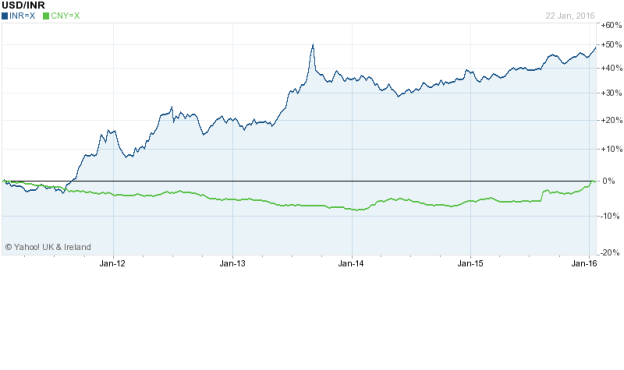
INR vs RMB - Yahoo

Source: Yahoo finance

The Chinese currency could sink significantly should their government deem it necessary, however, expectations of a collapse of growth in China may be premature as this article from the Peterson Institute – The Price of Oil, China, and Stock Market Herding – indicates:-

A collapse of growth in China would indeed be a world changing event. But there is just no evidence of such a collapse. At most there is suggestive evidence of a mild slowdown, and even that is far from certain. The mechanical effects of such a mild decrease on the US economy should, by all accounts, and all the models we have, be limited. Trade channels are limited (US exports to China represent less than 2 percent of GDP), and so are financial linkages. The main effect of a slowdown in China would be through lower commodity prices, which should help rather than hurt the United States.

Peterson go on to suggest:-

Maybe we should not believe the market commentaries. Maybe it was neither oil nor China. Maybe what we are seeing is a delayed reaction to the slowdown in the world economy, a slowdown that has now gone on for a few years. While there has been no significant news in the last two weeks, maybe markets are only realizing that growth in emerging markets will be lower for a long time, that growth in advanced economies will be unexciting. Maybe…

I think the explanation is largely elsewhere. I believe that to a large extent, herding is at play. If other investors sell, it must be because they know something you do not know. Thus, you should sell, and you do, and so down go stock prices. Why now? Perhaps because we have entered a period of higher uncertainty. The world economy, at the start of 2016, is a genuinely confusing place. Political uncertainty at home and geopolitical uncertainty abroad are both high. The Fed has entered a new regime. The ability of the Chinese government to control its economy is in question. In that environment, in the stock market just as in the presidential election campaign, it is easier for the bears to win the argument, for stock markets to fall, and, on the political front, for fearmongers to gain popularity.

They are honest enough to admit that economics won’t provide the answers.

Energy Prices

The June 2015 BP – Statistical Review of World Energy – made the following comments:-

Global primary energy consumption increased by just 0.9% in 2014, a marked deceleration over 2013 (+2.0%) and well below the 10-year average of 2.1%. Growth in 2014 slowed for every fuel other than nuclear power, which was also the only fuel to grow at an above-average rate. Growth was significantly below the 10-year average for Asia Pacific, Europe & Eurasia, and South & Central America. Oil remained the world’s leading fuel, with 32.6% of global energy consumption, but lost market share for the fifteenth consecutive year.

Although emerging economies continued to dominate the growth in global energy consumption, growth in these countries (+2.4%) was well below its 10-year average of 4.2%. China (+2.6%) and India (+7.1%) recorded the largest national increments to global energy consumption. OECD consumption fell by 0.9%, which was a larger fall than the recent historical average. A second consecutive year of robust US growth (+1.2%) was more than offset by declines in energy consumption in the EU (-3.9%) and Japan (-3.0%). The fall in EU energy consumption was the second-largest percentage decline on record (exceeded only in the aftermath of the financial crisis in 2009).

The FT – The world energy outlook in five charts – looked at five charts from the IEA World Energy Outlook – November 2015:-
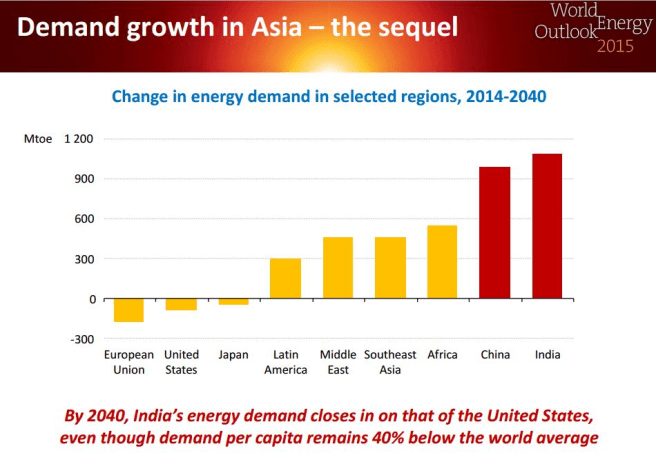
Demand_Growth_in_Asia

Source: IEA

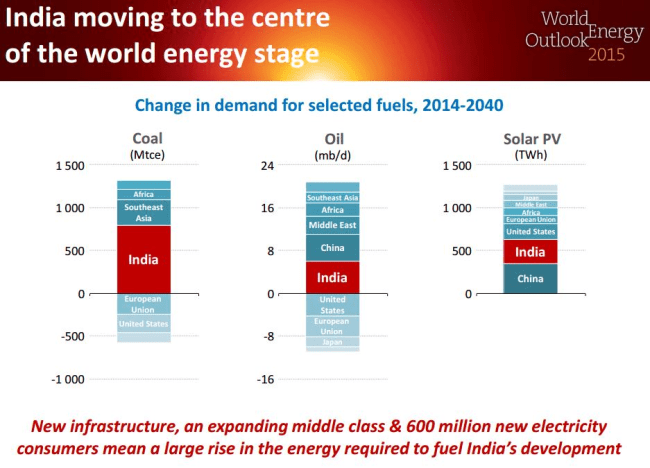
With 315m of its population expected to live in urban areas by 2040, and its manufacturing base expanding, India is forecast to account for quarter of global energy demand growth by 2040, up from about 6 per cent currently.
India_moving_to_centre

Source: IEA

Oil demand in India is expected to increase by more than in any other country to about 10m barrels per day (bpd). The country is also forecast to become the world’s largest coal importer in five years. But India is also expected to rely on solar and wind power to have a 40 per cent share of non-fossil fuel capacity by 2030.
A_new_chapter_in_Chinas_growth_story

Source: IEA

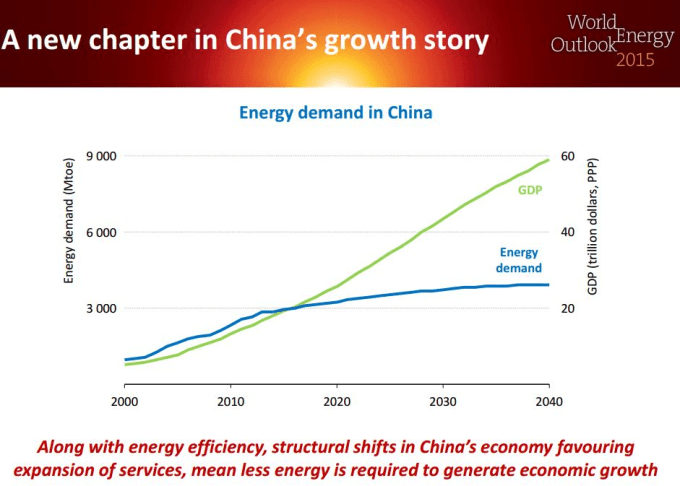
China’s total energy demand is set to nearly double that of the US by 2040. But a structural shift in the Asian country away from investment-led growth to domestic-demand based economy will “mean that 85 per cent less energy is required to generate each unit of future economic growth than was the case in the past 25 years.”
A_new_balancing_item_in_the_oil_market

Source: IEA

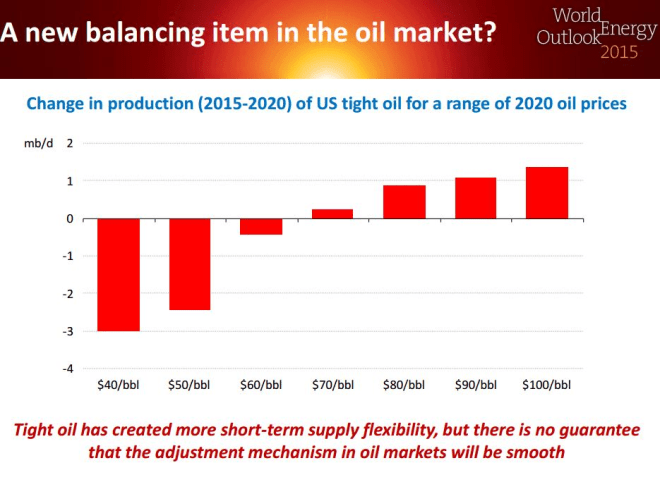
US shale oil production is expected to “stumble” in the short term, but rise as oil price recovers. However the IEA does not expect crude oil to reach $80 a barrel until 2020, under its “central scenario”. The chart shows that if prices out to 2020 remain under $60 per barrel, production will decline sharply.
Power_is_leading_the_transformation

Source: IEA

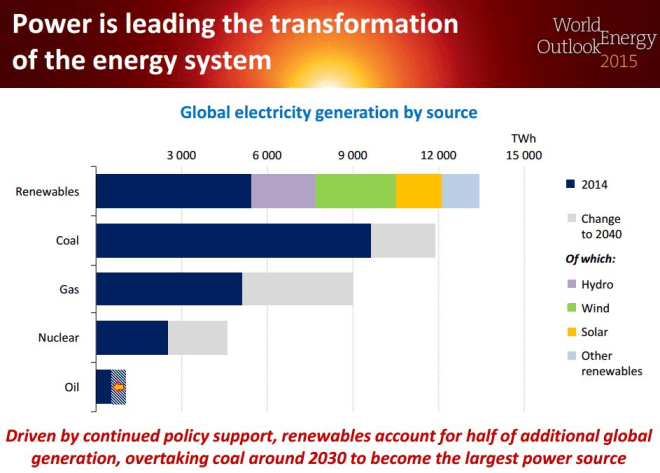
Renewables are set to overtake coal to become the largest source of power by 2030. The share of coal in the production of electricity will fall from 41 per cent to 30 per cent by 2040, while renewables will account for more than half the increase in electricity generation by then.

The cost of solar energy continues to fall and is now set to “eclipse” natural gas, as this article from Seeking Alpha by Siddharth Dalal – Falling Solar Costs: End Of Natural Gas Is Near? Explains:-

A gas turbine power plant uses 11,371 Btu/kWh. The current price utilities are paying per Btu of natural gas are $3.23/1000 cubic feet. 1000 cubic feet of natural gas have 1,020,000 BTUs. So $3.23 for 90kWh. That translates to 3.59c/kWh in fuel costs alone.

A combined cycle power plant uses 7667 Btu/kWh, which translates to 2.42c/kWh.

Adding in operating and maintenance costs, we get 4.11c/kWh for gas turbines and 3.3c/kWh for combined cycle power plants. This still doesn’t include any construction costs.

…The average solar PPA is likely to go under 4c/kWh next year. Note that this is the total cost that the utility pays and includes all costs.

And the trend puts total solar PPA costs under gas turbine fuel costs and competitive with combined cycle plant total operating costs next year.

At this point it becomes a no brainer for a utility to buy cheap solar PPAs compared to building their own gas power plants.

The only problem here is that gas plants are dispatchable, while solar is not. This is a problem that is easily solved by batteries. So utilities would be better served by spending capex on batteries as opposed to any kind of gas plant, especially anything for peak generation.

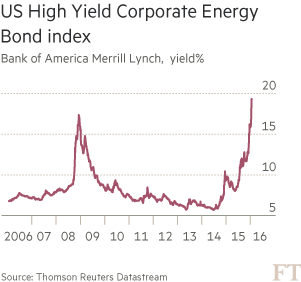
The influence of the oil price, whilst diminishing, still dominates. In the near term the importance of the oil price on financial market prices will relate to the breakeven cost of production for companies involved in oil exploration. Oil companies have shelved more than $400bln of planned investment since 2014. The FT – US junk-rated energy debt hits two-decade lowtakes up the story:-

US-High Yield - Thompson Reuters

Source: Thomson Reuters Datastream, FT

The average high-yield energy bond has slid to just 56 cents on the dollar, below levels touched during the financial crisis in 2008-09, as investors brace for a wave of bankruptcies.

…The US shale revolution which sent the country’s oil production soaring from 2009 to 2015 was led by small and midsized companies that typically borrowed to finance their growth. They sold $241bn worth of bonds during 2007-15 and many are now struggling under the debts they took on.

Very few US shale oil developments can be profitable with crude at about $30 a barrel, industry executives and advisers say. Production costs in shale have fallen as much as 40 per cent, but that has not been enough to keep pace with the decline in oil prices.

…On Friday, Moody’s placed 120 oil and gas companies on review for downgrade, including 69 in the US.

…The yield on the Bank of America Merrill Lynch US energy high-yield index has climbed to the highest level since the index was created, rising to 19.3 per cent last week, surpassing the 17 per cent peak hit in late 2008.

More than half of junk-rated energy groups in the US have fallen into distress territory, where bond yields rise more than 1,000 basis points above their benchmark Treasury counterpart, according to S&P.

All other things equal, the price of oil is unlikely to rally much from these levels, but, outside the US, geo-political risks exist which may create an upward bias. Many Middle Eastern countries have made assumptions about the oil price in their estimates of tax receipts. Saudi Arabia has responded to lower revenues by radical cuts in public spending and privatisations – including a proposed IPO for Saudi Aramco. As The Guardian – Saudi Aramco privatisation plans shock oil sector – explains, it will certainly be difficult to value – market capitalisation estimates range from $1trln to $10trln.

Outright energy company bankruptcies are likely to be relatively subdued, unless interest rates rise dramatically – these companies locked in extremely attractive borrowing rates and their bankers will prefer to renegotiate payment schedules rather than write off the loans completely. New issuance, however, will be a rare phenomenon.

Technology

“We don’t want technology simply because it’s dazzling. We want it, create it and support it because it improves people’s lives.”

These words were uttered by Canadian Prime Minister, Justin Trudeau, at Davos last week. The commodity markets have been dealing with technology since the rise of Sumer. The Manhattan Institutes – SHALE 2.0 Technology and the Coming Big-Data Revolution in America’s Shale Oil Fields highlights some examples which go a long way to explaining the downward trajectory in oil prices over the last 18 months – emphasis is mine:-

John Shaw, chair of Harvard’s Earth and Planetary Sciences Department, recently observed: “It’s fair to say we’re not at the end of this [shale] era, we’re at the very beginning.” He is precisely correct. In recent years, the technology deployed in America’s shale fields has advanced more rapidly than in any other segment of the energy industry. Shale 2.0 promises to ultimately yield break-even costs of $5–$20 per barrel—in the same range as Saudi Arabia’s vaunted low-cost fields.

…Compared with 1986—the last time the world was oversupplied with oil—there are now 2 billion more people living on earth, the world economy is $30 trillion bigger, and 30 million more barrels of oil are consumed daily. The current 33 billion-barrel annual global appetite for crude will undoubtedly rise in coming decades. Considering that fluctuations in supply of 1–2 MMbd can swing global oil prices, the infusion of 4 MMbd from U.S. shale did to petroleum prices precisely what would be expected in cyclical markets with huge underlying productive capacity.

Shipbuilding has also benefitted from technological advances in a variety of areas, not just fuel efficiency. This article (please excuse the author’s English) from Marine Insight – 7 Technologies That Can Change The Future of Shipbuilding – highlights several, I’ve chosen five:-

3-D Printing Technology:…Recently, NSWC Carderock made a fabricated model of the hospital ship USNS Comfort (T-AH 20) using its 3-D printer, first uploading CAD drawings of ship model in it. Further developments in this process can lead the industry to use this technique to build complex geometries of ship like bulbous bow easily. The prospect of using 3-D printers to seek quick replacement of ship’s part for repairing purpose is also being investigated. The Economist claims use this technology to be the “Third Industrial Revolution“.

Shipbuilding Robotics: Recent trends suggest that the shipbuilding industry is recognizing robotics as a driver of efficiency along with a method to prevent workers from doing dangerous tasks such as welding. The shortage of skilled labour is also one of the reasons to look upon robotics. Robots can carry out welding, blasting, painting, heavy lifting and other tasks in shipyards.

LNG Fueled engines

…In the LNG engines, CO2 emission is reduced by 20-25% as compared to diesel engines, NOX emissions are cut by almost 92%, while SOX and particulates emissions are almost completely eliminated.

…Besides being an environmental friendly fuel, LNG is also cheaper than diesel, which helps the ship to save significant amount of money over time.

…Solar & Wind Powered Ships:

…The world’s largest solar powered ship named ‘Turanor’ is a 100 metric ton catamaran which motored around the world without using any fuel and is currently being used as a research vessel. Though exclusive solar or wind powered ships look commercially and practically not viable today, they can’t be ruled out of future use with more technical advancements.

Recently, many technologies have come which support the big ships to reduce fuel consumption by utilizing solar panels or rigid sails. A device named Energy Sail (patent pending) has been developed by Eco Marine Power will help the ships to extract power from wind and sun so as to reduce fuel costs and emission of greenhouse gases. It is exclusively designed for shipping and can be fitted to wide variety of vessels from oil carrier to patrol ships.

Buckypaper: Buckypaper is a thin sheet made up of carbon nanotubes (CNT). Each CNT is 50,000 thinner than human air. Comparing with the conventional shipbuilding material (i.e. steel), buckypaper is 1/10th the weight of steel but potentially 500 times stronger in strength  and 2 times harder than diamond when its sheets are compiled to form a composite. The vessel built from this lighter material would require less fuel, hence increasing energy efficiency. It is corrosion resistant and flame retardant which could prevent fire on ships. A research has already been initiated for the use of buckypaper as a construction material of a future aeroplane. So, a similar trend can’t be ruled out in case of shipbuilding.

Shipping has always been a cyclical business, driven by global demand for freight on the one hand and improvements in technology on the other. The cost of production continues to fall, old inventory rapidly becomes uncompetitive and obsolete. The other factor effecting the cycle is the cost of finance; this is true also of energy exploration and development. Which brings us to the actions of the CBs.

The central role of the central banks

Had $100 per barrel oil encouraged a rise in consumer price inflation in the major economies, it might have been appropriate for their CBs to raise interest rates, however, high levels of debt kept inflation subdued. The “unintended consequences” or, perhaps we should say “collateral damage” of allowing interest rates to remain unrealistically low, is overinvestment. The BIS – Self-oriented monetary policy, global financial markets and excess volatility of international capital flows – looks at the effect developed country CB policy – specifically the Federal Reserve – has had on emerging markets:-

A major policy question arising from these events is whether US monetary policy imparts a global ‘externality’ through spillover effects on world capital flows, credit growth and asset prices. Many policy makers in emerging markets (e.g. Rajan, 2014) have argued that the US Federal Reserve should adjust its monetary policy decisions to take account of the excess sensitivity of international capital flows to US policy. This criticism questions the view that a ‘self-oriented’ monetary policy based on inflation targeting principles represents an efficient mechanism for the world monetary system (e.g. Obstfeld and Rogoff, 2002), without the need for any cross-country coordination of policies.

…Our results indicate that the simple prescriptions about the benefits of flexible exchange rates and inflation targeting are very unlikely to hold in a global financial environment dominated by the currency and policy of a large financial centre, such as the current situation with the US dollar and US monetary policy. Our preliminary analysis does suggest however that an optimal monetary policy can substantially improve the workings of the international system, even in the absence of direct intervention in capital markets through macro-prudential policies or capital controls. Moreover, under the specific assumptions maintained in this paper, this outcome can still be consistent with national independence in policy, or in other words, a system of ‘self-oriented’ monetary policy making.

Whether CBs should consider the international implications of their actions is not a new subject, but this Cobden Centre article by Alisdair Macleod – Why the Fed Will Never Succeed – suggests that the Fed should be mandated to accept a broader role:-

That the Fed thinks it is only responsible to the American people for its actions when they affect all nations is an abrogation of its duty as issuer of the reserve currency to the rest of the world, and it is therefore not surprising that the new kids on the block, such as China, Russia and their Asian friends, are laying plans to gain independence from the dollar-dominated system. The absence of comment from other central banks in the advanced nations on this important subject should also worry us, because they appear to be acting as mute supporters for the Fed’s group-think.

This is the context in which we need to clarify the effects of the Fed’s monetary policy. The fundamental question is actually far broader than whether or not the Fed should be raising rates: rather, should the Fed be managing interest rates at all? Before we can answer this question, we have to understand the relationship between credit and the business cycle.

There are two types of economic activity, one that correctly anticipates consumer demand and is successful, and one that fails to do so. In free markets the failures are closed down quickly, and the scarce economic resources tied up in them are redeployed towards more successful activities. A sound-money economy quickly eliminates business errors, so this self-cleansing action ensures there is no build-up of malinvestments and the associated debt that goes with it.

When there is stimulus from monetary inflation, it is inevitable that the strict discipline of genuine profitability that should guide all commercial enterprises takes a back seat. Easy money and interest rates lowered to stimulate demand distort perceptions of risk, over-values financial assets, and encourages businesses to take on projects that are not genuinely profitable. Furthermore, the owners of failing businesses find it possible to run up more debts, rather than face commercial reality. The result is a growing accumulation of malinvestments whose liquidation is deferred into the future.

Macleod goes on to discuss the Cantillon effect, at what point we are in the Credit Cycle and why the Fed decided to raise rates now:-

We must put ourselves in the Fed’s shoes to try to understand why it has raised rates. It has seen the official unemployment rate decline for a prolonged period, and more recently energy and commodity prices have fallen sharply. Assuming it believes government unemployment figures, as well as the GDP and its deflator, the Fed is likely to think the economy has at least stabilised and is fundamentally healthy. That being the case, it will take the view the business cycle has turned. Note, business cycle, not credit-driven business cycle: the Fed doesn’t accept monetary policy is responsible for cyclical phenomena. Therefore, demand for energy and commodities is expected to increase on a one or two-year view, so inflation can be expected to pick up towards the 2% target, particularly when the falls in commodity and energy prices drop out of the back-end of the inflation numbers. Note again, inflation is thought to be a demand-for-goods phenomenon, not a monetary phenomenon, though according to the Fed, monetary policy can be used to stimulate or control it.

Unfortunately, the evidence from multiple surveys is that after nine years since the Lehman crisis the state of the economy remains suppressed while debt has continued to increase, so this cycle is not in the normal pattern. It is clear from the evidence that the American economy, in common with the European and Japanese, is overburdened by the accumulation of malinvestments and associated debt. Furthermore, nine years of wealth attrition through monetary inflation (as described above) has reduced the purchasing power of the average consumer’s earnings significantly in real terms. So instead of a phase of sustainable growth, it is likely America has arrived at a point where the economy can no longer bear the depredations of further “monetary stimulus”. It is also increasingly clear that a relatively small rise in the general interest rate level will bring on the next crisis.

So what will the Fed – and, for that matter, other major CBs – do? I look back to the crisis of 2008/2009 – one of the unique aspects of this period was the coordinated action of the big five: the Fed, ECB, BoJ, BoE and SNB. In 1987 the Fed was the “saviour of the universe”. Their actions became so transparent in the years that followed, that the phase “Greenspan Put” was coined to describe the way the Fed saved stock market investors and corporate creditors. CEPR – Deleveraging? What deleveraging? which I have quoted from in previous letters, is an excellent introduction to the unintended consequences of CB largesse.

Since 2009 economic growth has remained sluggish; this has occurred despite historically low interest rates – it’s not unreasonable to surmise that the massive overhang of debt, globally, is weighing on both demand pull inflation and economic growth. Stock buy-backs have been rife and the long inverted relationship between dividend yields and government bond yields has reversed. Paying higher dividends may be consistent with diversifying a company’s investor base but buying back stock suggests a lack of imagination by the “C” Suite. Or perhaps these executives are uncomfortable investing when interest rates are artificially low.

I believe the vast majority of the rise in stock markets since 2009 has been the result of CB policy, therefore the Fed rate increase is highly significant. The actions of the other CBs – and here I would include the PBoC alongside the big five – is also of significant importance. Whilst the Fed has tightened the ECB and the PBoC continue to ease. The Fed appears determined to raise rates again, but the other CBs are likely to neutralise the overall effect. Currency markets will take the majority of the strain, as they have been for the last couple of years.

A collapse in equity markets will puncture confidence and this will undermine growth prospects globally. Whilst some of the malinvestments of the last seven years will be unwound, I expect CBs to provide further support. The BoJ is currently the only CB with an overt policy of “qualitative easing” – by which I mean the purchasing of common stock – I fully expect the other CBs to follow to adopt a similar approach. For some radical ideas on this subject this paper by Professor Roger Farmer – Qualitative Easing: How it Works and Why it Matters – which was presented at the St Louis Federal Reserve conference in 2012 – makes interesting reading.

Investment opportunities

In comparison to Europe– especially Germany – the US economy is relatively immune to the weakness of China. This is already being reflected in both the currency and stocks markets. The trend is likely to continue. In the emerging market arena Brazil still looks sickly and the plummeting price of oil isn’t helping, meanwhile India should be a beneficiary of cheaper oil. Some High yield non-energy bonds are likely to be “tarred” (pardon the pun) with the energy brush. Meanwhile, from an international perspective the US$ remains robust even as the US$ Index approaches resistance at 100.
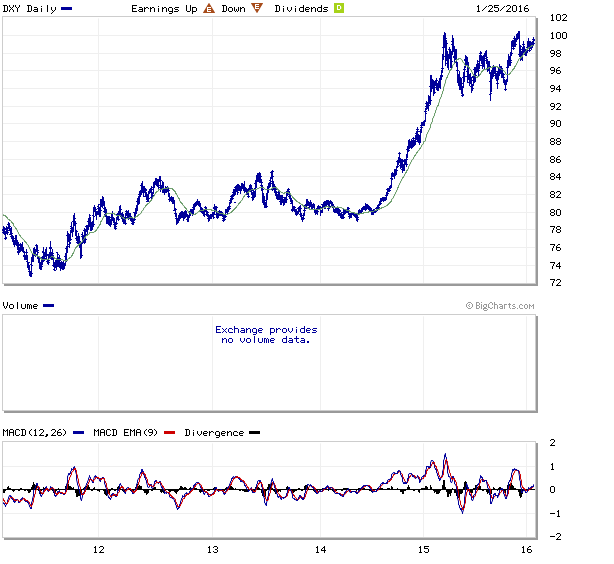
US_Index_-_5_yr_Marketwatch

Source: Marketwatch
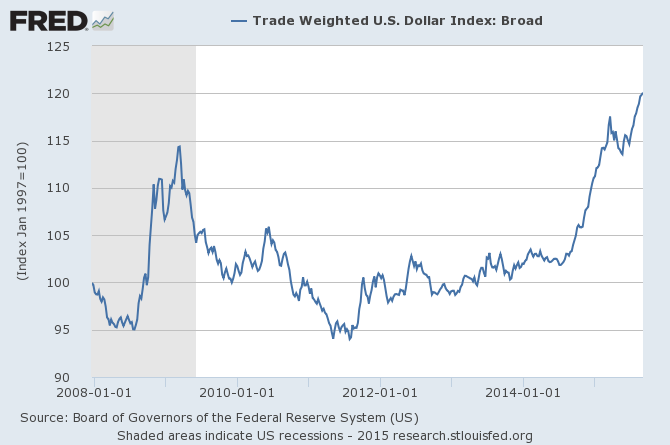
Is the ascension of the RMB to the SDR basket more than merely symbolic?

400dpiLogo

Macro Letter – Supplemental – No 2 – 11-12-2015

Is the ascension of the RMB to the SDR basket more than merely symbolic?

  • Chinese rebalancing towards domestic consumption changes the balance of trade
  • China’s largest trading partner remains the EU, making a US$ peg sub-optimal
  • SDR currencies offer the best liquidity for intervention or speculation
  • International investment will be dramatically enhanced by full convertibility

I’ve changed my view of the importance of the RMBs inclusion in the SDR. Initially I thought this a purely symbolic action but, having discussed the issue with several economists and ex-Central Bankers (including one from the PBoC) I believe this a logical move towards free convertibility of the RMB.

For many years the RMB has been pegged to the US$. During the early part of this century it rose relative to its neighbours. This was not such a great imposition on the economy since annual GDP growth was still in double figures.

After the great financial recession of 2008 things changed. New economic policies focused on increasing domestic consumption. At the same time the Chinese economy began to slow dramatically as a result of over-investment, especially in primary industries, meanwhile, the benefits of cheap labour, which had driven China’s mercantilist expansion during the past 25 years, showed signs of fatigue.

After 2008, the US embarked on aggressive quantitative easing which eventually began to foster new domestic employment opportunities – in turn leading to a recovery of the fortunes of the US$. Earlier this year the PBoC devalued the RMB albeit to a small degree.

If you were the PBoC what would you do?

China is rebalancing towards domestic consumption at a pace which would be almost inconceivable in any other country. The implications of this shift include an increase in imports and a structural adjustment in the momentum of the trade surplus. China is moving on from simply being the world’s manufacturer to become a trading nation. A freely convertible currency would reduce frictions in trade and encourage foreign direct investment. The downside to this regime change is the volatility of the exchange rate.

At $3.5trln the PBoC has the largest foreign reserves of any Central Bank. This has primarily been a function of their peg against the US$, although they have actively sought to diversify in to EUR and even the “barbarous relic” gold. During the last 18 months the bank has drawn down on some of those reserves (they peaked at $3.9trln in May 2014) as it managed a devaluation versus the US$ which has fallen from RMBUSD 6.05 in January 2014 to RMBUSD 6.49 today (8-12-2015).

Has the benefit of the US$ peg now run its course? During the period of strong – export led – growth, China was under significant international political pressure to allow the RMB to rise against the US$. The perception is that they resisted international interference, but over the last 20 years the RMB has risen by around 30%. Nonetheless, market commentators immediately seized on the devaluation – especially since August – as a sign that the Chinese were engineering an export led recovery at the expense of the US. This 2013 paper from the Bundesbank – China‘s role in global inflation dynamics suggests there may be some substance to these concerns:-

The overall share of international inflation explained by Chinese shocks is notable (about 5 percent on average over all countries but not more than 13 percent in each region). This suggests that monetary policy makers should take macroeconomic developments in China into account when stabilizing domestic inflation rates; (ii) Direct channels (via import and export prices) and indirect channels (via greater exposure to foreign competition and commodity prices) both seem to matter; (iii) Differences in trade (overall and with China) and in commodity exposure help explaining cross-country differences in price responses.

Nonetheless, the authors note that, between 2002 and 2011, the “supply shock” from cheap Chinese goods explained only 1% of changes in consumer prices outside China, whilst the “demand shock”, from rapid Chinese, growth accounted for 3.6% of changes in global consumer prices. 95% of the variation in global inflation were due to non-Chinese factors.

As the Trans Pacific Partnership comes into effect, China needs to embark on a series of bilateral trade agreements. After the US, its largest trading partners are Japan, South Korea, Taiwan, Germany, Australia and Malaysia, however, as a currency trading block the Euro Area is preeminent.

There are two alternatives to a US$ peg, the first is to manage the RMB effective exchange rate, but this would be expensive due to the multiple currencies involved, the second option is to peg the RMB to the SDR basket. Both politically and economically this acknowledges China’s position as the second largest economy. It also heralds another incremental change in perception about the pre-eminence of the US$ as a reserve currency.

The RMB will be included in the SDR from October 2016. As the Chinese administration moves towards free-convertibility it is likely that they will start by widening the degree to which the currency can fluctuate. By managing the RMB versus the other SDR currencies they can take advantage of the liquidity these currencies provide and the lower volatility that the SDR basket has relative to its constituents. This will also allow the PBoC to intervene to stem the largest speculative currency flows. Table below shows the annual level of trade by region (2011):-

Region Exports Imports Total trade Trade balance
 European Union 356 211.2 567.2 144.8
 United States 324.5 122.2 446.7 202.3
 Hong Kong 268 15.5 283.5 252.5
 ASEAN 170.1 192.8 362.9 -22.7
 Japan 148.3 194.6 342.9 -46.3


Source: China National Statistics Bureau

Capital Flows

Trade is one aspect of China’s development, the other is capital; the Kansas City Federal Reserve Macro Bulletin – Global Capital Flows from China – takes up the story:-

In 2014-15, China experienced five consecutive quarters of capital outflows for the first time since 2000, and the annual volume of outflows is at a record level. If growth expectations continue to soften, this trend may continue in the near future.

China has been an active investor in Africa and other resource-rich regions, but, as its competitive advantages from labour dissipate, external investment will become far more important. Another reason to allow full convertibility.

Technical issues and challenges

The two requirements for joining the SDR are; being a larger exporter – which is no issue for China -and having a freely accessible currency. They still have some way to go on the latter, but China now has more than two dozen swap lines with foreign central banks, has promoted offshore trading and abolished quotas for foreign central banks and sovereign wealth funds investing in mainland bonds. 

RMB fixing – the PBoC as a participating SDR central bank, must provide the IMF with a daily fix. Currently there is a gap between domestic and the offshore RMB rate, closing that gap will be an operational challenge.

SDR currencies are weighted based on trade and reserve status – Marc Chandler – China And The Pull Of The SDR – elaborates:-

Given China’s export prowess, it suggests the yuan should be a major currency in the SDR. However, as a reserve asset, it is very small. The IMF estimates the yuan’s share of reserves at a minuscule 1.1%.

For more on the technical aspects of the SDR this paper from Europacifica – The RMB in the SDR and why Australia should care offers more insights.

In October China issued its first Treasury bill on the international market. Here is how it was reported by the FT – China completes first London debt sale:-

Spencer Lake, global head of capital financing at HSBC, one of the banks that arranged the sale, called the transaction a milestone in the internationalisation of the renminbi, noting that it was the first debt offering in any currency from the PBoC outside China.

“This strategic move demonstrates the clear commitment by the Chinese authorities to grow the offshore bond market and the confidence in the City of London as a leading renminbi hub for future activities,” he said.

“The PBoC bond will give a genuine boost to liquidity, market confidence and provide investors with the quality that they demand.”

Who will buy the non-performing loans?

Another reason China may want to move towards free convertibility is to encourage foreign investment. An article from Zero-Hedge – One Analyst Says China’s Banking Sector Is Sitting On A $3 Trillion Neutron Bomb explains:-

If one very conservatively assumes that loans are about half of the total asset base (realistically 60-70%), and applies an 20% NPL to this number instead of the official 1.5% NPL estimate, the capital shortfall is a staggering $3 trillion. 

That, as we suggested three weeks ago, may help to explain why round after round of liquidity injections (via RRR cuts, LTROs, and various short- and medium-term financing ops) haven’t done much to boost the credit impulse. In short, banks may be quietly soaking up the funds not to lend them out, but to plug a giant, $3 trillion, solvency shortfall. 

Conclusion

I believe the inclusion of the RMB in the SDR is more than simply symbolic. It will allow the PBoC to move away from a US$ peg, widen it trading bands and balance its currency more effectively relative to its main trading partners. PBoC Intervention can be generally confined to SDR currencies which, due to their high liquidity, will be the cross-currency pairs of choice for speculators.

Have technological advances offset the reduction in capital allocated to financial markets trading?

400dpiLogo

Macro Letter – No 45 – 06-11-2015

Have technological advances offset the reduction in capital allocated to financial markets trading?

  • Increases in capital requirements have curtailed financial institutions trading
  • Improved execution, clearing and settlement has reduced frictions in transactions
  • Faster real-time risk management systems have enhanced the efficiency of capital
  • On-line services have democratized market access

Liquidity in financial markets means different things to different participants. A sharp increase in trading volume is no guarantee that liquidity will persist. Before buying (or selling) any financial instrument the first thing one should ask is “how easy will it be to liquidate my exposure?” This question was at the heart of a recent paper by the UK Government – The future of computer trading in financial markets – 2012here are some of the highlights:-

…The Project has found that some of the commonly held negative perceptions surrounding HFT are not supported by the available evidence and, indeed, that HFT may have modestly improved the functioning of markets in some respects. However, it is believed that policy makers are justified in being concerned about the possible effects of HFT on instability in financial markets.

There will be increasing availability of substantially cheaper computing power, particularly through cloud computing: those who embrace this technology will benefit from faster and more intelligent trading systems in particular.

Special purpose silicon chips will gain ground from conventional computers: the increased speed will provide an important competitive edge through better and faster simulation and analysis, and within transaction systems.

Computer-designed and computer-optimised robot traders could become more prevalent: in time, they could replace algorithms designed and refined by people, posing new challenges for understanding their effects on financial markets and for their regulation.

Opportunities will continue to open up for small and medium-sized firms offering ‘middleware’ technology components, driving further changes in market structure: such components can be purchased and plugged together to form trading systems which were previously the preserve of much larger institutions.

The extent to which different markets embrace new technology will critically affect their competitiveness and therefore their position globally: The new technologies mean that major trading systems can exist almost anywhere. Emerging economies may come to challenge the long-established historical dominance of major European and US cities as global hubs for financial markets if the former capitalise faster on the technologies and the opportunities presented.

The new technologies will continue to have profound implications for the workforce required to service markets, both in terms of numbers employed in specific jobs, and the skills required: Machines can increasingly undertake a range of jobs for less cost, with fewer errors and at much greater speed. As a result, for example, the number of traders engaged in on-the-spot execution of orders has fallen sharply in recent years, and is likely to continue to fall further in the future. However, the mix of human and robot traders is likely to continue for some time, although this will be affected by other important factors, such as future regulation.

Markets are already ‘socio-technical’ systems, combining human and robot participants. Understanding and managing these systems to prevent undesirable behaviour in both humans and robots will be key to ensuring effective regulation…

While the effect of CBT (Computer Based Trading) on market quality is controversial, the evidence available to this Project suggests that CBT has several beneficial effects on markets, notably:

liquidity, as measured by bid-ask spreads and other metrics, has improved;

transaction costs have fallen for both retail and institutional traders, mostly due to changes in trading market structure, which are related closely to the development of HFT in particular;

market prices have become more efficient, consistent with the hypothesis that CBT links markets and thereby facilitates price discovery.

While overall liquidity has improved, there appears to be greater potential for periodic illiquidity: The nature of market making has changed, with high frequency traders now providing the bulk of such activity in both futures and equities. However, unlike designated specialists, high frequency traders typically operate with little capital, hold small inventory positions and have no obligations to provide liquidity during periods of market stress. These factors, together with the ultra-fast speed of trading, create the potential for periodic illiquidity. The US Flash Crash and other more recent smaller events illustrate this increased potential for illiquidity.

…Three main mechanisms that may lead to instabilities and which involve CBT are:

nonlinear sensitivities to change, where small changes can have very large effects, not least through feedback loops;

incomplete information in CBT environments where some agents in the market have more, or more accurate, knowledge than others and where few events are common knowledge;

internal ‘endogenous’ risks based on feedback loops within the system.

The crux of the issue is whether market-makers have been replaced by traders. This trend is not new. On the LSE the transition occurred at “Big Bang” in October 1986. The LSE was catching up with the US deregulation which prompted the formation of NASDAQ in 1971.

Electronic trading, once permitted, soon eclipsed the open-outcry of futures pits and traditional practices of stock exchange floors. Transactions became cheaper, audit trails, more accurate and error incidence declined. Commission rates fell, bid/offer spreads narrowed, volumes increased, in an, almost, entirely virtuous circle.

The final development which was needed to insure liquidity, was the evolution of an efficient repurchase market for securities – sadly this market-place remains remarkably opaque. Nonetheless, the perceived need for designated market-makers, with an obligation to make a two-way price, has diminished. It has been replaced by proprietary trading firms, which forgo the privileges of the market-maker – principally lower fees or preferential access to supply – for the flexibility to abstain from providing liquidity at their own discretion.

In the late 1990’s I remember a conversation with a partner at NYSE Specialist – Foster, Marks & Natoli – he had joined the firm in 1953 and sold his business to Spear, Leeds Kellogg in 1994. He told me that during his career he estimated the amount of capital relative to size of the trading portfolio had declined by a factor of five times.

Since the mid-1990’s stock market volumes have increased dramatically as the chart below shows:-

NYSEvolume

Source: NYSE

The recommendations of the UK Government report include:-

European authorities, working together, and with financial practitioners and academics, should assess (using evidence-based analysis) and introduce mechanisms for managing and modifying the potential adverse side-effects of CBT and HFT.

Coordination of regulatory measures between markets is important and needs to take place at two levels: Regulatory constraints involving CBT in particular need to be introduced in a coordinated manner across all markets where there are strong linkages.

Regulatory measures for market control must also be undertaken in a systematic global fashion to achieve in full the objectives they are directed at. A joint initiative from a European Office of Financial Research and the US Office of Financial Research (OFR), with the involvement of other international markets, could be one option for delivering such global coordination.

Legislators and regulators need to encourage good practice and behaviour in the finance and software engineering industries. This clearly involves the need to discourage behaviour in which increasingly risky situations are regarded as acceptable, particularly when failure does not appear as an immediate result.

Standards should play a larger role. Legislators and regulators should consider implementing accurate, high resolution, synchronised timestamps because this could act as a key enabling tool for analysis of financial markets. Clearly it could be useful to determine the extent to which common gateway technology standards could enable regulators and customers to connect to multiple markets more easily, making more effective market surveillance a possibility.

In the longer term, there is a strong case to learn lessons from other safety-critical industries, and to use these to inform the effective management of systemic risk in financial systems. For example, high-integrity engineering practices developed in the aerospace industry could be adopted to help create safer automated financial systems.

Making surveillance of financial markets easier…The development of software for automated forensic analysis of adverse/extreme market events would provide valuable assistance for regulators engaged in surveillance of markets. This would help to address the increasing difficulty that people have in investigating events

At no point do they suggest that all market participants – especially those with principal or spread risk – be required to increase their capital. This will always remain an option. An alternative solution, the reinstatement of designated market-makers with obligations and privileges, is also absent from the report – this may prove to be a mistake.

An example of technological emancipation

In this paper, Review of Development Finance – The impact of technological improvements on developing financial markets: The case of the Johannesburg Stock Exchange – Q3 – 2013 – the authors investigate how the adoption of the SETS trading platform transformed the volume traded on the JSE:-

The adoption of the SETS trading platform was supposed to represent a watershed moment in the history of the Johannesburg Stock Exchange. The JSE is more liquid after SETS. The JSE has nearly doubled its trading activity (volume), trading is cheaper, and there are more trades at JSE after SETS.

Overall, average daily returns are higher. We posit that this is mainly because the returns are increased to the levels demanded for the associated risk. With the new trading platform, it would also be expected that there would be improvements in market efficiency. Higher numbers of investors, more listed companies, faster trading and more trade (evidenced with trading activity and liquidity), all would imply more market efficiency. Contrary to our expectations, however, market-wide and individual-level stock returns are still somewhat predictable; this is a clear violation of market efficiency.

If market participants had been required to increase their capital in line with the increased volume, the transformation would have been far less dramatic. This is not to say that increased trading volume equates to increased risk. Technology has improved access, traders are able to liquidate positions more easily, most of the time, due to improved technology. At any point in the trading day they may hold the same open position size, but by turning over their positions more frequently they may be able to increase their return on capital (and risk) employed.

Federal Reserve concern

The Federal Reserve Bank of New York – Introduction to a series on Liquidity published eleven articles on different aspects of liquidity during the last three months, here are some of the highlights:-

Has U.S. Treasury Market Liquidity Deteriorated? …it might be that liquidity concerns reflect anxiety about future liquidity conditions, with a possible imbalance between liquidity supply and demand. On the demand side, the share of Treasuries owned by mutual funds, which may demand daily liquidity, has increased. On the supply side, the primary dealers have pared their financing activities sharply since the crisis and shown no growth in their gross positions despite the sharp increase in Treasury debt outstanding.

This seems to ignore the effect of QE on the “free-float” of T-Bonds. The chart below shows the growth of the Federal Reserve holdings during the last decade:-

T-Bonds at the Fed - St Louis Fed

Source: St Louis Federal Reserve

Liquidity during Flash Events…all three events exhibited strained liquidity conditions during periods of extreme price volatility but the Treasury market event arguably exhibited a greater degree of price continuity, consistent with descriptions of the flash rally as “slow-moving.”

Unlike the FX and equity market, the US government still appoint primary dealers who have privileged access to the issuer. This probably explains much of the improved price continuity.

High-Frequency Cross-Market Trading in U.S. Treasury Markets. Cross-market trading by now accounts for a significant portion of trading in Treasury instruments in both the cash and futures markets. This reflects improvements in trading technology that allow for high-frequency trading within and across platforms. In particular, nearly simultaneous trading between the cash and futures platforms now accounts for up to 20 percent of cash market activity on many days. Market participants often presume that price discovery happens in Treasury futures. However, our findings show that this is not always the case: Although futures usually lead cash, the reverse is also often true. Therefore, from a price discovery point of view, the two markets can effectively be seen as one.

For many years the T-Bond future was regarded as the most liquid market and was therefore the preferred means of liquidation in times of stress. The most extreme example I have witnessed was in the German bond market during re-unification (1988). The Bund future was the most liquid market in which to lay off risk. As a result, Bund futures traded more than 10 bps cheap to cash and cash Bunds offered a yield premium of 13bps to bank Schuldschein – unsecured promissory notes.

The introduction of electronic trading in T-Bond cash markets has created competing pools of liquidity which should be additive in times of stress. The increasing use of Central Counter Party (CCP) clearing has allowed new market participants to operate with a smaller capital base.

This evolution has also been sweeping through the Interest Rate Swap market, reducing pressure on the T-Bond futures market further still.

The Evolution of Workups in the U.S. Treasury Securities Market. The workup is a unique feature of the interdealer cash Treasury market. Over time, the details of the workup have changed in response to changing market conditions, with the abandonment of the private phase and the shortening of the default duration to 3 seconds. While some market participants may consider it an anachronism, given the increased trading activity in benchmark Treasuries and the tight link to the extremely liquid Treasury futures market, the workup has not only remained an important feature of the interdealer market; it has actually grown in importance, now accounting for almost two-thirds of trading volume in the benchmark ten-year Treasury note.

On the Frankfurt stock exchange each Bund issue is “fixed” at around 13:00 daily. This process creates a liquidity concentration. A similar “clearing” process occurs at the end of LME rings. For spread traders, the ability to “lean” against a relatively un-volatile market – such as during a workup – whilst making an aggressive market in the correspondingly more volatile companion, represents an enhanced trading opportunity. One side of the potential spread price is provided “risk-free”.

What’s Driving Dealer Balance Sheet Stagnation? …The growing role of electronic trading has likely narrowed bid-ask spreads and reduced dealers’ profits from intermediating customer order flow, causing dealers to step back from making markets and reducing their need for large balance sheets. The changing competitive landscape of market making, as manifested by the entry of nondealer firms since the early 2000s, may therefore also play a role in the post-crisis dealer balance sheet dynamics.  …The picture that emerges is that post-crisis dealer asset growth represents the confluence of several issues. Our findings suggest that business-cycle factors (the hangover from the housing boom and bust and subsequent risk aversion) and secular trends (electronification and competitive entry) should be considered alongside tighter regulation in explaining stagnating dealer balance sheets. 

I refer back to my conversation with Mr Foster, the NYSE Specialist; in asset markets – equities and to a lesser extent bonds – as volume increases during a bull-market, the number of market participants increases. In this environment “liquidity providers” trade more frequently with the same capital base. Subsequently, as volatility declines – provided trading volume is maintained – these liquidity providers increase their trading size in order to maintain the same return on capital. When the bear-market arrives, the new participants, who arrived during the bull-market, liquidate. The remaining “liquidity providers” – those that haven’t exited the gene pool – are left passing the parcel among themselves as the return on capital declines precipitously (the chart, some way below, shows this evolution quite clearly).

Has U.S. Corporate Bond Market Liquidity Deteriorated? …price-based liquidity measures—bid-ask spreads and price impact—are very low by historical standards, indicating ample liquidity in corporate bond markets. This is a remarkable finding, given that dealer ownership of corporate bonds has declined markedly as dealers have shifted from a “principal” to an “agency” model of trading. These findings suggest a shift in market structure, in which liquidity provision is not exclusively provided by dealers but also by other market participants, including hedge funds and high-frequency-trading firms.

Given the “quest for yield” and the reduction in T-Bond supply due to QE, this shift in market structure is unsurprising, however the relatively illiquid nature of the Corporate bond repo market means much of the activity is based around “carry” returns. Participants are cognizant of the dangers of swift reversals of sentiment in carry trading.

Has Liquidity Risk in the Corporate Bond Market Increased? …We measure market liquidity risk by counting the frequency of large day-to-day increases in illiquidity and price volatility, where “large” is defined relative to measures of recent liquidity and volatility changes (details are described here). We refer to the illiquidity jumps as “liquidity risk” and to the volatility jumps as “vol-of-vol.” Counting the number of such jumps in an eighteen-month trailing window shows that liquidity risk and vol-of-vol have declined substantially from crisis levels…

…Current metrics indicate ample levels of liquidity in the corporate bond market, and liquidity risk in the corporate bond market seems to have actually declined in recent years. This is in contrast to liquidity risk in equity and Treasury markets…

The Fed methodology is contained in a four page paper A Note on Measuring Illiquidity Jumps. It may be of interest to those with an interest in exotic option pricing. I’m not convinced that I agree with their conclusions about Liquidity Risk – it is difficult to measure that which is unseen.

Has Liquidity Risk in the Treasury and Equity Markets Increased? …While current levels of liquidity appear similar to those observed before the crisis, sudden spikes in illiquidity—like the equity market flash crash of 2010, the recent equity market volatility on August 24, and the flash rally in Treasury yields on October 15, 2014—seem to have become more common. Such spikes in illiquidity tend to coincide with spikes in option-implied volatility, in both equity and Treasury markets…

…we refer to these liquidity jumps as “liquidity risk” and volatility jumps as “vol-of-vol.” Counting the number of such jumps in an eighteen-month trailing window reveals a recent uptick in liquidity risk and vol-of-vol, and confirms the link between them… The evidence that liquidity risk in equities and Treasuries is elevated contrasts with our earlier post, which found no such increase for corporate bonds.

Our findings suggest a trade-off between liquidity levels and liquidity risk: while equity and Treasury markets have been highly liquid in recent years, liquidity risk appears elevated. This change has gone hand in hand with an apparent increase in the vol-of-vol of asset prices, so that illiquidity spikes seem to coincide with volatility spikes. Our findings further suggest that the increase in liquidity risk is more likely attributable to changes in market structure and competition than dealer balance sheet regulations, since the latter would also have caused corporate bond liquidity risk to rise. Moreover, evidence from option markets suggests that this seeming rise in liquidity risk is not reflected in the price of volatility.

Market liquidity in a given market is never constant, the trading volume may remain the same but the market participants, wholly different. In the 1980’s Japanese institutions were a significant influence on the US bond market, today it is the Federal Reserve. Changes, such as minimum price increments and exchange trading hours are significant; the list of factors is long and ever changing. The increase in Liquidity Risk has as much to do with the increase in systematic trading and the relative consistency of approach these traders take to risk management. These traders and their methods have become increasingly prevalent. Whilst cognizant of skewness they see the world through a Gaussian lense. They measure strategy success by Sharpe and Sortino ratio, assessing it by the minute or the hour and being “flat” by market close.

Changes in the Returns to Market Making. We show estimated returns to market making to be at historically low levels—a finding that seems inconsistent with market analysts’ argument that higher capital requirements have reduced market liquidity. The picture that emerges from our analysis is of a change in the risk-sharing arrangement among trading institutions. We uncover a compression in expected returns to market making in the corporate bond market, where dealers remain the predominant market makers, as well as the equity market, where dealers are less important. The compression of market making returns may be tied to competitive pressures, with high-frequency trading competition being important in the equity market.

High-Frequency Equity Market-Making Returns and VIX

Source: Reuters, Haver Analytics

The chart above looks at one minute reversals on the Dow. As long ago as 2003, the HFT customers I dealt with were operating on sub-second reversal time horizons. Nonetheless, the pattern of profitability may be broadly similar.

Redemption Risk of Bond Mutual Funds and Dealer Positioning. Mutual funds’ share of corporate bond ownership has increased sharply in recent years, while dealers’ share has declined substantially. Because mutual funds are subject to redemption risk, this shift in ownership patterns raises the concern that redemption risk might have increased. However, we find no evidence that the net flow volatility of bond funds has increased. Likewise, we uncover no evidence of contrarian behavior by dealers relative to bond fund flows. Therefore, even if we do observe large mutual fund redemptions in the future, our evidence does not suggest that reduced dealer positions will exacerbate the effects on corporate bond pricing and liquidity.

Since the Mutual Fund “Late Trading” scandal of 2003, arbitrage operators have maintained a low-profile. The “flight-to-quality” properties of T-Bonds should also mean mass-redemption is a much lower probability – “mass-subscription” is a higher risk.

The Liquidity Mirage. While low-latency cross-market trading has undoubtedly led to more consistent pricing of Treasury securities and derivatives, there is strong evidence that it has also resulted in a more complex and dynamic nature of market liquidity. Under the new market structure, it has arguably become more challenging for large investors to accurately assess available liquidity based on displayed market depth across venues. The striking cross-market patterns in trading and order book changes suggest that quote modifications/cancellations by high-frequency market makers rather than preemptive aggressive trading are an important contributing factor to the liquidity mirage phenomenon.

In the days of open-outcry trading on futures exchanges “local” traders would frequently cancel and replace bids and offers. These participants were visible, their reliability, or otherwise, was known to the market-place. In an electronic order book there is less transparency. Algorithmic trading solutions have developed, over the last twenty years, to enable efficient execution in this more opaque environment.

“Cost plus” pricing for equity and futures execution is still quite rare outside the HFT world but it has had a dramatic influence on stock market micro-structure and liquidity since the 1990’s.

In a recent speech by Minouche Shafik of the Bank of England – Dealing with change: Liquidity in evolving market structuressuggested that the changes in liquidity are a natural process:-

The reduction in the relative size of dealer balance sheets may also be a natural process of evolution as the market-making industry matures and emphasis is placed on using its warehousing capacity efficiently rather holding lots of inventory. Market making wouldn’t be the first industry to go through such a change: Just In Time management swept through manufacturing in the 70s and 80s with its focus on minimising waste, eliminating inventories, and quickly responding to changing market demand. More recently, supermarkets have reversed their once relentless expansion of retail space, and started moving away from inventory-intensive hypermarkets toward smaller retail units.

Indeed, moving toward smaller in-store inventories is not the only parallel between retailing and market making: both have also been dramatically changed by innovation. Just as the rise of internet shopping has given consumers access to a broader choice of shops and much easier means of price comparison, so has electronic trading facilitated new ways of matching buyers and sellers in financial markets, and added to the data generally available for price discovery.

The Deputy Governor goes on to remind us that the BoE acted as Market-Maker of Last Resort during the last crisis and would do so again.

Conclusion – Financial markets – for the benefit of whom

Financial markets evolve to allow investors to provide capital in exchange for a financial reward. Technology has increased the speed and reliability of market access whilst reducing the cost, however these benefits change the underlying structure of markets, be it co-location of servers in the last decade or block-chain technology in the next.

Politicians seek to encourage long-term investment; high frequency trading is a very short-term investment strategy indeed, but without short-term investors – shall we call them speculators – the ability to transfer of capital is severely impaired. Even the most jaundiced politician will admit, speculators are a necessary evil.

Innovation has democratized financial markets, it has enabled individual investors to create complex portfolios and implement strategies which were once the preserve of hedge funds and investment banks, however the experience has not been an unmitigated success, in the process it purportedly enabled one man from Hounslow to wipe $750bln off the value of the US stock market in May 2010. That this was possible defies credulity for many; I believe it indicates how technology has more than offset the decline in capital allocated to financial market trading, nonetheless, when it comes to financial market liquidity, I concur with Deputy Governor Shakif – “caveat emptor”.

What’s right with the Trans-Pacific Partnership?

400dpiLogo

Macro Letter – No 44 – 23-10-2015

What’s right with the Trans-Pacific Partnership?

  • The TPP may boost real-incomes by $285bln by 2025
  • US Congress should approve the TPP to avoid international political embarrassment
  • The TPP may be expanded to include South Korea, Taiwan and maybe even China
  • Many companies involved in auto, pharma, IT and agricultural should benefit

For Asia-Pacific, the Trans-Pacific Partnership (TPP) is the most substantial trade agreement in history. In this video Cato Institute – Putting the TPP in Perspective: 150 Years of U.S. Trade Policy in Less than 4 Minutes – remind us that this is a “Managed Trade Agreement” rather than a “Free Trade Agreement” (FTA).

The 12 TPP participating countries – Australia, Brunei, Canada, Chile, Japan, Malaysia, Mexico, New Zealand, Peru, Singapore, USA and Vietnam – represent almost 40% of output and 25% of exports of goods and services globally. This makes it the largest regional trade agreement in history.

After five years of “horse-trading” and “turf-wars” the agreement was finally signed on 5th October, yet, with US Congressional enactment still awaited in December, much media commentary has focussed on the weaknesses of the agreement. These include:-

  • Agriculture – Japanese resistance to the elimination of tariffs on agricultural imports, including rice, beef, pork, dairy, wheat, barley, and sugar. Japan’s average most-favoured nation (MFN) tariff for agricultural products is 16.6% – although some tariffs are as high as 700%. The US accounts for 25% of agricultural imports to Japan.
  • Intellectual property rights – Whilst all TPP members agree on high IP standards, the devil is in the detail. The period of data exclusivity for drug tests, protection of trade secrets, and liability of ISPs for transmitting illegal/pirated material all remain contentious.
  • State-owned enterprises – TPP members are committed to levelling the playing field in respect of preferential access to finance or new markets. Problems arise over the length of the transition period before the new rules must be adopted, standardisation of accounting practices, board governance and unbiased procurement processes.
  • Labour – Issues remain around the adoption of ILO Fundamental Principles, prohibiting workplace discrimination and upholding consistent child labour practices.
  • Investor-State Dispute Settlement – Investor-State Dispute Settlement provisions allow international investors to use dispute settlement proceedings against host governments if they believe their property has been expropriated without compensation or regulated in a discriminatory manner. TPP members disagree about the extent of carve-outs from Investor-State Dispute Settlements for health, safety, and environmental regulations.

According to the Independent – TPP trade agreement text won’t be made public for four years – so in the interim here is the USTR Summary.

The Guardian – Wikileaks release of TPP deal text stokes ‘freedom of expression’ fears – provides more details about Chapter 12, covering IP, yet it is not clear whether this is the final version of the document or not.

In attempting to assess the initial deal The Economist – Every silver lining has a cloud – said:-

First, there is the fact that the agreement has been so hard to sell in America. It took months, and several legislative setbacks, before Barack Obama won the authority to fast-track a congressional vote on TPP. The deal may still be voted down, in America or elsewhere. Those who would succeed Mr Obama as president know that TPP holds few votes. This week Hillary Clinton, the Democratic front-runner and once a promoter of TPP, came out against it. The beneficiaries of TPP—consumers, as well as exporters—are numerous, but their potential gains diffuse. By contrast, inefficient firms and farms, about to be exposed to greater foreign competition, are obvious and vocal. Canada, for example, limited the threat to its dairy farmers and doled out a big new subsidy. The saga is a reminder of how hard free trade is to champion.

Second, the TPP deal underscores the shift away from global agreements. The World Trade Organisation, which is responsible for global deals, has been trying, and largely failing, to negotiate one since 2001. Reaching agreement among its 161 members, especially now that average tariffs around the world are relatively low and talks are focused on more contentious obstacles to trade, has proved almost impossible. Regional deals are the next best thing, but, by definition, they exclude some countries, and so may steer custom away from the most efficient producer. In the case of TPP, the glaring outcast is China, the linchpin of most global supply chains.

Third, good news on TPP stands in contrast to bad news elsewhere. Cross-border trade today is as much about the exchange of data as it is the flow of goods and services: this week saw the annulment by a European court of a deal that had enabled American firms to transfer customer data across the Atlantic. Conventional trade faces even stronger headwinds. The volume of goods shipped in the first half of this year was just 1.9% higher than in the same period of 2014, far below its long-term average growth of 5%. This reflects not only China’s soggy demand for imports—a threat to the developing economies that supply it—but also the accumulation of minor measures that silt up global trade.

Deals like TPP are the most effective way to reverse this sorry trend, by reducing tariffs and other obstacles to trade. Optimists hope it can now be expanded, to include China and others. Sadly, experience suggests that will be hard.

Looked at from a more positive perspective, the TPP tops the US trade policy agenda, incorporating President Obama’s “Asia Pivot”. Signatory countries account for 36% of US trade in goods and services. US ratification of this agreement will upgrade a range of existing FTAs stretching back to NAFTA (1994).

With some exceptions – mostly in agriculture – the TPP aims to remove tariff barriers for goods and services. It will also address some “access” issues in areas such as competition policy, direct investment, labour and environmental standards.

Japan and the US will be the principal beneficiaries of the TPP (64% of GDP gains) but it has been estimated that the agreement could boost real incomes of member countries by $285bln by 2025, with exports increasing by $440 billion (+7%) assuming full-adoption.

The TPP could achieve even more since is allows for the future accession of new members. South Korea, possibly regretting its decision not to take part in the initial negotiations, has announced its interest, while Indonesia, the Philippines, Thailand, and Taiwan are evaluating the benefits. It might even form the framework for a bilateral FTA between the US and China. The chart below shows the potential benefit in GDP terms:-

20150725_FNC164

Source: Economist and Peterson Institute

A brief history of free-trade

Richard_Cobden

Source: Mises.org

The liberal idea of free trade sprang from the earliest discoveries in the field of economics. It is the embodiment of the spirit of “comparative advantage” – David Riccardo’s observation that specialisation makes economic sense and that those agents with a natural economic advantage should specialise and trade, rather than attempting to produce all goods to meet their own needs.

There are difficulties in achieving genuine free trade. Consumer organisations are relatively weak in comparison with trade organisations: this iniquity is the flaw at the heart of so many FTAs. Consumers, if consulted, would vote unanimously in favour of cheaper goods. Inflation targeting might prove difficult for central banks but people’s standard of living would improve, all other things equal. This is the benign face of deflation; it is also the reason why productivity growth is critical to economic progress.

Since the time of Sumer, empire building has involved conquest, assimilation and trade. Artefacts of North African and Middle-Eastern origin uncovered at Roman archaeological sites in Britain, bears testament to the wide-spread distribution of goods throughout the Roman Empire.

The Spanish theologian, philosopher and jurist Francisco de Vitoria (1483 – 1546) developed the first ideas about freedom of commerce and freedom of the seas. A forerunner to FTAs, were the “most favoured nation” (MFN) clauses attached to international treaties during the European colonial era – many of these MFN clauses are still in use today – but it was the philosopher Adam Smith, along with Ricardo, who articulated what we would recognise as free-trade theory today.

William Huskisson (1770 – 1830) was appointed President of the Board of Trade and Treasurer of the Navy in 1823. He was part of the Canningite faction of the Tory party, led by George Canning, which formed a brief coalition government in 1827. Perhaps Huskisson’s greatest contribution to free-trade was his reform the Navigation Acts. This allowed other nations full equality and reciprocity of shipping duties, it repealed the labour laws, introduced a new sinking fund, reduced duties on manufactures and foreign imports, and repealed quarantine duties.

Huskisson had also been a member of the committee appointed to inquire into the causes of the agricultural distress of 1821 – this committee proposed a relaxation of the Corn Laws chiefly due to his strenuous advocacy. Sadly it was the potato famine in Ireland that eventually saw their repeal in 1846. It was the campaign to repeal the Corn Laws which eventually led to the next great clarion for free trade, the Cobden-Chevalier Treaty of 1860. The treaty reduced French duties on most British manufactured goods to around 30% and reduced British duties on French wines and brandy. During the next decade the value of British exports to France more than doubled whilst French wine imports increased by 100%.

Richard Cobden (1804 – 1865) had founded the Anti-Corn Law league in 1838. That the current TPP has taken just five years is therefore encouraging. Cobden is a giant in the annals of free-trade, to find out more about this extraordinary man and the relevance of his ideas today please visit The Cobden Centre. A recent post – No more “Free-Trade” treaties: it’s time for genuine free trade – is an excellent example of their important work:-

Murray Rothbard opposed NAFTA and showed that what the Orwellians were calling a “free trade” agreement was in reality a means to cartelize and increase government control over the economy. Several clues lead us to the conclusion that protectionist policies often hide behind free trade agreements, for as Rothbard said, “genuine free trade doesn’t require a treaty.”

The Cobden-Chevalier Treaty spawned a cascade of bilateral FTAs across Europe. By some estimates these agreements reduced tariffs in Europe by 50%. Sadly as the world economy entered a recession in 1873 the enthusiasm for free trade began to wane. The First World War saw the situation deteriorate further, whilst the great depression of the 1930’s heralded an increase in nationalism which went hand in hand with protectionism.

According to the World Trade Organisation (WTO) – established in 1995 in the wake of the NAFTA agreement of 1994 – the General Agreement on Tariffs and Trade (GATT) of 1947 was the starting point for multilateral FTAs, although it was originally agreed between just 23 countries. This followed in the wake of the 1944 Bretton Woods Agreement which had established the IMF, World Bank and Bank for Reconstruction and Development. By 1951 the European Coal and Steel Community had been founded – later to become the EEC (1957).

Many other bilateral and multilateral agreements followed. For a more detailed investigation of the history of free trade, this WTO – Historical background and current trends 2011 – article is worth investigating. One point the WTO make in conclusion is:-

…despite the explosion of PTAs in recent years, 84 per cent of world merchandise trade still takes place on an MFN (Most Favoured Nation) basis (70 per cent if intra-EU trade is included).

Viewed from this perspective, the ideal of “Free Trade” still has far to go.

Other perspectives on the TPP

In this recent article Bruegal – Trans-Pacific Partnership: Should the key losers – China and Europe – join forces? the authors anticipate a Chinese response which could benefit the EU-

The winners are obvious: Obama and Shinzo Abe, arguably also the US and Japanese economies. Obama can leave office with a strong demonstration of the US pivot to Asia, and Abe can finally argue that the third arrow of his Abenomics program is not empty.

The losers are also obvious: China and Europe. China not only has been left out of the deal, but it has been left out on purpose. If anybody had any doubt (at some point China was invited into the negotiations and some still expect China to continue discussing membership in the future), Obama’s official statement on TPP yesterday makes it very clear: “when more than 95 percent of our potential customers live outside our borders, we can’t let countries like China write the rules of the global economy”. For China the issue is not only losing access to the US market but also the fact that its most important trading partners are in the deal, with the notable exception of Europe.

The fact that TPP has not yet being ratified by national parliaments still offers room for doubt as to TPP’s actual economic significance (exemptions from its coverage could spring out in every jurisdiction) but there is no doubt that it will be economically relevant. TPP covers 40 per cent of global trade and spans 800 million people. Not only will trade barriers be reduced to the minimum in virtually every sector (including generally protected ones such as agriculture) but also common standards will need to be used by all participants, be it for investment, environment or labour. In this regard, the primacy of the protection of brand names over the protection of geographical indications of agricultural products, or the priority of the protection of trade secrets over press freedom are cornerstones of the US success in its negotiations with TPP partners, which also shows the price that a country like Japan are willing to pay for US-led security. In the same vein, the high price to pay (in terms of US supremacy on the negotiation table) makes it all the more unlikely for China to seriously consider joining the bloc in the near future: the treatment of state-owned enterprises and data protection are two stumbling blocks. The latter is also a key deterrent for Europe’s TTIP negotiations.

They see a window of opportunity to the EU to negotiate a deal with China.

From a geo-political standpoint Chatham House – For the West, the Trans-Pacific Partnership Must Not Falter – see the TPP providing benefits which go well beyond economics:-

But the economic benefits are only one upside of the deal. While it is by no means assured, there could also be a significant geostrategic impact. The TPP was not the only Asian trade agreement of choice. China, for example, had been supporting an alternative Regional Comprehensive Economic Partnership. But the 12 TPP participants – the US, Australia, Brunei, Canada, Chile, Japan, Malaysia, Mexico, New Zealand, Peru, Singapore and Vietnam –  sent a clear message regarding the kind of standards and rules they believe are best placed to provide the greatest benefit to their populations – from greater transparency and anticorruption to more free and open markets.

Western leadership

The TPP now sets the bar. If successful, in time other states will hopefully join including, most significantly, India, China and South Korea. But this will take time and the TPP has to prove itself first. Prospective member states will have to make extremely tough political choices in order to join and they and their populations will need to see meaningful tangible benefits first. But the door has been left open and if the TPP turns out to realize some of its potential, others could come knocking on the door.

This podcast from CFR – Trans-Pacific Partnership Trade Deal – gives a good global overview from both an economic and political perspective:-

…If you look at the U.S. negotiations with Europe—the Transatlantic Trade and Investment Partnership—if those come to fruition—and they’re on a somewhat slower track—you’re going to reach a position for the United States where two-thirds of its trade is covered under free trade arrangements of some sort of another.

…you’ve had a stalemate in the Doha Round for more than a decade now between the advanced economies—primarily the United States, Europe, Japan to some extent—and the big emerging economies—China, India, and Brazil. And they’re just at loggerheads over a whole series of issues, from, you know, farm subsidies in the U.S. and Europe to the pace of opening up manufacturing markets in the developing countries.

…The Europeans are always very conscious about not losing their relative trade advantages, and the possibility of Japan, and then if Korea docks on to the TPP as well—the possibility of those countries having better access to the U.S. market than European companies would enjoy, I think that will be a spur to action at the—at the U.N.

…Peterson Institute, for example, thinks that Japan is going to gain upwards of $119 billion in absolute gains from TPP.

…TPP is an instrument of Abenomics, the broader structural reorganization inside Japan, and it leverages for Abe all kinds of transformations that would be difficult to accomplish by a Japanese government on its own.

…There’s some loud minority voices of criticism. But overall, the opinion polling in Japan has really embraced this notion of TPP participation.

…The LDP has long been the protector and party that has advocated on behalf of Japan’s farmers. It is now leading this agricultural reform, largely because Japan’s farmers are aging. They’re getting older. And there’s a demand from within the agricultural sector for these reforms and a more competitive-oriented agricultural policy.

Nonetheless, in some parts of Japan Abe’s party still is seen as betraying some of the core interests of its postwar conservative protections, and so he’ll have to tread a little bit carefully to make sure that he can pay off or make sure that the farmers will not be mistreated.

…Initially the rhetoric out of the Chinese government was reasonably hostile to TPP. That has softened in recent months. But clearly, to make the sorts of reforms that would be necessary to join the TPP would be a very big lift for China.

…if Congress rejects the TPP, that’s a slap in the face to 11 other countries, including close allies like Mexico, Canada, Japan, Australia, and New Zealand that have made difficult decisions domestically in order to be able to conclude the deal. So the thinking has always been, at the end of the day, Congress is going to be very reluctant to do that.

Countering the enthusiasm of Chatham House, The Diplomat – Could the TPP Actually Divide Asia? – cautions that there are geopolitical risks that the TPP will increase tensions in the region.

Firstly, South Korea:-

U.S.-Korea free trade agreement (KORUS) came into effect in March 2012. South Korea is undoubtedly a strong candidate to join the group, given that KORUS is seen as a gold standard for free trade deals. Nevertheless, the U.S.-Korea free trade pact largely exempted the politically sensitive Korean rice market. That alone will undoubtedly be a major political issue for all member countries should Korea negotiate entry into the pact, and it will certainly be a source of contention with Japan, a founding member of the TPP that was forced to make concessions on its equally politically sensitive rice market. 

Then, Taiwan:-

The Taiwanese government has made clear that it hopes to be one of the first entrants to the TPP, not only to further its position as a global exporter, but also to encourage domestic reform that is critical if Taiwan is to remain competitive. Given its experience in joining the World Trade Organization, whereby it had to wait until China was ready for accession in 2001 so that it could join at the same time, there is growing concern that Taipei would have to wait again for Beijing to be ready. The frustration of being unable to join a group that is seen as key to Taiwan’s growth will undoubtedly strain cross-Strait relations.

And finally, the undermining of existing agreements:-

The Regional Comprehensive Economic Partnership (RCEP) includes not only all 10 ASEAN countries, but also China, Japan, South Korea, India, Australia, and New Zealand. Critics of the RCEP have been quick to dismiss the pact as aiming at lower standards compared to the TPP, and as focused too heavily on relatively unambitious tariff barrier reductions. Moreover, it is seen as a Chinese-led initiative that does not include the United States. Yet the fact that RCEP brings hitherto unlikely partners such as Burma and Cambodia into the fold of regional trade agreements in itself should be heralded as a significant development that has already achieved what is one of the major longer-term goals of TPP, namely to encourage nations to adopt internationally developed rules and standards. 

To round off the arguments for and against here is Mish Shedlock – Hillary Clinton, Dead Rats, Toilet Paper Politics – he’s definitively unimpressed:-

Every country is a firm believer in free trade for exports, but no country wants free trade for imports. Obviously, that cannot work mathematically, which is precisely why the deal had to be negotiated in secret and has taken five years to produce questionable results. …The New York Times reports “Trans-Pacific Partnership Seen as Door for Foreign Suits Against U.S.“. WikiLeaks analysis explains that this lets firms “sue” governments to obtain taxpayer compensation for loss of “expected future profits.” This agreement is a lawyer’s fantasyland dream come true. Corporations will be suing governments left and right over “expected future profits.” For example, Australia would not sign the deal unless it obtained a waiver for health warnings on cigarette packages that are more stringent than elsewhere. Apparently, all other lawsuits are fair game. And it will be taxpayers who pay the bill. Imagine the lawsuits over GMOs (genetically modified organisms). Monsanto will be suing every country that blocks its GMO products.

…I propose TPP will create a nightmare of worldwide lawsuits at taxpayer expense, while doing nothing that will genuinely advance free trade. Mish Free Trade Proposal As I have stated numerous times, I am in favor of free trade. An excellent free trade agreement would consist of precisely one line of text: “All tariffs and all government subsidies on all goods and services will be eliminated effective immediately”. I maintain that the first country that does that will be the beneficiary, regardless of what any other country does!

Conclusions and investment opportunities

The TPP has 30 chapters to be analysed. It will probably under-deliver as Shedlock indicates, however, perception that large scale, multilateral free-trade negotiation is back on the agenda, after such a long absence – NAFTA was back in 1994 – is likely to be supportive for markets

Country level benefit to financial markets

  • Japan will benefit from the external assistance it lends to the policies of Abenomics. Japanese agriculture will be negatively affected but internal subsidies will mitigate its impact. The TPP should have a strong positive influence on the Nikkei. This will help support JGB yields but is unlikely to cause a significant increase in the JPY if the BoJ continues with its QQE policy..
  • Singapore should benefit, providing goods and services to its Asian neighbours. The Straits Times Index should be supported and the SGD is likely to appreciate.

Sectoral stock market effects

  • US, Canadian, Australian and New Zealand agricultural businesses should reap significant benefits over time – especially Australian sugar refineries – whilst agro-business in Japan will be impaired.
  • Vietnam’s apparel manufactures should have improved terms of trade, as will Malaysian Palm Oil producers.
  • Companies in the Japanese and US auto-industry will benefit.
  • US pharmaceutical companies will benefit.
  • IT companies, especially from the US but also Japan, will benefit.

In the long run, other countries, including South Korea, Taiwan and perhaps even China, may join the TPP. Uncertainty still revolves around final approval of the treaty by the US, but, as more information begins to emerge, investment flows will start to influence equity prices across certain sectors and, more broadly, on a country specific basis.

What are the bond markets telling us about inflation, recession and the path of central bank policy?

400dpiLogo

Macro Letter – No 41 – 11-09-2015

What are the bond markets telling us about inflation, recession and the path of central bank policy?

  • Since January US Government bond yields have risen across the yield curve
  • Corporate bond yields have risen more rapidly as stock markets have retreated
  • China, Canada and Mexico have seen their currencies weaken against the US$

For several years some commentators have been concerned that the Federal Reserve is behind the curve and needs to tighten interest rates before inflation returns. To date, inflation – by which I refer narrowly to CPI – has remained subdued. The recent recovery in the US economy and improvement in the condition of the labour market has seen expectations of rate increases grow and bond market yields have risen in response. In this letter I want to examine whether the rise in yields is in expectation of a Fed rate increase, fears about the return of inflation or the potential onset of a recession for which the Federal Reserve and its acolytes around the globe are ill-equipped to manage.

Below is a table showing the change in yields since the beginning of February. Moody Baa rating is the lowest investment grade bond. Whilst the widening of spreads is consistent with the general increase in T-Bond yields, the yield on Baa bonds has risen by 30bp more than Moody BB – High Yield, sub-investment grade. This could be the beginning of an institutional reallocation of risk away from the corporate sector.

Bond       Spread over T-Bonds    
08-Sep 02-Feb Change 08-Sep 02-Feb Change
10yr US T-Bond 2.19 1.65 0.54 N/A N/A N/A
Baa Corporate 5.28 4.29 0.99 3.09 2.64 0.45
BB Corporate 5.55 4.86 0.69 3.36 3.21 0.15


Source: Ycharts and Investing.com

The chart below shows the evolution of Baa bond yields over the last two years:-

FRED Baa Corporate bond yield 2013-2015

Source: St Louis Federal Reserve

The increase in the cost of financing for the corporate sector is slight but the trend, especially since May, is clear.

Another measure of the state of the economy is the breakeven expected inflation rate. This metric is derived from the differential between 10-Year Treasury Constant Maturity Securities and 10-Year Treasury Inflation-Indexed Constant Maturity Securities:-

FRED Breakeven Inflation rate 2007-2015

Source: St Louis Federal Reserve

By this measure inflation expectations are near their lowest levels since 2010. It looks as if the bond markets are doing the Federal Reserve’s work for it. Added to which the July minutes of the FOMC stated:-

The risks to the forecast for real GDP and inflation were seen as tilted to the downside, reflecting the staff’s assessment that neither monetary nor fiscal policy was well positioned to help the economy withstand substantial adverse shocks.

This is hardly hiking rhetoric.

The International perspective

The table below looks at the largest importers into the US and their contribution to the US trade deficit as at December 2014:-

Country/Region Imports Deficit
China $467bln $343bln
EU $418bln $142bln
Canada $348bln $35bln
Mexico $294bln $54bln
Japan $134bln $68bln

Source: US Census Bureau

The TWI US$ Index shows a rather different picture to the US$ Index chart I posted last month, it has strengthened against its major trading partners steadily since it lows in July 2011; after a brief correction, during the first half of 2015, the trend has been re-established and shows no signs of abating:-

FRED USD TWI 2008-2015

Source: St Louis Federal Reserve

A closer inspection of the performance of the Loonie (CAD) and Peso (MXN) reveals an additional source of disinflation:-

CAD and MXN vs USD 2yr

Source: Yahoo Finance

Focus Economics – After dismal performance in May, exports and imports increase in June – investigates the bifurcated impact of lower oil prices and a weaker currency on the prospects for the Mexican economy:-

Looking at the headline numbers, exports increased 1.2% year-on-year in June, which pushed overseas sales to USD 33.8 billion. The monthly expansion contrasted the dismal 8.8% contraction registered in May. June’s expansion stemmed mainly from a solid increase in non-oil exports (+6.8% yoy). Conversely, oil exports registered another bleak plunge (-41.0% yoy).

Should the U.S. economy continue to recover and the Mexican peso weaken, growth in Mexico’s overseas sales is likely to continue improving in the coming months.

Mexico’s gains have to some extent been at the expense of Canada as this August 2015 article from the Fraser Institute – Canada faces increased competition in U.S. market – explains:-

There are several possible explanations of the cessation of real export growth to the U.S. One is the slow growth of the U.S. economy over much of the period from 2000-2014, particularly during and following the Great Recession of 2008. Slower real growth of U.S. incomes can be expected to reduce the growth of demand for all types of goods including imports from Canada.

A second possible explanation is the appreciation of the Canadian dollar over much of the time period. For example, the Canadian dollar increased from an all-time low value of US$.6179 on Jan. 21, 2002 to an all-time high value of US$1.1030 on Nov. 7, 2007. It then depreciated modestly to a value of US$.9414 by Jan. 1, 2014.

A third possible explanation is the higher costs to shippers (and ultimately to U.S. importers) associated with tighter border security procedures implemented by U.S. authorities after 9/11.

Perhaps a more troubling and longer-lasting explanation is Canada’s loss of U.S. market share to rival exporters. For example, Canada’s share of total U.S. imports of motor vehicles and parts decreased by almost 12 percentage points from 2000 through 2013, while Mexico’s share increased by eight percentage points. Canada lost market share (particularly to China) in electrical machinery and even in its traditionally strong wood and paper products sectors.

There is fundamentally only one robust way for Canadian exporters to reverse the recent trend of market share loss to rivals. Namely, Canadian manufacturers must improve upon their very disappointing productivity performance over the past few decades—both absolutely and relatively to producers in other countries. Labour productivity in Canada grew by only 1.4 per cent annually over the period 1980-2011. By contrast, it grew at a 2.2 per cent annual rate in the U.S. Even worse, multifactor productivity—basically a measure of technological change in an economy—did not grow at all over that period in Canada.

With an election due on 19th October, the Canadian election campaign is focused on the weakness of the domestic economy and measures to stimulate growth. While energy prices struggle to rise, non-energy exports are likely to be a policy priority. After rate cuts in January and July, the Bank of Canada left rates unchanged this week, but with an election looming this is hardly a surprise.

China, as I mentioned in my last post here, unpegged its currency last month. Official economic forecasts remain robust but, as economic consultants Fathom Consulting pointed out in this July article for Thomson Reuters – Alpha Now – China a tale of two economies – there are many signs of a slowing of economic activity, except in the data:-

With its usual efficiency, China’s National Bureau of Statistics released its 2015 Q2 growth estimate earlier this week. Reportedly, GDP rose by 7.0% in the four quarters to Q2. We remain sceptical about the accuracy of China’s GDP data, and the speed with which they are compiled. Our own measure of economic activity — the China Momentum Indicator — suggests the current pace of growth is nearer 3.0%.

…although policymakers are reluctant to admit that China has slowed dramatically, the recent onslaught of measures aimed at stimulating the economy surely hints at their discomfort. While these measures may temporarily alleviate the downward pressure, they do very little to resolve China’s long standing problems of excess capacity, non-performing loans and perennially weak household consumption.

Accordingly, as China tries out the full range of its policy levers, we believe that eventually it will resort to exchange rate depreciation. Its recent heavy-handed intervention in the domestic stock market has demonstrated afresh its disregard for financial reform.

The chart below is the Fathom Consulting – China Momentum Indicator – note the increasing divergence with official GDP data:-

Fathom_Consulting_China_Momentum_Indicator

Source: Fathom Consulting/Thomson Reuters

A comparison between international government bonds also provides support for those who argue Fed policy should remain on hold:-

Government Bonds 2yr 2yr Change 5yr 5yr Change 10yr 10yr Change 30yr 30yr Change
08-Sep 02-Feb 08-Sep 02-Feb 08-Sep 02-Feb 08-Sep 02-Feb
US 0.74 0.47 0.27 1.52 1.17 0.35 2.19 1.65 0.54 2.96 2.23 0.73
Canada 0.45 0.39 0.06 0.79 0.61 0.18 1.48 1.25 0.23 2.24 1.83 0.41
Mexico 5.01* 4.13* 0.88 5.29 4.89 0.4 6.15 5.41 0.74 6.81 6.1 0.71
Germany -0.22 -0.19 -0.03 0.05 -0.04 0.09 0.68 0.32 0.36 1.44 0.9 0.54
Japan 0.02 0.04 -0.02 0.07 0.09 -0.02 0.37 0.34 0.03 1.41 1.31 0.1
China 2.59 3.22 -0.63 3.2 3.45 -0.25 3.37 3.53 -0.16 3.88 4.04 -0.16

*Mexico 3yr Bonds

Source: Investing.com

Canada and Mexico have both witnessed rising yields as their currencies declined, whilst Germany (a surrogate for the EU) and Japan have seen a marginal fall in shorter maturities but an increase for maturities of 10 years or more. China, with a still slowing economy and aided by PBoC policy, has lower yields across all maturities. Mexican inflation – the highest of these trading partners – was last recorded at 2.59% whilst core inflation was 2.31%. The 2yr/10yr curve for both Mexico and Canada, at just over 100bps, is flatter than the US at 145bp. The Chinese curve is flatter still.

A final, if somewhat tangential, article which provides evidence of a lack of inflationary pressure comes from this fascinating post by Stephen Duneier of Bija Advisors – Doctoring Deflation – in which he looks at the crisis in healthcare and predicts that computer power will radically reduce costs globally:-

The future of medical diagnosis is about to experience a radical shift. The same pocket sized computer which now holds the power to beat any human being at the game of chess, will soon be used to diagnose medical ailments and prescribe actions to follow, far more cheaply and with a whole lot more accuracy.

Conclusions and investment opportunities

The bond yield curves of America’s main import partners have steepened in train with the US – Canada being an exception – whilst stock markets are unchanged or lower over the same period – February to September. Corporate bond spreads have widened, especially the bottom of the investment grade category. Corporate earnings have exceeded expectations, as they so often do – see this paper by Jim Liew et al of John Hopkins for more on this topic – but by a negligible margin.

The FOMC has already expressed concern about the momentum of GDP growth, commodity prices remain under pressure, China has unpegged and the US$ TWI has reached new highs. This suggests to me, that inflation is not a risk, disinflationary forces are growing – especially driven by the commodity sector. Major central banks are unlikely to tighten but corporate bond yields may rise further.

Currencies

Remain long US$ especially against resource based currencies, but be careful of current account surplus countries which may see flight to quality flows in the event of “risk off” panic.

Stocks

At the risk of stating what any “value” investor should always look for, seek out firms with strong cash-flow, low leverage, earnings growth and comfortable dividend cover. In addition, in the current environment, avoid commodity sensitive stocks, especially in oil, coal, iron and steel.

Bonds

US T-Bonds will benefit from a strengthening US$, if the FOMC delay tightening this will favour shorter maturities. An early FOMC tightening, after initial weakness, will be a catalyst for capital repatriation – US T-Bonds will fare better in this scenario too. Bunds and JGBs are likely to witness similar reactions but, longer term, both their currencies and yields are less attractive.

An Autumn Reassessment – Will the fallout from China favour equities, bonds or the US Dollar?

400dpiLogo

Macro Letter – No 40 – 28-08-2015

An Autumn Reassessment – Will the fallout from China favour equities, bonds or the US Dollar?

  • The FOMC rate increase may be delayed
  • An equity market correction is technically overdue
  • Long duration bonds offer defensive value
  • The US$ should out-perform after the “risk-off” phase has run its course

It had been a typical summer market until the past fortnight. Major markets had been range bound, pending the widely-anticipated rate increase from the FOMC and the prospect of similar, though less assured, action from the BoE. The ECB, of course, has been preoccupied with the next Greek bailout, whilst EU politicians wrestle with the life and death implications of the migrant crisis.

What seems to have changed market sentiment was the PBoC’s decision to engineer a 3% devaluation in the value of the RMB against the US$. This move acted as a catalyst for global markets, commentators seizing on the news as evidence that the Chinese administration has lost control of its rapidly slowing economy. As to what China should do next, opinion is divided between those who think any conciliatory gesture is a sign of weakness and those who believe the administration must act swiftly and with purpose, to avoid an inexorable and potentially catastrophic deterioration in economic conditions. The PBoC reduced interest rates again on Wednesday by 25bp – 1yr Lending Rate to 4.6% and 1yr Deposit Rate to 1.75% – they also reduced the Reserve Ratio requirement from 18.5% to 18%. This is not exactly dramatic but it leaves them with the flexibility to act again should the situation worsen.

Markets, especially equities, have become more volatile. The largest bond markets have rallied as equities have fallen. This is entirely normal; that the move has occurred during August, when liquidity is low, has, perhaps, conspired to exacerbate the move – technical traders will await confirmation when new lows are seen in equity markets during normal liquidity conditions.

Has anything changed in China?    

The Chinese economy has been rebalancing since 2012 – this article from Michael Pettis – Rebalancing and long term growth – from September 2013 provides an excellent insight. The process still has a number of years to run. Meanwhile, pegging the RMB to the US$ has made China uncompetitive in certain export markets. Other countries have filled the void, Mexico, for example, now appears to have a competitive advantage in terms of labour costs whilst transportation costs are definitely in its favour when meeting demand for goods from the US. This April 2013 article from the Financial Times – Mexican labour: cheaper than China elaborates:-

Mexico_vs_China_-_wages_Merrill_Lynch

Source: BofA Merrill Lynch

China’s economy continues to slow, a lower RMB is not unexpected but how are the major economies faring under these conditions?

US growth and lower oil prices?

I recently wrote about the US economy – US Growth and employment – can the boon of cheap energy eclipse the collapse of energy investment? My conclusion was that US stock earnings were improving. The majority of Q2 earnings reports have been released and the improvement is broad-based. This article from Pictet – US and Europe Q2 Earnings Results: positive surprises but no game changer which was published last week, looks at both the US and Europe:-

US earnings: strong profit margins and strong financials

Almost all S&P500 (456) companies published their Q2 results. At the sales level, 46% of companies beat their estimates; meanwhile, the corresponding number was 54% at the net profit level. Companies beat their sales and net profit estimates by 1.2% and 2.2% respectively, thus demonstrating strong cost control. Financials were big contributors as sales and net profit surprises came out at +0.5% and 1.5% respectively excluding this sector. Banks (37% of financials) beat sales estimates by 9% sales surprises and 8.4% at the net profit level. This sector’s hit ratio was especially impressive with 92% of reporting companies ahead of the street estimates. Oil and gas companies, which suffered from very large downgrades in 2015, reported earnings in line with expectations. Sales of material-related sectors (basic resources, chemicals, construction materials) suffered from the decline in global commodity prices, but those companies were able to post better than expected net profits. While positive, these numbers were not sufficient to alter the general US earnings picture. Thus the 2015 expected growth remains anaemic at 1.6% for the whole S&P500 and at 9.1% excluding the oil sector.

Q2 GDP came out at 2.3% vs forecasts of 2.6%, nonetheless, this was robust enough to raise expectations of a September rate increase from the FOMC.

European growth – lower oil a benefit?

The European Q2 reporting season is still in train, however, roughly half the earnings reports have now been published; here’s Pictet’s commentary:-

European earnings: positive surprises, strong banks but no substantial currency impact

A little more than half of Stoxx Europe 600 constituents published their numbers. Sales and net earnings surprises came out at 4% and 4.3% respectively. Excluding financials, the beat was less impressive with 0.8% at the sales level and 2.7% at the net income level. Banks had a strong quarter on the back of a rebound in loan volumes and improvements in some peripheral economies. This sector’s published sales and net income were thus 33% and 11% higher respectively than estimates. One of the key questions going into the earnings season was whether the very weak euro would boost European earnings. Unfortunately, this element failed to impact Q2 earning in a meaningful way. Investors counting on the weaker currency to boost European companies’ profit margins were clearly disappointed as this process remains very gradual. Thus, European corporates’ profit margins remain well below their US counterparts (11% versus 15%).

The weakness of the oil price doesn’t appear to have had a significant impact on European growth. This video from Bruegel – The impact of the oil price on the EU economy from early June, suggests that the benefit of lower energy prices may still feed through to the wider European economy, however they conclude that the weakening of prices for industrial materials supports the view that the driver of lower oil prices is a weakening in the global economy rather than the result of a positive supply shock. The views expressed by Lutz Kilian, Professor of Economics at the University of Michigan, are particularly worth considering – he sees the oil price decline as being a marginal benefit to the global economy at best.

When attempting to gain a sense of how economic conditions are changing, I find it useful to visit a country or region. The UK appears to be in reasonably rude health by this measure, however, mainland Europe has been buffeted by another Greek crisis during the last few months, so my visit to Spain, this summer, provided a useful opportunity for observation. The country seems more prosperous than last year – albeit I visited a different province – despite the lingering problems of excess debt and the overhang of housing stock. The informal economy, always more flexible than its regulated relation, seems to be thriving, but most of the seasonal workers are non-Spanish – mainly of North African descent. This suggests that the economic adjustment process has not yet run its course – unemployment benefits are still sufficiently generous to make menial work unattractive, whilst unemployment remains stubbornly high:-

spain-unemployment- youth unemployment rate

Source: Trading Economics

Euro area youth unemployment remains stubbornly high at 22% – down from 24% in 2013 but well above the average for the period prior to the 2008 financial crisis (15%).

If structural reforms are working, Greece should be leading the adjustment process. Wages should be falling and, as the country regains competitiveness, and employment opportunities should rise:-

greece-german unemployment-rate

Source: Trading Economics

The chart above shows Greek vs German unemployment since the introduction of the Euro in 1999. Germany always had structurally lower unemployment and a much smaller “black economy”. During the early part of the 2000’s it suffered from a lack of competitiveness whilst other Eurozone countries benefitted from the introduction of the Euro. Between 2003 and 2005 Germany introduced the Hartz labour reforms. Whilst average earnings in Germany remained stagnant its economic competitiveness dramatically improved.

During the same period Greek wages increased substantially, the Greek government issued a vast swathe of debt and unemployment fell marginally – until the 2008 crisis. Since 2013 the adjustment process has begun to reduce unemployment, yet, with youth unemployment (see chart below) still above 50% and migrants arriving by the thousands, this summer, it appears as though the economic adjustment process has barely begun:-

greece-german youth-unemployment-rate

Source: Trading Economics

Japan – has Abenomics failed?

Japanese Q2 GDP was -1.6% y/y, Q1 was revised to an annualised +4.5% from 3.9% – itself a revision from 2.4%, so there may be room for some improvement in subsequent revisions. The weakness was blamed on lower exports to the US and China – despite policies designed to depreciate the JYP – and a weather related lack of domestic demand. The IMF – Conference Call from 23rd July urged greater efforts to stimulate growth by means of “third arrow” structural reform:-

In terms of the outlook for growth, we project growth at 0.8 percent in 2015 and 1.2 percent in 2016, and potential growth over the medium term under current policies we estimate to be about 0.6 percent. Although this near-term growth forecast looks modest, we would like to emphasize that it is above potential and, therefore, we think that the output gap will be closing by early 2017.

Still, we need to emphasize that the risks are on the downside, including from external developments, weaker growth in the United States and China, and global financial turbulence that could lead to safe haven appreciation of the yen, which would take the wind out of the recovery to some degree.

The key domestic risks include weaker than expected real wage growth in the short term and weak domestic demand and incomplete fiscal and structural reforms over the medium term. These scenarios could result in stagnation or stagflation and trigger a jump in JGB yields.


Conclusions and investment opportunities

I want to start by reviewing the markets; here are three charts comparing equities vs 10yr government bonds – for the Eurozone I’ve used German Bunds as a surrogate:-

Dow - T-Bond 2008-2015

Source: Trading Economics

Eurostoxx - Bunds - 2008-2015

Source: Trading Economics

Nikkei - JGB 2008-2015

Source: Trading Economics

With the exception of the Dow – and its pattern is similar on the S&P500 – the uptrend in stocks hasn’t been broken, nonetheless, a significant stock market correction is overdue. Below is a 10 year monthly chart for the S&P500:-

S&P500 10yr

Source: Barchart.com

US Stocks

Looking at the chart above, a retest of the November 2007 highs (1545) would not be unreasonable – I would certainly view this as a buying opportunity from a shorter term trading perspective. A break of the October 2014 low (1821) may presage a move towards this level, but for the moment I remain neutral. This is a change to my position earlier this year, when I had become more positive on the prospects for US stocks – earnings may have improved, but the recent price action suggests doubts are growing about the ability of US corporates to deliver sufficient multi-year growth to justify the current price-multiples in the face of potential central bank rate increases.

US Bonds

T-Bonds have been a short term beneficiary of “flight to quality” flows. A more gradual move lower in stocks will favour Treasuries but FOMC rate increases will lead to curve-flattening and may completely counter this effect. Should the FOMC relent – and the markets may well test their mettle – it will be a reactive, rather than a proactive move. The market will perceive the rate increases as merely postponed. Longer duration bonds will be less susceptible to the vagaries of the stock market and will offer a more attractive yield by way of recompense when a new tightening cycle begin in earnest.

Europe and Japan – stocks and bonds

Since the recent stock market decline and bond market rally are a reaction to the exogenous impact of China’s economic fortunes, I expect correlation between the major markets to increase – whither the US so goes the world.

The US$ – conundrum

Finally, I feel compelled to mention the recent price action of the US$ Index:-

US Dollar Index

Source: Barchart.com

Having been the beneficiary of significant inflows over the past two years, the US$ has weakened versus its main trading partners since the beginning of 2015, however, the value of the US$ has been artificially reduced over multiple years by the pegging of emerging market currencies to the world’s reserve currency – especially the Chinese RMB. The initial reaction to the RMB devaluation on 12th August was a weakening of the US$ as “risk” trades were unwound. The market correction this week has seen a continuation of this process. Once the deleveraging and risk-off phase has run its course – which may take some weeks – fundamental factors should favour the US$. The FOMC is still more likely to raise rates before other major central banks, whilst concern about the relative fragility of the economies of emerging markets, Japan and Europe all favour a renewed strengthening of the US$.