German growth prospects – the ECB and Russian gas

400dpiLogo

Macro Letter – No 19 – 12-09-2014

German growth prospects – the ECB and Russian gas

  • The ECB cut rates and implemented the first phase of OMT
  • Russia continues to retaliate against European sanctions
  • European Natural Gas prices have risen but shortages seem unlikely

Last week I started researching the risks to German growth of a gas embargo by Russia. This could become a reality if the geo-political situation in the Ukraine should deteriorate further. Before I could put pen to paper, ECB Governor Mario Draghi had implemented a pre-emptive strike; cutting the repo rate to 0.05% and announcing the ECBs intention to embark on outright monetary transactions (OMT) initially in the asset backed securities (ABS) market. The ECB – Statement – provides fuller details. It’s still a little light on content but JP Morgan estimates that the ECB will purchase Eur 47bln of newly issued ABS securities over a three year period.

Whilst these measures stopped short of purchasing Eurozone (EZ) sovereign bonds, European government bond markets reacted favourably. French T-Bill rates turned negative, so too did the yield on 2 year Irish Gilts. The Spanish, not to be outdone, issued 50 year Bonos at a yield of 4%.

Here is a table of some European short term rates from Monday 8th September: –


Security Yield Spread vs Germany Inflation Real Yield
Austria 1Y -0.032 0.027 1.8 -1.832
Belgium 3M -0.05 0.029 0 -0.05
Belgium 6M -0.025 0.038 0 -0.025
Belgium 1Y -0.043 0.016 0 -0.043
Bulgaria 1Y 1 1.059 -1 2
Croatia 6M 0.95 1.013 -0.1 1.05
Croatia 9M 1.15 1.218 -0.1 1.25
Croatia 1Y 1.38 1.439 -0.1 1.48
Czech Republic 3M 0.01 0.089 0.5 -0.49
Czech Republic 6M 0.03 0.093 0.5 -0.47
Czech Republic 1Y 0.11 0.169 0.5 -0.39
Denmark 3M -0.06 0.019 0.8 -0.86
Denmark 6M -0.01 0.053 0.8 -0.81
Denmark 1Y 0.15 0.209 0.8 -0.65
France 3M -0.027 0.052 0.5 -0.527
France 6M -0.03 0.033 0.5 -0.53
France 9M -0.011 0.057 0.5 -0.511
France 1Y -0.029 0.03 0.5 -0.529
Germany 3M -0.079 0 0.8 -0.879
Germany 6M -0.063 0 0.8 -0.863
Germany 9M -0.068 0 0.8 -0.868
Germany 1Y -0.059 0 0.8 -0.859
Greece 3M 1.47 1.549 -0.7 2.17
Greece 6M 1.86 1.923 -0.7 2.56
Hungary 3M 1.52 1.599 0.1 1.42
Hungary 6M 1.55 1.613 0.1 1.45
Hungary 1Y 1.84 1.899 0.1 1.74
Ireland 1Y 0.08 0.139 0.3 -0.22
Italy 3M 0.083 0.162 -0.1 0.183
Italy 6M 0.144 0.207 -0.1 0.244
Italy 9M 0.193 0.261 -0.1 0.293
Italy 1Y 0.217 0.276 -0.1 0.317
Latvia 3M 0.2 0.279 0.8 -0.6
Latvia 6M 0.374 0.437 0.8 -0.426
Latvia 1Y 0.258 0.317 0.8 -0.542
Lithuania 6M 0.3 0.363 0.2 0.1
Lithuania 1Y 0.4 0.459 0.2 0.2
Netherlands 3M -0.072 0.007 1 -1.072
Netherlands 6M -0.092 -0.029 1 -1.092
Norway 3M 1.259 1.338 2.2 -0.941
Norway 6M 1.118 1.181 2.2 -1.082
Norway 9M 1.248 1.316 2.2 -0.952
Norway 1Y 1.276 1.335 2.2 -0.924
Poland 3M 2.65 2.729 -0.2 2.85
Poland 1Y 2.044 2.103 -0.2 2.244
Portugal 6M 0.15 0.229 -0.9 1.05
Romania 6M 2.289 2.352 1 1.289
Romania 1Y 2.25 2.309 1 1.25
Spain 3M 0.058 0.137 -0.5 0.558
Spain 6M 0.072 0.135 -0.5 0.572
Spain 1Y 0.153 0.212 -0.5 0.653
Sweden 3M 0.211 0.29 0 0.211
Sweden 6M 0.202 0.265 0 0.202
Switzerland 3M -0.11 -0.031 0.1 -0.21
Switzerland 6M -0.05 0.013 0.1 -0.15
Switzerland 1Y 0.05 0.109 0.1 -0.05
UK 3M Yield 0.43 0.509 1.6 -1.17
UK 6M Yield 0.546 0.609 1.6 -1.054
UK 1Y Yield 0.509 0.568 1.6 -1.091

Source: Investing.com and Trading Economics

I have omitted Finland since I was unable to locate prices for shorter maturity than 2 year. Two year Finnish bonds yield -0.026% and inflation is running at +0.8%.

Europe and its periphery are benefitting from low or negative real interest rates. Even this seems insufficient to stimulate robust, sustainable growth.

The Economic Cost of Geo-politics

When I last wrote about the Ukraine earlier this year, I concluded: –

I believe the Ukrainian situation may reduce the likelihood of a rapid increase in tapering by the Fed and increase the prospects for ECB Outright Monetary Transactions. In aggregate that amounts to more QE which should support stocks and higher yielding bonds.

To date, the economic impact on Europe has been limited. The fed have continued to taper in the face of a robust recovery from weak US Q1 GDP data. The EZ, however, has struggled to follow the US lead and the ECB has been forced to act repeatedly to avert further disinflation.

As we head into the winter, it seems an appropriate time to review European Natural Gas, in light of the escalation of tension between Russia and NATO. This is especially pertinent to Germany where, along with its north European neighbours, winter Natural Gas demand is three times greater than during the summer.

This week has seen an escalation of European sanctions against Russia. The European Commission (EC) has curtailed the ability of three of the largest Russian Oil companies to raise capital beyond a one month maturity. Since around half of all longer term gas contracts are priced in relation to the oil price this seems a strange way to avoid disrupting the European gas price. The Russian’s have responded by threatening to ban aircraft access to Russian airspace and, more significantly, to disrupt gas supplies. The Financial Times – Russia aims to choke off gas re-exports to Ukraine picks up on this theme: –

In an effort to offset lost volumes from Russia, Ukraine has sought to secure more gas from the EU, principally through “reverse flows” – re-exports of Russian gas via countries such as Poland, Hungary and Slovakia. But Gazprom, Russia’s state gas company, has long complained about the re-exports, with Alexei Miller, its chief executive, denouncing them as a “semi-fraudulent mechanism”. Senior officials in the European Commission and in eastern European governments say Russia has been raising the prospect of reducing export volumes so their customers have no gas left over for reverse flows to Ukraine. “They say this pretty openly,” said one central European ambassador.

To understand the importance of Russian energy exports to Europe the following table is a useful guide: –
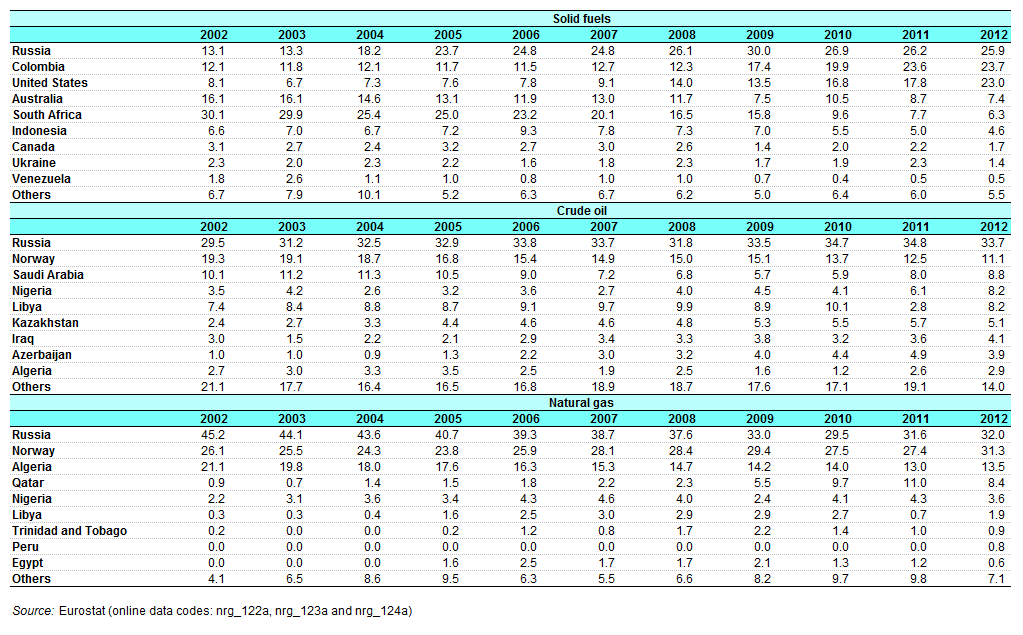
Main origin of primary energy imports - Source EuroStat

Source: Eurostat

An insight into EU energy policy is provided by the European Commission – Energy Economic Developments in Europepublished in Q1 2014. The section on Natural Gas starts at Page 33:-

In the European Union the majority of natural gas is supplied through bilateral long-term contracts which are negotiated between two parties, importer and exporter, and traditionally indexed to the price of oil. Currently, half of natural gas supply in the EU is still indexed to oil while across the EU a wide variation in import prices of piped gas and LNG has been observed. This is remarkable as at the same time a growing share of gas is traded on spot markets where short-term contracts are concluded on the basis of the market price determined by actual demand and supply. Spot market prices in the EU have been constantly lower than long-term contracts’ prices, at least since 2005.

In both the US and in the EU, spot-market gas prices have progressed in a similar fashion over the past decade and have followed the movements in the oil price.

In 2005, however, these gas prices have started to clearly fall below the level of the oil price. Between 2008 and 2009 they fell significantly in both regions, likely as a consequence of declining demand due to the economic downturn.

The fall in energy consumption has led to an excess supply of gas on the gas markets around the world and both US and the UK spot markets temporarily converged, trading at around 4/5 USD/MBtu in mid-2009, while the German hub prices fell less evidently, trading still above 8 USD/MBtu in 2009. From 2007 onwards, the US gas spot price has fallen under the price level of the other gas spot markets, which most likely reflects the effect of the surge in domestic shale gas supply. This becomes quite clear after 2009, when energy consumption picked up again following the recovery of the economy. Statistics from more recent years show that while the US spot prices remained low (around 4 USD/Btu in 2011), the EU spot prices (both in the UK and German hub) kept increasing. Wholesale gas prices have continued to rise in the EU while economic activity contracted and consequently natural gas consumption in the EU has been declining: the first half of 2012 represented the EU’s lowest first half year consumption of the last ten years. It was 7% and 14% less than the first half of 2011 and 2010 respectively.

The continued rise in EU wholesale gas prices despite the slump in gas demand and the lower gas spot prices vividly depicts the kind of vulnerability the EU is exposed to due to its high import dependency: as the Asian markets offer higher returns and more robust demand, gas producing countries have increased their trade with Asia lowering supply to Europe. As a consequence wholesale gas prices in Europe have increased while in the US, which now can rely more heavily on domestic production, prices have remained low. US prices were shielded from potential upwards pressure from export demand because of export restrictions (generally expected to be gradually lifted). Furthermore, the impacts on the EU have been further aggravated in this context due to the oil-price indexation of many long-term gas import contracts.

This chart from Schneider Electric shows the divergence in gas prices between US (yellow) EU (red) and Asia (blue): –
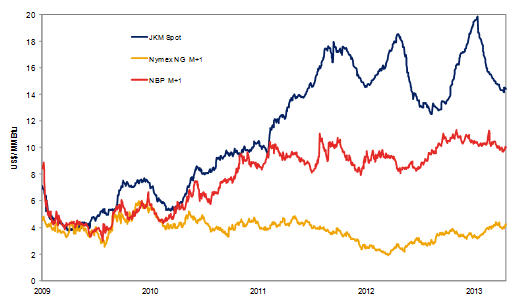
Natural Gas price comparison - Schneider Electric-page1

Source: Schneider-Electric

European Natural Gas prices are down from their December 2013 highs but have recently started to recover from the July 2014 lows. The chart below is for Dutch TTF (Title Transfer Facility) Gas: –
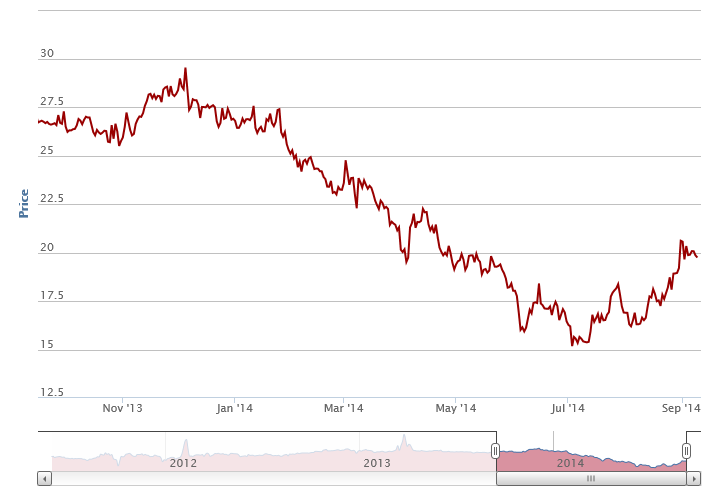
TTF Gas Daily Reference Prices - source EEX

Source: EEX

By way of comparison here are the one year charts for US Natural Gas and West Texas Intermediate Crude Oil: –
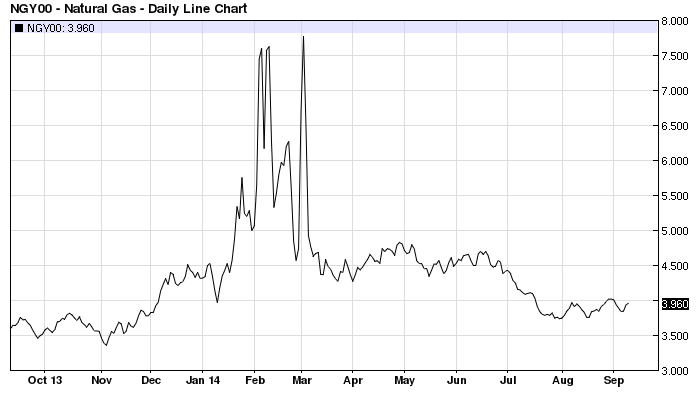
US Spot Nat Gas 1 yr

Source: Barchart.com

Understandably, the US Natural gas market is less concerned about Russian sanctions, and also cognisant of the long lead time between receiving an export license and the US capacity to increase exports of LNG.
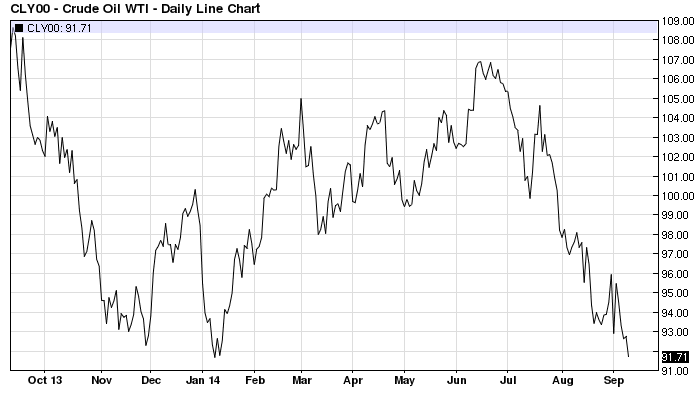
WTI Spot 1 yr

Source: Barchart.com

The US Crude Oil market is seemingly unperturbed by the politics of Russia or the Middle East. Or, perhaps, it is the combination of continuous improvements in US supply coupled with rising concern about the slowing of China. A similar pattern is evident in the Brent Crude price.

Returning to Europe: establishing a generic price for European Natural Gas is difficult as this article from Natural Gas Europe – European Natural Gas: So What’s the Real Price? explains. It is also worth noting the seasonality in gas prices. The last major spikes occurred in February/March 2013 and January/February 2012, coinciding with the advent of cold European winter weather.

The EU Commission and national governments are taking no chances this year, as this article from Reuters –  Europe drafts emergency energy plan with eye on Russia gas shut-down makes plain:-

A source at the EU Commission said it was considering a ban on the practise of re-selling to bolster reserves.

“In the short-term, we are very worried about winter supplies in southeast Europe,” said the source, who has direct knowledge of the Commission’s energy emergency plans.

“Our best hope in case of a cut is emergency measure 994/2010 which could prevent LNG from leaving Europe as well as limit industrial gas use in order to protect households,” the source said.

European Union Regulation number 994/2010, passed in 2010 to safeguard gas supplies, could include banning gas companies from selling LNG tankers outside of Europe, keeping more gas in reserve, and ordering industry to stop using gas.

The Russian threat to reduce gas supplies to the EU in order to reduce the re-sale of gas to other countries seems rather hollow when the EC would appear to be preparing to take these steps anyway. Nonetheless, if Russia reduces supply what can the EU importing countries do?

Norway is not in a position to make up the shortfall. 96% of Norwegian gas is already exported. At the Flame gas conference in Amsterdam this May, Statoil spokesman Rune Bjornson told delegates, “I think many producers, including us, can adjust on the margins, but most of the production capacity from Norway is typically designed to produce at maximum in winter and that is what we’ll do.”

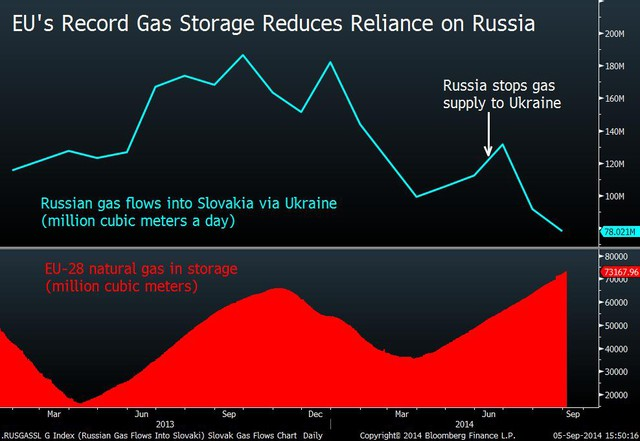
European governments have, however,  been actively improving storage capabilities. This process has been on-going since the first Russian/Ukrainian dispute in 2006 – according to recent estimates EU-28 storage is at 90% of capacity which is around 74 bcm. Businessweek – EU Need for Russian Gas Via Ukraine Wanes as Stores Fill gives a good overview: –

EU-28 Gas Storage-Bloomberg

Source: Bloomberg

Europe’s reliance on Russian natural gas shipments via Ukraine is declining after the region pumped a record volume of the fuel into underground inventories, minimizing the risk of shortages during the coming winter.

Given that Geo-politics seems to have had little impact on the performance of world financial markets in the long run should we be worried in the short run and especially with respect to Germany this winter?

The Council for Foreign Relations – The Geopolitical Paradox: Dangerous World, Resilient Marketsopines on this subject this week. The article is concerned mainly about disruption to the oil market: –

It is often noted that the vast majority of postwar recessions have been associated with energy shocks. Rising turbulence in the Middle East has raised the prospect of a long-term disruption in the region, where national borders could be rewritten through violent upheavals. The threat of a Russian cutoff of gas to Europe also hangs over markets. Consequently, it is surprising that energy markets, and oil markets in particular, do not ask for a premium in futures markets for secure energy supplies. At present, current oil contracts are higher than longer-term futures contracts, and though there are technical reasons for this downward trend (“backwardation”), it hardly is suggestive of disrupted or anxious markets.

They go on to discuss Europe describing it as the weak link: –

There are a number of reasons why Europe is the channel through which political risk could reverberate in the global economy. Europe is most vulnerable to disruptions in trade and financial relationships with Russia, though I have argued elsewhere that these costs may be small relative to the costs of inaction. Weak growth in China and elsewhere in the emerging world could significantly affect exports, particularly in Germany. Significantly, though, Europe also faces these challenges at a time of economic stress and limited resilience. Growth in the region has disappointed and leading indicators have tilted downward. Further, concern about deflation is beginning to weigh on sentiment and investment. The persistence of low inflation—well below the ECB’s goal of around 2 percent—is symptomatic of deeper structural problems facing the eurozone, including an incomplete monetary union, deep-seated competitiveness problems in the periphery, and devastatingly high unemployment. Homegrown political risks also threaten to add to the turmoil, as rising discontent within Europe over the costs of austerity is undermining governing parties and fueling populism. The result is a monetary union with little capacity or resilience to defend against shocks. The ECB has responded to these risks with interest-rate cuts and asset purchases, and is expected to move to quantitative easing later this year or early next, but the move comes late, and is unlikely to do more than address the headwinds associated with the ongoing banking reform and continued fiscal austerity. Overall, a return to crisis is an increasing concern and political risks could be the trigger.

The limited impact on financial markets since the beginning of the Ukrainian crisis in February can be seen in the table below: –

Market/Security Price 28 Feb Price 9 Sept Change % Change
TTF Gas 22.85 19.78 -3.07 -13.44
GPL Gas 23.23 20.06 -3.17 -13.65
US Nat Gas 4.74 3.96 -0.78 -16.46
WTI 102.58 91.71 -10.87 -10.60
E.ON 13.82 14.31 0.49 3.55
RWE 29.02 31.43 2.41 8.30
DAX 9692 9700 8 0.08
S&P500 1859.45 1995.69 136.24 7.33
10yr Bund yield 1.63 1 -0.63 -38.65
Gold 1327.6 1249.4 -78.2 -5.89


Source: EEX and Investing.com

Germany – the weakest link?

Since the Hartz reforms of 2002 Germany has emerged from the strain of unification to re-establish its credentials as the powerhouse of European growth. Latterly – and especially since 2008 – its preeminent reputation has become tarnished. The Bundesbank raised its growth forecast in June to 1.9% for 2014 vs its December 2013 forecast of 1.7%. Their optimism has been dented since then by concerns about the politics of Eastern Europe. The Deutsche Bundesbank – August 2014 Monthly Report makes the following observations: –

The global economy appears to have got off to a good start in the second half of the year. As regards the industrial countries, Japan’s economy is expected to rebound in the third quarter. The US economy is likely to remain on a growth path, although it will probably be impossible to maintain the rapid pace of growth attained in the second quarter of the year. Following second- quarter stagnation, the euro area is looking at a resumption of positive economic growth, albeit not at the pace predicted by many analysts in the spring. The underlying cyclical trend in some euro- area countries is turning out to be weaker than expected. At the same time, the geopolitical tensions in Eastern Europe owing to the Ukraine conflict as well as in other parts of the world are now appearing to weigh more heavily on corporate sentiment. Although they will only affect a small percentage of EU exports directly, the recently enacted EU sanctions and the Russian response are likely to dampen sentiment.

The Bundesbank are still predicting an increase in GDP growth for 2015 before moderating once more in 2016. Below is a chart of annual GDP since 2002: –
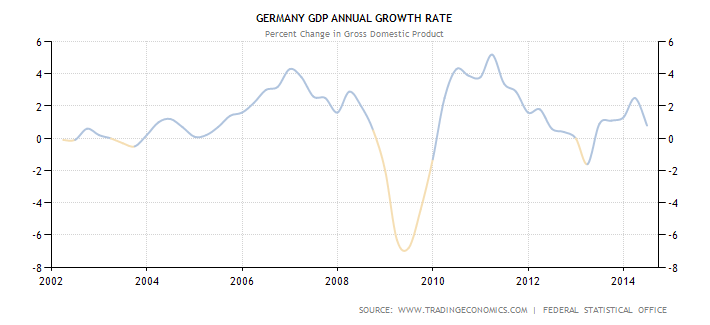
German GDP - 2002-2014

Source: Trading Economics

The momentum seems to be dissipating. According to the Federal Statistics Office, in 2013, 69% of Germany’s exports were to other EU countries.  Asia came second with 16% and the USA third with 12% – a slow down in Asia, specifically China, would be problematic, but the UK, US and peripheral EZ countries might be able to absorb the slack. What is clear, however, is that Germany is vulnerable.

This brings me to the risks to Germany this winter due to rising Natural Gas prices and a curtailment of supply. The IEA – Germany Oil and Gas Security Report 2012 provides a comprehensive overview of the German market: –

Germany has very little domestic oil and natural gas production and relies heavily on imports. It has well diversified and flexible oil and natural gas supply infrastructure, which consists of crude, product and gas pipelines and crude and oil product import terminals. Natural gas is imported into Germany exclusively by cross-border pipeline. The country has no LNG infrastructure, although some German companies have booked capacities in overseas LNG terminals.

Oil continues to be the main source of energy in Germany although it has declined markedly since the early 1970s. It now represents approximately 32% of Germany’s total primary energy supply (TPES).

Natural gas consumption in Germany has declined 10% since 2006. Demand was 90 bcm in 2010, down from 100 bcm in 2005. According to government commissioned analysis, the total consumption of natural gas in Germany is expected to continue to decline over the long term. The share of natural gas in Germany’s TPES is currently around 22%.

The decline in Natural Gas demand is evident across Europe. Earlier this year the Oxford Institute for Energy Studies estimated that, across 35 European countries, demand had fallen from 594 bcm in 2008 to 528 bcm in 2013 – an 11% decline. This is largely due to the high price of Natural Gas relative to Coal and the Europe-wide policies mandating increases in renewable energy production. For those who want to read more about EU renewable energy developments,  Bruegal – Elements of Europe’s energy union , published this week, looks at the policy challenges facing Europe between now and 2030.

Germany’s declining demand for Natural Gas and increase in storage capacity will mitigate some of the potential disruption to supply – in 2012 Natural Gas represented 22% of supply vs Oil 32% and Coal 24%. Added to which Germany has adopted some of the most aggressive policies to develop renewable energy, offset, to some extent, by their closure of Nuclear Power plants: –

Under existing government policies the trend towards an increasing share of renewables looks set to continue. The Energy Concept 2010 established a goal for Germany to increase its share of electricity generated from renewable sources to at least 35% of total consumption by 2020. Conversely, the trend towards an increasing share of nuclear in the energy mix looks set to reverse following the government announcement in 2011 of its decision to phase out all German nuclear power plants by the end of 2022.

Germany imports Natural Gas primarily from Russia (39%) followed by Norway (35%) and the Netherlands (22%). Germany has no Liquefied Natural Gas (LNG) capacity but the GATE (Gas Access To Europe) terminal in Rotterdam – opened in 2011 – was operating at 10% of capacity in April 2014 and is purported to be capable of supplying 12 bcm (Billion Cubic Metres). This is still a drop in the ocean – Russia supplied Germany with 140 bcm last year. German domestic demand is less than 100 bcm leaving a substantial amount for re-export. Further LNG supply is available from Spain but there are bottlenecks with the trans-Pyrenean pipeline.  In any case, Spanish LNG prices are high. The table below shows the divergence in prices for LNG globally, even more than in pipeline supply LNG prices are a function of logistical supply constraints: –
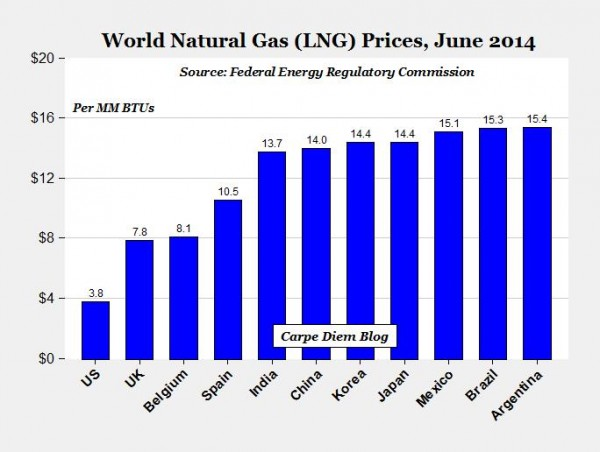
World LNG prices - June 2014 AEI and FERC-page1

Source: FERC and AEI

Germany’s Natural Gas storage capacity (2012) is 20.8 bcm, making it the highest in Europe, although there are plans to increase this further. In H1 2013 German Natural Gas consumption was 50 bcm – the high levels of storage suggest that Germany is well placed to weather a Russian go-slow this winter.

The complex and diverse nature of Germany’s cross-border pipeline capabilities are shown in the map below, however the largest pipelines by potential capacity are (2012 data): –


Country Pipeline Capacity
Ukraine Bratstvo 120 bcm
Norway Norpipe, Europipe I and II 54 bcm
Russia Yamal 33 bcm
Russia Nord Stream 27 bcm


Source : IEA

Germany - Gas Grid - IEA-page1

Source: IEA


Conclusions and financial market implications

After two interruptions to Russian Natural Gas supply in less than a decade, Germany – along with other gas importing countries within the EZ have taken precaution. The most vulnerable countries in the event of a complete cessation of gas supply by Russia are probably the Baltic States, Hungary and Bulgaria. However, Russia is also very dependant on the EU for sales of Gas, Oil and Coal. Nearly 60% of state revenue comes from this trade. This trade is worth $80bln per annum to Gazprom alone. Germany is Russia’s third largest trading partner, whilst Russia ranks 11th on Germany’s list.

If Russian sanctions lead to a cessation of Gas exports then a number of large German utility companies will suffer – most notably E.ON and RWE. However it is most unlikely that German supply will run out. Price increases will either be passed on through higher prices or lead of margin compression due to the disinflationary forces emanating from elsewhere in the economy.

John W Snow – the US Secretary to the Treasury under George W Bush – is quoted as saying, “Higher energy prices act like a tax. They reduce the disposable income people have available for other things after they’ve paid their energy bills.” This is the potential that a reduction in Russian gas supplies and commensurate rise in prices is likely to have on the wider German economy. The ECB has cut rates and started down the road to QE even before the onset of winter. Mario Draghi knows that monetary policy works slowly and many commentators believe the ECB are demonstrably behind the curve due to their attempts to impose austerity on the more profligate member states.

German Bunds may have hit their high for this year, especially since the ECB are now buying ABS, but they remain a “hedge short” at best. The quest for yield hasn’t gone away, EZ high yielding sovereign names will be supported still.

European Equities will be nervous in this environment despite some 52% of Eurostoxx 600 companies beating their earning forecasts for Q2, according to Reuters data. After a summer shakeout, the DAX has regained its composure, but it is already trading on a P/E ratio of nearly 22. Technically it’s a “Hold” until a break of 9,000 on the downside or 10,000 on the upside. But don’t forget that when Mr Draghi uttered, “whatever it takes” the DAX was toying with 5,000

European Natural Gas prices should be supported through the winter but a full-blown “Gas Crisis” is unlikely. A “Winter Squeeze” such as 2012 or 2013 could see spot prices double under normal market conditions. German growth will continue to be hampered by political uncertainty but, all other things equal, it should rebound on any sign of detente and will benefit from the continued recovery of the UK and US economies.
The Spanish Renaissance

400dpiLogo

Macro Letter – No 17 – 15-08-2014

The Spanish Renaissance

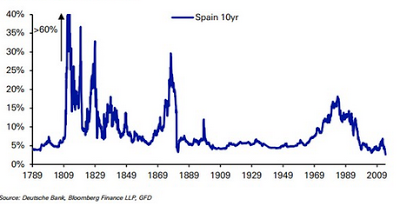
  • Spanish government bond yields have fallen to the lowest since 1789
  • Non-performing loans continue to increase
  • The two main political parties have lost support due to austerity

Last month I spent two weeks visiting Catalunya, the North Eastern province of Spain which has Barcelona as it capital. The region contains 16% of Spain’s population and generates 19% of national GDP, according to this OECD report. As an economic region it remains the wealthiest in the country although it is fourth by per capita GDP. Its economic prowess is matched by it levels of debt – in 2012 it had the highest debt of any of the 17 autonomous regions of Spain. It remains one of the most industrialised regions of Spain having developed its industrial base in the second half of the 19th century. As traditional industry declined Barcelona led the industrial renaissance developing new businesses in biotechnology and design. It is a member of the “Four Motors of Europe” group which includes Rhone-Alps, Lombardy and Baden Wurttemberg.

Aside from the new industry the region has a large agricultural sector and a substantial tourist industry. Supporting these industries is an array of regional financial institutions including La Caixa – Europe’s largest savings bank and Spain third largest banking institution.

Bordering France and Andorra to the north there is strong political support for Catalan separatism or a federation of Spanish states.

Catalunya – land of contrasts

During my visit I spent time Blanes, a popular local Costa Brava resort, 60 miles north of Barcelona. This is just beyond the commuter belt but the tourist business appeared robust. Property prices are lower than in 2008 but this, predominantly Spanish, resort has gradually developed over several decades; over-supply does not seem to be the issue it is in areas such as the Costa del Sol. There was little evidence of new property development but the bars and restaurants were busy and the main shopping areas had a prosperous feel with new stores opening for the summer season.

From the east coast I drove west to Lleira which is the geographic centre of a large agricultural region irrigated by rivers which rise in the Pyrenees. The city was ravaged during the Spanish civil war but since the death of Franco (1975) it has witnessed a demographic revival as immigrants have arrived, predominantly from Andalusia. My journey then took me north to the Vall D’Aran. This district contains Spain’s premier ski resort, Baqueira-Beret.  The town was originally developed in the 1970’s and 1980’s but has been significantly added to in the last decade. Property prices, while substantially lower than similar accommodation in the Alpes, are being offered at significant discounts. This reflects the dramatic increase in new properties, the limited skiing area, the less reliable snowfall and the domestic nature of the clientele – yet Toulouse airport is only a two hour drive. Aside from the tourist industry and farming the region produces a significant amount of hydro-electric power, according to data from 2001 Catalunya is the second largest producer in Spain – I couldn’t find more recent data, but generating capacity appears to have been fairly static for the past decade. Spain is ranked sixth in Europe for hydro-electric generation and hyrdo accounts for 12% of Spain’s installed generating capacity.

Catalunya – a surrogate for Spain

Despite high levels of debt, Catalunya is a dynamic economic region. The tourist industry remains strong. The agricultural sector is stable, benefitting from excellent road links to the rest of Spain and France to the north. The relative proximity to the Mediterranean seaboard enables export to a wider international market. It’s worth noting that Spanish exports are up 7% on 2013.

Newer industries in the Barcelona area benefit from a highly educated workforce and the attraction of a cosmopolitan city with a desirable climate. In some ways Catalunya resembles the Lombardy region of Italy, held back by its less successful provinces. However Spain’s Fascist regime retained control until 1975 and political stability was properly established only in October 1982 when the PSOE won the general election. During the period from 1939, and especially during the Francoist “Spanish Miracle” of the 1960’s, Spain was essentially a command economy. Those institutions which were supported by the state, thrived and became larger than their Italian counterparts. This structure makes Catalunya, and for that matter the rest of Spain, less quick to adapt.

I believe Catalunya can be viewed as a leading indicator of the direction in which the Spanish economy might travel if Spain embraces economic reform and addresses the problem of property related non-performing debt which continues to stymie their banking system.

Spain – The Economy

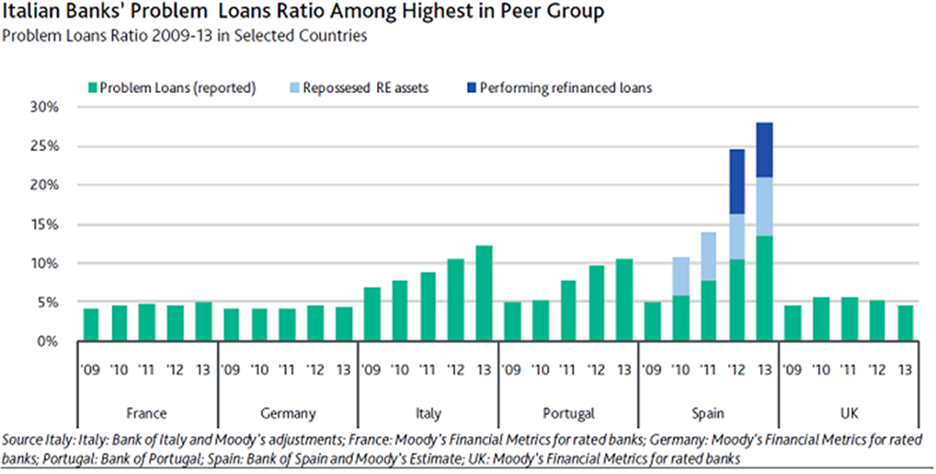
The table below comes from the American Enterprise Institute – the AEI are concerned about Italy and also Portugal where reported problem loans are rising. The same is true in Spain despite considerable efforts to refinance or repossess assets.

Non-Performing Loan Ratio - AEI - Moody

Source: AEI and Moody’s

This doesn’t paint the picture of an economy in rude health. The level of non-performing loans continues to grow despite government bond yields which are at the lowest yields since 1789.

10 yr Spanish bond yields since 1789

Source: Deutsche Bank and Bloomberg

The IMF 2014 Article IV – Staff Report on Spain, published in June, reflects some of the contradictions I observed during my visit, they go on to propose several policy recommendations, including a further bolstering of financial institutions at the expense of shareholders: –

Context. Spain has turned the corner. Growth has resumed, labor market trends are improving, the current account is in surplus, banks are healthier, and sovereign yields are at record lows. But unemployment is unacceptably high, incomes have fallen, trend productivity growth is low, and the deleveraging of high debt burdens—public and private—is weighing on growth.

Policies. Spain’s overarching policy priority must be to ensure the recovery is strong, long-lasting, and most pressingly, job-rich. This requires:

  • Reducing the drag on domestic demand from private sector deleveraging with a more comprehensive, coordinated, approach to corporate debt restructuring, and by introducing a personal insolvency framework.
  • Bolstering banks’ ability to support the recovery by continuing to raise capital levels over time, including by limiting cash dividends and bonuses.
  • Creating jobs for the low skilled by sharply cutting the fiscal cost of employing them, compensated by higher indirect revenues.
  • Making the labor market more inclusive and responsive to economic conditions by striking a better balance between highly-protected/permanent and precarious/temporary contracts, and further helping firms adapt working conditions (wages, hours) to their specific circumstances.
  • Helping the unemployed improve their skills and enhancing the support they receive to find a job.
  • Removing regulatory barriers that prevent firms from growing, hiring, and becoming more productive, especially at the regional level.
  • Gradually, but steadily, reducing the fiscal deficit to keep debt on a sustainable path, and making the tax system more growth and job friendly.
  • Policies by Spain’s European partners, in particular, sufficient monetary easing by the ECB to achieve its inflation targets.

 For a closer look at the current state of the Spanish economy the Banco de Espana – Quarterly Report – July 2014 makes interesting reading. The central bank is broadly positive, here are some of the highlights: –

GDP is estimated to have increased at a quarter-on-quarter rate of 0.5% (compared with 0.4% in Q1). Following four consecutive quarters of quarterly increases in output, the year-on-year rate of change in GDP is expected to stand at 1.1% (0.5% in the previous quarter).

…the update of these projections points to GDP growth rates of 1.3% in 2014 and 2% in 2015, 0.1 pp and 0.3 pp up on those previously projected

…financial market conditions continued improving in Q2, underpinned by brighter economic expectations and the effect of the measures adopted by the ECB. There were further cuts in the yields on Spanish public debt and a narrowing in the related spread over the German benchmark (at the cut-off date for this report the risk premium stood at 151 bp, after having risen slightly in recent days). Yields and risk premia on fixed-income securities issued by the private sector also fell. Lastly, stock markets continued on a rising trend, meaning the IBEX-35 has posted gains of 1.3% since end-March (and of 5.6% since the start of the year). Against this background, bank lending interest rates fell slightly, but remain excessively high given the expansionary monetary policy stance.

Both external and financial factors contributed to bolstering the increase in spending by the non-financial private sector in Q2. Household consumption is estimated to have increased by 0.4% quarter-on-quarter, in line with the rate for the previous quarter, and on the back of improved confidence and the recovery in employment. In contrast, other determinants of consumption moved on a somewhat less positive path. In particular, on information to March, the decline in disposable income intensified, meaning that the saving ratio dropped sharply to 9.4% in cumulated four-quarter terms (compared with 10.4% the previous quarter). That is illustrative of the delicate financial situation from which households are addressing their spending decisions in the early stages of the recovery. The rise in household financial wealth perhaps marked a counterpoint to the weakness of disposable income, but it did not prevent the expansion in consumption from having to be  made at the expense of the disposal of financial assets, according to information from the financial accounts.

The contractionary profile of residential investment eased in Q2, posting an estimated quarter-on-quarter decline of 0.8% (a similar rate to Q1), in a setting in which the main real estate market indicators began to evidence a significance moderation in the adjustment of the sector. Housing transactions showed a degree of stabilisation, with notable momentum in purchases by foreigners, and the declining trend in the number of mortgages arranged was checked. The number of building permits ceased to move on a declining path, hovering in recent months at values slightly higher than their historical low. However, the absorption of the sizeable stock of unsold houses is advancing but slowly, which is hampering the start of the new construction cycle. Lastly, the pace of the year-on-year decline in house prices eased in 2014 Q1 to -3.8% according to Spanish Ministry of Development figures, placing the cumulative loss in the value of this asset since early 2008 at 31%, in nominal terms. This behaviour at the aggregate level was, however, compatible with price increases in certain regions.

As a result of the developments in household saving and investment, households’ net lending moved once more onto a declining course in Q1, following the pause observed in 2013, to stand at 1.9% of GDP in cumulated four-quarter terms. The pace of the contraction in financing extended to households slackened slightly in Q2, posting a year-on-year rate of change of -4.6% in May (-4.8% in March

In the corporate arena, productive investment is expected to have risen in Q2, as the sustained recovery in investment in capital goods discernible since 2013 Q1 has been accompanied by the more favourable behaviour of investment in non-residential construction, following its fall the previous quarter. Overall, the improvement in the business climate, along with the favourable trend in foreign orders and the recovery in domestic demand, accounts for this acceleration in business expenditure. According to the non-financial accounts of the institutional sectors for Q1, the increase in investment was accompanied by a break in the rising course of non-financial corporations’ saving, leading to a slight reduction in their net lending, which stood at 4% of GDP in cumulated four-quarter terms, 0.3 pp down on end-2013. On information updated to May, the pace of the decline in total funds obtained by non-financial corporations lessened by 0.6 pp compared with March to a rate of 5%.

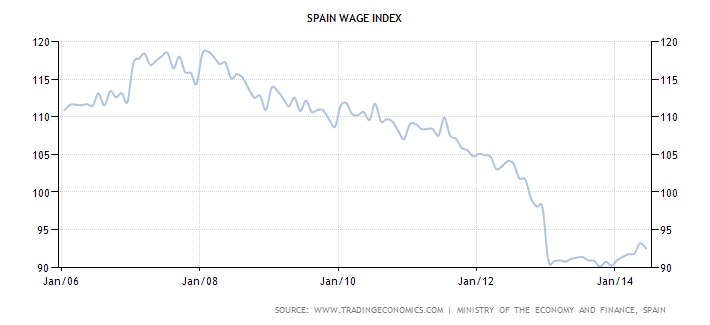
Spain has a more flexible labour market than many of its EZ neighbours, although, as the IMF state, this situation could be further improved. The crisis affected workers more quickly than institutions. Unemployment rose dramatically and wages, for those still in employment, remains under pressure as a result: –

Spain Wages - 2006 - 2014

Source: Trading Economics, Spanish Ministry of Finance

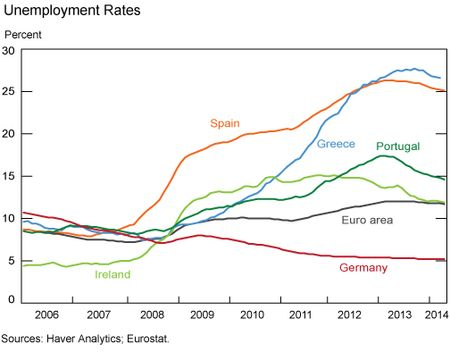
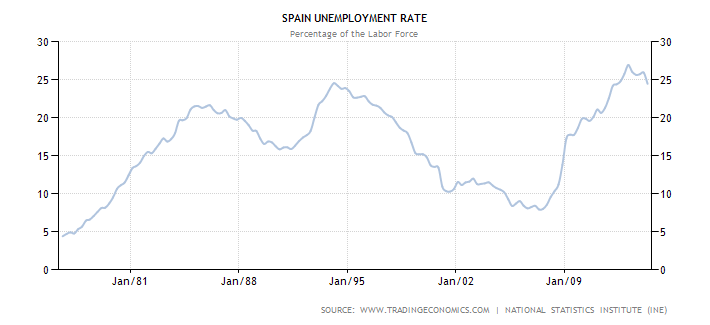
Unemployment remains stubbornly high but historically Spain has had a large “informal” economy which is not captured by official statistics. The first chart looks at the recent evolution of the unemployment across the EU and the second looks at the longer run pattern specific to Spain: –

EZ Unemployment - NY Fed Haver Analytics

Source: NY Fed, Haver Analytics, Eurostat

Spain Unemployment 1976 - 2014

Source: Trading Economics, National Statistics Institute – Spain

On the bright side, Spain is now toying with deflation as this, tongue in cheek, table from Charles Butler – Ibex Salad illustrates: –

CPI Category Oct CPI Rationale for delaying spending in anticipation of lower prices
Electronics -8.1 I’m lining up at the Apple Store waiting for lower prices.
Communications -7.5 Let’s talk next month. It’ll be cheaper.
Vehicles -3.3 This one’s got potential (too bad sales are up 34% YoY)
Vehicle parts & repairs -2.3 Spreadsheet > calculate fuel savings on 3 cylinders vs cost of repair.
Electricity -2 Watch this week’s Walking Dead…. next week.
Household Appliances -1.7 No problem. I like sushi.
Hospital services -1.2 They’re offering a special on biopsies in August.
Personal articles -1.2 In the meantime, just tear up a few rags.
Household textiles -1.1 (see previous)
Sports & recreation goods -0.9 Trending > air football
Home rent -0.5 If we don’t pay, the landlord’ll charge us less next month.
Home repairs -0.4 Leak? No problem. Cut the mains.
Sports & recreation services -0.4 I’ll exercise twice as much next month (multipurpose rationalization).
Hotels -0.2 I love Benidorm in January.
Personal goods & services -0.1 Let hair grow.Call myself an indignao.(Won’t work for Luís de Guindos.)
Medicines 0 I’ll hedge my insulin habit with a Viagra short.
Financial services 0 Cash is king, anyway.

Source: Ibex Salad

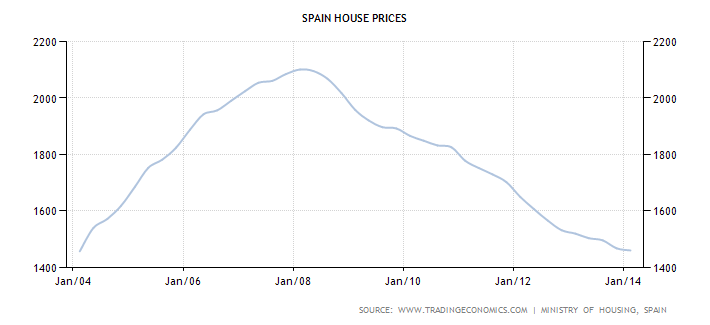
Which brings us back to house prices; six years after the financial crisis, prices are back to the level of 2004.

Spain House Prices 2004 - 2014

Source: Trading Economics, Spanish Ministry of Housing

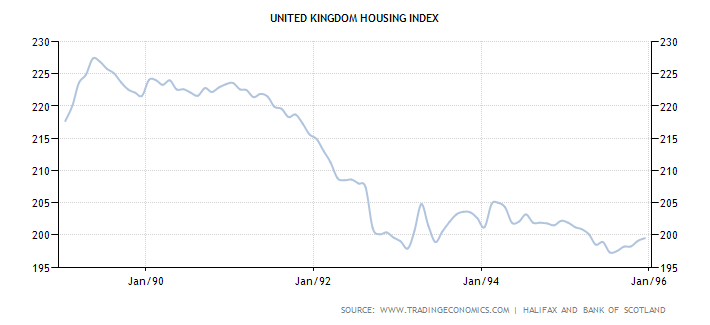
Whilst the environment was different in the UK in the late 1980’s the chart below is an indication of the time it can take for housing prices to recover. In the UK interest rates rose and then declined sharply making mortgages significantly more affordable. Spain has seen interest rates fall already, a rise from these levels might prolong the agony: –

UK House Prices - 1989 - 1995

Source: Trading Economics and HBOS

With Spanish bond yields at record lows the fear of higher rates is a disincentive investment. The debt overhang and rising level of non-performing loans will continue to undermine any lasting recovery. Since the financial crisis many Spanish nationals have emigrated in search of work. At the same time the rising trend of non-Spanish immigration has reversed. During the boom years Spain’s population was swelled by an influx of nearly six million immigrants – with unemployment at nearly 25% they are no longer arriving. In the longer term, like many other European countries, Spain has to deal with an ageing population. The IMF Spain – selected issues document published last month noted: –

Demographics have turned negative. After expanding at a fast pace until 2007, population growth slowed significantly and turned negative in 2012. This is likely to be a new trend, as INE projects working-age population to continue to decline over the next years.

…Labor dynamics will make a much weaker contribution to potential output. Demographics will be a drag on growth due to declining working-age population (emigration and ageing). The Spanish statistical agency (INE) expects working-age population to fall by 1 percent a year over the medium term.

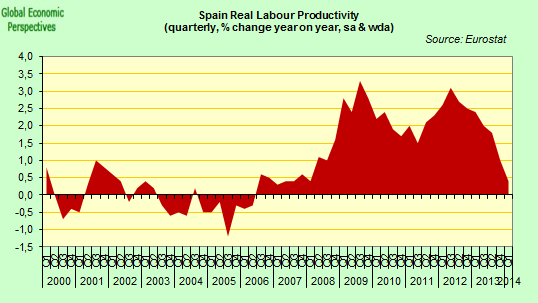
Another issue of concern is productivity. The productivity gains derived from the recession have reversed as this chart shows: –

Spain Productivity - 2000 - 2014 - Eurostat

Source: Eurostat

To some extent these TFP gains are illusory since the fall in employment has been bourne by the least productive employees. As the economy recovers these workers will find new employment and TFP will decline.

Politics and Institutional Reform

What wasn’t discussed by the IMF or the BdE is the changing political landscape. In the recent European Elections the two main parties which have governed Spain since 1982 saw a significant decline in support. Historically they have garnered 70% of the vote, in theses elections they captured only 49%.

Edward Hugh – Spanish Economy Watch captures the mood: –

What people are missing about Spain is the way the credibility of the institutional structure is weakening. Voices talking about a constitutional crisis are growing. The economic crisis basically coincided with the moment when the set up established – including the return of the monarchy – during the transition from Franco’s dictatorship to democracy was increasingly seen as having “run its course”. Many observers recognise that major constitutional reform is needed and some kind of “rebirth” and renovation in the political system. Last months EU elections were the latest warning signal. The two main political parties (the so called institutional parties) for the first time since the transition failed to get over 50% of the popular vote between them, while the Syriza-like Podemos – who hadn’t even been listed in the opinion surveys – surged from nowhere to take 5 seats and 9% of the vote. And in Catalonia a large majority of voters voted for parties who are actively campaigning for independence from Spain. A general election is coming next year, but it is hard to see either of the “old” parties getting a majority without a complex set of coalition partners.

With respect to the politics of Catalunya, the rivals to the main Spanish parties are in favour of a range of measurers ranging from Separatist to Federalist .

A further sign of the need for reform is the significant decline in the popularity of the Spanish Royal family. Juan-Carlos abdicated in favour of his son earlier this year amid a corruption scandal. Six years after the financial crisis Spain is still in need of a Renaissance.

Conclusion and market implications

Unlike several other EZ countries, Spain is likely to see a continued pick-up in economic growth. This may be tempered by economic slow-down in their main export markets Italy (7.7%) Germany (10%) and France (15%): the French Finance Ministry halved their GDP forecast to +0.5% this week. The principal drag on the economy still emanates from the housing market bust and the problem of non-performing loans. In the longer run, institutional reform is needed to head-off the demographic effect of a shrinking working age population. In the past this has been achieved through immigration but the long term solution is to concentrate on productivity growth through investment in education and other policies.

For investors there is an opportunity to acquire dynamic companies especially in new industries such as biotechnology – for those investors looking for company specific information Biotech Spain is a useful resource – however, financial institutions – 42% of the IBEX35 index – remain vulnerable due to the debt overhang. The IBEX 35 and the Italian MIB index have moved in tandem since the initial recovery in 2010 but the prospects for Spanish growth are better over the next couple of years. Last month the Banca D’Italia revised their GDP forecast for 2014 down to 0.2% and for 2015 to 1.3%. My preference is to take a relative value approach to Spanish stocks given the slow-down in EZ growth.

Spanish 10 year government bonds offer little value at 2.5% although they may remain around these levels from a significant time. Yields have fallen from 7.74% in July 2012 to 2.45% last month. During the same period German 10 yr Bunds (Europe’s “Risk-Free” asset) have ranged between 2.05% (September 2013) and 1.02% this month. The record low yield on Bunds is a response to general concern about EZ growth – Germany’s ZEW Indicator of Economic Sentiment showed it seventh monthly decline in July although it is still above its long run average. France also looks vulnerable as witnessed by a new high of 3.398mln unemployed in June and Q2 GDP at zero.

Spanish Real-Estate is down 31% since the crisis according to the BdE. Inevitably, property is always about location and there are some opportunities which look tempting, especially in areas where foreign buyers are active, but with non-performing loan rates still rising. I don’t envisage a broad based recovery for some while.


A very French revolt

400dpiLogo

Macro Letter – No 13 – 06-06-2014

A very French revolt

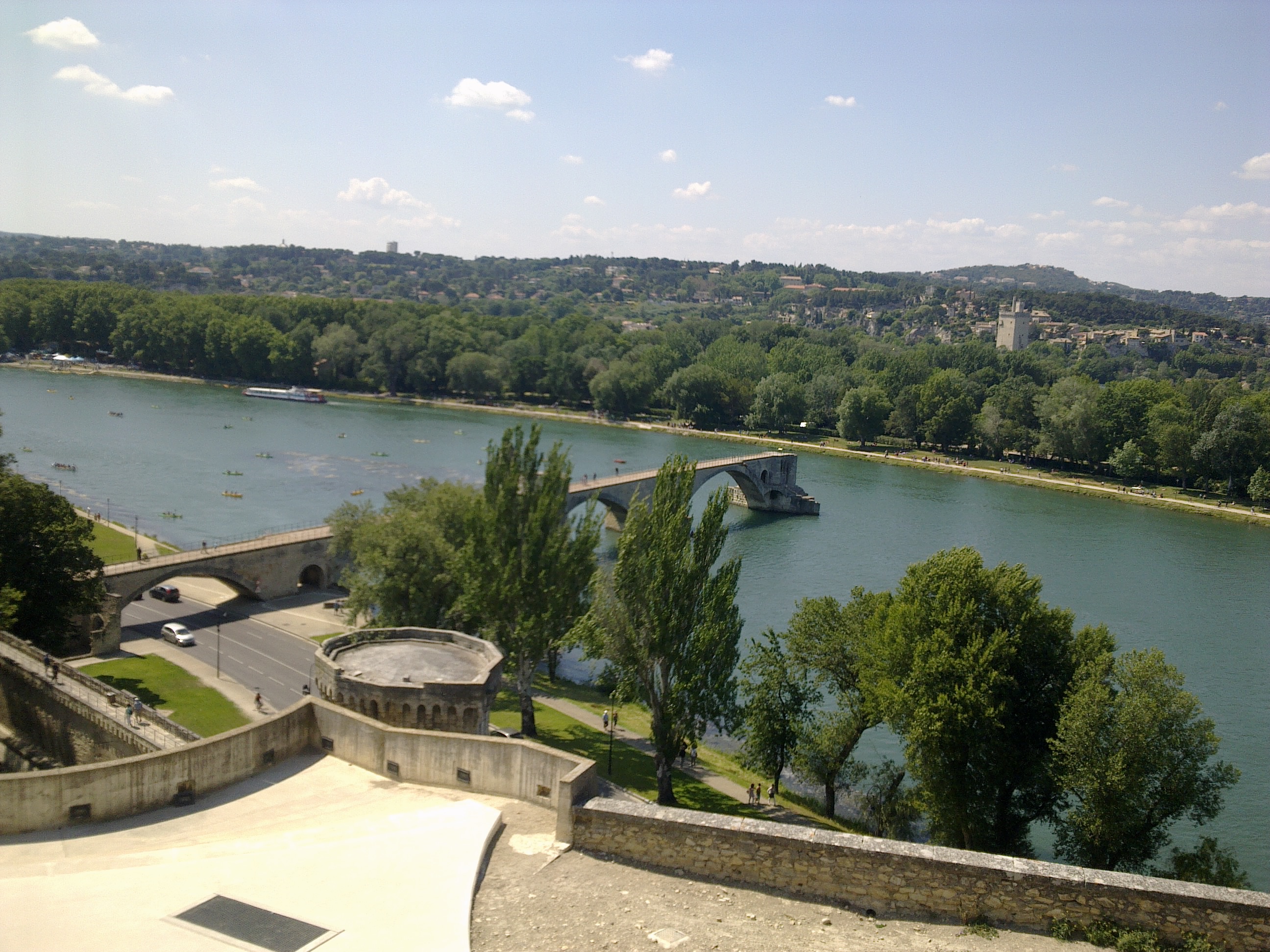
18052014311

Sur le Pont d’Avignon

L‘on y danse, l’on y danse

Sur le Pont d’Avignon

L’on y danse tous en rond

Last month I spent a few days helping a friend with his business in Avignon. This was a brilliant opportunity to canvass the views of the non-metropolitan French in respect of the current government and the state of the French economy. During my career I have worked closely with Parisian bankers and asset managers. Somewhat like London, Paris is “another country” which happens to be situated in the middle of France. In the provinces they believe in “rendre la vie plus simple”– life rendered easier.

The city of Avignon is close to the tourist heartland of Provence but it is also very much a commercial centre for a wider agricultural region. The above picture is of the famous Pont Saint-Benezet bridge across the Rhone; the bridge collapsed in 1644 and is now a tourist attraction. It is better suited to dancing today than it was at the time of the 15th century childrens’ song, but, as the home of the Pope from 1309 until 1377, the city has a long history as a tourist attraction.

Old Avignon is a beautiful city and a world heritage site. As one wanders around the walled centre,interieur du murs, filled with shops, cafes and restaurants, one is reminded of the French esteem for “La Bonne Vie”.  Exterior du murs it is a different story. Large housing projects and, often, poorly maintained properties, bare witness to the, predominantly North African, diaspora who work in agriculture or the service industries, or, in many instances, do not work at all. Avignon is a city of contrasts but it offers a unique window into “real France”.  During my visit I spoke to four of the city’s residents:-

  1. a French engineer who works for a large utility company.
  2. a French economist working for local government helping immigrant workers find local jobs
  3. an ex-pat American carpenter who has lived and worked in the region since the 1960’s
  4. a French national who works in the real-estate and tourist industry

None of them were overwhelmed by the performance of Francois Hollande’s PS (socialist party) government, but, to my surprise, none were surprised by his “about-turn” on economic policy.

Francois Hollande was elected in 2012 on a mandate to “tax and spend” but soon achieved a volte-face. The current policy calls for Eur 50bln of spending cuts over the next three years. These cuts will be concentrated on health and welfare. Public sector wages are to be frozen – though I have no doubt many public sector workers will be promoted to higher pay grades. The headline figure is somewhat misleading since the policy package also incorporates reductions in taxes for employers amounting to some Eur 30bln. Nonetheless, it is unlikely that any other French political party could have achieved as much austerity.

The French electorate seem unimpressed by these policies as witnessed by the rising fortunes of the Front National in the European Elections last month. The rightward swing has been widely reported but I doubt the “protest vote” – which has been seen across the EU – will have much impact except to slow the process of federalisation.  Steen Jakobsen – Saxo bank had this to say following the outcome of the vote:-

Across Europe, EU-sceptic voters gained ground, but it could be in vain as the overall majority of the old guard: Conservative, Liberals, Greens and Social Democrat’s still carry 70 percent of the mandates.

…The 751 members of the EU Parliament operate through coalitions of interest across countries and sometimes political standpoint. The final date for submitting a coalition is June 23, and a “coalition” has to be at least 25 members from seven different nations. Here the protest votes can play vital role. The Europe-sceptic vote is divided. The risk is that, similar to the Occupy movement in the US, all lack of common goal, except those of a negative nature, allows the majority get away with ignoring what clearly is a call from the voters to the politicians that Europe is too far away from the daily life of its 500 million citizens.

…The EU “economic police” will be tested. France and Spain is already in violation of budget deficits for 2014 and 2015. The so called “recovery” is actually a stabilisation, not recovery. In history, unions, even primitive ones, fail when economic times turns negative.

The condition of French government finances is not rosy: public debt to GDP is running at 57%. Tax to GDP, at 57%, is the highest in Europe. Meanwhile unemployment is stuck in double digits. The economy has stalled; Q1 GDP was zero and the IMF revised forecast for 2014 is down to 1%. Unsurprisingly, foreign investment into France declined -0.9% during the first quarter.

Employment

Returning to Avignon the issues which most concerned all the “locals” I interviewed were immigration and the standard of living: or perhaps I should say “Quality of Life”. As in many developed countries, immigrants will accept lower pay and take on more menial tasks than the indigenous population. As long as there are higher paid, higher skilled employment opportunities this process frees up scare resources to be employed in productivity enhancing roles. When those opportunities do not exist a country’s standard of living suffers: younger and older workers bare the brunt. In France this effect has been softened by encouraging younger people to study longer, often at the tax payers’ expense. Older workers have been encouraged to retire earlier, again, at the tax payers’ expense.

A recent post from Scott Sumner – How to think about Francemakes some economic comparisons with the USA: –

…So, here are some [2008] ratios of France to the United State:-

GDP per capita: 0.731

GDP per hour worked: 0.988

Employment as a share of population: 0.837

Hours per worker: 0.884

So French workers are roughly as productive as US workers. But fewer Frenchmen and women are working, and when they work, they work fewer hours.

…The bottom line is that France is a society with the same level of technology and productivity as the US, but one that has made different choices about retirement and leisure. Vive la difference!

Professor Sumner observes what von Mises called “Human Action”. He goes on to make some observations about employment protection: –

France has a wide range of policies that reduce aggregate supply:

1.  High taxes and benefits, which create high MTRs.

2.  High minimum wages and restrictions on firing workers.

What should we expect from these “bad” supply-side policies?  I’d say we should expect less work effort at almost every single margin. Earlier retirements, more students staying longer in college, longer vacations, and a higher unemployment rate.

France has always had a reputation for employment protection but overall it is not dramatically different from its larger European neighbour as the OECD – Employment Outlook 2013  reveals in their latest employment protection rankings. Whilst France is above the OECD average (Page 78 – Figure 2.1) it is not that far above Germany.

TheInternational Labour Office –An anatomy of the French labour market – January 2013gives a detailed account employment trends. The rise of temporary labour has been as prevalent in France as in many other countries despite, or perhaps as a result of, its rigid employment laws. The ILO describes this as a Two-tier system which creates a more stringent protective framework for workers on long-term contracts and very limited protection for workers on short-term contracts. According to their report the legislative policies in countries such as France and Spain has led to higher job turnover. Since the 1990’s France has seen a 70% to 90% increase in short-term employment. This trend has accelerated since the Great Recession.

As French government spending falls, the opportunities for longer-term employment, especially for the young and older worker, will be reduced. The ILO continue: –

The share of temporary jobs in the private sector is far higher among young workers aged between 15 and 24 years old than among prime-age workers (25-50) and senior workers (over 50): 39.9 per cent vs. 10.7 per cent and 7.0 per cent in 2010. It is also higher for women (15.2 per cent) than for men (9.1 per cent).

When viewed through the lens of “employment opportunity” the French protest vote at the European Elections is not that surprising. The table below shows the wage inequality between permanent and temporary contracts across Europe, France comes third, behind the Netherlands and Sweden on this measure: –

Wage premium for permanent contracts for 15 European countries.
Sweden 44.7
Netherlands 35.4
France 28.9
Luxembourg 27.6
Germany 26.6
Italy 24.1
Greece 20.2
Austria 20.1
Finland 19
Ireland 17.8
Denmark 17.7
Spain 16.9
Portugal 15.8
Belgium 13.9
United Kingdom 6.5

Source: Boeri (2011)

Impact on the financial markets

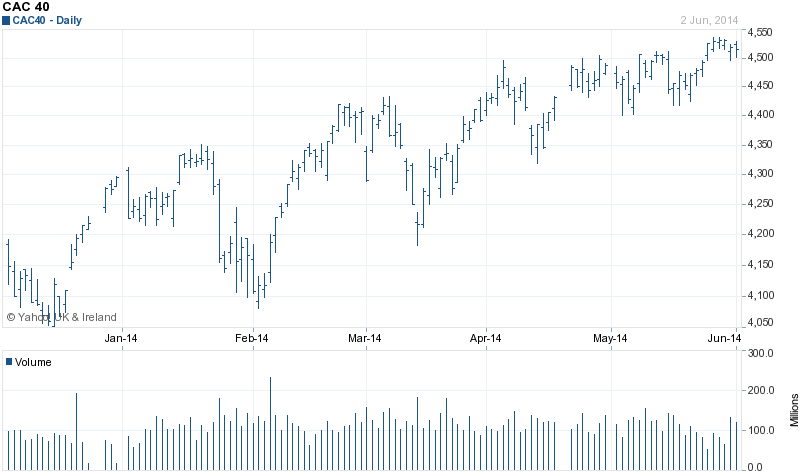
But what does all this mean for the French financial markets? To judge by the recent performance of the CAC40 and 10yr OATs, not much.


CAC40 - source - yahoo finance

Source: Yahoo finance

The new highs have been achieved on low volume which may indicate a lack of conviction. What is clear is that the EU election results were anticipated. What is less clear is whether the market reaction is a sign of approval at the “protest” or apathy. It is clear that the financial markets are more concerned about ECB policy. May 2014 EU inflation was +0.5% vs an ECB target of +2%. The small cut in the refinance rate this week and the introduction of negative interest rates on deposits held at the ECB are hardly sufficient to offset the disinflationary forces of the EZ rebalancing which has been on-going since the great recession. The end of “monetary sterilisation” and new targeted LTROs, together with the proposal for the ECB to purchase certain ABS, however, looks like the beginning of something more substantial. OMT is still in the arsenal but has yet to be deployed.

10 yr OATs reflect a similar story: –

OAT 10yr yield

Source: Investing.com 

The all-time low yield was set in April 2013 at 1.64% but, with French growth apparently slowing, yields remain wedded to those of German Bunds. The 10 year spread has continued to converge this year from 65bp on 15th January to around 40 bp today.

French Real-Estate may also be influencing other asset classes. According to a recent OECD report French residential property is still overvalued despite the declines of the past couple of years. On a Price to Rent measure the OECD estimate values to be 35% higher than the long run average. On a Price to Income basis the overvaluation is only 32%. It is worth noting that interest rates are at historically low levels so these overvaluations are not entirely surprising. France is not alone in its overvaluation as the table from Deutsche Bank (using earlier OECD data) shows: –

Global House Prices - OECD + Deutsche bank - February 2014

Source: Deutsche Bank and OECD

In their March 2014 Global House Price Index report, Frank Knight commented that residential property in France and Spain was still languishing. However, in comparison with March 2012 prices were down only 1.4% in France compared to 4% in Spain and 9.3% in Greece.

If historically low interest rates cannot stimulate demand for Real-Estate then asset managers would do well to allocate to a more attractive asset class. With OAT yields nearing historic lows the CAC40 appears to be benefitting by default; it trades on a P/E of 26 times. The UK, with the strongest growth forecast in Europe, is trading at 33 times (FTSE) whilst the DAX trades on a P/E of 22.

Conclusion

The French Revolt at the EU elections is principally a protest against the immigration policies of the French administration. The main concern of the average French voter is long-term employment and quality of life. The policies of Brussels, which reinforce those of the French administration, are seen as contrary to the interests of the French people in respect of immigration but this does not mean that the French people are anti-EU.

French financial markets have paid little heed to the EU election results. The actions of the ECB are of much greater importance in the near-term. The longer-term implications of the gains for the Front National will be tested at the Senate Elections in September this year, but, given the large socialist majority last time, any swing to the Front National will be a further “protest”. The real test will be at the presidential elections – scheduled for 2017.

Low interest rates from the ECB look set to continue. The central bank has now begun to utilise some of the unconventional tools at their disposal to transmit longer-term liquidity to the non-financial economy. OAT yields should remain low in expectation of the implementation of these more aggressive policies. They will also be supported internally if Hollande succeeds with his austerity package. French property prices are likely to remain subdued and may weaken further if the economy continues to stall. French stocks will therefore continue to benefit, both from international and domestic capital flows, but, at their current valuations, they will reflect the direction of international markets led by the US and, within Europe, by the UK and Germany.

European Markets and Unification

400dpiLogo.

.

.

Macro Letter – No 3 – 17 -01-2014

European Markets and Unification

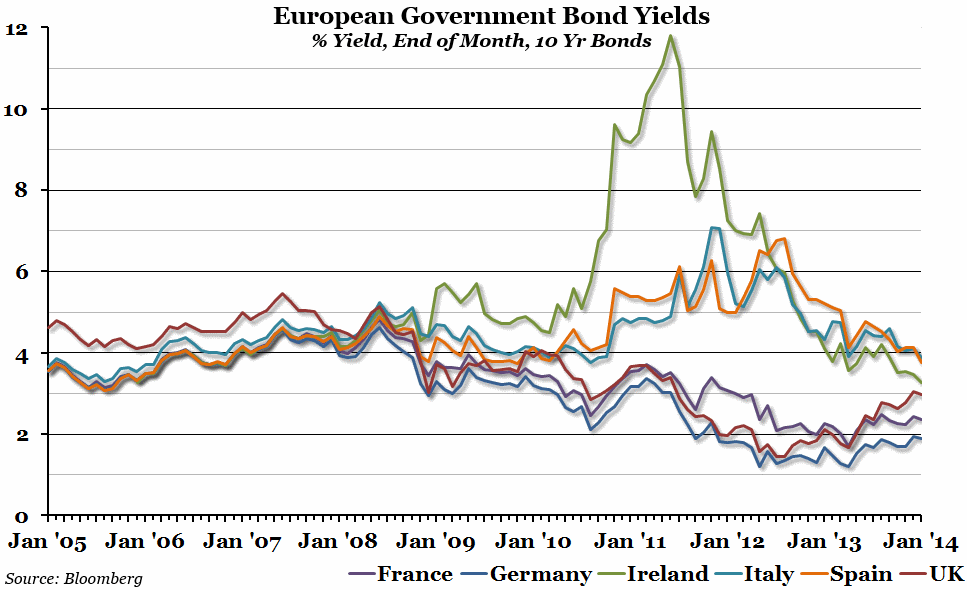
During 2013 developed market equities were the top performing major asset class. The US and UK had justification for rising since the effects of quantitative easing appear to have stimulated some economic activity. Europe, however, has less reason for strength since ECB policies have been less accommodative. The performance of the German mid-cap index aside, European equity market performance in 2013 was largely due to receding fears of the break-up of European currency union. This has been a major contributor to the decline in peripheral bond yields as the chart below shows.

European Bond Yields - 2005 - 2014 - Bloomberg.

.

.

Source: Bloomberg

Banking Union and the ECB

In 2014 the focus will be on deepening unification, commencing with a European Banking Union. Der Spiegel reports: –

Not Fit for the Next Crisis: Europe’s Brittle Banking Union – 19th December 2013

http://www.spiegel.de/international/business/weak-eu-banking-union-could-have-dangerous-side-effects-a-940065.html

When German Finance Minister Wolfgang Schäuble, a trained lawyer, announced an agreement on Wednesday night in Brussels on the long negotiated EU banking union, observers might have been left thinking that he is precisely this type of lawyer.

On paper, Schäuble and his negotiators are right about very many points. They succeeded in ensuring that in 2016, the Single Resolution Mechanism will go into effect alongside the European Union banking supervisory authority. The provision will mean that failing banks inside the euro zone can be liquidated in the future without requiring German taxpayers to cover the costs of mountains of debt built up by Italian or Spanish institutes.

They also backed the European Commission, which wanted to become the top decision-maker when it comes to liquidating banks. The Commission will now be allowed to make formal decisions, but only in close coordination with national ministers from the member states.

But it goes even farther. Negotiators from Berlin have also created an intergovernmental treaty, to be negotiated by the start of 2014, that they believe will protect Germany from any challenges at its Constitutional Court that might arise out of the banking union.

They also established a very strict “liability cascade” that will require bank shareholders, bond holders and depositors with assets of over €100,000 ($137,000) to cover the costs of a bank’s liquidation before any other aid kicks in. The banks are also required to pay around €55 billion into an emergency fund over the next 10 years. Until that fund has been filled, in addition to national safeguards, the permanent euro bailout fund, the European Stability Mechanism, will also be available for aid. However, any funds would have to be borrowed by a national government on behalf of banks, and that country would also be liable for the loan. This provision is expected to be in place at least until 2026.

The government in Berlin put a strong emphasis on preventing the ESM, with its billions in funding, from being used to recapitalize debt-ridden European banks. Schäuble was alone with this position during negotiations, completely isolating himself from the other 16 finance ministers from euro-zone countries. Brussels insiders report that it was “extremely unusual because normally at least a few countries share Germany’s position.”

The article goes on to highlight some of the weaknesses with this agreement: –

  1. 1.       It’s too complex – The Financial Times stated, “In total, the process could involve nine committees and up to 143 votes cast.”
  2. It’s underfunded – The Single Resolution Mechanism, at Euro 55bln by 2026, is a drop in the ocean.
  3. It’s primarily a domestic affair, the union will be subject to national borders
  4. It will probably take at least five years to establish joint European liability.

Bruegel – Ending uncertainty: recapitalisation under European Central Bank Supervision – takes up the subject:-

http://www.bruegel.org/publications/publication-detail/publication/806-ending-uncertainty-recapitalisation-under-european-central-bank-supervision/

• Estimates of the recapitalisation needs of the euro-area banking system vary between €50 and €600 billion. The range shows the considerable uncertainty about the quality of banks’ balance sheets and about the parameters of the forthcoming European Central Bank stress tests, including the treatment of sovereign debt and systemic risk. Uncertainty also prevails about the rules and discretion that will apply to bank recapitalisation, bank restructuring and bank resolution in 2014 and beyond.

• The ECB should communicate the relevant parameters of its exercise early and in detail to give time to the private sector to find solutions. The ECB should establish itself as a tough supervisor and force non-viable banks into restructuring. This could lead to short-term financial volatility, but it should be weighed against the cost of a durably weak banking system and the credibility risk to the ECB. The ECB may need to provide large amounts of liquidity to the financial system.

• Governments should support the ECB, accept cross-border bank mergers and substantial creditor involvement under clear bail-in rules and should be prepared to recapitalise banks. Governments should agree on the eventual creation of a single resolution mechanism with efficient and fast decision-making procedures, and which can exercise discretion where necessary. A resolution fund, even when fully built-up, needs to have a common fiscal backstop to be credible.

The initial Asset Quality Review (AQR) of European Banks carried out in 2011 by the European Banking Authority proved to be a political embarrassment since almost every bank was found to be in relatively rude financial health: shortly before bailouts were required.

Breaking Views – Still time to undo EU bank stress test fiasco – November 2011 – sums up the problems with the previous stress tests eloquently: –

http://www.breakingviews.com/still-time-to-undo-eu-bank-test-fiasco/1616988.article

The test, which was blessed by last month’s ill-fated European summit, had two problems. First, it wasn’t stringent enough: the European Banking Authority concluded that Europe’s lenders needed an additional 106 billion euros, when the International Monetary Fund thought about twice as much was needed. The test has done little to restore confidence in the blighted sector. Banks are still unable to issue long-term unsecured debt, and have been increasingly thrown back on short-term support from the European Central Bank.

Second, the test encouraged deleveraging by expressing the capital requirement as a ratio and giving lenders eight months to get there. Given depressed share prices, many banks are anxious to avoid issuing equity. Instead they are trying to boost capital ratios by shrinking their balance sheets. This will almost certainly have the unfortunate side-effect of further suffocating the European economy, which is already on the edge of recession.

The current iteration of the AQR will, undoubtedly, have more “teeth” but these are shark infested waters where an ECB “health warning” might precipitate an ugly banking crisis.

The Peterson Institute – The European Central Banks Big Moment – December 2013 –  elaborates:-

http://www.piie.com/publications/opeds/oped.cfm?ResearchID=2527

Europe’s banking union project has had many doubters since it started to be widely discussed in the spring of 2012. What is not in doubt, however, is its transformative nature. In June 2012, EU leaders chose—in a galloping hurry, as usual—to move towards the centralization of bank supervision across euro area countries, with this authority entrusted to the European Central Bank (ECB). The consequences have only gradually become apparent to most and represent both an opportunity and a risk.

The opportunity is to reestablish trust in European banks, reboot the pan-European interbank market, end dysfunctional credit allocation, and start reversing the vicious circle between bank and sovereign credit. In an optimistic scenario, the ECB’s 12-month process of “comprehensive assessment,” including an asset quality review (AQR) and stress tests of about 130 credit institutions covering 85 percent of the euro area’s banking assets, will trigger the triage, recapitalization, and restructuring that history suggests is a prerequisite for systemic crisis resolution.

The risk is that, if the assessment fails to be consistent and rigorous, the ECB may find its reputation so damaged that the credibility of its monetary policy—and the perception of Europe’s ability to get anything done—could be affected. After all, this exercise is unprecedented in scale and scope, which means the ECB has little prior experience. At the same time, the political fallout is potentially poisonous to most of the states concerned.

Thus, much is at stake in the balance sheet review, and the scene is set for an escalating confrontation between the ECB and member states in the months ahead. The ECB has pointedly made clear that it will form an independent judgment on the capital strength of the banks examined, without necessarily following the views of national supervisors.

A successful AQR and establishment of the Single Supervisory Mechanism (SSM)—EU jargon for the handover of supervisory authority to the ECB—would have structural consequences. Europe’s national and local governments often use their leverage over the publicly-regulated banking industry for industrial policy purposes or to facilitate their own financing, a dynamic known to economists as financial repression.

Bruegel – Supervisory transparency in the European banking union – January 2014  – looks, in more detail, at the issues surrounding European bank regulation by the  ECB, they acknowledge the need for greater transparency and highlight the dangers of a half-baked approach to a banking union: –

http://www.bruegel.org/publications/publication-detail/publication/807-supervisory-transparency-in-the-european-banking-union/

• Bank supervisors should provide publicly accessible, timely and consistent data on the banks under their jurisdiction. Such transparency increases democratic accountability and leads to greater market efficiency.

• There is greater supervisory transparency in the United States compared to the member states of the European Union. The US supervisors publish data quarterly and update fairly detailed information on bank balance sheets within a week. By contrast, based on an attempt to locate similar data in every EU country, in only 11 member states is this data at least partially available from supervisors, and in no member state is the level of transparency as high as in the US.

• Current and planned European Union requirements on bank transparency are either insufficient or could be easily sidestepped by supervisors. A banking union in Europe needs to include requirements for greater supervisory transparency.

I always find Bruegel comments useful , not only in terms of what should be done to move the “European Project” forward, but also as a guide to what the institutional response is likely to be should an EU proposal fail to be adopted. They conclude: –

Finding agreement on an EU legal change that requires the ECB and member-state supervisors to open their books to greater scrutiny will surely be a difficult task given the current diversity of practices and interests – eg banks, national supervisors – that benefit from this diversity.

But greater supervisory transparency will facilitate more efficient distribution of capital and increase market discipline. It will increase the legitimacy of actions that the regulator takes against banks. The European Union receives justified flak that there is a great distance between European citizens and the institutions that make decisions on their behalf. There is real suspicion of the financial sector and distrust that public money goes only to help out political friends. Transparency in terms of the data the supervisors themselves use to make decisions would allow the public, and more realistically the various interest groups one finds in civil society, to judge whether regulators did choose actions consistent with protecting the public interest. Such ‘fire alarms’ therefore represent one small step towards addressing the democratic deficit that most citizens think exists in Europe.

If such transparency is not possible, for purposes of increasing ‘output legitimacy’ more work should be done to strengthen the role of parliaments. For the European Parliament, the autumn 2013 interinstitutional agreement with the European Central Bank represents a good start. Under all current proposals, national regulators will continue to play an important role especially for any bank resolution. As discussed earlier, the German Bundestag gains the ability in 2014 to investigate specific banks as part of the national implementation of Basel III. Such parliamentary powers should become standard in all European Union member states. Moreover, such a procedure should be not only a theoretical power, but also one that is used.

Nationalist Backlash

In a more recent post this month – Peterson Institute – Calm Seas in Europe in 2014? – Jacob Funk Kirkegaard predicts that whilst 2013 was a year of relative calm for the Eurozone, 2014 may be a very different matter. As usual the driving force behind any change in sentiment will be political: –

http://www.piie.com/blogs/realtime/?p=4195

No major EU elections are scheduled in 2014. In Italy, a new electoral law is unlikely to be agreed upon before it takes over the rotating EU presidency in the second half of 2014. By tradition, countries in that position refrain from holding national elections. Rather, European Parliament elections in May will be the political highlight of 2014. As discussed earlier, there is a risk that angry voters will turn out and elect some colorful non-mainstream members to that body. Still, there seems little risk that the European Parliament will become a “Weimar Parliament” with a majority of anti-EU members. Instead the established European parties seem likely to prevail with a smaller majority, ensuring that Europe remains governable.

With their increased representation, the question of what the anti-EU parties want (aside from their daily parliamentary allowances) will arise. Much has been written about the alliance between Marine Le Pen, leader of the French National Front, and the leader of the Dutch Freedom Party Geert Wilders. But theirs is little more than a photo-op coalition, posing limited political risks. There are inherent limitations on the ability of nationalist parties to collaborate across borders.

The European Parliament elections, though, may also indirectly influence the choice of the next president of the European Commission. In an attempt to broaden the democratic appeal of the European Union, the European political parties have suggested that they each propose a pan-European spitzen-kandidat for the post and then let the European voters decide. Of course, this is a naked—if well-intended—power grab by the European Parliament, as the right to select the Commission president resides with the EU member states according to the EU Treaty. And they are unlikely to surrender this right. At the same time, it will be very difficult for the EU member states to ignore the winning side in the European Parliament election. The heads of states will hence likely be compelled to at least choose a new European President from the side of the political aisle that won the most votes in the election. Their selection power will thus be constrained…

Economically, the biggest event in 2014 will be the rollout of the ECB’s asset quality review (AQR) and stress tests of the euro area banking system, representing the opportunity to finally restore the soundness of Europe’s bank balance sheet. Failure to carry out a convincing review will threaten the region with Japanese-style prolonged stagnation and undermine the credibility of the ECB. The AQR/stress test is more important than the hotly debated single resolution mechanism (SRM) designed to close down or consolidate failing banks, finally agreed by the EU finance ministers in late December [pdf]. Only a successful AQR/stress test can avert the continuing fragmentation of credit markets and reduce the high interest spreads between the core and periphery. Assuming that the SRM can fix financial fragmentation is erroneous, and much of the related criticism of the complex SRM compromise is misplaced. Even an optimally designed SRM would not make euro area banks suddenly lend to each other again.

A more pertinent question is whether the SRM compromise makes it more or less likely that the AQR succeeds in 2014. For sure the envisioned SRM is far from perfect. It has an excessively complex structure, including a 10-year phase-in, and a multistage resolution process involving a resolution board, the European Commission, and the EU finance ministers in the ECOFIN (finance ministers’) Council. Parts of it are grounded in EU law and parts are to be embodied by a new intergovernmental treaty. Hopefully some of these kinks will be corrected in the ongoing final reconciliation negotiations on the SRM between the member states and the European Parliament. But writing off the SRM as unworkable just because it is complex is a mistake. The European Union of 28 member states works every day, despite breathtaking complexity. Moreover, in emergencies the European bureaucracy can be circumvented and a decision forced through in 24 hours.

The European political landscape may become more polarised in 2014 with right wing parties gaining ground in the European parliament.

The Economist – Europe’s Tea Parties – 4th January 2014 – looks at the rise of nationalist parties in Europe, making comparison with the US Tea Party Republican group, there are some similarities but the differences are more pronounced: –

There are big differences between the Tea Party and the European insurgents. Whereas the Tea Party’s factions operate within one of America’s mainstream parties, and have roots in a venerable tradition of small-government conservatism, their counterparts in Europe are small, rebellious outfits, some from the far right. The Europeans are even more diverse than the Americans. Norway’s Progress Party is a world away from Hungary’s thuggish Jobbik. Nigel Farage and the saloon-bar bores of the United Kingdom Independence Party (UKIP) look askance at Marine Le Pen and her Front National (FN) across the Channel. But there are common threads linking the European insurgents and the Tea Party. They are angry people, harking back to simpler times. They worry about immigration. They spring from the squeezed middle—people who feel that the elite at the top and the scroungers at the bottom are prospering at the expense of ordinary working people. And they believe the centre of power—Washington or Brussels—is bulging with bureaucrats hatching schemes to run people’s lives.

The minority parties might seem largely irrelevant but voter apathy towards voting at European Elections gives European “Tea Parties” an opportunity to punch above their weight: –

Ultimately, though, the choice falls to voters themselves. The Tea Party thrived in America partly because a small minority of voters dominate primary races especially for gerrymandered seats. In elections to the European Parliament many voters simply do not bother to take part. That is a gift to the insurgents. If Europeans do not want them to triumph, they need to get out to the polls.

For an historical perspective on how the Eurozone might move towards closer unification the New York Fed – The Mississippi Bubble of 1720 and the European Debt Crisis – 10th January 2014 – offers some interesting observations. This is part of a series of articles called the “Crisis Chronicles” from Liberty Street Economics: –

http://libertystreeteconomics.newyorkfed.org/2014/01/crisis-chronicles-the-mississippi-bubble-of-1720-and-the-european-debt-crisis.html

Austerity and Debt Restructuring

From summer 2012 through 2013 European equities performed well, with peripheral markets such as Greece and Ireland benefitting from the reduced risk of a Greek exit and single currency area breakup. Bond markets exhibited a similar response with higher yielding peripheral markets outperforming the core – see first chart above.  2014 may see these convergence patterns reverse as this article from the Council for Foreign Relations – Beware of Greeks Bearing Primary Budget Surpluses – points out: –

http://blogs.cfr.org/geographics/2013/12/04/greeksurpluses

Sovereign Debt Default and Primary Balances - Source IMF.

.

.

.

Source: IMF

Things are looking up in Greece – that’s what Greek ministers have been telling the world of late, pointing to the substantial and rapidly improving primary budget surplus the country is generating.  Yet the country’s creditors should beware of Greeks bearing surpluses.

A primary budget surplus is a surplus of revenue over expenditure which ignores interest payments due on outstanding debt.  Its relevance is that the government can fund the country’s ongoing expenditure without needing to borrow more money; the need for borrowing arises only from the need to pay interest to holders of existing debt.  But the Greek government (as we have pointed out in previous posts) has far less incentive to pay, and far more negotiating leverage with, its creditors once it no longer needs to borrow from them to keep the country running.

This makes it more likely, rather than less, that Greece will default sometime next year.  As today’s Geo-Graphic shows, countries that have been in similar positions have done precisely this – defaulted just as their primary balance turned positive.

The upshot is that 2014 is shaping up to be a contentious one for Greece and its official-sector lenders, who are now Greece’s primary creditors.  If so, yields on other stressed Eurozone country bonds (Portugal, Cyprus, Spain, and Italy) will bear the brunt of the collateral damage.

European debt restructuring meanwhile still has far to go but many EZ countries seem to think that being “developed” precludes the need to restructure and reform. Carmen Reinhart and Kenneth Rogoff produced a working paper for the IMF –  Financial and Sovereign Debt Crises: Some Lessons Learned and Those Forgotten – December 2013 – which takes a global look at this subject in detail: –

http://www.imf.org/external/pubs/ft/wp/2013/wp13266.pdf

Here’s the abstract: –

Even after one of the most severe multi-year crises on record in the advanced economies, the received wisdom in policy circles clings to the notion that high-income countries are completely different from their emerging market counterparts. The current phase of the official policy approach is predicated on the assumption that debt sustainability can be achieved through a mix of austerity, forbearance and growth. The claim is that advanced countries do not need to resort to the standard toolkit of emerging markets, including debt restructurings and conversions, higher inflation, capital controls and other forms of financial repression. As we document, this claim is at odds with the historical track record of most advanced economies, where debt restructuring or conversions, financial repression, and a tolerance for higher inflation, or a combination of these were an integral part of the resolution of significant past debt overhangs.

The paper follows on from research they have undertaken over the last couple of years including their seminal work – Growth in a time debt – NBER – January 2010 – which achieved considerable notoriety when an economics student discovered statistical errors in the paper – a short version is available here: –

http://www.nber.org/digest/apr10/w15639.html

Their new paper concludes: –

Of course, if policymakers are fortunate, economic growth will provide a soft exit, reducing or eliminating the need for painful restructuring, repression, or inflation. But the evidence on debt overhangs is not heartening. Looking just at the public debt overhang, and not taking into account old-age support programs, the picture is not encouraging. Reinhart, Reinhart, and Rogoff (2012) consider 26 episodes in which advanced country debt exceeded 90 percent of GDP, encompassing most or all of the episodes since World War II. (They tabulate the small number of cases in which the debt overhang lasted less than five years, but do not include these in their overhang calculations.) They find that debt overhang episodes averaged 1.2 percent lower growth than individual country averages for non-overhang periods. Moreover, the average duration of the overhang episodes is 23 years. Of course, there are many other factors that determine longer-term GDP growth, including especially the rate of productivity growth. But given that official public debt is only one piece of the larger debt overhang issue, it is clear that governments should be careful in their assumption that growth alone will be able to end the crisis. Instead, today’s advanced country governments may have to look increasingly to the approaches that have long been associated with emerging markets, and that advanced countries themselves once practiced not so long ago.

Germany’s slowing growth and potential banking crisis

Meanwhile, Germany, which has benefitted economically from the painful Hartz reforms of the early 2000’s may be losing momentum.

Peterson Institute –  Making Labor Market Reforms Work for Everyone: Lessons from Germany – sets the scene, highlighting how labour reform in Germany has given the country a significant competitive edge: –

http://www.piie.com/publications/pb/pb14-1.pdf

…First, Germany has the best functioning labor market among large economies in Europe and the United States. Second, German wage restraint is of a relatively limited magnitude compared with most euro area countries and hence fails to explain the uniformly large intra–euro area unit labor cost divergences between Germany and other members after 1999. Third, total German labor costs per worker continue to exceed costs in other major EU countries and the United States. Fourth, Germany’s recent labor market revival has not come about through the expansion of predominantly low wage jobs. Fifth, the expansion of mini-jobs in Germany since 2003 has overwhelmingly taken place as second jobs. And sixth, the successful reliance on kurzarbeit programs in 2009 was not an innovation but rather another instance of labor input adjustment in favor of “insider workers” in Germany.

I’m indebted to Quartz.com for the table below which shows German exports and imports by region. Within the Eurozone the two components are fairly balanced but this disguises country specific imbalances, for example, for the first 10 months of 2013, Germany ran a surplus with France of Euro 30bln but a deficit with the Netherlands of Euro 15bln.

German exports and imports by region - source Quartz.

.

.

Source: Quartz.com

The Economist – Die grosse stagnation – 30th November 2013 – paints a rather different picture of the risks ahead for Germany – once again these risks are political in nature, but their principal concern is that the recent coalition deal looks set to reverse a number of these successful reforms: –

http://www.economist.com/news/leaders/21590903-germanys-proposed-new-government-set-turn-motor-europe-slowcoach-die-grosse

…That is because Germany’s economy has been living off past glory—especially “Agenda 2010”, a series of reforms launched in 2003 by Gerhard Schröder, Mrs Merkel’s predecessor. But it is running out of puff. Labour productivity has grown less than half as fast as Spain’s over the past ten years; and its overall rate of public and private investment, at 17% of GDP, has fallen by more than a fifth since the euro was introduced. No European country has carried out fewer reforms than Germany since the euro crisis began.

… The coalition’s 185-page “treaty” was a chance to launch a new reform agenda. Instead, its proposals are a mixture of the irrelevant—charging foreigners to use German motorways—and the harmful.

…The coalition’s pension policy seems even more retrogressive. These days, most advanced economies are expecting longer-living people to be longer-working, too. But the coalition wants the pension age, raised to 67 in the previous grand coalition, to be moved back down again for specific groups, in some cases to 63. France’s president, François Hollande, was rightly mocked, not least by Mrs Merkel, for a similar ploy. Now the woman who has lectured the rest of Europe about the unsustainability of its welfare spending will follow down the same spendthrift road.

…The impact on this coalition on the rest of Europe would not be all bad. One bonus is that, for all its primitive economic policies, the SPD seems keener to support some basic reforms such as the creation of a banking union. But that will count for little if Germany, the motor of Europe’s economy, stalls. And, in the light of the coalition agreement, that is a real danger.

After a strong performance by European Equities and peripheral government bonds in 2013, the prospects for 2014 may be less sanguine, though I’m not bearish at this stage. The principal market risk is likely to emanate from the European banking sector. One example of this, concerns shipping. The chart below shows the Baltic Dry Freight Index month end values from 1985 to end December 2013 – it’s worth noting that the BDI has plummeted this month leading many commentators to predict a global economic downturn.

Baltic Dry index 29 yrs.

.

.

Source: Bloomberg

Over the past ten years the price of “Dry” cargoes has soared and plummeted. During this cycle European banks, German ones in particular – abetted by favourable German government tax treatment – moved aggressively into the shipping finance sector; it is estimated that German banks are currently the financiers behind more than 40% of the world container shipping fleet. These shipping loans were often repackaged and sold on to high net worth investors but, rumour has it, the majority of these investments carried a “principal guarantee”. The ships, meanwhile, are no longer competitive due to improvements in fuel efficiency since the mid 2000’s. The banks are effectively left long “scrap metal”.

Moody’s gave an estimate last month for German banks impairment due to shipping loans of US$22bln for 2014, they went on to state: –

Germany’s eight major ship financiers have lent a total of 105 billion euros to the sector, a fifth of which are categorized as non-performing…

We expect the extended downward shipping cycle to cause rising problem loans in the shipping sector during 2013-14, requiring German banks to increase their loan-loss provisions. This will challenge their earnings power.

Here is the Reuters article for further detail: –

http://www.reuters.com/article/2013/12/10/moodys-shippingbanks-idUSL6N0JP2CV20131210

I wonder whether the ECB’s AQR will uncover the extent of this problem. Last Autumn S&P estimated European banks had a funding gap of Euro 1.3trln as at the end of 2012. My guess is that this is understated: shipping is just one sector, the “quest for yield” is industry wide.

EZ Money supply growth and rising peripheral debt

Another headwind facing Europe is the weakness in money supply growth. In 2012 EZ M3 was growing at above 3%, it dipped below 3% in H1 2013 and below 2% in H2 2013.

Eurozone M3 - ECB.

.

.

.

Source: ECB

The ECB CPI target of 2% is roughly consistent with M3 growth of 4-6%.

The Telegraph – Eurozone M3 plunge flashes deflation alert – Novemebr 28th 2013

takes up the theme of potential deflation:-

http://www.telegraph.co.uk/finance/economics/10481773/Eurozone-M3-money-plunge-flashes-deflation-alert-for-2014.html

The European Central Bank said M3 money growth fell to 1.4pc from a year earlier, lower than expected and far below the bank’s own 4.5pc target deemed necessary to keep the economy on an even keel.

A rather more extreme view is expressed by Andrew Cullen – Europeans Looking To Inflate Their Debts Away – Mises Institute – 12th November 2013

http://mises.org/daily/6581/Europeans-Looking-To-Inflate-Their-Debts-Away

How does a reduction in consumer price inflation become “deflation”? How does a minor improvement in the purchasing power of consumers become a problem for liquidity in the financial markets? Austrian-economic thinking, which understands that new money is never neutral in its effects, offers insight:

[T]he crux of deflation is that it does not hide the redistribution going hand in hand with changes in the quantity of money …[4]

European politicians and central bank policy-makers are concerned not about consumer price reductions but about real reductions in the money supply as such reductions would force governments to abandon permanent budget deficit monetization. That is why they maintain a monopoly over the power to create money and they like to control where money enters the economy. Politicians use these advantages in two ways.

First, they are all, with the sole exception of the Bundesbank, “inflationists” when it comes to monetary policy. Inflation (that is, an increase in the money supply) steadily reduces the purchasing power of a fiat money and, in parallel, eases the burden of debt repayments over time as nominal sums become progressively of less relative value.

Such price inflation benefits debtors at the expense of creditors. Hence, for highly indebted Eurozone governments, price inflation is the perceived “get out of jail” card, permitting them to meet their debt obligations with a falling share of government expenditures.

Second, at least amongst the political elites in the “PIIGS” (Portugal, Italy, Ireland, Greece, Spain) and in France, they espouse “reflation” plans using the ECB’s money-creation powers which would ratchet up to another degree inflation of the money supply, monetization of government debt, and increases in total government debts; and thereby protect and enhance the economic power and privileges of governments and the state.[5]

Yet growth of PIIGS governments’ debts as a proportion of GDP (Table 1) have now crossed above the critical 90 percent ratio advised by Rogoff and Reinhart as being the threshold above which growth rates irrevocably decline.[6]

Table 1. Gross Government Debt as Per cent of GDP 2008-14 for the Eurozone and selected member countries (Adapted from: IMF Fiscal Monitor: Taxing Times, p16. October 2013)

                                2008       2010       2012       2014 (forecast)

Eurozone                70.3        85.7        93.0        96.1

Spain                      40.2        61.7        85.9        99.1

Italy                        106.1      119.1      127.0      133.1

Portugal                 71.7        94.0        123.8      125.3

Ireland                    44.2        91.2        117.4      121.0

There is another potential problem: European commercial banks may be too fragile to fulfil their allotted role. ECB President Mario Draghi himself has initiated another round of stress testing of European banks’ balance sheets against external shocks, a sign that the ECB itself has doubts about systemic stability in the banking sector. But this testing has hardly begun. Here are four risk factors in play:

First, there has been large-scale flight of deposits from banks operating within the PIIGS’ toward banks of other Eurozone countries,[7] as well as outside the Eurozone entirely. This phenomenon is caused by elevated risk of seizures, consequent upon the forced losses on bondholders at Greek banks and the recent “bail-in” of depositors at the Bank of Cyprus.

Second, many PIIGS’ domestic banks still hold on their books bad loans arising from the boom years (2000-2007). Failure to deleverage and liquidate losses is prolonging the banks’ adjustment process.

Third, they already hold huge quantities of sovereign debt (treasury bonds) from Eurozone governments from previous rounds of buying. Banks have had to increase their risk weightings on such debt holdings as Ratings Agencies have downgraded these investments to comply with Basel II. This constrains their forward capacity for lending to these governments.

Fourth, there is concern for rising interest rates. Since the famous “Draghi put” in July 2012, real rates remain low and yields on PIIGS’ sovereign bonds fell back closer to German bunds. But this summer yields on US Treasury bonds with long maturities started to rise on Fed taper talk.[8] Negative surprises knock confidence in the international bond markets. The risk of massive losses should bond prices drop is one that the European-based banks cannot afford given their still low capital reserves and boom phase legacy of over-leveraging.

Implementation impediments aside, a new phase of aggressive easy money policy from the ECB is both probable and imminent.

[4] J.G. Hülsmann, Deflation & Liberty (2008), p. 27.

You might also enjoy Andrew’s blogsite where he also speculates about large scale asset purchases from the ECB: –

http://www.thecantillonobserver.com

European equity and bond market prospects for 2014

This brings me neatly to what you may consider a rather contrarian view of European equities and bonds. So far this article has focussed on the negative headwinds which many commentators expect to undermine confidence in financial markets, however, I’m reminded of some sage words from the “Sage of Omaha” – the quote below comes from an interview/speech which Warren Buffet gave in July 2000 at the Allen & Co, Sun Valley corporate gathering, reported here by Fortune/CNN: –

http://money.cnn.com/magazines/fortune/fortune_archive/2001/12/10/314691/

In economics, interest rates act as gravity behaves in the physical world. At all times, in all markets, in all parts of the world, the tiniest change in rates changes the value of every financial asset. You see that clearly with the fluctuating prices of bonds. But the rule applies as well to farmland, oil reserves, stocks, and every other financial asset. And the effects can be huge on values. If interest rates are, say, 13%, the present value of a dollar that you’re going to receive in the future from an investment is not nearly as high as the present value of a dollar if rates are 4%.

So here’s the record on interest rates at key dates in our 34-year span. They moved dramatically up–that was bad for investors–in the first half of that period and dramatically down–a boon for investors–in the second half.

Since short term rates are close to zero and central bank buying of government bonds has flattened yield curves in most major markets, surely the risk has to be that government bond yields have an asymmetric upside risk? Well, yes, but only if investors lose all confidence in those “risk-free” government obligations. Added to which – what is the correct size for a central bank balance sheet – $4trln or $400trln? When measured in balance sheet expansion terms the ECB is far behind the curve; they have availed themselves of the aggressive quantitative easing of other central banks to exert internal pressure on profligate EZ countries, cajoling them to structurally reform. I believe this austerity has largely run its course, but, as the AQR, is likely to show, it has left the EZ financial system in a weak position.

European bond convergence between the core and periphery continues as the table below (15/1/2014) from Bloomberg shows : –

Europe Yield

1 Day

1 Month

1 Year

Germany 1.82% +1 -1 +24
Britain 2.86% +3 -4 +84
France 2.47% +1 +4 +34
Italy 3.88% +1 -21 -33
Spain 3.82% +1 -28 -120
Netherlands 2.13% +1 -1 +43
Portugal 5.25% 0 -77 -104
Greece 7.67% 0 -95 -388
Switzerland 1.18% +1 +22 +56

European stock markets are making new highs – although EuroStoxx 50 is still some way below its 2008 peak, unlike the S&P. EUR/USD continues to regain composure after the fears of an EZ break-up in the summer of 2012. In this environment I see no reason to liquidate long positions in European equities and higher yielding peripheral bond markets. If US Equities turn bearish and US bond yields rise abruptly, as they did in 2013, then I would expect the ECB to provide their long overdue support. However, a precipitous decline in EUR/USD is cause for concern as this may herald the beginning of another Eurozone crisis – whilst I anticipate some of the above issues will surface during 2014, the “Draghi put” still offers significant protection, whilst the Peterson Institute – Why the European Central Bank Will Likely Shrink from Quantitive Easing – January 15th 2014 – makes a strong case for the ECBs hands being tied: –

http://blogs.piie.com/realtime/?p=4208

I still believe European markets represent a “hedged” exposure to the continued bullish trends in major market equities and higher yielding bonds – the market always prefers to travel than to arrive.