Rising yields and rising correlation in major bond markets – end of cycle or correction?

400dpiLogo

Macro Letter – No 36 – 22-05-2015

Rising yields and rising correlation in major bond markets – end of cycle or correction?

  • European bond yields have risen following the lead of US treasuries
  • Yield curves are steepening despite minimal inflation
  • A return to the natural rate of interest seems unlikely
  • Over-indebtedness will stifle GDP growth and yields will fall

Since the beginning of 2015 the world’s largest bond markets have witnessed increasing yields. In the aftermath of the Great Financial Crisis many economies decoupled and their government bond markets followed suit. Now correlations are rising once more. The table below, which is a snapshot of prices on Tuesday morning 19th May, looks at a broad range of developed bond markets:-

Bond & Maturity Yield Low Date Change CPI Real yield 10yr-2yr
Australia 2Y 2.035
Australia 5Y 2.305
Australia 10Y 2.92 2.236 March 0.684 1.3 1.62 0.885
Canada 2Y 0.646
Canada 5Y 1.006
Canada 10Y 1.711 1.23 February 0.481 1.2 0.511 1.065
Denmark 2Y -0.299
Denmark 5Y 0.088
Denmark 10Y 0.786 0.075 February 0.711 0.5 0.286 1.085
France 2Y -0.162
France 5Y 0.182
France 10Y 0.832 0.332 April 0.5 0.1 0.732 0.994
Germany 2Y -0.21
Germany 5Y 0.026
Germany 10Y 0.563 0.049 April 0.514 0.5 0.063 0.773
Italy 2Y 0.108
Italy 5Y 0.697
Italy 10Y 1.753 1.041 March 0.712 -0.1 1.853 1.645
Japan 2Y -0.002
Japan 5Y 0.103
Japan 10Y 0.388 0.199 January 0.189 2.3 -1.912 0.39
New Zealand 2Y 3.09
New Zealand 5Y 3.25
New Zealand 10Y 3.74 3.085 January 0.655 0.1 3.64 0.65
Norway 2Y 0.857
Norway 5Y 1.035
Norway 10Y 1.676 1.202 February 0.474 2 -0.324 0.819
Sweden 2Y -0.331
Sweden 5Y 0.169
Sweden 10Y 0.691 0.216 April 0.475 -0.2 0.891 1.022
Switzerland 2Y -0.839
Switzerland 5Y -0.48
Switzerland 10Y -0.003 -0.28 January 0.281 -1.1 1.097 0.836
UK 2Y Yield 0.537
UK 5Y Yield 1.39
UK 10Y Yield 1.892 1.337 January 0.555 -0.1 1.992 1.355
US 2Y Yield 0.565
US 5Y Yield 1.506
US 10Y Yield 2.193 1.63 January 0.563 -0.1 2.293 1.628

Source: Investing.com and Trading Economics

I’ve highlighted some of the data. The highest real 10yr yield is to be found in New Zealand (3.64%) but US T-Bonds lie second. The lowest real yield is evident in Japanese Government Bonds (JGBs) however, a quick glance at the shape of the Japanese yield curve suggests that inflation, or perhaps I should say deflation, expectations are firmly anchored at near zero, despite repeated bouts of Abenomic stimulus. Japan has the flattest yield curve. The US curve is second steepest, behind Italy, where the spread between 2yr and 10yr is 164.5bp. Italy has also seen the largest rise in yields since its low back in March, although Danish yields have risen to a similar degree as its non-Euro “safe haven” status has waned.

A number of factors have driven yields higher. In the Eurozone (EZ) concern about a Greek exit initially stimulated a “flight to safety” in government securities – other than Greek government bonds – this spilled over into Swiss Confederation bonds. Switzerland remains the ultimate “safe haven”. As yields in the EZ declined to record lows, capital also flowed into EZ stocks. At the same time economic data began to turn more positive, prompted further flows into equities. The last EZ bond markets to turn lower were France and Germany, last month.

Outside the EZ, the US economy has seen mixed data but GDP growth remains steady. Expectations of Federal Reserve rate increases, whilst still some way off (current consensus January 2016) weigh on the T-Bond market. A rebound in crude oil and weakening of the US$ TWI since its highs in early March have also seen an unwinding of bullish US$ and US Treasury exposures.

Stock markets have so far paid little heed to the bond markets. The S&P500 made new highs this week. Canada, Japan, Germany and the UK all made highs in April whilst the Australian ASX retouched its March highs during the month. Even New Zealand, with the second flattest yield curve and structurally higher real interest rate curve, is less than 4% off its all-time highs.

Inflation expectations and real returns

Earlier this week saw the publication of this first part of a two part article about inflation expectations from the NY Fed – FRBNY DSGE Model Forecast–April 2015:-

The top panel in the chart below presents quarterly forecasts for real output growth and the core PCE inflation rate over the 2014-17 horizon. These forecasts were produced on April 9 using data released through 2014:Q4, augmented for 2015:Q1 with a “nowcast” for GDP growth, core PCE inflation, and growth in total hours, and 2015:Q1 observations for financial variables. The reason for using nowcasts is that the model is estimated on National Income and Product Accounts data, which are only available with a lag. Nowcasts incorporate up-to-date information, and this tends to improve short-run forecasts, as shown here. The black line represents released data, the red line is the forecast, and the shaded areas mark the uncertainty associated with our forecasts at 50, 60, 70, 80, and 90 percent probability intervals. Output growth and inflation are expressed in quarter-to-quarter percentage annualized rates. 

NY Fed PCE GDP forecasts

Source: NY Fed

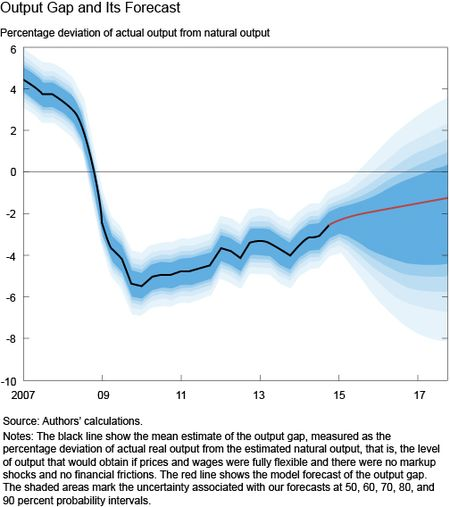
The FRBNY DSGE forecast for output growth is slightly stronger than it was in our earlier blog post which used data ending in July 2014. This difference is highlighted in the bottom left panel of the chart, which compares current (solid line) and September (dashed line) forecasts. The model projects the economy to grow 1.9 percent in 2015 (Q4/Q4), 2.1 percent in 2016 and 2.2 percent in 2017. The headwinds that slowed down the economy in the aftermath of the financial crisis are finally abating. This is reflected in the model-implied “natural” level of output and the “natural” rate of interest, which are defined as the counterfactual level of output and interest rate that would obtain in an ideal economy where nominal rigidities, markup (or cost-push) shocks, and financial frictions are absent. Estimates of the recent natural level of output show a more rapid growth as the headwinds facing the economy are fading. As we will discuss at length in our next post, the natural rate of interest is finally increasing toward positive ranges, after having been negative for the entire post-Great Recession period.  The recovery has been relatively slow, however, with economic activity remaining below its natural level since the end of 2008 and projected to remain so throughout the forecast horizon. The model thus predicts a very gradual closing of the output gap, measured as the percentage deviation of actual output from natural output (although there is much uncertainty about the gap forecast). This output gap, along with its forecast, is shown in the next chart. 

NY Fed Output Gap

Source: NY Fed

…In conclusion, the FRBNY DSGE model continues to predict a gradual recovery in economic activity with a slow return of inflation toward the FOMC’s long-run target of 2 percent, as the negative effect of the Great Recession dissipates. This forecast remains surrounded by significant uncertainty, with the risks slightly skewed to the downside for output growth because of the constraint on policy imposed by the zero lower bound. 

The Peterson Institute – Quantity Theory of Money Redux? Will Inflation Be the Legacy of Quantitative Easing? Examines the classical monetarist argument that QE will eventually lead to inflation, this is their conclusion:-

On balance, the risk of severe inflation resulting from the buildup of the balance sheet of the Federal Reserve in association with quantitative easing seems low. To begin with, the US economy has not experienced inflation driven by excessive money expansion since at least the mid-1980s. Indeed, the rising demand for money, as the opportunity cost of holding money fell with lower inflation, has meant that over the past three decades there has been a tendency for faster money growth(relative to real GDP) to be associated with lower rather than higher inflation. The supply-focused quantity theory of money broke down. The pattern associating rapid money growth with low inflation since the mid-1980s would require a sharp reversal for money supply to become the proximate cause of inflation. In the meantime, it seems fair to say that in the United States inflation is determined by labor market and product market tightness (in the Phillips curve tradition), and that the opposing proposition that “inflation is always and everywhere a monetary phenomenon” (Friedman’s summary of the quantity theory) does not hold in a narrow sense relating to money supply.

A second important phenomenon is that inflation has remained low despite a large buildup in the Fed’s balance sheet not because the velocity of broad money has collapsed, but because the money multiplier has done so. Because of a large increase in excess bank reserves equal to nearly three-fourths of the increase in the Federal Reserve’s total assets, the usual money multiplier (inverse of the reserve requirement ratio) no longer holds. Broad money was 14 times the money base in 2007; by end-2014 it was only 4 times the money base.

A third observation is that arguably this same phenomenon could pose a risk of inflationary money expansion when and if banks start to draw down excess reserves.

Fourth, the principal implication for policy purposes is that the Federal Reserve will need to be particularly adept in avoiding any inflationary pressures that might develop from the unwinding of large excess bank reserves as more normal monetary conditions return. The Fed has clearly given considerable attention to this task and at present plans to use higher interest rates on excess reserves as needed to control such pressures. Indeed, the authority to pay interest on reserves is what will enable the Fed to raise rates when necessary, because otherwise an incipient rise in the short-term interest rate would quickly be choked off as banks ran down excess reserves to take advantage of the higher interest rates.

Fifth, because quantitative easing constitutes navigating in uncharted waters, there is some non-zero probability that inflation could nevertheless still be the consequence of potential money supply expansion resulting from QE.

The key element in their assessment is the “multiplier effect”, bank reserve requirements have increased globally since 2008, QE has merely offset the tightening of credit conditions, but in the process it has crowded out the private sector – which is where real-GDP growth is generated.

A more deflationary view of the current environment is provided in the quarterly letter from Hoisington Asset Management, here are Lacy Hunt’s six characteristics of highly over-indebted nations:-

1. Transitory upturns in economic growth, inflation and high-grade bond yields cannot be sustained because debt is too much of a constraint on economic activity.

2. Due to inherently weak aggregate demand, economies are subject to structural downturns without the typical cyclical pressures such as rising interest rates, inflation and exhaustion of pent-up demand.

3. Deterioration in productivity is not inflationary but just another symptom of the controlling debt influence.

4. Monetary policy is ineffectual, if not a net negative.

5. Inflation falls dramatically, increasing the risk of deflation.

6. Treasury bond yields fall to extremely low levels.

…Many assume that economies can only contract in response to cyclical pressures like rising interest rates and inflation, fiscal restraint, over-accumulation of inventories, or the stock of consumer and corporate capital goods. This idea is valid when debt levels are normal but becomes problematic when debt is excessively high.

Large parts of Europe contracted last year for the third time in the past four years as interest rates and inflation plummeted. The Japanese economy has turned down numerous times over the past twenty years while interest rates were low. Indeed, this has happened so often that nominal GDP in Japan is currently unchanged for the past twenty-three years. This is confirmation that after a prolonged period of taking on excessive debt additional debt becomes counterproductive.

…Falling productivity does not cause faster inflation. The weaker output per hour is a consequence of the over-indebtedness as much as the other five characteristics mentioned above. Productivity is a complex variable impacted by many cyclical and structural influences. Productivity declines during recessions and declines sharply in deep ones.

…Monetary policy impacts the overall economy in two areas – price effects and quantity effects. Price effects, or changes in short-term interest rates, are no longer available because rates are near the zero bound. This is a result of repeated quantitative easing by central banks. It is an attempt to lift overly indebted economies by encouraging more borrowing via low interest rates, thus causing even greater indebtedness.

Quantity effects also don’t work when debt levels are excessive. In a non-debt constrained economy, central banks have the capacity, with lags, to exercise control over money and velocity. However, when the debt overhang is excessive, they lose control over both money and velocity. Central banks can expand the monetary base, but this has little or no impact on money growth.

…In periods of extreme over-indebtedness Treasury bond yields can fall to exceptionally low levels and remain there for extended periods. This pattern is consistent with the Fisher equation that states the nominal risk-free bond yield equals the real yield plus expected inflation (i=r+E*). Expected inflation may be slow to adjust to reality, but the historical record indicates that the adjustment inevitably occurs.

The Fisher equation can be rearranged algebraically so that the real yield is equal to the nominal yield minus expected inflation (r=i–E*). Understanding this is critical in determining how unleveraged investors fare. Suppose that this process ultimately reduces the bond yield to 1.5% and expected inflation falls to -1%. In this situation the real yield would be 2.5%. The investor would receive the 1.5% coupon but the coupon income would be supplemented since the dollars received will have a greater purchasing power. A 1.5% nominal yield with real income lift might turn out to be an excellent return in a deflationary environment. Contrarily, earnings growth is problematic in deflation. Businesses must cut expenses faster than the prices of goods or services fall.

Hunt goes on to predict that yields may rise but this presents an opportunity to buy rather than signalling the end of the bond bull market.

A slightly contrasting view is expressed by Bill Gross in Janus Capital – Investment Outlook:-

Because of this stunted growth, zero based interest rates, and our difficulty in escaping an ongoing debt crisis, the “sense of an ending” could not be much clearer for asset markets. Where can a negative yielding Euroland bond market go once it reaches (–25) basis points? Minus 50? Perhaps, but then at some point, common sense must acknowledge that savers will no longer be willing to exchange cash Euros for bonds and investment will wither. Funny how bonds were labeled “certificates of confiscation” back in the early 1980’s when yields were 14%. What should we call them now? Likewise, all other financial asset prices are inextricably linked to global yields which discount future cash flows, resulting in an Everest asset price peak which has been successfully scaled, but allows for little additional climbing. Look at it this way: If 3 trillion dollars of negatively yielding Euroland bonds are used as the basis for discounting future earnings streams, then how much higher can Euroland (Japanese, UK, U.S) P/E’s go? Once an investor has discounted all future cash flows at 0% nominal and perhaps (–2%) real, the only way to climb up a yet undiscovered Everest is for earnings growth to accelerate above historical norms. Get down off this peak, that F. Scott Fitzgerald once described as a “Mountain as big as the Ritz.” Maybe not to sea level, but get down. Credit based oxygen is running out.

But what should this rational investor do? Breathe deeply as the noose is tightened at the top of the gallows? Well no, asset prices may be past 70 in “market years”, but savoring the remaining choices in terms of reward / risk remains essential. Yet if yields are too low, credit spreads too tight, and P/E ratios too high, what portfolio or set of ideas can lead to a restful, unconscious evening ‘twixt 9 and 5 AM? That is where an unconstrained portfolio and an unconstrained mindset comes in handy. 35 years of an asset bull market tends to ingrain a certain way of doing things in almost all asset managers. Since capital gains have dominated historical returns, investment managers tend to focus on areas where capital gains seem most probable. They fail to consider that mildly levered income as opposed to capital gains will likely be the favored risk / reward alternative. They forget that Sharpe / information ratios which have long served as the report card for an investor’s alpha generating skills were partially just a function of asset bull markets. Active asset managers as well, conveniently forget that their (my) industry has failed to reduce fees as a percentage of assets which have multiplied by at least a factor of 20 since 1981. They believe therefore, that they and their industry deserve to be 20 times richer because of their skill or better yet, their introduction of confusing and sometimes destructive quantitative technologies and derivatives that led to Lehman and the Great Recession.

Hogwash. This is all ending. The successful portfolio manager for the next 35 years will be one that refocuses on the possibility of periodic negative annual returns and miniscule Sharpe ratios and who employs defensive choices that can be mildly levered to exceed cash returns, if only by 300 to 400 basis points. My recent view of a German Bund short is one such example. At 0%, the cost of carry is just that, and the inevitable return to 1 or 2% yields becomes a high probability, which will lead to a 15% “capital gain” over an uncertain period of time. I wish to still be active in say 2020 to see how this ends. As it is, in 2015, I merely have a sense of an ending, a secular bull market ending with a whimper, not a bang. But if so, like death, only the timing is in doubt. Because of this sense, however, I have unrest, increasingly a great unrest. You should as well.

I believe the world’s major central banks still have the capacity to provide support, should the bond and stock markets collapse, by the effective “quasi-nationalisation” of assets – both equity and fixed income, but I foresee a point where there is a public challenge to the legality of this activity as it crowds out the private sector. I also expect that investors will eventually realise that income generating assets must offer a real-return regardless of potential capital appreciation.

In aggregate, trading is a zero-sum game – except for the broker – investing, by contrast, is about generating long-term income. In a deflationary environment a government bond, should it prove to be risk-free, may offer good value even at next to the zero bound, but, for less fortunate bond holders, default risk needs to be compensated. What is a fair price for lending money to a grateful government? The Minneapolis Fed – Sovereign Default: The Role of Expectations takes a fresh approach to some of these issues. Thomas Piketty – Capital in the 21st Century suggests 5% is the long-term average return on investment, based on his extensive historical research – the link is to a Pdf presentation from 2014, which is easier than reading the 700 page book. Given developed nation governments propensity to run budget deficits, this seems a reasonable return. The only government offering close to 5% is New Zealand at 3.74%. Ironically, their Debt to GDP ratio is only 36% and they have run a small budget surplus for most of the last 40 years.

If risk premia are not permitted to return towards their long-run average, I envisage liquidity disappearing from bond and stock markets as public institutions – namely central banks – acquire the majority of bond issues and the free-float in “strategically important” stocks. Crowdfunding and microfinance may fill some of the gap and capital will flow to growing economies as the world order changes, but liquidity in the world’s largest capital markets may be in short supply. Fortunately, this somewhat apocalyptic view is a while away.

Bond yields may rise, but not significantly above 5%, at which juncture their respective economies will stall due to over-indebtedness – in reality I think it unlikely they will get anywhere near this level until pricing power in product markets returns. The FRBSF – Mortgaging the Future? Investigates the extraordinary expansion in credit since WWII and among their conclusions is the observation that the real estate sector has far greater impact on the economy than in the past. Of course the absolute return to savers is likely to remain pitiful, as this video, from the March conference of the Global Interdependence Centre – Policies for the Post Crisis Era, makes clear; Chris Whalen’s presentation starts around 4 minutes in and lasts for 10 minutes. It’s well worth considering his opinion that, for the world economy to function properly, interest rates need to rise and credit formation to rebound, lest the “wheel of circulation” – as originally described by Adam Smith – grind to an inexorable halt.

For most of the major Central banks, intervention will be undertaken if yield increases are deemed to be detrimental to the mortgage market, and, as bond yields then trend lower, stocks will rise.

At what rate will they intervene? The NY Fed recently commented on “the natural rate of interest” is this article – Why Are Interest Rates So Low?:-

In conclusion, the low level of interest rates experienced since 2008 is largely attributable to a reduction in the natural rate of interest, which reflects cautious behavior on the part of households and firms. Monetary policy has largely accommodated the decline in the natural rate of interest, in order to mitigate the adverse effects of the crisis, but the zero lower bound on interest rates has imposed a constraint on the ability of interest rate policy to stabilize the economy. Looking ahead, we expect these headwinds to continue to abate, and the natural rate of interest to return closer to historical levels.

This is somewhat at odds with thier DSGE forecast. Consensus indicates the natural rate of interest to be around 3% which equates to a nominal rate of 5% assuming an inflation target of 2%. The original concept of the natural rate of interest was introduced in 1898 by Knut Wicksell, it’s a slippery customer:-

…it is not a high or low rate of interest in the absolute sense which must be regarded as influencing the demand for raw materials, labour, and land or other productive resources, and so indirectly as determining the movement of prices. The causality factor is the current rate of interest on loans as compared to [the natural rate].

In the shorter term I do not believe bond investors will suffer too catastrophically. I’m indebted to Garth Friesen – III Capital Management –for the excellent charts below:-
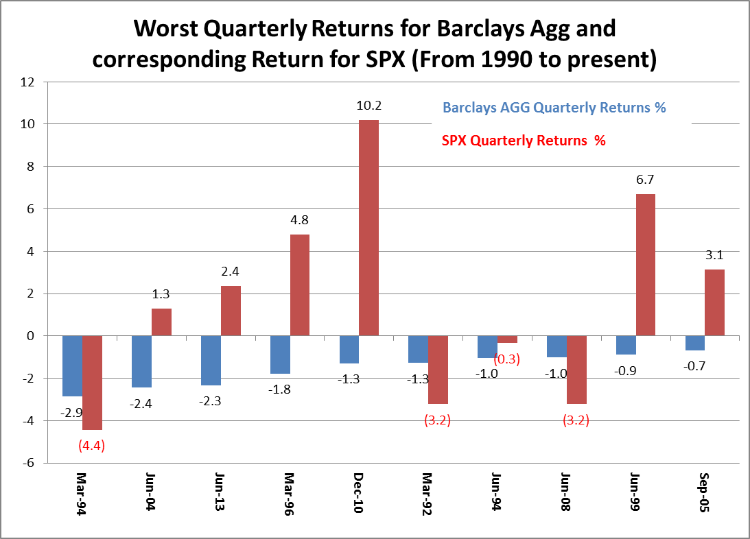
Barclay bond index vs SandP - III Capital Management

Source: III Capital Management

You can read his assessment of the current situation in this article – Silencing the Roar of the Bond Bear. In the past 25 years the largest negative quarterly return from the Barclays bond index was -2.9%, that was back in 1994 when the Fed tightened interest rates abruptly, causing stocks and bonds to collapse in tandem. The next chart highlights the benefits of diversification, generally bonds flip when stocks flop:-
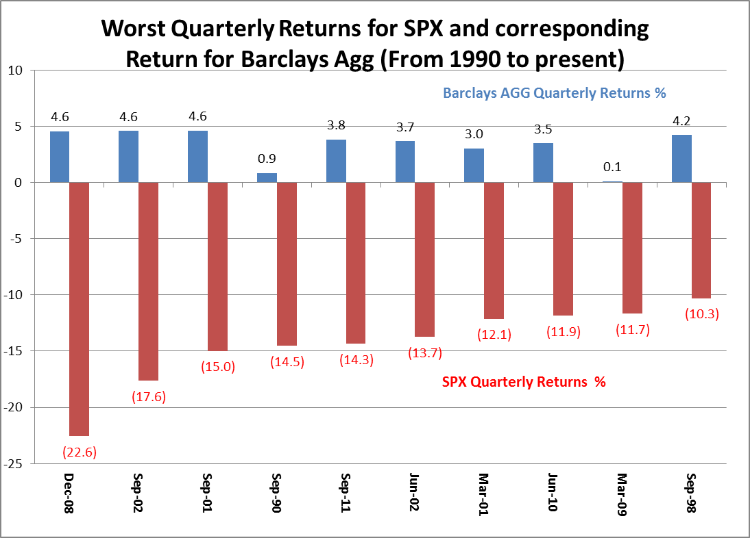
SandP vs Barclays Bond index 25 yr -III Cap Man

Source: III Capital Management

Conclusion and investment opportunities

If inflation is likely to remain subdued due to the excessive debt overhang, then the recent rise in bond prices is simply a correction. How far will this correction go or has it already run its course?

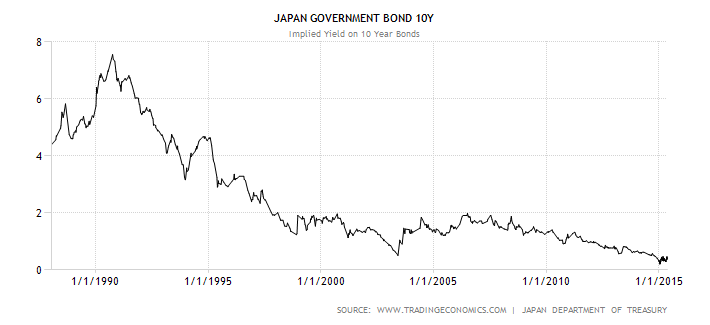
I could analyse each market, apply an array of technical analysis and establish a set of individual forecasts but I believe it is better to view these markets through the lens of the JGB market. Japan has been struggling with bouts of deflation since the 1990’s. Whilst most other nations – Switzerland being a notable exception – have only recently witnessed widespread falling prices, the evolution of inflation expectations are likely to follow a similar course.
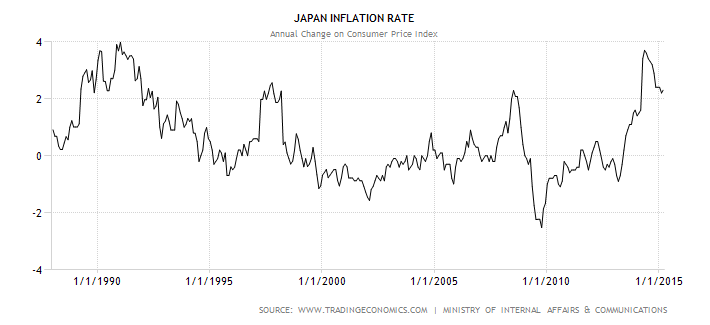
japan-inflation-cpi

Source: Trading Economics and Japanese Ministry of Internal Affairs
japan-government-bond-yield

Source: Trading Economics and Japanese Treasury
japan-interest-rate

Source: Trading Economics and Bank of Japan

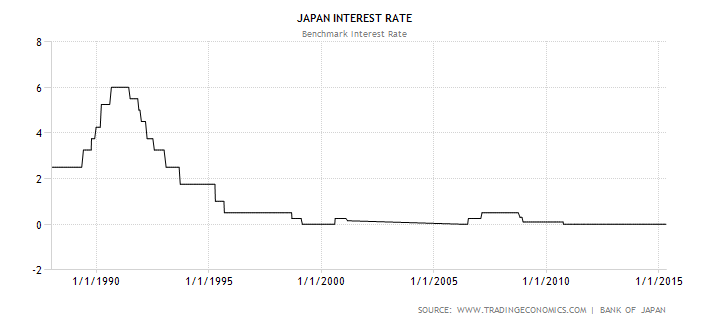
As the Japanese stock market collapsed after 1989 inflation declined rapidly. JGBs, influenced by the rate tightening of the US Fed, suffered a rise in yields in 1994 but then declined once more – after all, the price index was now negative. Inflation witnessed a brief rebound ahead of the Asian Financial Crisis of 1998. The Bank of Japan (BoJ) left short term interest rates on hold and JGB yields declined again as the Asian Crisis gathered momentum.

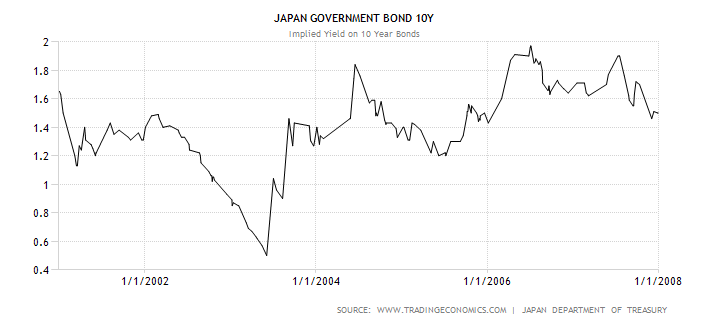
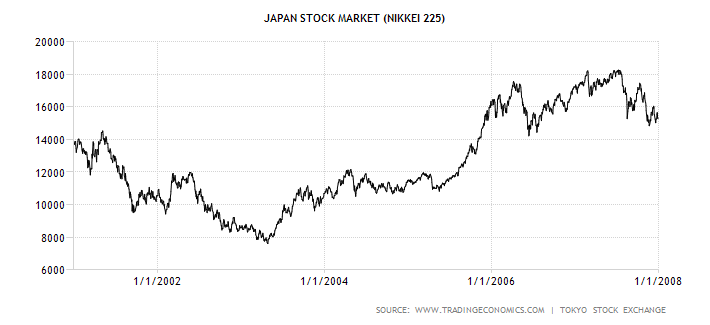
Between 2000 and 2005 Japan struggled with mild deflation, despite expansionary monetary and fiscal policies. At the risk of being vilified for wild generalisation, this is the point where the other bond markets are now. The charts below cover the period 2001-2007, after the bursting of the US Technology Bubble and prior to the Sub-Prime collapse:-
japan-government-bond-yield 2001-2007

Source: Trading Economics and Japanese Treasury
japan-stock-market 2001-2007

Source: Trading Economics and Tokyo Stock Exchange
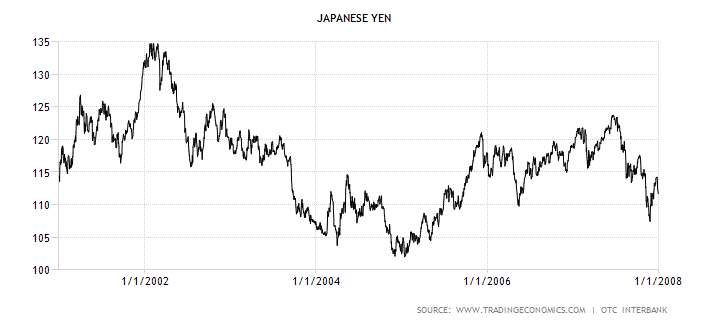
japan-currency 2001-2007

Source: Trading Economics

The table below extrapolates the corrections and counter-corrections of the JGB in the chart above and compares them to the German Bund and the US Treasury 10 year maturities:-

JGB 10yr Rise/Fall Change Bund 10yr Rise/Fall   Change US T-Bond 10yr Rise/Fall   Change
Range in bp BP % Equivalent bp BP % Equivalent bp BP %
55 – 185* 130* 236* 5 – 80* 75* 1500* 138 – 304* 166* 120*
185 – 120* -65* -35* 80 – 52 -28 35 304 – 163* -141* -46*
120 – 195* 75* 63* 52 – 85 33 63 163 – 266 103 63
195 – 160* -35* -18* 85 – 70 -15 -18 266 – 218 -48 -18
160 – 190* 30* 19* 70 – 83 13 19 218 –   259 41 19

*These figures are actual outcomes

Source: Investing.com and Tokyo Stock Exchange

I am taking the US T-Bond low (1.38%) of July 2012 to be the current nadir. It may now be embarking on a third corrective wave, if you believe in Elliott Wave theory, which could see yields rise toward 3% once more. The Bund correction, from 80bp to 55bp by 19th May, was probably too swift, meaning the market may break above 0.80% before yields decline again.

The price cycles in each of these markets are unlikely to tally either in duration or magnitude, but, after a capitulation in Europe, in which 10yr Bund yield almost turned negative, even the most ardent fixed income protagonists have been unable to justify remaining fully invested – we have now entered a corrective period. A 130bp rebound would take Bunds just above the 61.8% retracement of the recent decline (1.35%). This scale of correction would clear out the majority of weak hands.

Without inflation, growth prospects for the EZ will continue to rely on the benevolence of the ECB who announced additional QE measures earlier this week. Benoît Cœuré, Member of the Executive Board of the ECB, gave this speech on Monday – How binding is the zero lower bound?

Since 2007 JGB yields had marched steadily lower until this January; without some form of resolution of the over indebtedness of developed nations, yields will remain well below what used to be regarded as the natural rate of interest. 3% is likely to cap yields on 10yr US T-Bonds, Bunds will struggle to get above 2%. JGBs are more difficult to predict, but attempts at reflation are likely to fail whilst debt remains so high relative to GDP. The Japanese government cannot afford a doubling or tripling of its interest bill.

For the trader there is plenty of opportunity with yields ranges of 200 to 300bp, but beware of the void of liquidity that results from the absence of free-float. Rising bond correlation, rising yields and the lack of a “dealer of last resort” create dangers of their own.
Australia and Canada – Commodities and Growth

400dpiLogo

Macro Letter – No 30 – 20-02-2015

Australia and Canada – Commodities and Growth

  • Industrial commodities continue to weaken
  • The BoC and RBA have cut official rates in response to falling inflation and slower growth
  • The RBA has more room to manoeuvre in cutting rates, Australian Bonds will outperform

The price of Crude Oil has dominated the headlines for the past few months as Saudi Arabia continued pumping as the price fell in response to increased US supply. However, anaemic growth in Europe and a continued slowdown in China has taken its toll on two of the largest commodity exporting countries. This has prompted both the Bank of Canada (BoC) and the Reserve Bank of Australia (RBA) to cut interest rates by 25 bp each – Canada to 0.75% and Australia to 2.25% – even as CAD and AUD declined against the US$.

In this letter I will look at Iron Ore, Natural Gas and Coal, before going on to examine other factors which may have prompted central bank action. I will go on to assess the prospects for asset markets over the coming year.

Iron Ore

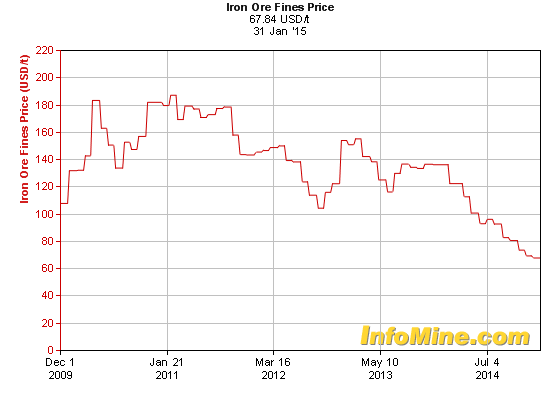
The price of Iron Ore continues to make fresh lows, driven by weakness in demand from China and Japan and the EU.

Iron Ore Fines 6 yr

Source: Infomine.com

Iron Ore is Australia’s largest export market, significantly eclipsing Coal, Gold and Natural Gas. It is the second largest producer in the world behind China. 2013 production was estimated at 530 Mt. Canada, with 40 Mt is ranked ninth by production but is the fourth largest exporter. Needless to say, Iron Ore production is of significant importance to both countries, although for Canada Crude Oil comes first followed by vehicle and vehicle parts, then Gold, Gas – including Propane – and Coal. It is also worth noting that the two largest Steel exporters are China and Japan – both major Iron Ore importers. The health of these economies is vital to the fortunes of the Iron Ore industry.

Natural Gas

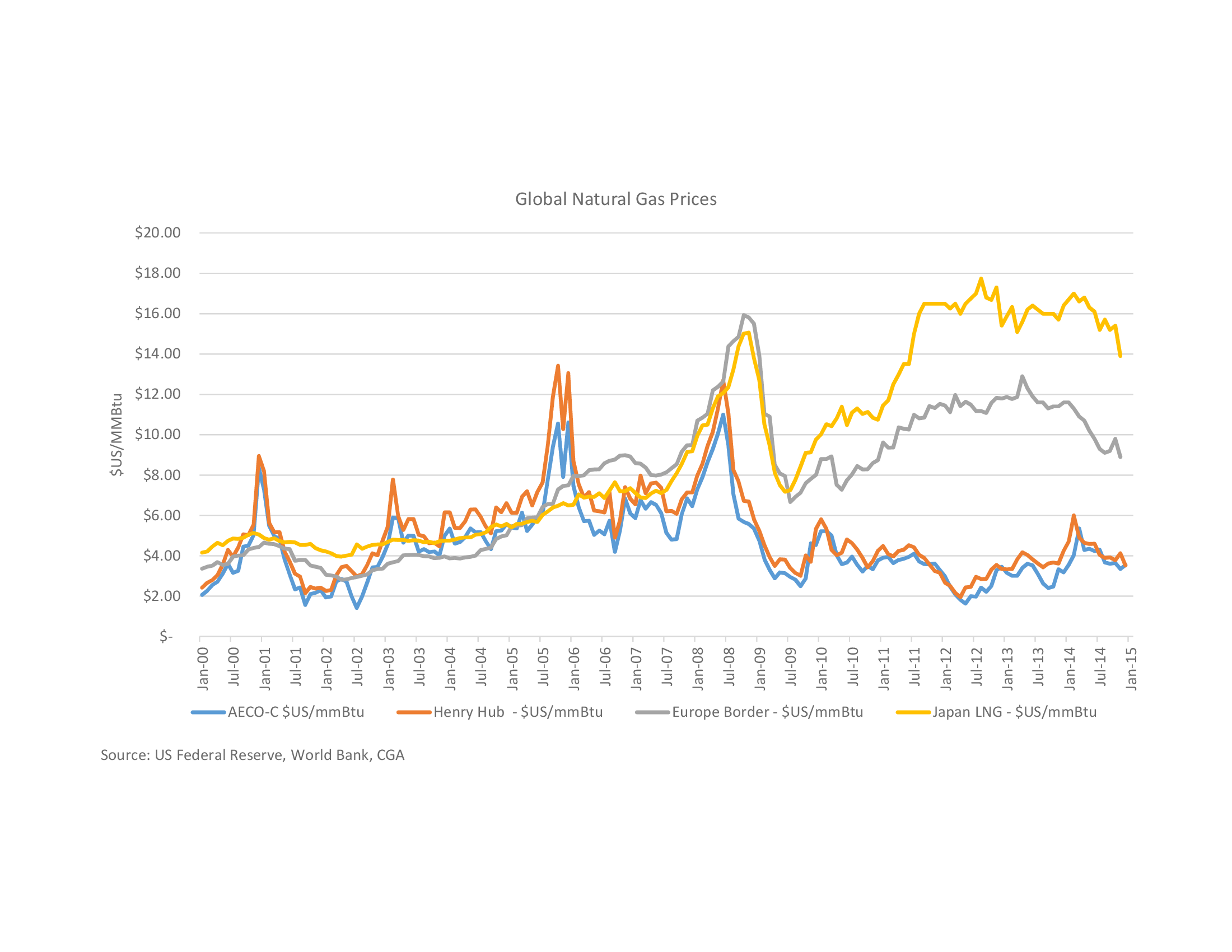
Natural Gas is a more difficult product to transport and therefore the price differential between different regions is quite pronounced. Japan pays the highest price of all the major economies – exacerbated by its reduction of nuclear generating capacity – closely followed by Singapore, Taiwan and South Korea. The US – Henry Hub – and AECO – Alberta – prices are broadly similar, whilst Europe and Japan pay a significant premium:-

Chart-4-Global-Natural-Gas-Prices11

Source: Federal Reserve, World Bank, CGA

Here is an extract from the International Gas Union report – IGU Wholesale Gas Price Survey Report – 2014 Edition:-

Wholesale prices can obviously vary significantly from year to year, but the top two regions are Asia Pacific followed by Europe – both with average prices over $11.00. OPE* remains the primary pricing mechanism in Asia Pacific and still a key mechanism in Europe.

*Oil Price Escalation – in this type of contract, the price is linked, usually through a base price and an escalation clause, to competing fuels, typically crude oil, gas oil and/or fuel oil. In some cases coal prices can be used as can electricity prices.

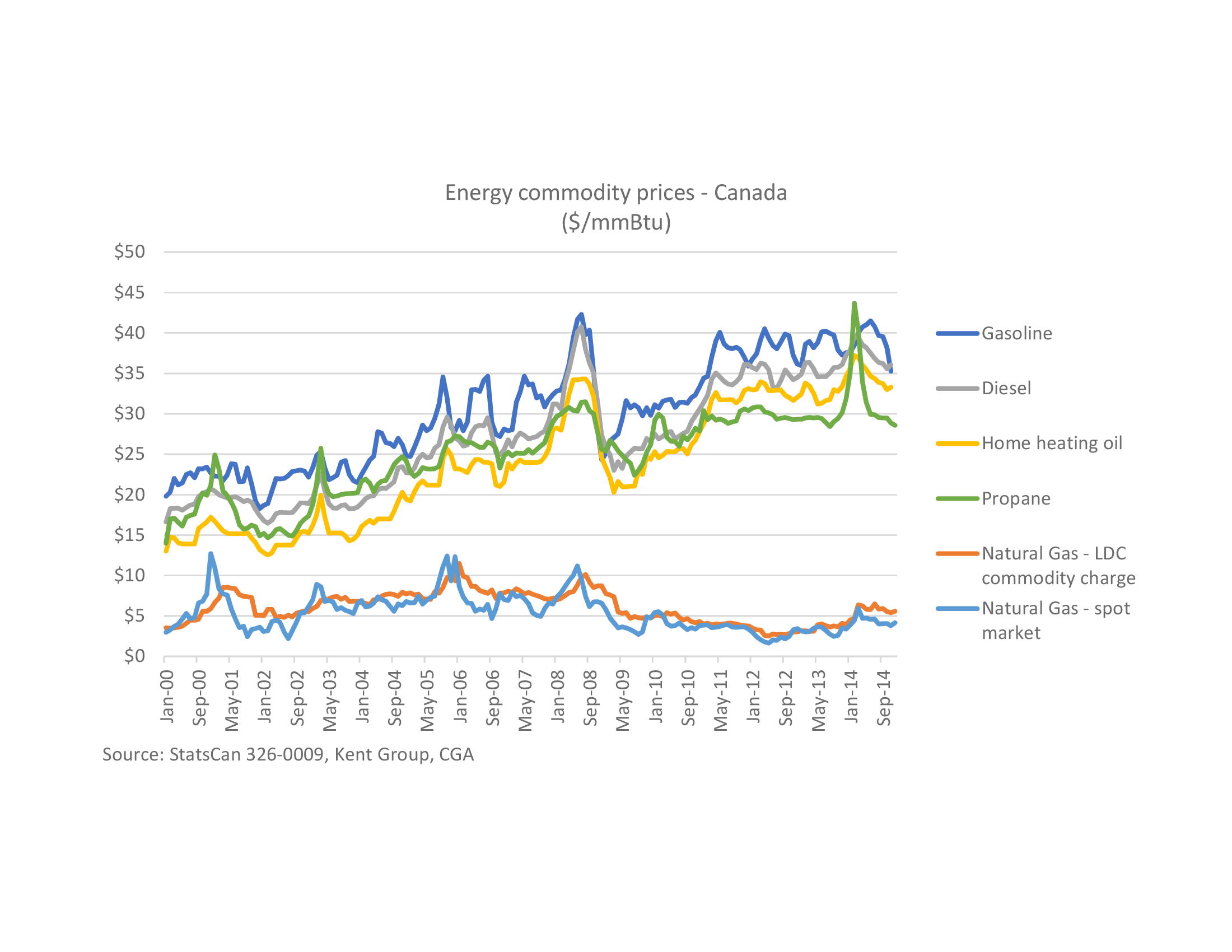
Canada has significant Gas reserves and is actively developing Liquefied Natural Gas (LNG) capacity. 13 plant proposals are underway but exports are still negligible. It also produces significant quantities of Propane which commands a premium over Natural Gas as this chart shows: –

Chart-5-Energy-Commodity-Prices10

Source: StatsCan, Kent Group, CGA

Australia, by comparison, is already a major source of LNG production. The IGU – World LNG Report – 2014 Edition:-

Though Australia was the third largest LNG capacity holder in 2013, it will be the predominant source of new liquefaction over the next five years, eclipsing Qatari capacity by 2017. With Pluto LNG online in 2012, seven Australian projects are now under construction with a total nameplate capacity of 61.8 MTPA (53% of global under construction capacity).

Coal

Australia is the fourth largest Coal producer globally. According to the World Coal Association, it produced 459 Mt in 2013. Canada did not feature in the top 10. However when measured in terms of Coking Coal – used for steel production – Australia ranked second, behind China, at 158 Mt whilst Canada ranked sixth at 34 Mt.

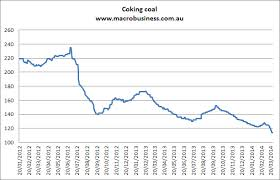
The price of Australian Coal has been falling since January 2011 and is heading back towards the lows last seen in 2009, driven primarily by the weakness in demand for Coking Coal from China.

Australian Coal Price - Macro Business 2012 - 2014

Source: Macro Business

This is how the Minerals Council of Australia describes the Coal export market:-

Coal accounted for almost 13 per cent of Australia’s total goods and services exports in 2012-13 down from 15 per cent in 2011-12. This made coal the nation’s second largest export earner after iron ore. Over the last five years, coal has accounted, on average, for more than 15 per cent of Australia’s total exports – with export earnings either on par or greater than Australia’s total agricultural exports.

Australia’s metallurgical coal export volumes are estimated at 154 million tonnes in 2012-13, up 8.5 per cent from 2011-12. However, owing to lower prices the value of exports decreased by almost 27 per cent to be $22.4 billion in 2012-13.

Whilst the scale of the Coal industry in Canada is not so vast, this is how the Coal Association of Canada describes Canadian Coal production:-

Production

Canada produced 60 million close to 67 million tonnes (Mt) of coal in 2012. 31 million tonnes was metallurgical (steel-making) coal and 36 million tonnes (Mt) was thermal coal. The majority of coal produced in Canada was produced in Alberta and B.C.

Alberta produced 28.3 Mt of coal in 2012

British Columbia produced 28.8 Mt (most was metallurgical coal) – 43% of all production

To meet its rapid infrastructure growth and consumer demand for things such as vehicles and home appliances, Asia has turned to Canada for its high-quality steel-making coal. As Canada’s largest coal trading partner, coal exports to Asia accounted for 73% of total exports in 2010.

Steel-Making Coal

Global steel production is dependent on coal and more and more the world is turning to Canada for its supply of quality steel-making coal.

The production of steel -making coal increased by 5.5% from 29.5 Mt in 2011 to 31.1 Mt in 2012.

Almost all of Canada’s steel-making coal produced was exported.

Thermal Coal

Approximately 36 million tonnes of thermal coal was produced in 2012.

The vast majority of Canadian thermal coal produced is used domestically.

Currency Pressures

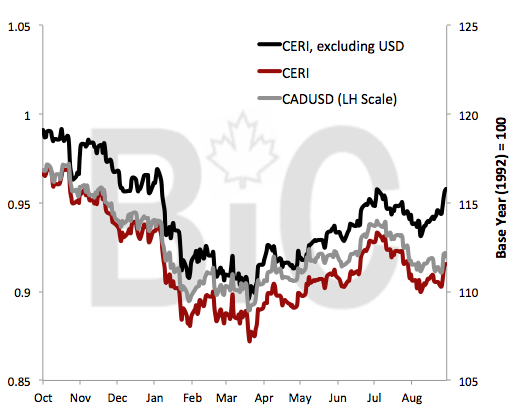
Until the autumn of 2014 the CAD was performing strongly despite weakness in several of its main export markets as the chart below of the Canadian Effective Exchange Rate (CERI) shows:-

CAD CERI - 1yr to sept 2014

Source: Business in Canada, BoC

Since September the CERI index has declined from around 112 to below 100.

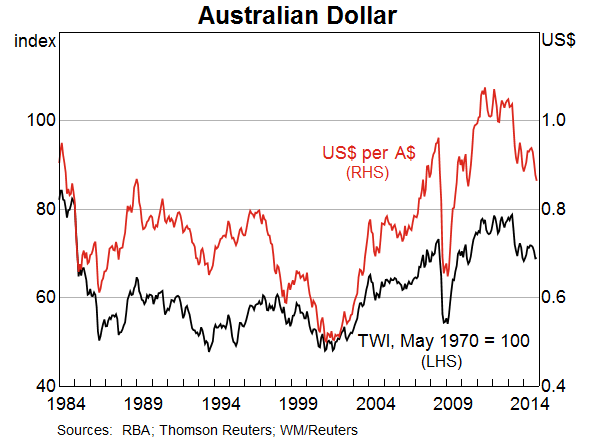
For Australia the weakening of their trade weighted index has been less extreme due to less reliance on the US. There is a sector of the RBA website devoted the management of the exchange rate, this is a chart showing the Trade Weighted Index and the AUDUSD rate superimposed (RHS):-

AUD_effective_and_AUDUSD_-_RBA

Source: RBA, Reuters

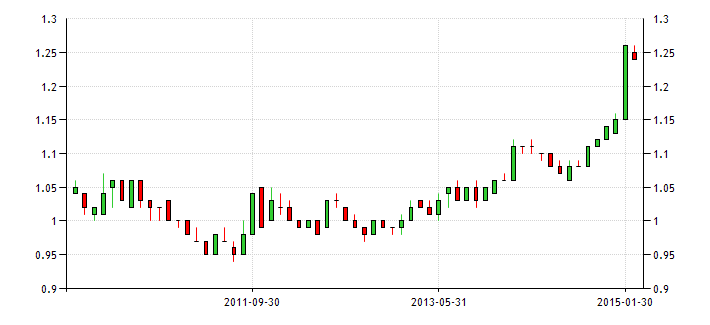
Taking a closer look at the monthly charts for USDCAD:-

canada-currency

Source: Trading Economics

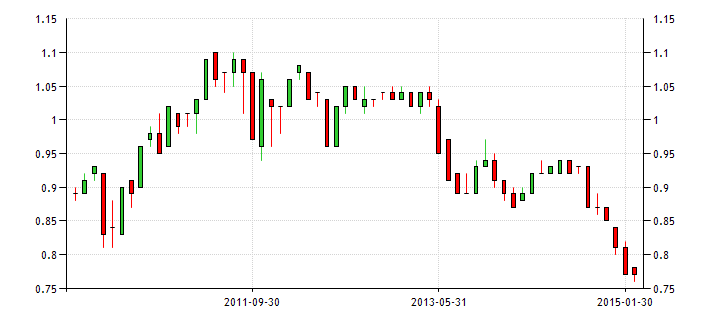
And AUDUSD:-

australia-currency

Source: Trading Economics

These charts show the delayed reaction both currencies have had to the decline in the price of their key export commodities – they may fall further.

Central Bank Policy

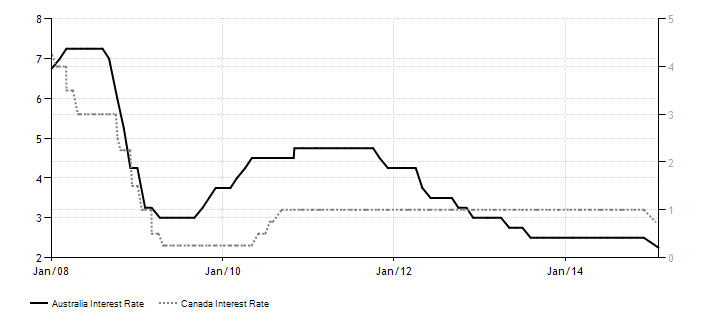
The chart below shows the evolution of BoC and RBA policy since 2008. Australian rates are on the left hand scale (LHS), Canadian on the right:-

australia and canadian -interest-rate 2008 - 2015

Source: Trading Economics

To understand the sudden change in currency valuation it is worth reviewing the central banks most recent remarks.

The BoC expect Oil to average around $60/barrel in 2015. Here are some of the other highlights of the latest BoC monetary policy report:-

The sharp drop in global crude oil prices will be negative for Canadian growth and underlying inflation.

Global economic growth is expected to pick up to 3 1/2 per cent over the next two years.

Growth in Canada is expected to slow to about 1 1/2 per cent and the output gap to widen in the first half of 2015.

Canada’s economy is expected to gradually strengthen in the second half of this year, with real GDP growth averaging 2.1 per cent in 2015 and 2.4 per cent in 2016, with a return to full capacity around the end of 2016, a little later than was expected in October.

Total CPI inflation is projected to be temporarily below the inflation-control range during 2015 because of weaker energy prices, and to move back up to target the following year. Underlying inflation will ease in the near term but then return gradually to 2 per cent over the projection horizon.

On 21 January 2015, the Bank announced that it is lowering its target for the overnight rate by one-quarter of one percentage point to 3/4 per cent.

…Although there is considerable uncertainty around the outlook, the Bank is projecting real GDP growth will slow to about 1 1/2 per cent and the output gap to widen in the first half of 2015. The negative impact of lower oil prices will gradually be mitigated by a stronger U.S. economy, a weaker Canadian dollar, and the Bank’s monetary policy response. The Bank expects Canada’s economy to gradually strengthen in the second half of this year, with real GDP growth averaging 2.1 per cent in 2015 and 2.4 per cent in 2016.

The RBA Statement on Monetary Policy – February 2015 provides a similar insight into the concerns of the Australian central banks:-

…Australia’s MTP growth is expected to continue at around its pace of recent years in 2015 as a number of effects offset each other. Growth in China is expected to be a little lower in 2015, while growth in the US economy is expected to pick up further. The significant fall in oil prices, which has largely reflected an increase in global production, represents a sizeable positive supply shock for the global economy and is expected to provide a stimulus to growth for Australia’s MTPs. The fall in oil prices is also putting downward pressure on global prices of goods and services. Other commodity prices have also declined in the past three months, though by much less than oil prices. This includes iron ore and, to a lesser extent, base metals prices. Prices of Australia’s liquefied natural gas (LNG) exports are generally linked to the price of oil and are expected to fall in the period ahead. The Australian terms of trade are expected to be lower as a result of these price developments, notwithstanding the benefit from the lower price of oil, of which Australia is a net importer.

…Available data since the previous Statement suggest that the domestic economy continued to grow at a below-trend pace over the second half of 2014. Resource exports and dwelling investment have grown strongly. Consumption growth remains a bit below average. Growth of private non-mining business investment and public demand remain subdued, while mining investment has fallen further. Export volumes continued to grow strongly over the second half of 2014, driven by resource exports. Australian production of coal and iron ore is expected to remain at high levels, despite the large fall in prices over the past year. The production capacity for LNG is expected to rise over 2015. Service exports, including education and tourism, have increased a little over the past two years or so and are expected to rise further in response to the exchange rate depreciation.

…Household consumption growth has picked up since early 2013, but is still below average. Consumption is being supported by very low interest rates, rising wealth, the decision by households to reduce their saving ratio gradually and, more recently, the decline in petrol prices. These factors have been offset to an extent by weak growth in labour income, reflecting subdued conditions in the labour market. Consumption growth is still expected to be a little faster than income growth, which implies a further gradual decline in the household saving ratio.

…Prior to the February Board meeting, the cash rate had been at the same level since August 2013. Interest rates faced by households and firms had declined a little over this period. Very low interest rates have contributed to a pick-up in the growth of non-mining activity. The recent large fall in oil prices, if sustained, will also help to bolster domestic demand. However, over recent months there have been fewer indications of a near-term strengthening in growth than previous forecasts would have implied. Hence, growth overall is now forecast to remain at a below trend pace somewhat longer than had earlier been expected. Accordingly, the economy is expected to be operating with a degree of spare capacity for some time yet, and domestic cost pressures are likely to remain subdued and inflation well contained. In addition, while the exchange rate has depreciated, it remains above most estimates of its fundamental value, particularly given the significant falls in key commodity prices, and so is providing less assistance in delivering balanced growth in the economy than it could.

Given this assessment, and informed by a set of forecasts based on an unchanged cash rate, the Board judged at its February meeting that a further 25 basis point reduction in the cash rate was appropriate. This decision is expected to provide some additional support to demand, thus fostering sustainable growth and inflation outcomes consistent with the inflation target.

Real Estate

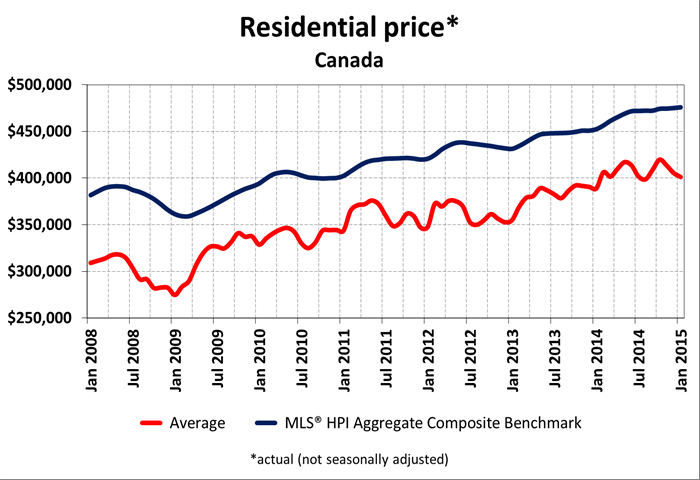
Neither central bank makes much reference to the domestic housing market. Western Canada has been buoyed by international demand from Asia. Elsewhere the overvaluation has been driven by the low interest rates environment. Overall prices are 3.1% higher than December 2014. Vancouver and Toronto are higher but other regions are slightly lower according to the January report from the Canadian Real Estate Association . The chart below shows the national average house price:-


Canada natl_chartA04_hi-res_en

Source: Canadian Real estate Association

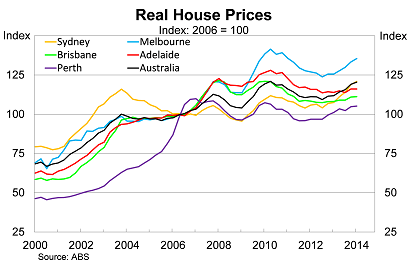
The Australian market has moderated somewhat during the last 18 months, perhaps due to the actions of the RBA, raising rates from 3% to 4.75% in the aftermath of the Great Recession, however, the combination of lower RBA rates since Q4 2011, population growth and Chinese demand has propelled the market higher once more. Prices in Western Australia have moderated somewhat due to the fall in commodity prices but in Eastern Australia, the market is still making new highs. The chart below goes up to 2014 but prices have continued to rise, albeit moderately (less than 2% per quarter) since then:-

Australian House Prices 2006 - 2014

Source: ABS

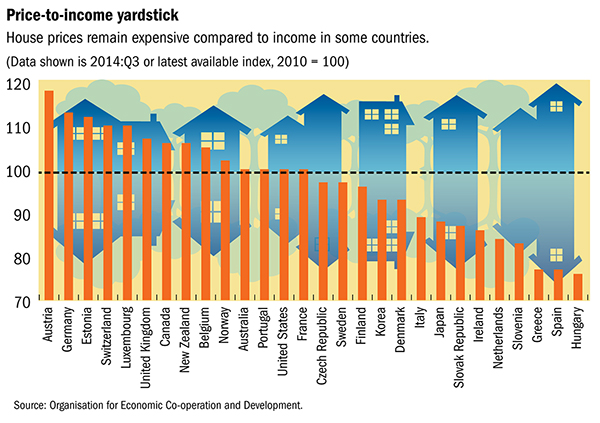
This chart from the IMF/OECD shows global Price to Income ratios, Canada and Australia are still at the expensive end of the global range:-

House pricetoincome IMF

Source: IMF and OECD

The lowering of official rates by the BoC and RBA will not help to alleviate the overvaluation.

Bonds

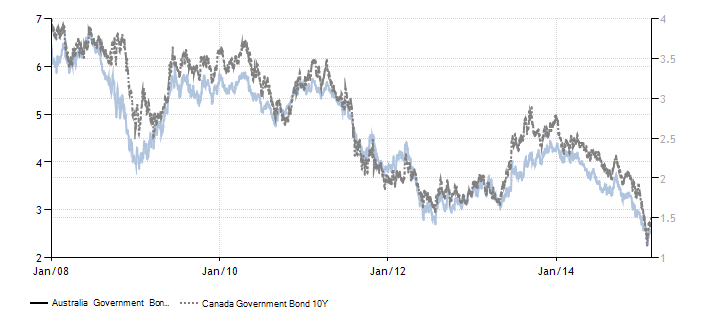
This chart shows the monthly evolution of 10 year Government Bond yields since 2008 in Australia (LHS) and Canada (RHS):-

australia-canada-government-bond-yield

Source: Trading Economics

Whilst the two markets have moved in a correlated manner Canadian yields have tended to be between 300 and 100 bp lower over the last seven years. The Australian yield curve is flatter than the Canadian curve but this is principally a function of higher base rates. Both central banks have cut rates in anticipation of lower inflation and slower growth. This is likely to support the bond market in each country but investors will benefit from the more favourable carry characteristics of the Canadian market.

Stocks  

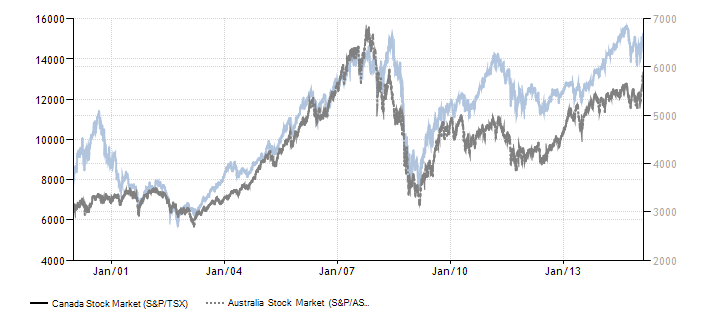
To understand the differential performance of the Australian and Canadian stocks markets I have taken account of the strong performance of commodity markets prior to the Great Recession, in the chart below you will observe that both economies benefitted significantly from the rally in industrial commodities between 2003 and 2008. Both stock markets suffered severe corrections during the financial crisis but the Canadian market has steadily outperformed since 2010:-

canada australian -stock-market 2000-2015

Source Trading Economics

This outperformance may have been due to Canada’s proximity to, and reliance on, the US – 77% of Exports and 52% of Imports. The Australian economy, by contrast, is reliant on Asia for exports – China 27%, Japan 17% – however, I believe that the structurally lower interest rate regime in Canada is a more significant factor.

Conclusions and investment opportunities

With industrial commodity prices remaining under pressure neither Canada nor Australia is likely to exhibit strong growth. Inflation will be subdued, unemployment may rise. These are the factors which prompted both central banks to cut interest rates in the last month. However, both economies have been growing reasonable strongly when compared with countries such as those of the Eurozone. Canada GDP 2.59%, Australia GDP 2.7%.

The BoC has little room for manoeuvre with the base rate at 0.75% but the RBA is in a stronger position. For this reason I believe the AUD is likely to weaken against the CAD if world growth slows, but the negative carry implications of this trade are unattractive.

Canadian Real Estate is more vulnerable than Australia to any increase in interest rates – although this seems an unlikely scenario in the near-term – more importantly, in the longer term, Canadian demographics and slowly population growth should alleviate Real Estate demand pressure. In Australia these trends are working in the opposite direction. Neither Real Estate market is cheap but Australia remains better value.

The Australian All-Ordinaries should outperform the Canadian TSX as any weakness in the Australian economy can be more easily supported by RBA accommodation. The All-Ordinaries is also trading on a less demanding earnings multiple than the TSX.

The RBA’s greater room to ease monetary conditions should also support the Australian Government Bond market, added to which the Australian government debt to GDP ratio is an undemanding 28% whilst Canadian debt to GDP is at 89%. The Canadian curve may offer more carry but the RBA ability to ease policy rates is greater. My preferred investment is in Australian Government Bonds. Both Canadian and Australian 10 year yields have risen since the start of February. The last Australian bond retracement saw yields rise 46 bp to 3.75% in September 2014. Since the recent rate cut yields have risen 30 bp to a high of 2.67% earlier this week. Don’t wait too long for better levels.

Where is the oil price heading in 2015?

400dpiLogo

Macro Letter – Supplemental – No 1 – 13-02-2015

Where is the oil price heading in 2015?

  • Growth in oil demand remains anaemic
  • Supply will gradually fall as contracts expire
  • Consolidation and declining volatility are the most likely outcome

The price of crude oil has rebounded strongly since the end of January. Is this the beginning of a new trend, a short-term correction prior to a further decline or the start of a period of consolidation?

Here is the price action for March 2015 WTI futures over the last four months:-

4month Mar15 WTI

Source: Barchart.com

Before jumping to any conclusions about the next trend it is worth taking a look at a longer term chart. This is the spot price chart for the period since 2005, it shows the period of the leveraged boom and the collapse during the Great Recession:-

10yr Oil

Source: Barchart.com

The collapse during the Great Recession was largely due to a reduction in demand as the world economy slowed dramatically. The price decline since the summer of 2014 has been driven by a combination of a delayed reaction to increased supply – specifically from the US – and a moderation in the rate of increase in demand associated with the slowing of Chinese growth and its policy of “rebalancing” towards domestic consumption. An additional factor has been the slowing of growth in Europe. An IEA report last December estimated that global oil demand had increased by only 0.75% between 2013 and 2014 – better, by 3.6%, than the 2009/2013 period but not excessive.

During 2013 and early 2014 geopolitical tension in the Middle East and Ukraine kept prices elevated amid expectations of supply disruptions. These disruptions failed to materialise. This coincided with an increase in US oil production. Finally the markets woke-up to the lack of geopolitical risk, the slowdown of growth in the EU and China, and the acceleration in US production. The price began to correct downwards taking out the 2012 lows. From here on it gathered momentum and, having taken out the majority of trading stop-losses, stabilised last month, not far from the 2009 lows.

Another look at the 10 year price chart shows the recovery in 2010/2011. At this stage the improvements in fracking and drilling technology were already becoming widely known, had it not been for geopolitical concerns the price would probably have begun to decline from this point – around $85. The widening price spread between Brent Crude and WTI shows the effect of increased US production:-

brent wti spread Goldman Sachs ZeroHedge

Source: Goldman Sachs and Zero Hedge

WTI begins to lag Brent Crude towards the end of 2010. Here is a chart of US versus World Oil production:-

US_vs_world_Oil_production

Source: EIA and Carpe Diem Blog


Price Prospects

What we have seen during the last six months is a delayed reaction to the increased supply of crude oil from the US. The recent decline has been very rapid and may have run its course, or may have further to fall. Either way, volatility is heightened and the price is likely to remain variable.

From a technical perspective I would expect the corrective rally to continue possibly to test the 2012 lows around $75/barrel. After such a rapid rise in the last few weeks, however, the price may retest the low first; there is an outside chance that the market takes out the January low to retest the 2009 bottom. The $75 level may be retested in the autumn as forward contracts expire and supply shortages appear. From this point a renewed decline is most likely, this phase will also be marked by declining volatility.

I have one concern with this technically bullish prediction – the steep contango in the futures market. At close of business on Wednesday 11th February the WTI futures settlements were as follows:-

Contract Last
CLY00 (Cash) 48.87s
CLH15 (Mar ’15) 50.43
CLU15 (Sep ’15) 57.15
CLH16 (Mar ’16) 60.14s
CLU16 (Sep ’16) 62.39s


Source: NYMEX and Barchart.com

The shape of the forward curve suggests that oil producers are not feeling quite as much pain as is implied by the spot price, the supply overhang may last into 2016.

Market views, as always, vary. At this week’s International Petroleum Week conference in London Igor Sechin – CEO of Rosneft predicted that oil prices may surge later this year due to supply shortages as a result of the precipitous decline. Meanwhile at the same conference Ian Taylor – CEO of Vitoil, questioned where oil demand would emanate from. His outlook was decidedly more bearish.

Moody’s research, published earlier this week, put a price target for 2015 is $55/barrel which makes sense if global growth slows: they see no boost to growth in China, Japan or the EU from a lower oil price but expect it to benefit India and the US.

I listened to a panel debate at the ICMA/JSDA – Japan Securities Summit on Wednesday where Takahiro Sato of the BoJ alluded to the positive impact lower oil prices might have on Japanese growth. He inferred that it would mean the BoJ undershot its inflation target. Here is a brief extract:-

On the price front, the inflation rates in major countries, including Japan, have been declining as a trend mainly due to the recent drop in crude oil prices. Under those circumstances, central banks in major countries have a common concern that major economies are trapped in a feedback-loop — the decline in the inflation rates would lead to a fall in people’s medium- to long-term inflation expectations, and it would result in a further decline in the actual inflation rates. That is why the Bank decided to expand the QQE last October.

As I cast a dissenting vote on that decision, I may not be an appropriate person to explain this policy.

The NY Times reported – KKR profits were down 89% in Q4 2014 due to turmoil in the US energy sector. New drilling has dried up in the last few months and concerns are growing about potential defaults by over-leveraged energy companies. This could slow US growth if the financial sector is wracked with contagion.

The prospects for the oil price is unclear; it will remain so for the next six months. For this reason I expect Moody’s price target of $55/barrel to be reasonably accurate even if their growth expectations prove wrong.

Obvious risk factors which could undermine my expectations include:-

  1. A dramatic slowdown in China
  2. An unravelling of the Eurozone currency union
  3. Russia and the US going head to head in the Ukraine

I think China is more likely to surprise on the upside if it does surprise at all. The Eurozone is still a difficult situation to predict but I think the Euro currency will survive and lower oil prices will aid Germany among other countries in the Euro area. The US may be performing well economically but its appetite for foreign conflict when the country is heading towards energy independence makes little strategic sense. They are likely to deploy their resources on dealing with ISIS first.

My 2015 outside range for WTI crude oil is $40 to $75 with an average of $55/barrel.

Swiss National Bank policy and its implications for currencies, assets and central banking

400dpiLogo

Macro Letter – No 29 – 06-02-2015

Swiss National Bank policy and its implications for currencies, assets and central banking

  • The SNB unpegged from the Euro and sustained balance sheet losses, they will survive
  • The Euro has been helped lower but rumours of a new SNB target are rife
  • The long run appreciation of the Swiss Franc (CHF) is structural and accelerating, the Swiss economy will adjust
  • If G7 central bank balance sheets expanded to Swiss levels, relative to GDP, QE would triple

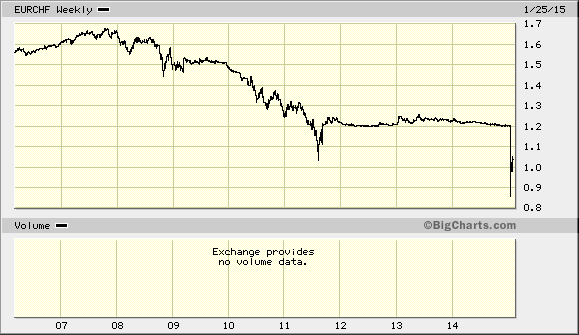
On Thursday 15th January the Swiss National Bank (SNB) finally, and unexpectedly, threw in the towel and ceased their foreign exchange intervention to maintain a pegged rate of EURCHF 1.20. The cap was introduced in September 2011 after a 28% appreciation in the CHF since the beginning of the Great Financial Crisis (GFC) – from 1.68 to 1.20. After plumbing the depths of 0.85 the EURCHF rate settled at 0.99 – around 18% higher in a single day. This is a huge one day move for a G10 currency and has inflicted collateral damage on leveraged traders, their brokers and those who borrowed in CHF to finance asset purchases in other currencies. Citibank estimates that is has also cost the SNB CHF 60bln. Here is a 10 year chart of EURCHF: –

EURCHF_10_yr

Source: Bigcharts.com

The Swiss SMI stock Index declined from 9259 to 8400 (-9.2%) whilst the German DAX Index rose from 9933 to 10,032 (+1.1%). Swiss and German bond yields headed lower. Swiss bonds now exhibit negative nominal yields out to 15 years – the table below is from Wednesday 4th February:-

Maturity Yield
1 week -1.35
1 month -1.65
2 month -1.55
3 month -1.4
6 month -1.38
1 year -1.11
2 year -0.823
3 year -0.768
4 year -0.632
5 year -0.505
6 year -0.419
7 year -0.305
8 year -0.257
9 year -0.181
10 year -0.111
15 year -0.024
20 year 0.196


Source: Investing.com

Swiss inflation is running at -0.3% so the real-yields are fractionally better due to the mild deflation seen in the past couple of months. I expect this deflation to deepen and persist.

Thomas Jordan – Chairman of the governing board of the SNB – made the following statement at a press conference which accompanied the SNB decision:-

Discontinuation of the minimum exchange rate

The Swiss National Bank (SNB) has decided to discontinue the minimum exchange rate of CHF 1.20 per euro with immediate effect and to cease foreign currency purchases associated with enforcing it. The minimum exchange rate was introduced during a period of exceptional overvaluation of the Swiss franc and an extremely high level of uncertainty on the financial markets. This exceptional and temporary measure protected the Swiss economy from serious harm. While the Swiss franc is still high, the overvaluation has decreased as a whole since the introduction of the minimum exchange rate. The economy was able to take advantage of this phase to adjust to the new situation. Recently, divergences between the monetary policies of the major currency areas have increased significantly – a trend that is likely to become even more pronounced. The euro has depreciated substantially against the US dollar and this, in turn, has caused the Swiss franc to weaken against the US dollar. In these circumstances, the SNB has concluded that enforcing and maintaining the minimum exchange rate for the Swiss franc against the euro is no longer justified.

Interest rate lowered

At the same time as discontinuing the minimum exchange rate, the SNB will be lowering the interest rate for balances held on sight deposit accounts to –0.75% from 22 January. The exemption thresholds remain unchanged. Further lowering the interest rate makes Swiss-franc investments considerably less attractive and will mitigate the effects of the decision to discontinue the minimum exchange rate. The target range for the three-month Libor is being lowered by 0.5 percentage points to between –1.25% and –0.25%.

Outlook for inflation and the economy

The inflation outlook for Switzerland is low. In December we presented a conditional inflation forecast, which predicts inflation of –0.1% for this year. Since this forecast was published, the oil price has once again fallen significantly, which will further dampen the inflation outlook for a time. However, lower oil prices will stimulate growth globally, and this will influence economic developments in Switzerland positively. Swiss franc exchange rate movements also impact inflation and the economic situation.

The SNB remains committed to its mandate of ensuring medium-term price stability while taking account of economic developments. In concluding, let me emphasise that the SNB will continue to take account of the exchange rate situation in formulating its monetary policy in future. If necessary, it will therefore remain active in the foreign exchange market to influence monetary conditions.

On Tuesday 27th January the CHF fell marginally after SNB Vice President Jean-Pierre Danthine told Swiss newspaper Tages Anzeiger – Die Presse war voller Spekulationen, that the SNB remains ready to intervene in the currency market. One comment worthy of consideration, with apologies for the “google-translate”, is:-

Q. Does the SNB did not develop a new monetary policy? Just as Denmark, which has tied its currency to the euro in 30 years? Or as Singapore, which manages its currency based on a trade-weighted basket of currencies?

A. Denmark is the euro zone financially and politically closer than Switzerland. The binding to Europe is a long standing. Means that this solution is for Switzerland hardly considered. The arrangement of Singapore is worthy of consideration. But what is decisive is the long-term. Apart from Switzerland and other small and open economies such as Sweden and Norway are done well over the years with a flexible exchange rate.

Rumours of a new unofficial corridor of EURCHF 1.05-1.10 are now circulating – strikingly similar to the level reached prior to the September 2011 peg.

Breaking the Bank

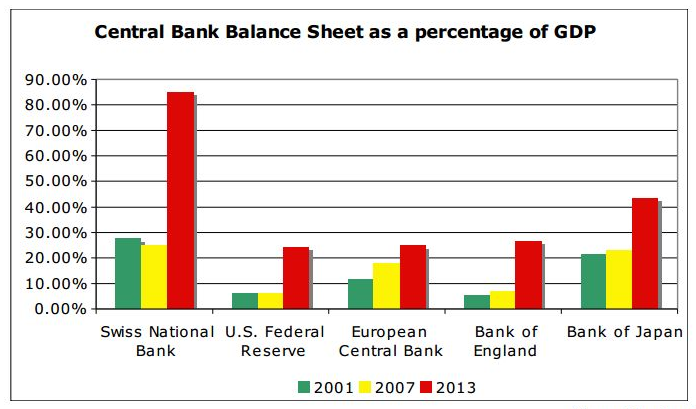
Another rumour to have surfaced after the currency move was that the SNB had become concerned about the size of their balance sheet relative to Swiss GDP. The chart below is from 2013 but it shows the relative scale of SNB QE:-

Central Bank Balance-of-percentage-GDP - source SNB

Source: SNB and snbchf.com

Estimates of the loss sustained by the SNB, due to the appreciation of the CHF, vary, but, rather like countries, central banks don’t tend to “go bust”. The Economist – Broke but never Bust takes up the subject (my emphasis in bold):-

…For one thing central banks are far bigger. Between 2006 and 2014 central-bank balance-sheets in the G7 jumped from $3.4 trillion to $10.5 trillion, or from 10% to 25% of GDP. And the assets they hold have changed. The SNB, aiming to protect Swiss exporters from an appreciating currency, has built up a huge stock of euros, bought with newly created francs.

…Bonds that paid 5% or more ten years ago now yield nothing, and other investments have performed badly (the SNB was stung by a drop in the value of gold in 2013 and cut its dividend to zero). Concerned that its euro holdings might lose value the SNB shocked markets on January 15th by abruptly ending its euro-buying spree.

…With capital of €95 billion supporting a €2.2 trillion balance-sheet, the Eurosystem (the ECB and the national banks that stand behind it) is 23 times levered; a loss of 4% would wipe out its equity. Since two central banks have suffered devastating crunches recently (Tajikistan in 2007, Zimbabwe in 2009) the standard logic seems to apply: capital-eroding losses must be avoided.

But the worries are overdone. For one thing central banks are healthier than they appear. On top of its equity, the Eurosystem holds €330 billion in additional reserves. These funds are designed to absorb losses as assets change in value. Even if the ECB were to buy all available Greek debt—around €50 billion—and Greece were to default, the system would lose just 15% of these reserves; its capital would not be touched.

And even if a central bank’s equity were wiped out it would not go bust in the way high-street lenders do. With liabilities outweighing its assets it might seem unable to pay all its creditors. But even bust central banks retain a priceless asset: the power to print money. Customers’ deposits are a claim on domestic currency, something the bank can create at will. Only central banks that borrow heavily in foreign currencies they cannot mint (as in Tajikistan) or in failing states (Zimbabwe) get into deep trouble.

The Economist goes on to highlight the risk that going “cap in hand” to their finance ministries will weaken central banks’ “independence” and might prove inflationary. In the current environment inflation would be a nice problem for the SNB, or, for that matter, the ECB or BoJ to have. As for the limits of central bank balance sheet expansion, the SNB – at 80% of GDP – have blazed a trail for their larger peers to follow.

Is it the money supply?

A further unofficial explanation of the SNB move concerns the unusually large expansion of Swiss money supply since the GFC. In early January an article from snbchf.comThe Risks on the Rising SNB Money Supply discussed how the SNB might be thinking (my emphasis): –

Since the financial crisis central banks in developed nations increased their balance sheets. The leading one was the American Federal Reserve that increased the monetary base (“narrow money”), followed by the Bank of Japan and recently the ECB. Only partially the extension of narrow money had an effect on banks’ money supply, so called “broad money”. For the Swiss, however, the rising money supply concerns both narrow and broad money. Broad money in Switzerland rises as strong as it did in Spain or Ireland before the financial crisis.

They go on to discuss the global effects of QE:-

…The SNB had the choice between a stronger currency and, secondly, an excessive appreciation of the Swiss assets.  With the introduction of the euro floor, it opted for the second alternative and increased its monetary base massively in order to absorb foreign currency inflows. Implicitly the central bank helped to push up asset prices even further. Hence it was rather foreign demand for Swiss assets that helped to increase the demand for credit and money in the real economy.

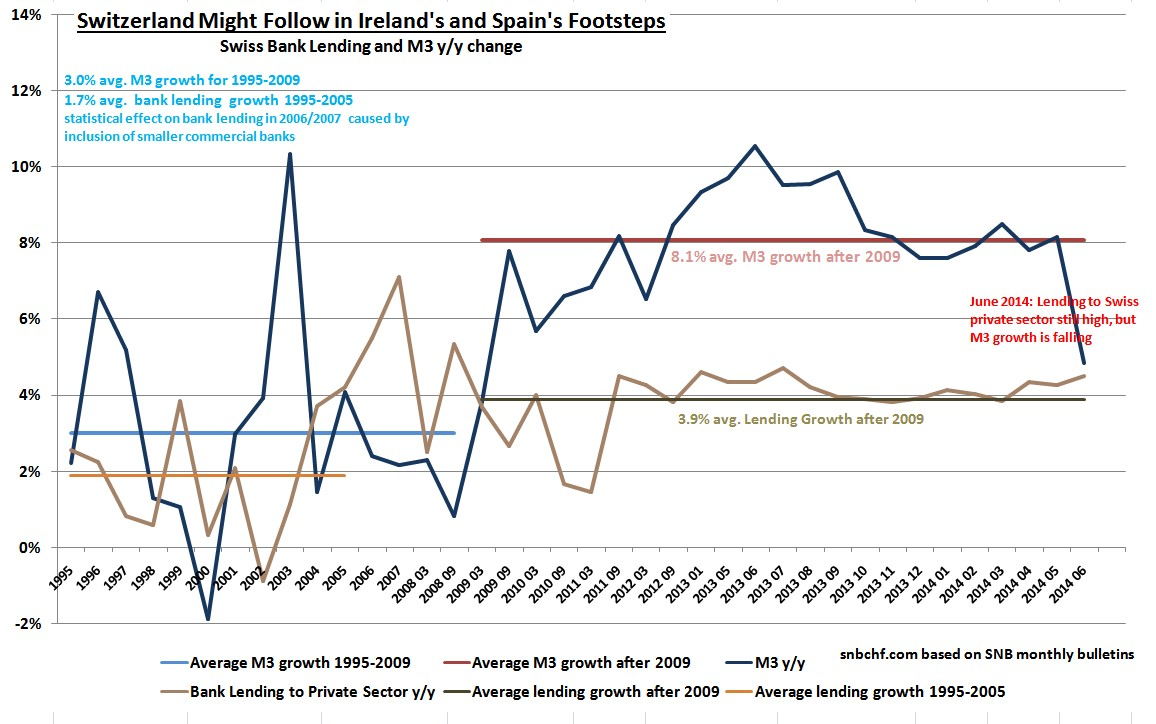
…The SNB printed a lot of money especially in the years before and just after the euro introduction until 2003, to weaken the franc and the “presumed slow” Swiss growth. The money increase, however, did not affect credit growth more than it should have: investors preferred other countries to Switzerland to buy assets. Finally the central bank increased interest rates a bit and reduced money supply between 2006 and 2008. Be aware that in 2006/2007 there is a statistical effect with the inclusion of “Raiffeisen” group banks into M3. Since 2009, things have changed M3 is rising with an average of 7.7% per year, while before 2009 it was 3% per year. Banking lending to the private sector is increasing by 3.9% per year while it was 1.7% between 1995 and 2005.

…Since April 2014, money supply M3 has suddenly stopped at around 940 billion CHF. Before it had increased by 80 bln. CHF per year from 626 bln. in each year since 2008.  We explained before that Fed’s QE translated in higher lending in dollars, dollars that found their way into emerging markets. The same thing happens in Switzerland with newly created Swiss francs. Not all of them remained in the Swiss economy, but they were loaned out to clients from Emerging Markets. Hence the second risk does not directly concerns the Swiss economy and the euro, but the relationship between its banks and emerging markets and the risks of a strong franc for banks’ balance sheets.


Here is a chart of M3 and bank lending in Switzerland, the annotation is from snbchf.com:-

Swiss-M3-and-Lending-2014-Ireland

Source: SNB and snbchf.com

The SNBs decision to unpeg seems a brutal way to impose discipline on the domestic lending market and an unusual way to test increased bank capital requirements, however, I believe this was the least bad time to escape from the corner into which they had boxed themselves. The recent fall in M3 should put some upward pressure on the CHF – until growth slows and reverses the process.

The SNB said this about money supply and bank lending in their Q4 2014 Quarterly Bulletin (my emphasis):-

Growth in money supply driven by lending

The expansion of the money supply witnessed since the beginning of the financial and economic crisis is mainly attributable to bank lending. An examination of components of the M3 monetary aggregate and its balance sheet counterparts, based on the consolidated balance sheet of the banking sector, shows that approximately 70% of the increase in the M3 monetary aggregate between October 2008 and October 2014 (CHF 311 billion) was attributable to the increase in domestic Swiss franc lending (CHF 216 billion). The remaining 30% of the M3 increase was due in part to households and companies switching their portfolio holdings from securities and foreign exchange into Swiss franc sight deposits.

Stable mortgage lending growth in the third quarter

In the third quarter of 2014 – as in the previous quarter – banks’ mortgage claims, which make up four-fifths of all domestic bank lending, were up 3.8% year-on-year. Mortgage lending growth thus continued to slow, as it has for some time now, despite the fact that mortgage rates have fallen to a historic low. A breakdown by borrower shows that the growth slowdown has taken place in mortgage lending to households as well as companies.

This slower growth in mortgage lending may be attributed to various measures taken since 2012 to restrain the banks’ appetite for risk and strengthen their resilience. These include the banks’ own self-regulation measures, which subject mortgage lending to stricter minimum requirements. Moreover, at the request of the SNB, the Federal Council activated the countercyclical capital buffer in 2013 and increased it this year. This obliges the banks to back their mortgage loans on residential property with additional capital. The SNB’s bank lending survey also indicates that lending standards have been tightened and demand for loans among households and companies has declined.

…Growing ratio of bank lending to GDP

The strong growth in bank lending recorded in recent years is reflected in the ratio of bank loans to nominal GDP. After a sharp rise in the 1980s, this ratio remained largely unchanged until mid-2008. Since the onset of the financial and economic crisis, it has increased again substantially. This increase suggests that banks’ lending activities have supported aggregate demand. However, strong lending growth also entails risks for financial stability. In the past, excessive growth in lending has often been the root cause of later difficulties in the banking industry.

Switzerland’s banking sector is truly multi-national, deposits continue to arrive, despite penal “negative” rates, meanwhile, many CHF bank loans have been made to international clients. The sharp appreciation of the CHF will force the banking sector to make additional provisions for non-performing international loans. Further analysis of the effect of relative money supply growth, between Switzerland and the Eurozone (EZ) on the EURCHF exchange rate, can be found in this post by Frank Shostak – Post Mortem on the Swiss Franc’s Euro-Peg. He makes an interesting “Austrian” case for a weakening of the CHF versus the EUR over-time.

Swiss Francs in the long run

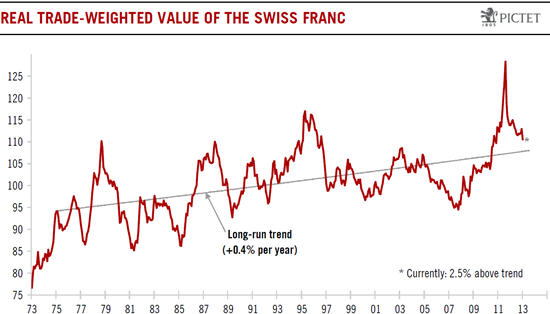
My first ever journey outside the UK was to Switzerland, that was back in 1971 when a pound sterling bought CHF 10.5. The Swiss economy has had to deal with a constantly rising exchange rate ever since. The chart below of the CHF Real Trade-Weighted value shows this most clearly: –

Real_Effective_CHF_Exchange_rate_EURCHF18_01_2013-

Source: Pictet

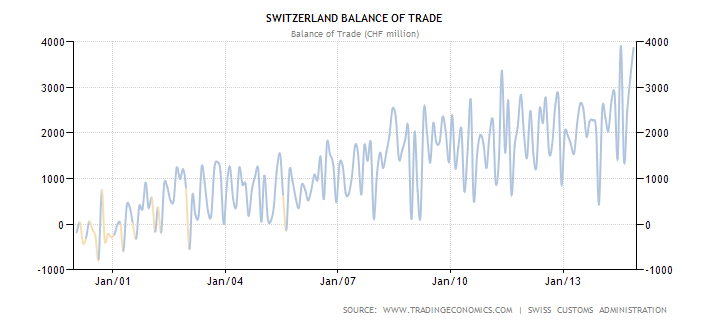
This chart only goes up to mid-2013, since then the USDCHF has moved from 0.88 and 0.99 by early January – after the unpegging the rate is near to its mid-point at 0.93. According to the Guardian – What a $7.54 Swiss Big Mac tells us about global currencies – the Swiss currency is now 33% overvalued. Exporters will be hit hard and the financial sector is bound to be damaged by commercial bank lending policies associated with pegging the CHF to a declining EUR. On Monday Bank Julius Baer (BAER.VX) announced plans to cut costs by CHF 100mln, domestic job cuts were also indicated – more institutions are sure to follow their lead. Meanwhile, there are bound to be emerging market borrowers which default. The Swiss economy will slow, exacerbating deflationary forces, but lower prices will improve the purchasing power of the domestic population. Switzerland’s trade balance hit a record high in July 2014 and came close to the same level in November:-

switzerland-balance-of-trade

Source: Trading Economics and Swiss Customs

In a recent newsletter – The Swiss Release the Kraken – John Maudlin quoted fellow economist Charles Gave in a tongue in cheek assessment of the SNB’s action:-

They [the SNB] didn’t mind pegging the Swiss franc to the Deutsche mark, but it is becoming more and more obvious that the euro is more a lira than a mark. A clear sign is the decline of the euro against the US dollar.

Mr. Draghi has been trying to talk the euro down for at least a year. This should not come as a surprise. After all, in the old pre-euro days, every time Italy had a problem, the solution was always to devalue.

But the Swiss, not being as smart as the Italians, do not believe in devaluations. You see, in Switzerland they have never believed in the ‘euthanasia of the rentier’, nor have they believed in the Keynesian multiplier of government spending, nor have they accepted that the permanent growth of government spending as a proportion of gross domestic product is a social necessity. The benighted Swiss, just down from their mountains where it was difficult to survive the winters, have a strong Neanderthal bias and have never paid any attention to the luminaries teaching economics in Princeton or Cambridge. Strange as it may seem, they still believe in such queer, outdated notions as sound money, balanced budgets, local democracy, and the need for savings to finance investments. How quaint!

Of course, the Swiss are paying a huge price for their lack of enlightenment. For example, since the move to floating exchange rates in 1971, the Swiss franc has risen from CHF4.3 to the US dollar to CHF0.85 and appreciated from CHF10.5 to the British pound to CHF1.5. Naturally, such a protracted revaluation has destroyed the Swiss industrial base and greatly benefited British producers [not!]. Since 1971, the bilateral ratio of industrial production has gone from 100 to 175…in favor of Switzerland.

And for most of that time Switzerland ran a current account surplus, a balanced budget, and suffered almost no unemployment, all despite the fact that nobody knows the name of a single Swiss politician or central banker (or perhaps because nobody knows a single Swiss politician or central banker, since they have such limited power? And that all these marvelous results come from that one simple fact: their lack of power.)

The last time I looked, the Swiss population had the highest standard of living in the world – another disastrous long-term consequence of not having properly trained economists of the true faith.

Swiss unemployment has been trending higher recently (3.4% in December) and this figure may rise as sectors such as banking and tourism adjust to the new environment, however, this level of unemployment is still enviable by comparison with other developed countries.

The following charts give an excellent insight into the nature of trade in the Swiss economy. Firstly, exports:-

Swiss_ExportsByCountry

Source: snbchf.com

The importance of the EZ is evident (46.4% excluding UK) however the next chart shows a rather different perspective:-

Swiss_TradeBalanceByCountry

Source: snbchf.com

The relative importance of the USA is striking – 11% of exports but nearly half of the trade surplus – so too, is the magnitude of the deficit with Germany, in fact, within Europe, only Spain and the UK are export surplus markets.

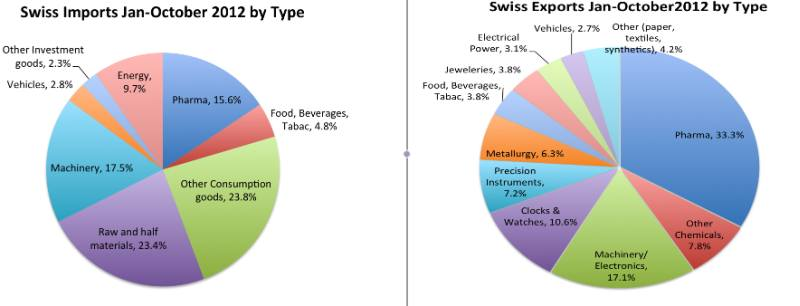
A closer look at the break-down of Imports and Exports by sector provides an additional dimension:-

Swiss-Imports-Exports-by-Type

Source: snbchf.com

The SNB already highlighted the import of energy as a significant factor – Switzerland’s energy bill is now much lower than it was in July 2014. The export of pharmaceuticals has always been of major importance – many of these products are inherently price inelastic, the rise in the currency will have less impact on Switzerland than it might do on other developed economies.

Conclusion and investment opportunities

“The reports of my death are greatly exaggerated.” Mark Twain

Contrary to what several commentators have been suggesting, I do not believe the SNB capitulation marks the beginning of the end of central bank omnipotence – they were never that omnipotent in the first place. The size of the SNB balance sheet is also testament to the limits of QE – if the other G7 central banks expand to 80% of GDP the total QE would more than triple from $10.5 trln to $33.6 trln – and what is to say that 80% of GDP is the limit?

Swiss Markets

Switzerland will benefit from a floating currency in the longer term, although the recent abrupt appreciation may lead to a recession – which in turn should reduce upward pressure on the CHF. Criticism of the SNB for creating greater volatility within the Swiss economy is only partially justified, the excessive rise of the CHF effective exchange rate was due to external factors and the SNB felt it needed to be managed, the subsequent rise in the US$ has brought the CHF back to a more realistic level but the current environment of zero interest rate policy adopted by several major central banks has parallels with the conditions seen after the collapse of Bretton Woods.

I believe the SNB anticipates an acceleration in the long term trend rate of appreciation of the CHF. Swiss exports, even to the US, will be impaired but German imports will be cheaper – with a record trade surplus, this is a good time to start the adjustment of market expectations about the value of the CHF going forward. Swiss companies are used to planning within a framework which incorporates a steadily rising value of their currency – now they must anticipate an acceleration in that trend.

The money and bond markets will remain distorted and, in the event of another EZ crisis, the SNB may increase the penalties for access to the “safe-haven” Switzerland represents: and, as indicated, they may intervene again if the capital flows become excessive. 20 year, or longer, Confederation Bonds, alone, offer positive carry, buying call spreads on shorter maturities is a strategy worth considering.

The SMI Index is likely to lag the broader European market, but negative bond yields offer little alternative to stocks and domestic investors will exhibit a renewed cognizance of the risk of foreign currency investments. The SMI Index, at around 8550, is only 7.6% below the level it was trading prior to the SNB announcement. Swiss stocks will undoubtedly benefit from any export led European economic recovery. Meanwhile, the relative strength of the US economy appears in tact – the Philadelphia Fed Leading Indexes for December – released earlier this week – suggest economic expansion in 49 states over the next six months.

Eurozone Markets

The EZ has already been aided by the departure of its strongest “shadow” member; combined with the ECB’s Expanded Asset Purchase Programme (EAPP) this should drive the EUR lower. European stocks have already taken heart, fuelled by the new liquidity and international competitiveness.

European bond spreads continue to compress. Fears of peripheral countries exiting the single currency area will provide volatility but for the major countries – France, Italy and Spain – any weakness is still a buying opportunity, but at these, often negative real-yields, they should be viewed as a “trading” rather than an “investment” asset.

Greece, Germany and the ECB: and what it means for Bonds, Stocks and the Euro

400dpiLogo

Macro Letter – No 27 – 9-1-2015

Greece, Germany and the ECB and what it means for Bonds, Stocks and the Euro

  • Greek elections this month have rekindled concern about the future of the Euro
  • Germany is beginning to consider the ramifications of a Greek exit from the EMU
  • European bonds – excluding Greece – continue to rise as EUR/USD falls
  • The ECB needs to make good on its promise to do “whatever it takes” 


Greece is back in the spotlight amid renewed fears of a break-up of the Euro as the Syriza party show a 3.1% lead over the incumbent New Democracy in the latest Rass opinion poll – 4th January. The average of the last 20 polls – dating back to 15th December shows Syriza with a lead of 4.74% capturing 31.9% of the vote.

These election concerns have become elevated since the publication of an article in Der Spiegel Grexit Grumblings: Germany Open to Possible Greek Euro Zone Exit -suggesting that German Chancellor Merkel is now of the opinion that the Eurozone (EZ) can survive without Greece. Whilst Steffen Seibert – Merkle’s press spokesman – has since stated that the “political leadership” isn’t working on blueprints for a Greek exit, the idea that Greece might be “let go” has captured the imagination of the markets.

A very different view, of the potential damage a Greek exit might cause to the EZ, is expressed by Market Watch – Greek euro exit would be ‘Lehman Brothers squared’: economist quoting Barry Eichengreen, speaking at the American Economic Association conference, who described a Greek exit from the Euro:-

In the short run, it would be Lehman Brothers squared.

Writing at the end of last month the Economist – The euro’s next crisis described the expectation of a Syriza win in the forthcoming elections:-

In its policies Syriza represents, at best, uncertainty and contradiction and at worst reckless populism. On the one hand Mr Tsipras has recanted from his one-time hostility to Greece’s euro membership and toned down his more extravagant promises. Yet, on the other, he still thinks he can tear up the conditions imposed by Greece’s creditors in exchange for two successive bail-outs. His reasoning is partly that the economy is at last recovering and Greece is now running a primary budget surplus (ie, before interest payments); and partly that the rest of the euro zone will simply give in as they have before. On both counts he is being reckless.

In theory a growing economy and a primary surplus may help a country repudiate its debts because it is no longer dependent on capital inflows.

The complexity of the political situation in Greece is such that the outcome of the election, scheduled for 25th January, will, almost certainly, be a coalition. Syriza might form an alliance with the ultra-right wing Golden Dawn who have polled an average of 6.49% in the last 20 opinion polls, who are also anti-Austerity, but they would be uncomfortable bedfellows in most other respects. Another option might be the Communist Party of Greece who have polled 5.8% during the same period. I believe the more important development for the financial markets during the last week has been the change of tone in Germany.

The European bond markets have taken heed, marking down Greek bonds whilst other peripheral countries have seen record low 10 year yields. 10 year Bunds have also marched inexorably upwards. European stock markets, by contrast, have been somewhat rattled by the Euro Break-up spectre’s return to the feast. It may be argued that they are also reacting to concerns about collapsing oil prices, the geo-political stand-off with Russia, the continued slow-down in China and other emerging markets and general expectations of lower global growth. In the last few sessions many stock markets have rallied strongly, mainly on hopes of aggressive ECB intervention.

Unlike the Economist, who are concerned about EZ contagion, Brookings – A Greek Crisis but not a Euro Crisis sees a Euro break-up as a low probability:-

A couple of years ago the prospect of a Syriza-led government caused serious tremors in European markets because of the fear that an extremely bad outcome in Greece was possible, such as its exit from the Euro system, and that this would create contagion effects in Portugal and other weaker nations. Fortunately, Europe is in a much better situation now to withstand problems in Greece and to avoid serious ramifications for other struggling member states. The worst of the crisis is over in the weak nations and the system as a whole is better geared to support those countries if another wave of market fears arise.

It is quite unlikely that Greece will end up falling out of the Euro system and no other outcome would have much of a contagion effect within Europe. Even if Greece did exit the Euro, there is now a strong possibility that the damage could be confined largely to Greece, since no other nation now appears likely to exit, even in a crisis.

Neither Syriza nor the Greek public (according to every poll) wants to pull out of the Euro system and they have massive economic incentives to avoid such an outcome, since the transition would almost certainly plunge Greece back into severe recession, if not outright depression. So, a withdrawal would have to be the result of a series of major miscalculations by Syriza and its European partners. This is not out of the question, but the probability is very low, since there would be multiple decision points at which the two sides could walk back from an impending exit.

I think The Guardian – Angela Merkel issues New Year’s warning over rightwing Pegida group – provides an insight into the subtle change in Germany’s stance:-

German chancellor Angela Merkel in a New Year’s address deplored the rise of a rightwing populist movement, saying its leaders have “prejudice, coldness, even hatred in their hearts”.

In her strongest comments yet on the so-called Patriotic Europeans Against the Islamisation of the West (Pegida), she spoke of demonstrators shouting “we are the people”, co-opting a slogan from the rallies that led up to the fall of the Berlin Wall 25 years ago.

“But what they really mean is: you are not one of us, because of your skin colour or your religion,” Merkel said, according to a pre-released copy of a televised speech she was to due to deliver to the nation on Wednesday evening.

“So I say to all those who go to such demonstrations: do not follow those who have called the rallies. Because all too often they have prejudice, coldness, even hatred in their hearts.”

Concern about domestic politics in Germany and rising support for the ultra right-wing Pegida party makes the prospect of allowing Greece to leave the Euro look like the lesser of two evils. Yet a Greek exit and default on its Euro denominated obligations would destabilise the European banking system leading to a spate of deleveraging across the continent. In order to avert this outcome, German law makers have already begun to soften their “hard-line” approach, extending the olive branch of a potential renegotiation of the terms and maturity of outstanding Greek debt with whoever wins the forthcoming election. I envisage a combination of debt forgiveness, maturity extension and restructuring of interest payments – perish the thought that there be a sovereign default.

Carry Concern

Last month the BIS – Financial stability risks: old and new caused alarm when it estimated non-domestic US$ denominated debt of non-banks to be in the region of $9trln:-

Total outstanding US dollar-denominated debt of non-banks located outside the United States now stands at more than $9 trillion, having grown from $6 trillion at the beginning of 2010. The largest increase has been in corporate bonds issued by emerging market firms responding to the surge in demand by yield-hungry fixed income investors.

Within the EZ the quest for yield has been no less rabid, added to which, risk models assume zero currency risk for EZ financial institutions that hold obligations issued in Euro’s. The preferred trade for many European banks has been to purchase their domestic sovereign bonds because of the low capital requirements under Basel II. Allowing banks to borrow short and lend long has been tacit government policy for alleviating bank balance sheet shortfalls, globally, in every crisis since the great moderation, if not before. The recent rise in Greek bond yields is therefore a concern.

An additional concern is that the Greek government bond yield curve has inverted dramatically in the past month. The three year yields have risen most precipitously. This is a problem for banks which borrowed in the medium maturity range in order to lend longer. Fortunately most banks borrow at very much shorter maturity, nonetheless the curve inversion represents a red flag : –

Date 3yr 10yr Yield curve
14-Oct 4.31 7.05 2.74
29-Dec 10.14 8.48 -1.66
06-Jan 13.81 9.7 -4.11


Source: Investing.com

Over the same period Portuguese government bonds have, so far, experienced little contagion:-

Date 3yr 10yr Yield curve
14-Oct 1.03 2.56 1.53
29-Dec 1.06 2.75 1.69
06-Jan 0.92 2.56 1.64


Source: Investing.com

EZ Contagion

Greece received Euro 245bln in bail-outs from the Troika; if they should default, the remaining EZ 17 governments will have to pick up the cost. Here is the breakdown of state guarantees under the European Financial Stability Facility:-


Country Guarantee Commitments Eur Mlns Percentage
Austria 21,639.19 2.78%
Belgium 27,031.99 3.47%
Cyprus 1,525.68 0.20%
Estonia 1,994.86 0.26%
Finland 13,974.03 1.79%
France 158,487.53 20.32%
Germany 211,045.90 27.06%
Greece 21,897.74 2.81%
Ireland 12,378.15 1.59%
Italy 139,267.81 17.86%
Luxembourg 1,946.94 0.25%
Malta 704.33 0.09%
Netherlands 44,446.32 5.70%
Portugal 19,507.26 2.50%
Slovakia 7,727.57 0.99%
Slovenia 3,664.30 0.47%
Spain 92,543.56 11.87%
EZ 17 779,783.14 100%

Assuming the worst case scenario of a complete default – which seems unlikely even given the par less state of Greek finances – this would put Italy on the hook for Eur 43bln, Spain for Eur 28.5bln, Portugal for Eur 6bln and Ireland for Eur 3.8bln.

The major European Financial Institutions may have learned their lesson, about over-investing in the highest yielding sovereign bonds, during the 2010/2011 crisis – according to an FT interview with JP Morgan Cazenove, exposure is “limited” – but domestic Greek banks are exposed. The interconnectedness of European bank exposures are still difficult to gauge due to the lack of a full “Banking Union”. Added to which, where will these cash-strapped governments find the money needed to meet this magnitude of shortfall?

The ECBs response

ECB Balance Sheet - Bloomberg

Source: Bloomberg

In an interview with Handelsblatt last week, ECB president Mario Draghi reiterated the bank’s commitment to expand their balance sheet from Eur2 trln to Eur3 trln if conditions require it. Given that Eurostat published a flash estimate of Euro area inflation for December this week at -0.2% vs +0.3% in November, I expect the ECB to find conditions requiring a balance sheet expansion sooner rather than later. Reuters – ECB considering three approaches to QE – quotes the Dutch newspaper Het Financieele Dagbad expecting one of three actions:-

…one option officials are considering is to pump liquidity into the financial system by having the ECB itself buy government bonds in a quantity proportionate to the given member state’s shareholding in the central bank.

A second option is for the ECB to buy only triple-A rated government bonds, driving their yields down to zero or into negative territory. The hope is that this would push investors into buying riskier sovereign and corporate debt.

The third option is similar to the first, but national central banks would do the buying, meaning that the risk would “in principle” remain with the country in question, the paper said.

The issue of “monetary financing” – forbidden under Article 123 of the Lisbon Treaty – has still to be resolved, so Outright Monetary Transactions (OMT) in respect of EZ government bonds are still not a viable policy option. That leaves Covered bonds – a market of Eur 2.6trln of which only around Eur 600bln are eligible for the ECB to purchase – and Asset Backed Securities (ABS) with around Eur 400bln of eligible securities. These markets are simply not sufficiently liquid for the ECB to expand its balance sheet by Eur 1trln. In 2009 they managed to purchase Eur 60bln of Covered bonds but only succeeded in purchasing Eur 16.9bln of the second tranche – the bank had committed to purchase up to Eur 40bln.

Since its inception in July 2009 the ECB have purchased just shy of Eur 108bln of Covered bonds and ABS: –

Security Primary Secondary Total Eur Mlns Inception Date
ABS N/A N/A 1,744 21/11/2014
Covered Bonds 1 N/A N/A 28,817 02/07/2009 *
Covered Bonds 2 6015 10375 16,390 03/11/2011
Covered Bonds 3 5245 24387 29,632 20/10/2014
Total 76,583
* Original purchase Eur 60bln

Source: ECB

These amounts are a drop in the ocean. If the ECB is not permitted to purchase government bonds what other options does it have? I believe the alternative is to follow the lead set by the Bank of Japan (BoJ) in purchasing corporate bonds and common stocks. To date the BoJ has only indulged in relatively minor “qualitative” easing; the ECB has an opportunity to by-pass the fragmented European banking system and provide finance and permanent capital directly to the European corporate sector.

Over the past year German stocks has been relatively stable whilst Greek equities, since the end of Q2, have declined. Assuming Greece does not vote to leave the Euro, Greek and other peripheral European stocks will benefit if the ECB should embark on its own brand of Qualitative and Quantitative Easing (QQE):-

Athens_vs_DAX_one_year bloomberg

Source: Bloomberg               Note:      Blue = Athens SE Composite               Purple = DAX

It is important to make a caveat at this juncture. The qualitative component of the BoJ QQE programme has been derisory in comparison to their buying of JGBs; added to which, whilst the socialisation of the European corporate sector is hardly political anathema to many European politicians it is a long way from “lending at a penal rate in exchange for good collateral” – the traditional function of a central bank in times of crisis.

Conclusion and investment opportunities

European Government Bonds

Whilst the most likely political outcome is a relaxation of Article 123 of the Lisbon Treaty, allowing the ECB, or the national Central Bank’s to purchase EZ sovereign bonds, much of the favourable impact on government bond yields is already reflected in the price. 10 year JGBs – after decades of BoJ buying – yield 30bp, German Bunds – without the support of the ECB – yield 46bp. Aside from Greek bonds, peripheral members of the EZ have seen their bond yields decline over the past month. If the ECB announce OMT I believe the bond rally will be short-lived.

European Stocks

Given the high correlation between stocks markets in general and developed country stock markets in particular, it is dangerous to view Europe in isolation. The US market is struggling with a rising US$ and collapsing oil price. These factors have undermined confidence in the short-term. The US market is also looking to the Europe, since a further slowdown in Europe, combined with weakness in emerging markets act as a drag on US growth prospects. On a relative value basis European stocks are moderately expensive. The driver of performance, as it has been since 2008, will be central bank policy. A 50% increase in the size of the ECB balance sheet will be supportive for European stocks, as I have mentioned in previous posts, Ireland is my preferred investment, with a bias towards the real-estate sector.

The Euro

Whilst the EUR/USD rate continues to decline the Nominal Effective Exchange Rate as calculated by the ECB, currently at 98, is around the middle of its range (81 – 114) since the inception of the currency and still some way above the recent lows seen in July 2012 when it reached 94. The October 2000 low of 81 is far away.

If a currency war is about to break-out between the major trading nations, the Euro doesn’t look like the principal culprit. I expect the Euro to continue to decline, except, perhaps against the JPY. Against the GBP a short EUR exposure will be less volatile but it will exhibit a more political dimension since the UK is a natural safe haven when an EZ crisis is brewing.

Will the next phase of easing be “qualitative” ? Purchasing common stock

400dpiLogo

  • How can central banks normalise interest rates without puncturing the recovery?
  • Will long-term capital smooth the economic cycle?
  • What does “qualitative easing” mean for equities?


Last month saw the release of a report by the OMFIF – Global Public Investors – the new force in markets.These quotes are from their press release:-

Central banks around the world, including in Europe, are buying increasing volumes of equities as part of diversification by official asset holders that are now a global force on international capital markets. This is among the findings of Global Public Investor (GPI) 2014, the first comprehensive survey of $29.1tn worth of investments held by 400 public sector institutions in 162 countries.

The report, focusing on investments by 157 central banks, 156 public pension funds and 87 sovereign funds, underlines growing similarities among different categories of public entities owning assets equivalent to 40% of world output.

…One of the reasons for the move into equities reflects central banks’ efforts to compensate for  lost revenue on their reserves, caused by sharp falls in interest rates driven by official institutions’ own efforts to repair the financial crisis. According to OMFIF calculations, based partly on extrapolations from published central bank data, central banks around the world have foregone $200bn to $250bn in interest income as a result of the fall in bond yields in recent years.

…The survey emphasises the two-edged nature of large volumes of extra liquidity held by GPIs. These assets have been built up partly as a result of efforts to alleviate the financial crisis, through foreign exchange intervention by central banks in emerging market economies or quantitative easing by central banks in the main developed countries. But deployment of these funds on capital markets can drive up asset prices and is thus a source of further risks. ‘Many of these challenges [faced by public entities] are self-feeding’, the report says. ‘The same authorities that are responsible for maintaining financial stability are often the owners of the large funds that have the potential to cause problems.’

The report looks at Sovereign Wealth and Pension Funds as well as Central Banks but the trend towards diversification into equities should not be a surprise. In many countries official interest rates are below even official measures of inflation. It is a long time since government bonds were capable of providing sufficient income to match long term liabilities, but the recent fall in interest rates since the great financial recession has forced these institutions to diversify into higher risk assets.

China’s SAFE (State Administration for Foreign Exchange) has now become the world’s largest holder of publicly traded equities. They have established minority stakes in a number of European companies. Central Banking Publications found that 23 percent of Central Banks surveyed said they own shares or plan to buy them. Back in April the BoJ said it will more than double investments in equity exchange-traded funds to 3.5 trl yen this year.  Abe’s third arrow is looking feeble – buying a basket of Nikkei 225 names would be an expedient solution to his political woes.

The BIS – 84th Annual Report – released last week, focussed on the need to move away from debt:-

The main long-term challenge is to adjust policy frameworks so as to promote healthy and sustainable growth. This means two interrelated things.

The first is to recognise that the only way to sustainably strengthen growth is to work on structural reforms that raise productivity and build the economy’s resilience.

…The second, more novel, challenge is to adjust policy frameworks so as to address the financial cycle more systematically. Frameworks that fail to get the financial cycle on the radar screen may inadvertently overreact to short-term developments in output and inflation, generating bigger problems down the road. More generally, asymmetrical policies over successive business and financial cycles can impart a serious bias over time and run the risk of entrenching instability in the economy. Policy does not lean against the booms but eases aggressively and persistently during busts. This induces a downward bias in interest rates and an upward bias in debt levels, which in turn makes it hard to raise rates without damaging the economy – a debt trap.

… In the longer term, the main task is to adjust policy frameworks so as to make growth less debt-dependent and to tame the destructive power of the financial cycle. More symmetrical macroeconomic and prudential policies over that cycle would avoid a persistent easing bias that, over time, can entrench instability and exhaust the policy room for manoeuvre.

The BIS doesn’t go so far as to promote the idea of central banks buying common stock but neither does it imply that this policy would meet with many objections from the central bankers central bank.

For a more radical argument in favour of central bank buying of common stock I am indebted to Prof. Roger Farmer of UCLA –  Qualitative easing: a new tool for the stabilisation of financial markets. In this speech, given at the Bank of England –John Flemming Memorial Lecture last October, Prof. Farmer elaborated on his ideas about “Qualitative Easing”: –

 …When I refer to quantitative easing I mean a large asset purchase by a central bank, paid for by printing money. By qualitative easing, I mean a change in the asset composition of the central Bank.

…In this talk I argue that qualitative easing is a fiscal policy and it is a tool that should be permanently adopted by national treasuries as a means of maintaining financial stability and reducing persistent long-term unemployment.

…My proposed policy tool follows directly from my research findings of the past twelve years. Those findings demonstrate that, by trading in asset markets, national treasuries can and should act to prevent swings in asset prices that have had such destructive effects on all of our lives.

…asset market volatility and unemployment are closely correlated and I will argue that by stabilising asset markets, we can maintain demand and prevent the spectre of persistent unemployment.

…Although there are very good arguments for the use of government expenditure to repair infrastructure during recessions, we should not rely on countercyclical government investment expenditure as our primary tool to stabilise business cycles. Qualitative easing is an effective and more efficient alternative.

…The crisis was caused by inefficient financial markets that led to a fear that financial assets were overvalued. When businessmen and women are afraid, they stop investing in the real economy. Lack of confidence is reflected in low and volatile asset values. Investors become afraid that stocks, and the values of the machines and factories that back those stocks, may fall further. Fear feeds on itself, and the prediction that stocks will lose value becomes self-fulfilling.

…My work demonstrates that the instability of financial markets is not just a reflection of inevitable fluctuations in productive capacity; it is a causal factor in generating high unemployment and persistent stagnation. The remedy is to design an institution, modelled on the modern central bank, with both the authority and the tools to stabilise aggregate fluctuations in the stock market.

These arguments are the heady stuff of political economy and put me in mind of the two views epitomised by the quotes below: –

“Centralization of the means of production and socialization of labor at last reach a point where they become incompatible with their capitalist integument. Thus integument is burst asunder. The knell of capitalist private property sounds. The expropriators are expropriated.”

Karl Marx – Das capital- 1867


“The traditional, correct pre-Marxist view on exploitation was that of radical laissez-faire liberalism as espoused by, for instance, Charles Comte and Charles Dunoyer. According to them, antagonistic interests do not exist between capitalists, as owners of factors of production, and laborers, but between, on the one hand, the producers in society, i.e., homesteaders, producers and contractors, including businessmen as well as workers, and on the other hand, those who acquire wealth non-productively and/or non-contractually, i.e., the state and state-privileged groups, such as feudal landlords.”

Hans-Hermann Hoppe – The Economics and Ethics of Private Property – 1993

There is a precedent for aggressive central bank intervention in equity markets. In August 1998 the HKMA responded to the forth wave of speculative attacks on the currency peg by buying equities. During the second half of August 1998 the HKMA, through its Exchange Fund, bought HK$118 bln (US$15bln) of Hang Seng constituent stocks – 8% of the total market capitalisation. It also intervened in the Hang Seng futures market, creating a violent short squeeze.  In order to further discourage speculators the HKMA mandated the prompt settlement of all outstanding trades, forcing naked short sellers to source stock loans. Having given the speculators a few days to get their stock borrow in place it then imposed a short selling ban on some of the more liquid names.

The Exchange Fund disposed of some of its holding, bringing the percentage of the Hang Seng it held down to 5.3% by 2003. By 2006 it had crept back up to more than 10%. The Exchange Fund currently manages HK$3032.8bln and is permitted to hold up to 20% in equities. According to the HKMA- 2013 Annual Report they held HK$ 153bln of Hong Kong equities and HK$ 297bln of US equities.

The Future of Central Banking

The developed world’s savers are being decimated to fund the profligacy of borrowers. Polonius’s advice to his son today would surely be “Never a lender, always a borrower be.”Major central banks are struggling with this dilemma. Interest rates are close to the zero bound in most developed countries. These are negative real-rates of return. At some point interest rates need to normalise, but the markets are hooked on the methadone of cheap and plentiful money.  Taking away the punchbowl is the central banker remedy for an “Inflation Party”, closing the cocktail bar in the current environment would risk sending the world economy “cold turkey” and potentially killing the patient.

I believe we will see more central bank buying of agency bonds, corporate debt, including convertibles and finally common stock. The objective will be to maintain stability of employment in the wider economy and provide long term capital to support economic growth. This will favour certain companies: –

  1. Large employers – the primary objective is “full employment”
  2. Large capitalisation names – even if the purchases are evenly weighted it will favour the largest stocks by market capitalisation
  3. Non-financial firms – the secondary objective is to supply capital to the real-economy, financial institutions are principally intermediaries
  4. Industries where trade union membership is higher – due to greater political influence
  5. Industries which are the favoured recipients of state subsidies and patronage

The “dispossessed” will be: smaller listed and non-listed companies.

Implications for asset allocation

Where the central banks lead I believe we should follow. Bond yields will inevitably rise as interest rates normalise and institutions switch increasing quantities of their assets to equities. As bond yields rise the attraction of real-estate will diminish due to increased financing costs – though I would make the caveat that property is always about “location”. Equities will benefit from a world-wide, state-sponsored version of the “Greenspan Put”. This doesn’t mean that stock markets will be a one way bet, but valuation models need to incorporate the prospect of this newly minted “wall of money” into their calculations of what represents “value”.

Remember, also, that there will be two distinct types of central bank investment: that which is designed to support domestic employment and that which is driven by the quest for an acceptable rate of return. Many common stocks now offer a higher dividend yield than government bonds, a situation which has not been seen for several decades. In a low inflation environment this should persist, but in pursuit of their inflation targets central banks are likely to distort this relationship once more. It is hard to dispute that this looks like a variant of the Cantillon Effect.

Implementing structural reform is politically difficult, mandating ones central bank to buy the stock market is much easier. There will be pockets of resistance from those who question whether it is appropriate for central banks to control the equity market but this is the least painful exit from the current impasse. The foreign exchange reserves of emerging market central banks have ballooned since the 1997/1998 Asian crisis. Their governments mercantilist policies rely on developed market consumption. Come the next major crisis, it won’t be just the “big five” central banks acting in isolation a concert party of elite capital will save the day.