An Italian stress-test

400dpiLogo

Macro Letter – No 23 – 07-11-2014

An Italian stress-test

240px-Palazzo_Salimbeni_Siena

Palazzo Salimbeni – Siena

  • After the ECB Comprehensive Assessment Italian Banks appear the “weakest link”
  • Italian bank ownership of BTPs is a growing concern if the “carry trade” should unravel
  • Italian stocks have performed better since March but Real-Estate looks better value

Last week I visited Tuscany for the first time in twenty years. Pictured above is of the head office of Banca Monte dei Paschi di Siena. Monte dei Paschi – founded in 1472 – is generally deemed to be the longest established bank in the world. When I visited the city in 1994 their splendid head office, originally the seat of the Salimbeni family, was not open to the public. In the past month in what looks like a “charm offensive” this situation has changed. It is now possible to peruse the bank’s fine collection of art and ponder on the challenges of operating a modern bank in a medieval building.

The change of attitude towards visitors may have been in response to the Banca D’Italia bail-out in January of last year. Monte dei Paschi suffered Eur 2bln in losses in the aftermath of the 2008 financial crisis. Then ,in 2009, they entered into a series of derivative contracts with Deutsche Bank and Nomura which led to further losses in late 2012. The central bank was forced to act since Monte dei Paschi is the third largest banking institution in Italy – though some distance behind Intesa and Unicredit.

AQR Stress

Last week also saw the release of the ECB Comprehensive Assessment. This included the Asset Quality Review (AQR) of the largest 123 financial institutions in Europe. 25 banks failed the test – eight of them were Italian. The tests were performed early this year and of the 25 banks 12 had addressed their capital shortage issues by the time of the publication of the results, however, Monte dei Paschi had the largest shortfall (Eur 2.11bln) and its share price declined by more than 20% on the news. Here is a list of the Italian banks, before and after their capital raising efforts:-

Bank Shortfall Capital Raised Net Shortfall
Monte dei Paschi di Siena 4.25 2.14 2.11
Banca Carige 1.83 1.02 0.81
Veneto Banca 0.71 0.74 0
Banca Popolare di Milano 0.68 0.52 0.17
Banca Popolare di Vicenza 0.68 0.46 0.22
Credito Valtellinese 0.38 0.42 0
Banca Popolare di Sondrio 0.32 0.34 0
Banca Popolare dell’Emilia Romagna 0.13 0.76 0
Italian Bank Total 8.98 6.4 3.31

Source: ECB

The Economist – The ECB’s asset Quality Review : Stressful tests sheds more light on what has changed since the last review of European banks: –

The European Central Bank (ECB) simultaneously to the stress-tests has carried out a comprehensive audit of the value of the stuff on each bank’s balance sheet, the Asset Quality Review (AQR). This was only applied to 123 big banks in the euro zone’s 18 countries, which from next month will be regulated by the ECB instead of national watchdogs. 

The ECB found €136 billion in troubled loans banks had not already confessed to owning, bringing the European total to €879 billion ($1.1 trillion). Italy will have to implement the biggest reclassification of loans (€12 billion), with Greek (€8 billion) and German banks (€7 billion) also challenged. Interpreting the results, even at aggregate level, is complicated by the fact that they are arrived at using data from the end of 2013—and much has happened since then. Notably, many banks that thought they might fail the tests have raised over €45 billion in equity, strengthening them considerably. That explains why only 13 banks will have to unveil plans to raise capital when 25 have apparently failed, including Eurobank in Greece, Monte dei Paschi di Siena in Italy and Portugal’s BCP, the only three with more than €1 billion to raise. They now have to come up with plans to strengthen their balance sheets.

For a different perspective on the ECB Comprehensive Assessment the Peterson Institute – Whither Europe’s Banks after the Stress Test? Makes for interesting reading:-

Beyond the 25 banks that failed the test, other banks face difficulties because the asset quality review forced them to acknowledge their exposure to €135.9 billion in nonperforming loans (NPLs) and write down their assets by €47.5 billion. As mentioned above, only €10.7 billion of this sum was uncovered in banks that failed the comprehensive assessment, leaving around €37 billion of these asset write-downs to be recognized on the books of other euro area banks in the coming quarters. The ECB must now aggressively require banks to recognize these losses.

…International banking authorities have agreed to introduce a new definition of capital for banks to be applicable in 2017. Although this new standard—known as the “fully loaded Common Equity Tier 1 (CET1) ratio” —was not part of the comprehensive assessment, the comprehensive assessment published the data so that financial markets can apply the standard to more fully understand the future state of euro area banks. The CET1 standard is much tougher on banks, as it excludes various lax interim arrangements and accounting standards used by banks before they adopt the new standard. The most notorious of these is the ability of banks to employ what are known as deferred tax assets, which enable the banks to inflate the amount of risk capital they have with what has in many cases been essentially a government fiscal transfer to the banks through the backdoor. The effects of these shenanigans in the comprehensive assessment were to let banks avoid having to add €126.2 billion in new capital to get to the new CET1 standard. Were they to have to add that amount, many more banks would have failed the test. German banks benefitted the most from these issues by €33 billion. Spanish banks get away with not having to add €25 billion in new capital, and Italian banks, €16 billion. The fully loaded CET1 data, which is provided for the adverse scenario for the year 2016, better indicates how banks will fare as the new supervisory rules come into force.

Peterson point out that under the fully-loaded CET1 capital definition a further four Italian banks would have failed the stress tests.

The Brookings Institute – Despite Headlines, it’s Good News on Europe’s Banks, but with Some Risk for the ECB has an altogether more sanguine view: –

European banks are in much better shape than many had feared, if the results announced yesterday for the combined “asset quality review” and “stress tests” are accurate measures of the underlying situation and future prospects for the banks. I know the key people involved and they are highly professional and had a strong incentive not to be too lenient, so I tend to take these results as truly positive. They had political room to produce somewhat more pessimistic results, so I interpret these optimistic findings as their true beliefs. On the downside, the European Central Bank (ECB) now “owns” any major banking problems in Europe and runs real risks if these tests were in fact too optimistic, or even if they were broadly right but new problems develop. Observers generally will not distinguish after the fact between new problems and the playing out of old weaknesses. It is hard to read these results as excessively harsh, which would have been the only protection for the ECB.

What was so good about the results? Only 10 percent or 13 banks out of 130 need to raise any additional capital and the total requirement is a miniscule 10 billion euros compared to 22 trillion euros of assets owned by these banks. This not only says positive things about the current state of the banking system, but also removes the threat of regulatory pressure to deleverage further, which might have inhibited needed lending.

Returning, specifically to the Italian banks Bruegel – Monday blues for Italian banks – suggests that for Italy there is still a long way to go:-

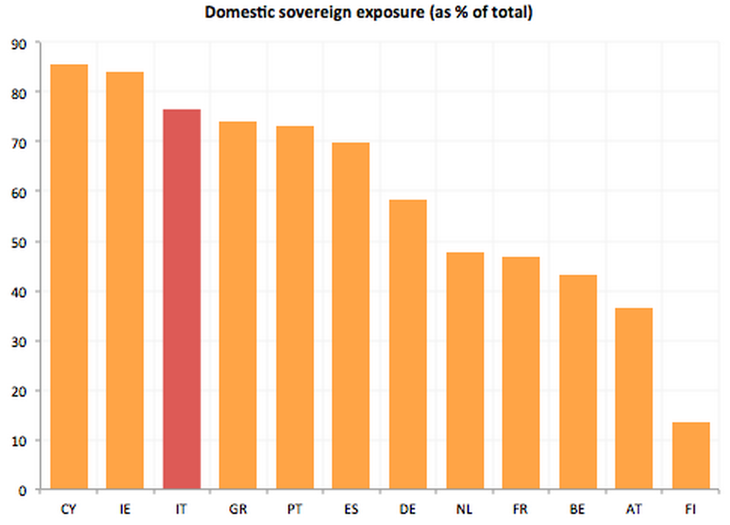
…the Italian banking system is still keeping in place a strong liason dangereuse with the (huge) government debt. This is not at all a special feature of Italian banks (as Figure 1 shows) but with almost 80% of their sovereign long direct gross exposures concentrated on Italy, Italian banks are found in this supervisory exercise to be among the most exposed to the sovereign debt issued by the domestic sovereign. Actually, if one excludes the countries that have been or are under a EU/IMF macroeconomic adjustment programme, Italian banks are the most exposed in the Eurozone.

Domestic Sovereign debt exposure of EU banks

Source: EBA

More interestingly, the exercise shows that this “home bias”, which is deeply at the root of the sovereign-banking vicious circle that characterised the euro crisis, has even worsened over the last three years.

…Sovereign debt accounts by now for around 10% of total assets of Italian banks, on average. The carry trade on these holdings might have kept banks afloat over the last 3 years, but these gains are actually concealing deeper structural issues that Italian banks have – until now – never been forced to face in full.

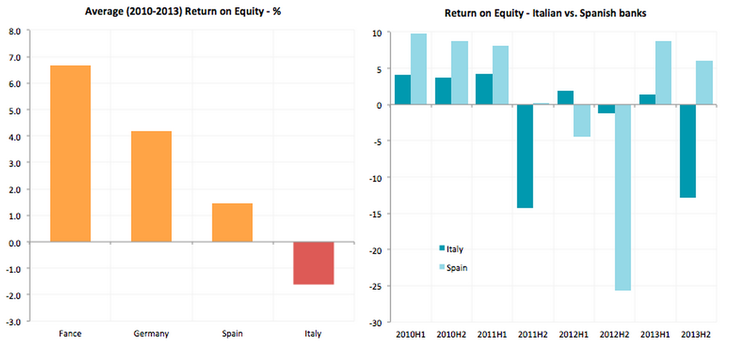
One such long-known problem of the Italian banking system is profitability, which is (and has been for quite a while now) very low. According to ECB data, average return on equity has been negative over the period 2010-2013 and the comparison with Spanish banks is especially striking. After the huge drop in return on equity during 2012, Spanish banks recovered, whereas Italian banks seemed to have never done it (Figure 2).

Italian vs Spanish Banks ROI

Source: EBA

Bruegel goes on to highlight the lack of restructuring of the Italian banking system and suggest that it is ripe for significant consolidation. Being Italy, this will undoubtedly be a more protracted process due to the complex legal structure of many financial institutions and the length of the judicial process. For a detailed review of the Italian judicial system this IMF – Italy Selected Issues paper may be of interest.

Italian Growth

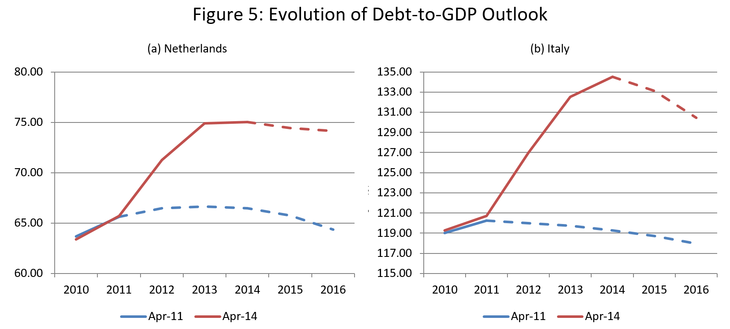
So what are the prospects for Italy now that the banks have almost got their houses in order? The European Commission – Autumn Forecast – released this week – is less than encouraging. Italy is expected to contract -0.4% in 2014 after a decline of -1.9% last year. 2015 is anticipated to see growth returning but only to +0.4%. The Italian government has attempted to reign in public spending but austerity measures have failed to stem the rising ratio of debt relative to GPD. The chart below, also from Bruegel, compares the situation in Italy with that in the Netherlands:-

Italy and Netherland Government debt to GDP

Source:IMF

The dotted lines show the forecast at each stage. It is some comfort to observe that this is not just an Italian problem but the size of the Italian government debt is, as usual, substantial.

Another important issue to consider when analysing the prospects for Italy is the substantial economic differences between the regions. This Wikipedia map shows the GDP/capita in 2008:-

italian_GDP_per_head_2008

Source: Wikipedia

My sojourn in Tuscany provided an insight into an “average area” consisting of agriculture and mostly light industry. The agricultural sector is a combination of small holdings, mostly in the north, and larger agro-industry around Maremma. Industry is diversified, although metallurgical firms are still prevalent despite the decline in mining. Service, including banking, and tourism are also significant contributors to the economy of the region.

This is neither the industrial heartland of the Northern League nor the administrative metropolis of Roma but it makes an interesting contrast with other parts of Europe and reveals the slow pace of Italian development over the past two decades. The Italian expression “La Bella Figura” (Nice appearance) as mentioned by Silvia Merler of Bruegal captures the essence of the problem. Italy is a little too comfortable.

In a speech in September by Salvatore Rossi – Senior Deputy Governor of the Banca D’Italia – Finance for Growth he reflected on some “home truths” about the state of the Italian economy:-

Italy has long strayed from the path of economic growth. Common sense tells us this is so and the data confirm it.

In the last six years the recession has doubled the rate of unemployment and eroded 11 percentage points from per capita GDP. But our problems go back much further than that: in 2008, on the eve of the financial crisis, the average amount of goods and services produced by Italian workers was basically unchanged from 1995. In the same period other countries, spurred by the technological paradigm shift of ICT, had seen their productivity rates soar.

The strong growth in employment that was nevertheless recorded in Italy in the pre-crisis years, favoured by the introduction of more flexible work contracts, proved insufficient to offset the effect of the stagnation of productivity on households’ disposable income. At the outbreak of the crisis, for the average household this was at the same level as in the mid-1990s and only the progressive reduction of the saving rate had enabled modest growth in consumption.

The diminishing ability to generate income heralds a decline in living standards, both with respect to this country’s past and to the world’s main players. This is all the more worrying when one considers that in forty years’ time the ratio of people of working age (20-69) to elderly retirees will have halved, from 4 to 2. Even just to maintain per capita living standards at their current levels would require an increase in labour productivity of 25 per cent.

Rossi goes on to discuss the need for finance to help the large number of small companies to grow. He observes that in other countries small firms either succeed and expand rapidly or wither and die whilst in Italy they simply limp on. Rossi discusses the need for economic reform. I believe it requires a serious crisis to achieve these goals.

Bonds

As mentioned earlier in this article, Italian banks are significant holders of BTPs. The European convergence trade has been extremely profitable and hopes that the ECB will begin outright monetary purchases (OMT) should the EZ head into a deep recession means the market prices these bonds with an implicit “put option” attached. I believe this is a far from certain. Only last month we saw a brief panic in the Greek bond market – Italian 10 yr yields followed suit rising by more than 25bp. I see little value remaining long 10yr BTPs at current yields – 2.43% – they have come a long way since their November 2011 lows when they touched 7.50%.

Stocks

The chart below shows the FTSE MIB Index vs EuroStoxx 50 ETF. The Italian stock market has been lagging the broader European market for s significant time as Deputy Governor Rossi’s speech about the lack of economic growth prior to the 2008 crisis observes. However, it is worth noting that the MIB has outperformed EuroStoxx since March of this year, perhaps reflecting concerns about slower growth in France and Germany:-

MIB vs Eurostoxx 50 ETF - 10yr

Source: Yahoo Finance

Sadly the ETF data only stretches back to 2005, nonetheless, this clearly demonstrates the profound underperformance of Italian stocks. The MIB may be outperforming this year but I believe the catalyst is an external slowdown rather than expectation of significant internal growth.

Real-Estate

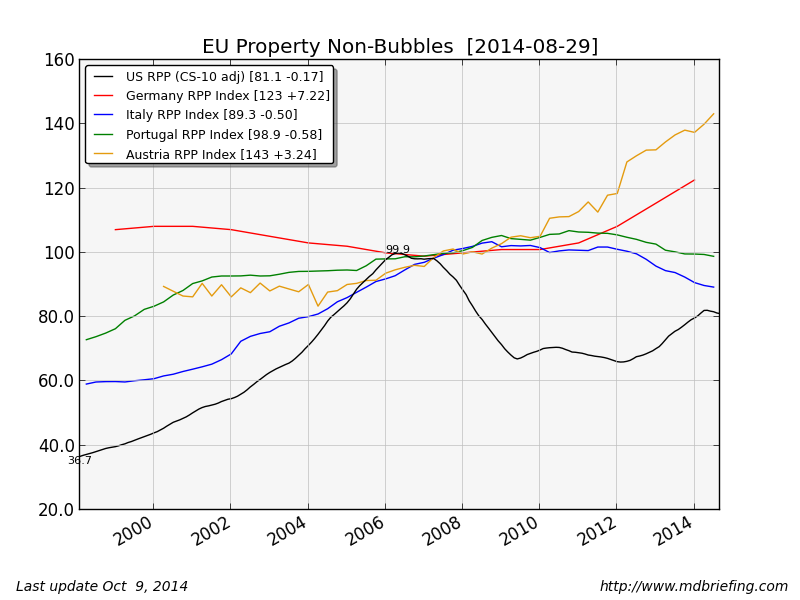
Italian property prices followed the trend seen in many other parts of Europe during the last twenty years but the rise has been muted. This article published in February by Global Property Guide – Italy’s house prices down 6.5% on the year. Will it ever end? Provides some useful background about home ownership and Loan to Value (LTV)rates, it also reflects on the fall in mortgage rate:-

The average interest rate for new housing loans was 2.92% from May 2009 to March 2011, but then rose to a maximum of 4.3% in February 2012. After the ECB rate was reduced from 1% to around 0.75% in July 2012, the average interest rate for house purchases also started declining along with the ECB rate. In November 2013, the interest rate for new housing loans was at 3.54%.

Across the country, Italian house prices have been declining since 2009, however, unlike some other European countries the Italian mortgage market is relatively under developed and LTV rates remain subdued. Whilst debt is a major issue for Italy, mortgage debt acts as less of a fiscal drag on the economy than in the UK or Ireland.

EU Property prices - mdbriefing

Source: MD Briefing

Recent price trends suggest that a recovery is under way. Milanese housing is now forecast to rise by around 4% in 2014 – earlier this year expectations were for continued price declines. The initial resurgence in demand is likely to emanate from the commercial sector. International demand for tourist property will be subdued by the supply overhang in Spain and Portugal but, once the new TASI property tax has worked its way through the system, the broader market will start to clear.

Conclusion and investment opportunities

The correction in Real-Estate prices in Italy has been relatively subdued in comparison with Spain, Portugal or Ireland but, despite additional taxation, the market is showing nascent signs of recovery. This is partly due to the significant reduction in mortgage rates since 2012. Italian property did rise substantially between 2000 and 2008 (around 85%) but this is moderate in comparison with some other EZ countries.

As an investment opportunity Real-Estate is preferable to BTPs or the Italian stock market. Italian REITs have been available since 2006 but recent changes to rules introduced in August may make the market more vibrant; this article from RE Europe -Italy makes REIT regime more competitive internationally, to grow sector by attracting foreign investment provides more detail. Before diving into, what is clearly, a limited market, this article from Bloomberg – Italy seeks to ease REIT rules is also worth reading.

Italy has weaker growth and demographic prospects than some other Europen countries and therefore Real-Estate investment opportunities will be better elsewhere in the EZ, but within Italy I prefer this sector to Bonds or Stocks. After all, at 74.1% Italy is 24th in the world ranking by property ownership (2012 data). After five years of declining prices housing is now more affordable. As the economy recovers from the weakness of 2013 latent demand should emerge. As the picture at the start of this article shows an Italian’s home is his castle.

The Celtic Tiger and the Eurozone periphery

400dpiLogo

Macro Letter – No 22 – 24-10-2014

The Celtic Tiger and the Eurozone periphery

  • Ireland has the lowest yield of troubled nations of the Eurozone periphery
  • The Irish stock market has performed well this year
  • Irish Real-Estate has begun to rebound – is this more than a convergence game?

Last week, for the first time in almost a decade, I visited Dublin. Like so many capital cities, Dublin gives one a very different perspective on a country’s economy than the provinces. Seen from this vantage, the Celtic Tiger has re-emerged like a phoenix from the ashes of the Great Recession. At the IMF-World Bank annual meeting on 10th October, Central Bank of Ireland (BCOI) Governor Patrick Honohan, Alternate Governor for Ireland of the IMF gave an interesting up-date on the state of the Irish economy: –

The Irish economy is emerging from the crisis and there are clears signs that economic recovery is underway. GDP growth of 0.2 per cent was recorded last year and data for the first half of this year were very strong and were well ahead of consensus expectations. The increase in economic activity is broadly-based with both domestic sectors and exporting sectors performing strongly. Although below our domestic forecasts, we welcome the WEO’s projection of 3.6 per cent GDP growth in Ireland for 2014.

Labour market recovery is clearly underway. Employment has increased in each of the last seven quarters representing an increase of over 70,000 jobs since the low-point in mid-2012. This reflects recovery of almost a quarter of jobs lost since the crisis. In line with this, the unemployment rate stood at 11.1 per cent in September, down from a peak of 15.1 per cent in early 2012. While this is still unacceptably high, it is certainly moving in the right direction.

Domestic demand has stabilised and is showing encouraging signs of growth. Consumer spending is improving as confidence returns, while firms are investing in plant and machinery once again.

Due to its relatively small domestic market, Ireland’s growth model must be export oriented. Exports are expected to gain ground this year as demand in Ireland’s main export markets, particularly the UK, continues to hold up. In addition, on the basis of the latest trends, the impact of patent expiry in the pharmaceutical sector appears to have passed.

Mr Honohan then went on to discuss the state of Irish public finances:-

Targets to reduce the underlying General Government deficit have been over achieved to date. Reflecting the continued prudent budgetary stance, the General Government deficit for 2014 is now likely to be of the order of 3.5% of GDP down from 8 per cent of GDP in 2012. The size of the consolidation undertaken has been of the order of 18 per cent of GDP since 2008.

Ireland emerged successfully and on schedule from the EU/IMF programme at the end of 2013 and, in 2014, has returned to participating normally in the sovereign debt markets. Our successful exit was based on a number of factors – both domestic and international – including the Government’s steadfast delivery on its programme commitments, the extension of the maturities on the European portion of our programme loans, and the interventions by the ECB to calm the wider euro crisis.

Concerns still remain about the Irish Banking system and October sees the launch of the Strategic Banking Corporation of Ireland (SBCI) which will side-step the traditional and lend to SMEs. Unlike many countries where demand for business loans is anaemic, Ireland has seen a dramatic increase in new businesses this year – according to data from Vision.net 10,700 new enterprises were incorporated in Q1 2014, up 6% on 2013. During the same period insolvencies were down 23%. A slight concern is that new construction company start-ups were up 29%. According to CBOI data house prices nationally are up around 7.5% y/y in May 2014 and within the Dublin area by 15%.

The Central Bank of Ireland – Consultation Paper 87 – highlights measures being taken to avoid another housing bubble by the introduction of macro-prudential policies aimed at limiting excessive leverage in the mortgage market. The proposals are as follows:-

Restrict new lending for principal dwelling houses (PDH) above 80 per cent LTV to no more than 15 per cent of the value of all new PDH loans.

Restrict new lending for PDHs above 3.5 times LTI to no more than 20 per cent of the value of all new PDH loans.

Restrict new lending to buy-to-let above 70 per cent LTV to no more than 10 per cent of the value of all housing loans for investment purposes.

The rise in house prices is almost certainly due to a lack of supply coupled with strong population growth. The 2011 Census – published in June confirmed the significant increase in Irelands population since 2002. The Great Recession may have tempered the pace of growth (the five year inter-censal period showed growth of only 8.2%) but the trend is still positive:-

Ireland - Population - source CSO

Source: CSO

Since 2002 the population in Ireland has grown by 17 per cent, two and a half times the rate of growth in Northern Ireland of 6.9 per cent.

…the median age of the population was 34, the lowest of any EU Member State.

These are attractive demographic trends and the rise in new construction companies is not surprising when viewed from this perspective.

In the Central Bank of Ireland – Macro-Financial Review – a semi-annual report last published in June – the  bank acknowledges their concern about residential property and other potential headwinds, both internal and external, which may knock the Irish recovery off course:-

A number of headwinds will continue to restrain growth, however, including modest external demand growth, high household indebtedness, elevated unemployment numbers, weak prospects for disposable income growth, and the continuing need for fiscal adjustment.

…The key systemic issue for the Irish economy remains the high level of impaired bank loans. Despite some recent reductions, mortgage arrears remain high, while the number of cases of very long-term arrears of over 720 days continues to increase. Loan-servicing arrears among small and medium enterprise (SME) borrowers are also a significant problem. Other challenges facing the SME sector include weak domestic demand conditions, difficulties accessing credit, and high indebtedness among a small proportion of firms. Resolving the loan arrears problem for both households and SMEs is essential for borrowers and lenders and in order to support growth and recovery in the broader economy.

Ireland’s largest export markets are the USA and UK. The relative strength of these economies helps to explain the export-led recovery in Ireland since 2008.

Exports_as_a_percentage_of_GDP_-_OECD

Source: OECD

The relative resilience of the export sector is a testament to the dynamic nature of the underlying economy. Added to this, US investment in Ireland is substantial, as is FDI in general. This March 2012 article from the World Bank – FDI in Ireland: A Reason for Optimism makes interesting reading:-

Over the past 10 years, inflows of FDI into Ireland tend to be substantially higher as a percentage of GDP than inflows into other OECD economies (see Figure 1). In 2009 and 2010, the two years immediately following the banking collapse, Ireland attracted three to four times more FDI proportionately than other OECD economies. These inflows were not just large in relative terms – they were equivalent to 11.7% of GDP in 2009 and 12.9% in 2010. The negative inflows in 2005 and 2008 do indicate that more money was disinvested out of Ireland than newly invested in the economy those years. However, such outflows are mostly loans or dividend payments from foreign-owned firms in Ireland to their affiliates abroad, at least some of which were likely caused by a 2004 change in the US tax rate on foreign profits.

Figure 1: Net inflows of FDI as percentage of GDP, Ireland vs OECD

FDI_Ireland_vs_OECD_Average

Source: UNCTAD and OECD

Ireland has a small, well educated, open economy. Many large multi-national companies have their European operations headquartered in Ireland; especially in the Science, Technology, Pharmaceuticals and Agricultural sectors.

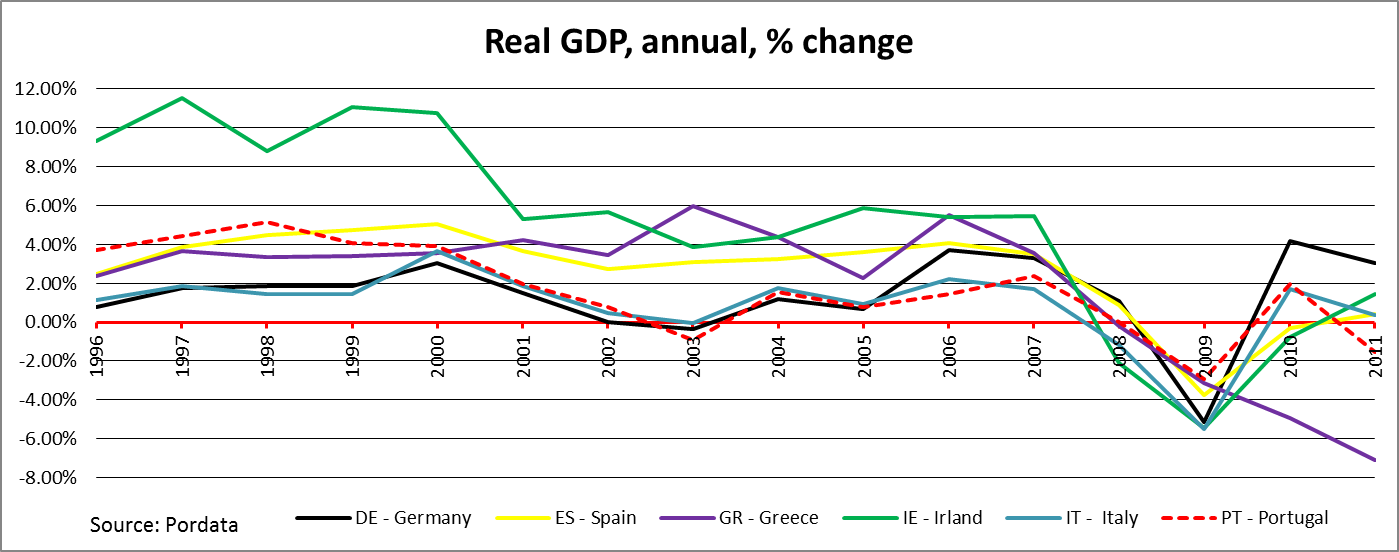
Ireland’s turn-around is in marked contrast to other countries of the Eurozone (EZ) periphery. The chart below shows Real GDP from 1996 to the end of 2010 for seven EZ countries:-

Real GDP_EU_chart7 - 1996-2011

Source: Pordata

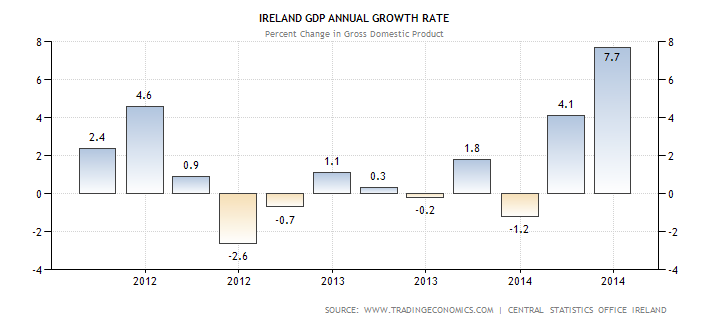
Since 2011 Ireland has outperformed further: –

Ireland GDP 2011-2014

Source: Tradingeconomics

Financial Market Performance

How has the Irish economic recovery been reflected in the performance of financial markets? I will look at Stocks, Bonds and Real-Estate.

Stocks

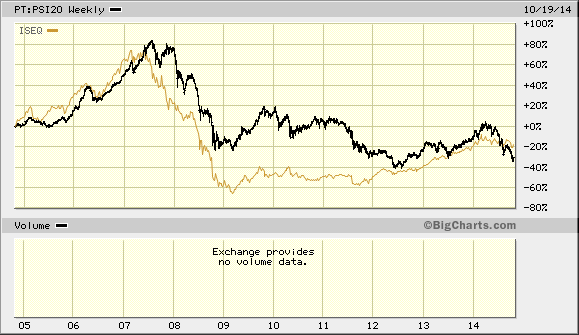
To begin, here is a ten year chart of the Portugese PSI20 vs Irish ISEQ Composite: –

PSI20_vs_ISEQ_2004_-2014 Bigchart.com

Source: Bigcharts.com

Ireland’s difficulties started with the unravelling of the sub-prime mortgage market in the US. The initial down-turn in the ISEQ index was more severe partly due to the heavy weighting of CRH – an international building materials firm – followed by the Irish Banking sector in the index. However unlike Portugal the Irish market had already begun to recover prior to ECB Governor Draghi’s “Whatever it takes” speech in July 2012.

The next chart compares the ISEQ to the Athens Composite:-

ISEQ vs SAGD 2003-2014 yahoo

Source: Yahoo Finance

This shows a similar pattern, however, the strong performance of the Athens Composite in the run up to 2008 was partly due to the heavy weighting of their highly leveraged Banking sector in the index – even today it has a 34% weighting.

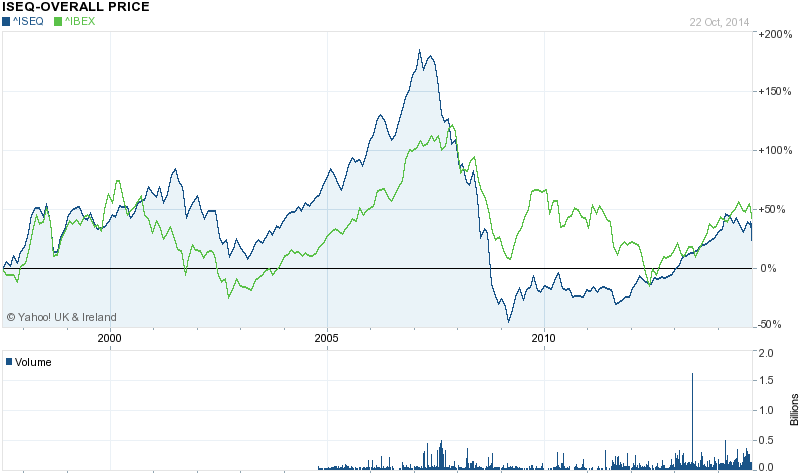
A longer term perspective can be seen in the comparison with the Spanish IBEX35 going back to 1995:-

IBEX vs ISEQ 1996 - 2014 yahoo

Source: Yahoo Finance

The broad-based strength of the Celtic Tiger meant that it avoided the worst effects of the bursting of the technology bubble in 2000, despite a significant technology sector. The lower interest rate regime across the EZ then hastened a dramatic housing bubble, which burst spectacularly in 2007. Both Spain and Ireland continue to struggle with high loan delinquency issues, but the accommodative policies of the ECB, as it seeks to soften the effects of a slow-down in economic growth in Germany and France, suggest both peripheral nations have time on their side.

Bonds

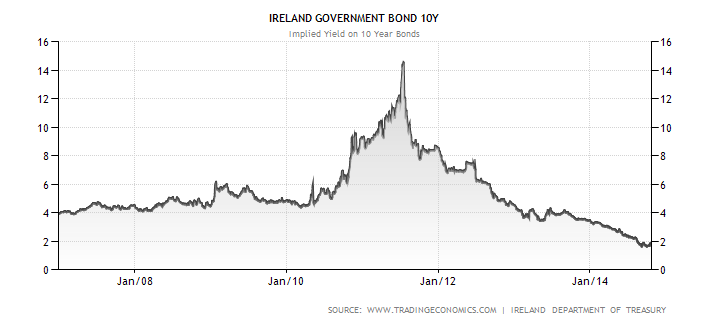
Irish 10 yr Gilts currently yield 1.82% down from July 2011 highs of 14.61% but they are off their recent lows of 1.62% seen last month.

Irish 10 yr Gilts 2006 - 2014 Trading Economics

Source: Tradingeconomics

Since early September uncertainty about EZ growth and the adequacy of ECB policy has precipitated an unwinding of yield convergence trades. The table below shows the evolution of 10 year Government bond yields since early September:-

Country Yld 06-9 Sprd vs Bunds Yld 23-10 Sprd vs Bunds Change
Ireland 1.62 0.69 1.82 0.94 0.25
Greece 5.54 4.61 7.46 6.58 1.97
Portugal 2.93 2 3.32 2.44 0.44
Spain 2.02 1.09 2.21 1.33 0.24
Germany 0.93 N/A 0.88 N/A

Source: Investing.com

The flight to quality into German Bunds has been muted by the excessively low absolute interest rate offered by Bunds, however, the difference for Ireland today in comparison with 2011 is significant. At the beginning of July 2011 the 10 yr Irish Gilt spread over Bunds was 8.82% whilst the 10 yr Bonos spread was only 2.4%. It is important to point out that Spanish Bonos yields hit their high a year later than Ireland, in July 2012. At the beginning of July 2012 the spread between 10 yr Bonos and Bunds was 4.74%. By either measure the performance of Irish Gilts, since the depths of their depression, suggests the Irish economy is healing at a faster pace than Spain, Portugal or Greece.

Real-Estate

Irish Real-Estate was at the heart of the economic crisis which slew the Celtic Tiger, it is, therefore, critical to examine to what extent this market has “cleared”:-

Irish_Property_price_index_2005-2014_CSO

Source: CSO and Global Property Guide

This chart shows the evolution of prices up to the end of 2013. Since then prices have improved further with Dublin leading the recovery. According to the Central Statistics office, new Dublin area homes were up 16% in Q1 2014 whilst second hand properties were up 5%. CBOI data to May 2014 shows this trend gaining further momentum. A similar pattern is developing in Spain though the overall correction in prices was far less severe: –

Spain_house_prices_2002_-_2014

Source: TINSA and Global Property Guide

By contrast Greek property prices are still under pressure. The prospects for a recovery were looking better as this Bank of Greece – Monetary Policy update from June explains:-

Prime commercial property prices are expected to stabilise in 2014, while prospects for high-end tourist properties are even more favourable, as a result of a projected substantial growth in tourism. Turning to non-prime commercial properties, prices are expected to drop further in the following quarters, while the real estate market as a whole is projected to start recovering gradually in 2015, provided that the present trend is not reversed by exogenous factors (political factors, international conjuncture, etc.).

The abrupt reversal of yield convergence this month may delay the recovery.

For Portugal the situation is similar to Greece, foreign demand has begun to re-emerge but the financial crisis surrounding Banco Espirito Santo during the summer has undermined confidence.

Ireland has domestic demographic growth on its side, although there is international demand for holiday homes in Ireland’s South West and West. The property market recovery is driven by domestic Dublin area demand connected to the broad-based resurgence in economic growth. The real estate market correction in Ireland has been larger than in Spain. I am also struck by the, almost mercantilist, export led recovery in Irish growth compared to the rising tide of imports into Spain.

Conclusion and investment opportunities

The Celtic Tiger suffered a severe mauling in the aftermath of the US sub-prime crisis. The Irish construction industry was forced to restructure or liquidate. Irish banking was devastated by the global forces of the Great Recession and the government embarked on an aggressive austerity programme to address these issues. The chart below, from the OECD, shows why the Irish government was forced to approach this situation in such a draconian manner: –

Government_surplus_or_deficit_since_2001_piiggs_an

Source: Eurostat and OECD

Unemployment rose from 4.2% in 2007 to 15.1% by early 2012. Between April 2009 and April 2010 a net emigration of 34,500 occurred – the first outward migration since 1989. Since 2012 Employment has risen by 70,000 – approximately a quarter of the jobs lost in the Irish depression – this suggests an output gap still exists. Ireland is a net importer of Oil – its recent decline, despite geo-political tensions, will help to flatter inflation figures.

A turning point in the crisis came in the summer of 2011. To set the scene I will begin in 2010 when Ireland accepted a Eur85bln joint EU-IMF bailout to stabilise its banking system. This quickly bore fruit and by May 2011 the Irish Finance Minister, Michael Noonan, was ruling out the need for a second bailout. Market commentators and economists generally doubted the governments resolve and Irish Gilt yields continued to rise into the summer of 2011. At this point the National Treasury Management Agency (NTMA) clarified the terms of the original EU-IMF bail-out. The bond market suddenly realised that funds which had been earmarked for bank recapitalisation could also be used to fund the fiscal deficit. The Irish government would therefore require minimal new funding until 2013.

Once confidence in government finances had returned, the Irish economy could resume something approaching normality. This brings me finally to the “value question”. Have the financial markets priced in the return of The Celtic Tiger?

Stocks

The Irish stock market has performed strongly this year relative to other peripheral markets but seems to be lagging its own GDP growth. The economy relies heavily on the USA, UK and Europe since these are its principal export markets. On a relative value basis I would remain long of Irish stocks versus other EZ peripheral markets – but not Spain since I am also optimistic about its fortunes. On an outright basis it still offers better value than the rest of the EZ but is likely to experience higher volatility and lower liquidity, especially during times of stress.

Bonds

Irish Gilts (1.82%) by contrast, have been re-priced to reflect a default risk better than Spain (2.21%) and not much worst than France (1.30%). There is, however, a downside risk should the leveraged carry trade be unwound further. Whilst this is true for Spanish Bonos it is less true of French OATs; added to which, the Irish Gilt market has less depth of liquidity than Spanish or French bond markets.

Real-Estate

After its substantial correction, Irish Real-Estate looks like the best value asset class. The macro-prudential policies of the Central bank of Ireland should insure leverage does not become excessive. This will dampen volatility and extend the duration of the appreciation, but I believe it will also favour Dublin over the provinces – cash will be king. My main concern with this prediction is the stubbornly high level of non-performing loans. Yet this also favours Dublin area Real-Estate since negative equity is swiftly being erased.

German growth prospects – the ECB and Russian gas

400dpiLogo

Macro Letter – No 19 – 12-09-2014

German growth prospects – the ECB and Russian gas

  • The ECB cut rates and implemented the first phase of OMT
  • Russia continues to retaliate against European sanctions
  • European Natural Gas prices have risen but shortages seem unlikely

Last week I started researching the risks to German growth of a gas embargo by Russia. This could become a reality if the geo-political situation in the Ukraine should deteriorate further. Before I could put pen to paper, ECB Governor Mario Draghi had implemented a pre-emptive strike; cutting the repo rate to 0.05% and announcing the ECBs intention to embark on outright monetary transactions (OMT) initially in the asset backed securities (ABS) market. The ECB – Statement – provides fuller details. It’s still a little light on content but JP Morgan estimates that the ECB will purchase Eur 47bln of newly issued ABS securities over a three year period.

Whilst these measures stopped short of purchasing Eurozone (EZ) sovereign bonds, European government bond markets reacted favourably. French T-Bill rates turned negative, so too did the yield on 2 year Irish Gilts. The Spanish, not to be outdone, issued 50 year Bonos at a yield of 4%.

Here is a table of some European short term rates from Monday 8th September: –


Security Yield Spread vs Germany Inflation Real Yield
Austria 1Y -0.032 0.027 1.8 -1.832
Belgium 3M -0.05 0.029 0 -0.05
Belgium 6M -0.025 0.038 0 -0.025
Belgium 1Y -0.043 0.016 0 -0.043
Bulgaria 1Y 1 1.059 -1 2
Croatia 6M 0.95 1.013 -0.1 1.05
Croatia 9M 1.15 1.218 -0.1 1.25
Croatia 1Y 1.38 1.439 -0.1 1.48
Czech Republic 3M 0.01 0.089 0.5 -0.49
Czech Republic 6M 0.03 0.093 0.5 -0.47
Czech Republic 1Y 0.11 0.169 0.5 -0.39
Denmark 3M -0.06 0.019 0.8 -0.86
Denmark 6M -0.01 0.053 0.8 -0.81
Denmark 1Y 0.15 0.209 0.8 -0.65
France 3M -0.027 0.052 0.5 -0.527
France 6M -0.03 0.033 0.5 -0.53
France 9M -0.011 0.057 0.5 -0.511
France 1Y -0.029 0.03 0.5 -0.529
Germany 3M -0.079 0 0.8 -0.879
Germany 6M -0.063 0 0.8 -0.863
Germany 9M -0.068 0 0.8 -0.868
Germany 1Y -0.059 0 0.8 -0.859
Greece 3M 1.47 1.549 -0.7 2.17
Greece 6M 1.86 1.923 -0.7 2.56
Hungary 3M 1.52 1.599 0.1 1.42
Hungary 6M 1.55 1.613 0.1 1.45
Hungary 1Y 1.84 1.899 0.1 1.74
Ireland 1Y 0.08 0.139 0.3 -0.22
Italy 3M 0.083 0.162 -0.1 0.183
Italy 6M 0.144 0.207 -0.1 0.244
Italy 9M 0.193 0.261 -0.1 0.293
Italy 1Y 0.217 0.276 -0.1 0.317
Latvia 3M 0.2 0.279 0.8 -0.6
Latvia 6M 0.374 0.437 0.8 -0.426
Latvia 1Y 0.258 0.317 0.8 -0.542
Lithuania 6M 0.3 0.363 0.2 0.1
Lithuania 1Y 0.4 0.459 0.2 0.2
Netherlands 3M -0.072 0.007 1 -1.072
Netherlands 6M -0.092 -0.029 1 -1.092
Norway 3M 1.259 1.338 2.2 -0.941
Norway 6M 1.118 1.181 2.2 -1.082
Norway 9M 1.248 1.316 2.2 -0.952
Norway 1Y 1.276 1.335 2.2 -0.924
Poland 3M 2.65 2.729 -0.2 2.85
Poland 1Y 2.044 2.103 -0.2 2.244
Portugal 6M 0.15 0.229 -0.9 1.05
Romania 6M 2.289 2.352 1 1.289
Romania 1Y 2.25 2.309 1 1.25
Spain 3M 0.058 0.137 -0.5 0.558
Spain 6M 0.072 0.135 -0.5 0.572
Spain 1Y 0.153 0.212 -0.5 0.653
Sweden 3M 0.211 0.29 0 0.211
Sweden 6M 0.202 0.265 0 0.202
Switzerland 3M -0.11 -0.031 0.1 -0.21
Switzerland 6M -0.05 0.013 0.1 -0.15
Switzerland 1Y 0.05 0.109 0.1 -0.05
UK 3M Yield 0.43 0.509 1.6 -1.17
UK 6M Yield 0.546 0.609 1.6 -1.054
UK 1Y Yield 0.509 0.568 1.6 -1.091

Source: Investing.com and Trading Economics

I have omitted Finland since I was unable to locate prices for shorter maturity than 2 year. Two year Finnish bonds yield -0.026% and inflation is running at +0.8%.

Europe and its periphery are benefitting from low or negative real interest rates. Even this seems insufficient to stimulate robust, sustainable growth.

The Economic Cost of Geo-politics

When I last wrote about the Ukraine earlier this year, I concluded: –

I believe the Ukrainian situation may reduce the likelihood of a rapid increase in tapering by the Fed and increase the prospects for ECB Outright Monetary Transactions. In aggregate that amounts to more QE which should support stocks and higher yielding bonds.

To date, the economic impact on Europe has been limited. The fed have continued to taper in the face of a robust recovery from weak US Q1 GDP data. The EZ, however, has struggled to follow the US lead and the ECB has been forced to act repeatedly to avert further disinflation.

As we head into the winter, it seems an appropriate time to review European Natural Gas, in light of the escalation of tension between Russia and NATO. This is especially pertinent to Germany where, along with its north European neighbours, winter Natural Gas demand is three times greater than during the summer.

This week has seen an escalation of European sanctions against Russia. The European Commission (EC) has curtailed the ability of three of the largest Russian Oil companies to raise capital beyond a one month maturity. Since around half of all longer term gas contracts are priced in relation to the oil price this seems a strange way to avoid disrupting the European gas price. The Russian’s have responded by threatening to ban aircraft access to Russian airspace and, more significantly, to disrupt gas supplies. The Financial Times – Russia aims to choke off gas re-exports to Ukraine picks up on this theme: –

In an effort to offset lost volumes from Russia, Ukraine has sought to secure more gas from the EU, principally through “reverse flows” – re-exports of Russian gas via countries such as Poland, Hungary and Slovakia. But Gazprom, Russia’s state gas company, has long complained about the re-exports, with Alexei Miller, its chief executive, denouncing them as a “semi-fraudulent mechanism”. Senior officials in the European Commission and in eastern European governments say Russia has been raising the prospect of reducing export volumes so their customers have no gas left over for reverse flows to Ukraine. “They say this pretty openly,” said one central European ambassador.

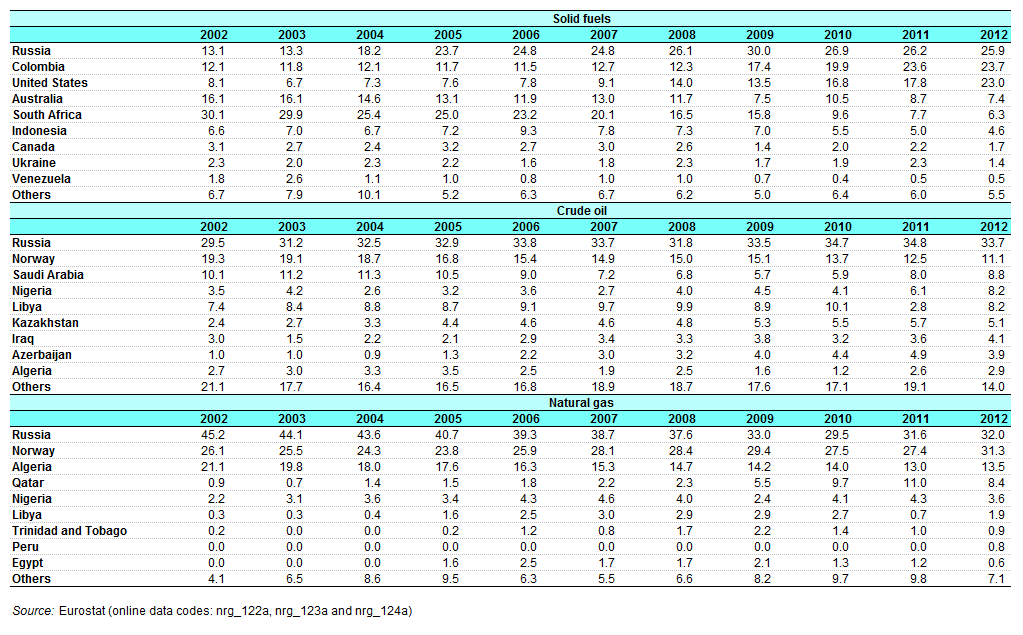
To understand the importance of Russian energy exports to Europe the following table is a useful guide: –

Main origin of primary energy imports - Source EuroStat

Source: Eurostat

An insight into EU energy policy is provided by the European Commission – Energy Economic Developments in Europepublished in Q1 2014. The section on Natural Gas starts at Page 33:-

In the European Union the majority of natural gas is supplied through bilateral long-term contracts which are negotiated between two parties, importer and exporter, and traditionally indexed to the price of oil. Currently, half of natural gas supply in the EU is still indexed to oil while across the EU a wide variation in import prices of piped gas and LNG has been observed. This is remarkable as at the same time a growing share of gas is traded on spot markets where short-term contracts are concluded on the basis of the market price determined by actual demand and supply. Spot market prices in the EU have been constantly lower than long-term contracts’ prices, at least since 2005.

In both the US and in the EU, spot-market gas prices have progressed in a similar fashion over the past decade and have followed the movements in the oil price.

In 2005, however, these gas prices have started to clearly fall below the level of the oil price. Between 2008 and 2009 they fell significantly in both regions, likely as a consequence of declining demand due to the economic downturn.

The fall in energy consumption has led to an excess supply of gas on the gas markets around the world and both US and the UK spot markets temporarily converged, trading at around 4/5 USD/MBtu in mid-2009, while the German hub prices fell less evidently, trading still above 8 USD/MBtu in 2009. From 2007 onwards, the US gas spot price has fallen under the price level of the other gas spot markets, which most likely reflects the effect of the surge in domestic shale gas supply. This becomes quite clear after 2009, when energy consumption picked up again following the recovery of the economy. Statistics from more recent years show that while the US spot prices remained low (around 4 USD/Btu in 2011), the EU spot prices (both in the UK and German hub) kept increasing. Wholesale gas prices have continued to rise in the EU while economic activity contracted and consequently natural gas consumption in the EU has been declining: the first half of 2012 represented the EU’s lowest first half year consumption of the last ten years. It was 7% and 14% less than the first half of 2011 and 2010 respectively.

The continued rise in EU wholesale gas prices despite the slump in gas demand and the lower gas spot prices vividly depicts the kind of vulnerability the EU is exposed to due to its high import dependency: as the Asian markets offer higher returns and more robust demand, gas producing countries have increased their trade with Asia lowering supply to Europe. As a consequence wholesale gas prices in Europe have increased while in the US, which now can rely more heavily on domestic production, prices have remained low. US prices were shielded from potential upwards pressure from export demand because of export restrictions (generally expected to be gradually lifted). Furthermore, the impacts on the EU have been further aggravated in this context due to the oil-price indexation of many long-term gas import contracts.

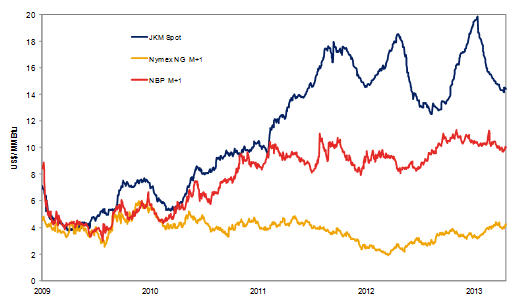
This chart from Schneider Electric shows the divergence in gas prices between US (yellow) EU (red) and Asia (blue): –

Natural Gas price comparison - Schneider Electric-page1

Source: Schneider-Electric

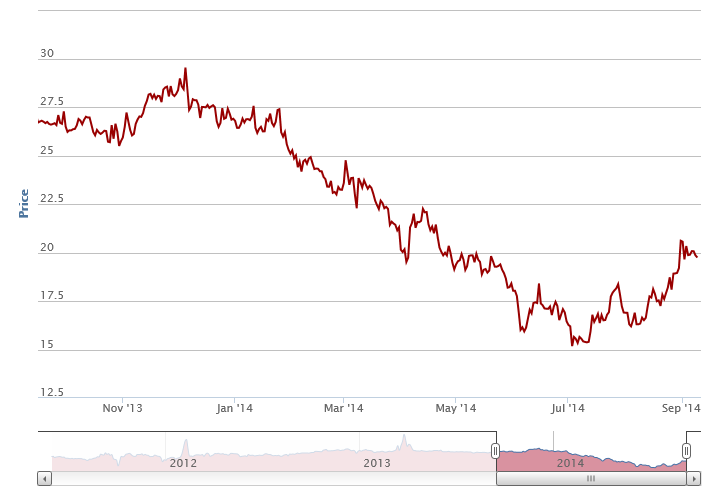
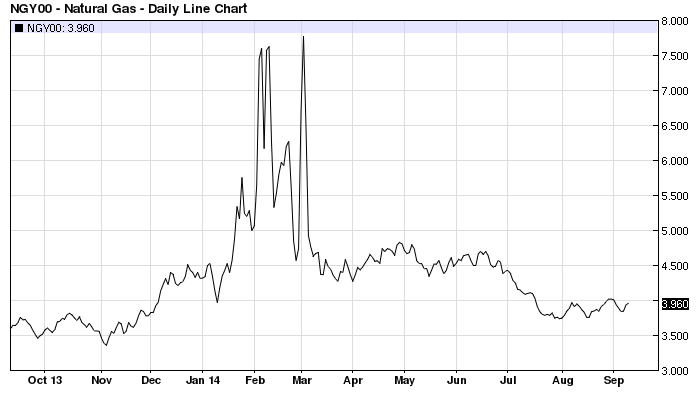
European Natural Gas prices are down from their December 2013 highs but have recently started to recover from the July 2014 lows. The chart below is for Dutch TTF (Title Transfer Facility) Gas: –

TTF Gas Daily Reference Prices - source EEX

Source: EEX

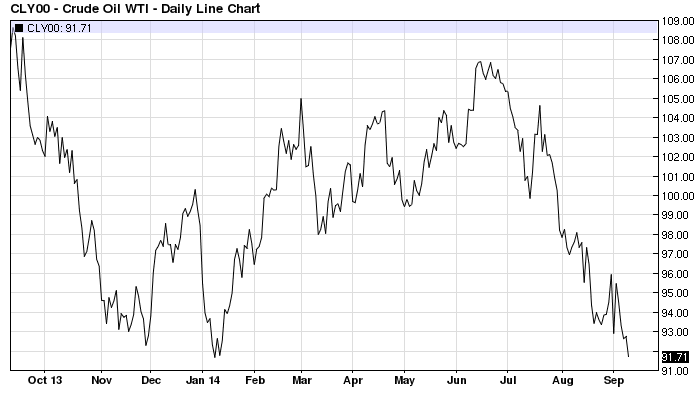
By way of comparison here are the one year charts for US Natural Gas and West Texas Intermediate Crude Oil: –

US Spot Nat Gas 1 yr

Source: Barchart.com

Understandably, the US Natural gas market is less concerned about Russian sanctions, and also cognisant of the long lead time between receiving an export license and the US capacity to increase exports of LNG.

WTI Spot 1 yr

Source: Barchart.com

The US Crude Oil market is seemingly unperturbed by the politics of Russia or the Middle East. Or, perhaps, it is the combination of continuous improvements in US supply coupled with rising concern about the slowing of China. A similar pattern is evident in the Brent Crude price.

Returning to Europe: establishing a generic price for European Natural Gas is difficult as this article from Natural Gas Europe – European Natural Gas: So What’s the Real Price? explains. It is also worth noting the seasonality in gas prices. The last major spikes occurred in February/March 2013 and January/February 2012, coinciding with the advent of cold European winter weather.

The EU Commission and national governments are taking no chances this year, as this article from Reuters –  Europe drafts emergency energy plan with eye on Russia gas shut-down makes plain:-

A source at the EU Commission said it was considering a ban on the practise of re-selling to bolster reserves.

“In the short-term, we are very worried about winter supplies in southeast Europe,” said the source, who has direct knowledge of the Commission’s energy emergency plans.

“Our best hope in case of a cut is emergency measure 994/2010 which could prevent LNG from leaving Europe as well as limit industrial gas use in order to protect households,” the source said.

European Union Regulation number 994/2010, passed in 2010 to safeguard gas supplies, could include banning gas companies from selling LNG tankers outside of Europe, keeping more gas in reserve, and ordering industry to stop using gas.

The Russian threat to reduce gas supplies to the EU in order to reduce the re-sale of gas to other countries seems rather hollow when the EC would appear to be preparing to take these steps anyway. Nonetheless, if Russia reduces supply what can the EU importing countries do?

Norway is not in a position to make up the shortfall. 96% of Norwegian gas is already exported. At the Flame gas conference in Amsterdam this May, Statoil spokesman Rune Bjornson told delegates, “I think many producers, including us, can adjust on the margins, but most of the production capacity from Norway is typically designed to produce at maximum in winter and that is what we’ll do.”

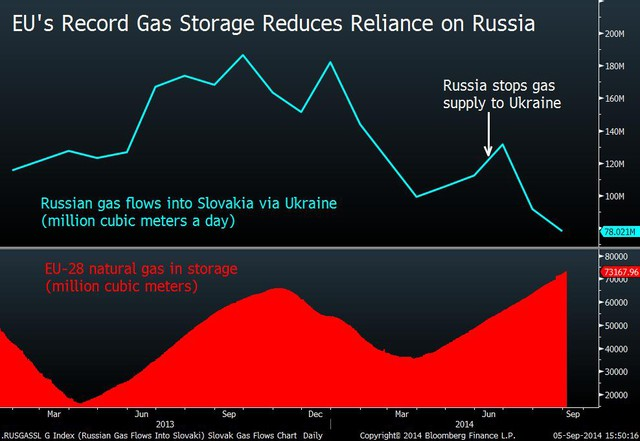
European governments have, however,  been actively improving storage capabilities. This process has been on-going since the first Russian/Ukrainian dispute in 2006 – according to recent estimates EU-28 storage is at 90% of capacity which is around 74 bcm. Businessweek – EU Need for Russian Gas Via Ukraine Wanes as Stores Fill gives a good overview: –

EU-28 Gas Storage-Bloomberg

Source: Bloomberg

Europe’s reliance on Russian natural gas shipments via Ukraine is declining after the region pumped a record volume of the fuel into underground inventories, minimizing the risk of shortages during the coming winter.

Given that Geo-politics seems to have had little impact on the performance of world financial markets in the long run should we be worried in the short run and especially with respect to Germany this winter?

The Council for Foreign Relations – The Geopolitical Paradox: Dangerous World, Resilient Marketsopines on this subject this week. The article is concerned mainly about disruption to the oil market: –

It is often noted that the vast majority of postwar recessions have been associated with energy shocks. Rising turbulence in the Middle East has raised the prospect of a long-term disruption in the region, where national borders could be rewritten through violent upheavals. The threat of a Russian cutoff of gas to Europe also hangs over markets. Consequently, it is surprising that energy markets, and oil markets in particular, do not ask for a premium in futures markets for secure energy supplies. At present, current oil contracts are higher than longer-term futures contracts, and though there are technical reasons for this downward trend (“backwardation”), it hardly is suggestive of disrupted or anxious markets.

They go on to discuss Europe describing it as the weak link: –

There are a number of reasons why Europe is the channel through which political risk could reverberate in the global economy. Europe is most vulnerable to disruptions in trade and financial relationships with Russia, though I have argued elsewhere that these costs may be small relative to the costs of inaction. Weak growth in China and elsewhere in the emerging world could significantly affect exports, particularly in Germany. Significantly, though, Europe also faces these challenges at a time of economic stress and limited resilience. Growth in the region has disappointed and leading indicators have tilted downward. Further, concern about deflation is beginning to weigh on sentiment and investment. The persistence of low inflation—well below the ECB’s goal of around 2 percent—is symptomatic of deeper structural problems facing the eurozone, including an incomplete monetary union, deep-seated competitiveness problems in the periphery, and devastatingly high unemployment. Homegrown political risks also threaten to add to the turmoil, as rising discontent within Europe over the costs of austerity is undermining governing parties and fueling populism. The result is a monetary union with little capacity or resilience to defend against shocks. The ECB has responded to these risks with interest-rate cuts and asset purchases, and is expected to move to quantitative easing later this year or early next, but the move comes late, and is unlikely to do more than address the headwinds associated with the ongoing banking reform and continued fiscal austerity. Overall, a return to crisis is an increasing concern and political risks could be the trigger.

The limited impact on financial markets since the beginning of the Ukrainian crisis in February can be seen in the table below: –

Market/Security Price 28 Feb Price 9 Sept Change % Change
TTF Gas 22.85 19.78 -3.07 -13.44
GPL Gas 23.23 20.06 -3.17 -13.65
US Nat Gas 4.74 3.96 -0.78 -16.46
WTI 102.58 91.71 -10.87 -10.60
E.ON 13.82 14.31 0.49 3.55
RWE 29.02 31.43 2.41 8.30
DAX 9692 9700 8 0.08
S&P500 1859.45 1995.69 136.24 7.33
10yr Bund yield 1.63 1 -0.63 -38.65
Gold 1327.6 1249.4 -78.2 -5.89


Source: EEX and Investing.com

Germany – the weakest link?

Since the Hartz reforms of 2002 Germany has emerged from the strain of unification to re-establish its credentials as the powerhouse of European growth. Latterly – and especially since 2008 – its preeminent reputation has become tarnished. The Bundesbank raised its growth forecast in June to 1.9% for 2014 vs its December 2013 forecast of 1.7%. Their optimism has been dented since then by concerns about the politics of Eastern Europe. The Deutsche Bundesbank – August 2014 Monthly Report makes the following observations: –

The global economy appears to have got off to a good start in the second half of the year. As regards the industrial countries, Japan’s economy is expected to rebound in the third quarter. The US economy is likely to remain on a growth path, although it will probably be impossible to maintain the rapid pace of growth attained in the second quarter of the year. Following second- quarter stagnation, the euro area is looking at a resumption of positive economic growth, albeit not at the pace predicted by many analysts in the spring. The underlying cyclical trend in some euro- area countries is turning out to be weaker than expected. At the same time, the geopolitical tensions in Eastern Europe owing to the Ukraine conflict as well as in other parts of the world are now appearing to weigh more heavily on corporate sentiment. Although they will only affect a small percentage of EU exports directly, the recently enacted EU sanctions and the Russian response are likely to dampen sentiment.

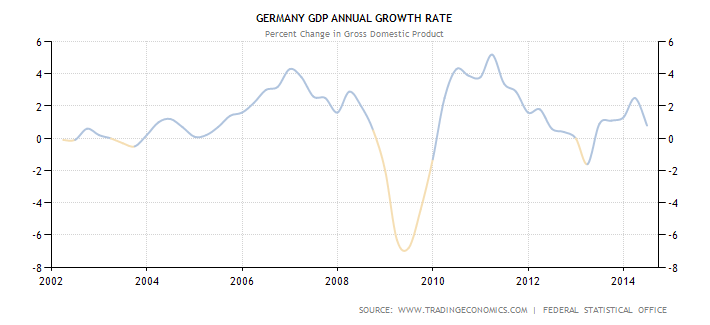
The Bundesbank are still predicting an increase in GDP growth for 2015 before moderating once more in 2016. Below is a chart of annual GDP since 2002: –

German GDP - 2002-2014

Source: Trading Economics

The momentum seems to be dissipating. According to the Federal Statistics Office, in 2013, 69% of Germany’s exports were to other EU countries.  Asia came second with 16% and the USA third with 12% – a slow down in Asia, specifically China, would be problematic, but the UK, US and peripheral EZ countries might be able to absorb the slack. What is clear, however, is that Germany is vulnerable.

This brings me to the risks to Germany this winter due to rising Natural Gas prices and a curtailment of supply. The IEA – Germany Oil and Gas Security Report 2012 provides a comprehensive overview of the German market: –

Germany has very little domestic oil and natural gas production and relies heavily on imports. It has well diversified and flexible oil and natural gas supply infrastructure, which consists of crude, product and gas pipelines and crude and oil product import terminals. Natural gas is imported into Germany exclusively by cross-border pipeline. The country has no LNG infrastructure, although some German companies have booked capacities in overseas LNG terminals.

Oil continues to be the main source of energy in Germany although it has declined markedly since the early 1970s. It now represents approximately 32% of Germany’s total primary energy supply (TPES).

Natural gas consumption in Germany has declined 10% since 2006. Demand was 90 bcm in 2010, down from 100 bcm in 2005. According to government commissioned analysis, the total consumption of natural gas in Germany is expected to continue to decline over the long term. The share of natural gas in Germany’s TPES is currently around 22%.

The decline in Natural Gas demand is evident across Europe. Earlier this year the Oxford Institute for Energy Studies estimated that, across 35 European countries, demand had fallen from 594 bcm in 2008 to 528 bcm in 2013 – an 11% decline. This is largely due to the high price of Natural Gas relative to Coal and the Europe-wide policies mandating increases in renewable energy production. For those who want to read more about EU renewable energy developments,  Bruegal – Elements of Europe’s energy union , published this week, looks at the policy challenges facing Europe between now and 2030.

Germany’s declining demand for Natural Gas and increase in storage capacity will mitigate some of the potential disruption to supply – in 2012 Natural Gas represented 22% of supply vs Oil 32% and Coal 24%. Added to which Germany has adopted some of the most aggressive policies to develop renewable energy, offset, to some extent, by their closure of Nuclear Power plants: –

Under existing government policies the trend towards an increasing share of renewables looks set to continue. The Energy Concept 2010 established a goal for Germany to increase its share of electricity generated from renewable sources to at least 35% of total consumption by 2020. Conversely, the trend towards an increasing share of nuclear in the energy mix looks set to reverse following the government announcement in 2011 of its decision to phase out all German nuclear power plants by the end of 2022.

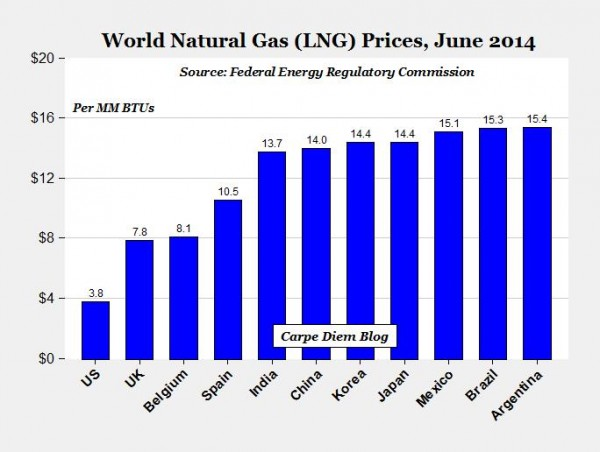
Germany imports Natural Gas primarily from Russia (39%) followed by Norway (35%) and the Netherlands (22%). Germany has no Liquefied Natural Gas (LNG) capacity but the GATE (Gas Access To Europe) terminal in Rotterdam – opened in 2011 – was operating at 10% of capacity in April 2014 and is purported to be capable of supplying 12 bcm (Billion Cubic Metres). This is still a drop in the ocean – Russia supplied Germany with 140 bcm last year. German domestic demand is less than 100 bcm leaving a substantial amount for re-export. Further LNG supply is available from Spain but there are bottlenecks with the trans-Pyrenean pipeline.  In any case, Spanish LNG prices are high. The table below shows the divergence in prices for LNG globally, even more than in pipeline supply LNG prices are a function of logistical supply constraints: –

World LNG prices - June 2014 AEI and FERC-page1

Source: FERC and AEI

Germany’s Natural Gas storage capacity (2012) is 20.8 bcm, making it the highest in Europe, although there are plans to increase this further. In H1 2013 German Natural Gas consumption was 50 bcm – the high levels of storage suggest that Germany is well placed to weather a Russian go-slow this winter.

The complex and diverse nature of Germany’s cross-border pipeline capabilities are shown in the map below, however the largest pipelines by potential capacity are (2012 data): –


Country Pipeline Capacity
Ukraine Bratstvo 120 bcm
Norway Norpipe, Europipe I and II 54 bcm
Russia Yamal 33 bcm
Russia Nord Stream 27 bcm


Source : IEA

Germany - Gas Grid - IEA-page1

Source: IEA


Conclusions and financial market implications

After two interruptions to Russian Natural Gas supply in less than a decade, Germany – along with other gas importing countries within the EZ have taken precaution. The most vulnerable countries in the event of a complete cessation of gas supply by Russia are probably the Baltic States, Hungary and Bulgaria. However, Russia is also very dependant on the EU for sales of Gas, Oil and Coal. Nearly 60% of state revenue comes from this trade. This trade is worth $80bln per annum to Gazprom alone. Germany is Russia’s third largest trading partner, whilst Russia ranks 11th on Germany’s list.

If Russian sanctions lead to a cessation of Gas exports then a number of large German utility companies will suffer – most notably E.ON and RWE. However it is most unlikely that German supply will run out. Price increases will either be passed on through higher prices or lead of margin compression due to the disinflationary forces emanating from elsewhere in the economy.

John W Snow – the US Secretary to the Treasury under George W Bush – is quoted as saying, “Higher energy prices act like a tax. They reduce the disposable income people have available for other things after they’ve paid their energy bills.” This is the potential that a reduction in Russian gas supplies and commensurate rise in prices is likely to have on the wider German economy. The ECB has cut rates and started down the road to QE even before the onset of winter. Mario Draghi knows that monetary policy works slowly and many commentators believe the ECB are demonstrably behind the curve due to their attempts to impose austerity on the more profligate member states.

German Bunds may have hit their high for this year, especially since the ECB are now buying ABS, but they remain a “hedge short” at best. The quest for yield hasn’t gone away, EZ high yielding sovereign names will be supported still.

European Equities will be nervous in this environment despite some 52% of Eurostoxx 600 companies beating their earning forecasts for Q2, according to Reuters data. After a summer shakeout, the DAX has regained its composure, but it is already trading on a P/E ratio of nearly 22. Technically it’s a “Hold” until a break of 9,000 on the downside or 10,000 on the upside. But don’t forget that when Mr Draghi uttered, “whatever it takes” the DAX was toying with 5,000

European Natural Gas prices should be supported through the winter but a full-blown “Gas Crisis” is unlikely. A “Winter Squeeze” such as 2012 or 2013 could see spot prices double under normal market conditions. German growth will continue to be hampered by political uncertainty but, all other things equal, it should rebound on any sign of detente and will benefit from the continued recovery of the UK and US economies.

The second arrow of Likonomics and the Chinese property market

400dpiLogo

Macro Letter – No 18 – 29-08-2014

The second arrow of Likonomics and the Chinese property market

  • The Chinese rebalancing towards domestic consumption continues
  • The shadow banking system is being forced into the light
  • But a slowdown in the property sector poses a potential risk to economic reform

Seven Lucky Gods

The Japanese “Ship of Happiness” containing the seven lucky gods – originally of Chinese and Indian origin

Source: onmarkproductions.com

Back in March I anticipated a stimulus package to avert too dramatic a slow-down in the Chinese economic rebalancing, process: –

By a number of conventional measures China has reached the Ponzi stage. Total debt has increased from $9trln in 2008 to $23trln in 2013 (250% of GDP). Private sector debt has increased from 115% of GDP in 2007 to 193% in 2013. Measures of the multiplier effect of debt to GDP suggest it now takes 4 RMB of debt to create 1 RMB of GDP growth. The Chinese authorities attempts to slow bank lending have led to a significant expansion of shadow bank credit. Much of this lending is to sub-prime borrowers.

Recent action by the PBOC suggests they are now targeting the illusive shadow banking sector. Last week they drained 50 bln RMB via reverse-repos…after strong growth in 2013 the PBOC may be inadvertently engineering a “Minsky Moment” – when asset prices collapse – but the Third Plenum focus on market based reform would suggest this is not the intention…

Since then the PBOC has been actively steering the Chinese “Ship of Happiness” towards more tranquil waters by, among other measures, reducing bank capital requirements. Highlights of China’s Monetary Policy in the Second Quarter of 2014 updates the recent timeline:-

 On April 22, the PBC decided to cut the reserve requirement ratios for county-level rural commercial banks and county-level rural cooperative banks by 200 and 50 basis points respectively, effective from April 25, 2014.

On June 9, the PBC decided to cut, effective from June 16, 2014, the deposit reserve requirement ratio by 0.5 percentage points for commercial banks (excluding those that were subject to the deposit reserve ratio reduction on April 25, 2014) that have complied with prudential requirements and have reached the required ratios in their lending to the agricultural sector, rural areas, and farmers, and to small and micro enterprises. In addition, the RMB deposit reserve requirement ratio of finance companies, financial leasing companies and auto financial companies was cut by 0.5 percentage points.

This change in reserve requirements has dampened the extreme volatility of short term repo rates. Lower volatility and lower rates fuel risk-taking; bank credit surged in June by RMB1970bln – up 90% on June 2013.

Meanwhile, the government, in pursuit of President Xi’s “Chinese Dream”, embarked on a mini-stimulus package – estimated in the local media at around RMB10tln. This has reignited the stock market but begs the question “How can further stimulus solve the problem of excessive liquidity?” The Business Insider – China Unveils ‘Mini Stimulus’ To Boost Its Slowing Economy described it thus: –

“The State Council is responding to the growth slowdown by announcing tax breaks for SMEs (small and medium enterprises), speeding up investment in railways and rebuilding urban shantytowns,” HSBC economists Qu Hongbin and Sun Junwei said in a report Thursday.

“This time the package is small in scale, but it is more targeted and involves reforms on financing to secure funding,” they said. “So this should help China to smooth growth without exacerbating financial stability risks.”

The tax breaks for “small and micro” companies will be extended until the end of 2016, the State Council said in a statement on the central government website.

It also said 6,600 kilometres (4,100 miles) of new railway lines will come into operation this year, 1,000 kilometres more than in 2013.

The plan will also see the creation of a railway fund that will receive between 200-300 billion yuan ($32-$48 billion) each year, the statement said.

… “These measures show that Premier Li’s government aims to stabilise short-term growth with policies which can enhance efficiency while avoiding future financial troubles,” Bank of America Merrill Lynch economists Lu Ting and Sylvia Sheng said in a report Wednesday.

“We believe these measures are the right policy responses to the ‘fiscal cliff’ as a consequence of the anti-corruption campaign, and we think markets will overall welcome them.”

There have been nine reported cases of Trust Fund defaults in the five months to May which matches the total during the whole of 2013, however, several shadow banks are being merged and acquired by licensed banking institutions. Meanwhile, the China Banking Regulatory Commission (CBRC) is helping to ease the pain of rebalancing for the banking system. Caixin – Banks Start Using New Loan-To-Deposit Ratio on July 1looks at the detail: –

Starting July 1 banks in China are using a new method of calculating the loan-to-deposit ratio, a change that the regulator and analysts say will allow for more loans to be extended.

The China Banking Regulatory Commission (CBRC) announced on June 30 the new set of rules for figuring the ratio, which is capped by law at 75 percent, meaning that banks cannot lend out more than three-quarters of the deposits they accept.

A CBRC official has said the regulator will consider adjusting the way the ratio is calculated to allow for more lending. That includes broadening the range of deposits to include “relatively stable” funds.

The new rules differ from the old ones in both loan and deposit calculations, the announcement shows.

Six types of loans can now be excluded from the formula. They include loans linked to the central bank’s re-lending program and proceeds from the sales of a special financial bond that raises money to support small and micro businesses. Loans made using money raised from bonds that investors cannot redeem for at least one year are also excluded under the new rules.

These loans all have clear and stable sources of funding and thus do not need to be matched with general deposits, the regulator said.

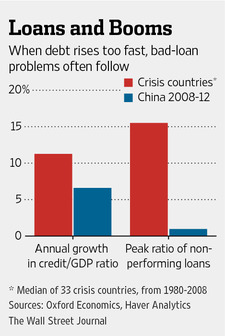
Why ease conditions when M2 is growing at 14.7%, M1 at 8.9% and M0 at 5.3% (June 2014)? I believe the easing of conditions is due to official concern that risk in the financial system is substantially understated. This article from the Wall Street Journal  – Risky Business in China’s Financial System – highlights some of the issues: –

Is China heading for a financial crisis? Some risk indicators have risen markedly over the past twelve months: Interbank rates are more volatile, with liquidity shortages increasingly common; there have been a few minor bank runs; and the country experienced its first corporate default in recent history earlier this year.

Loans and Booms - China vs Crisis countries-page1

Source: Oxford Economics, Haver Analytics and Wall Street Journal

Moreover, though official figures suggest that just 1% of loans are non-performing, bank balance sheets likely aren’t as healthy as they seem.

Evidence from a range of countries suggests that credit booms – as China experienced from 2009-‘13 – result in substantially higher levels of non-performing loans (NPLs). A more realistic assumption that 10%-20% of total loans might go bad implies total NPLs of RMB6-12 trillion (US$1-1.9 trillion). The higher end of the range would suggest a bad-asset problem comparable in scale to the one that followed the U.S. subprime loan crisis.

The author goes on to discuss the importance of the shadow banking system. Then he asks: –

What might trigger a crisis in China? The drift downward in property prices could accelerate as the economy cools, leaving substantial oversupply. Property and land are often used in China as collateral for loans, so a sharp fall in house prices would damage bank balance sheets; liquidity would dry up; and institutions with high rollover needs might struggle to find funding.

Higher interest rates also would increase debt-service payments, and banks could see their deposit bases erode as corporate deposits shrink. The growing importance of the shadow-banking system would likely exacerbate these effects.

Such a crisis would have major economic implications not only for China but — through financial and trade linkages – for the whole world. The Oxford Economics Global Economic Model estimates that, in such a scenario, Chinese gross domestic product would grow less than 2% in 2015, and world growth would drop as low as 1%.

Of course, that’s a worst-case scenario, and odds of it happening are only about 10%. With China’s overall government debt relatively low and foreign exchange reserves at an all-time high, authorities have the means to intervene on a large scale if necessary.

Still, as long as interest on deposits is capped by the government, Chinese savings will continue to be invested in riskier and higher-yielding products, adding to distortions in the financial system.

That means the risk of a financial crisis will remain until the government introduces reforms to the financial sector, and manages its way out of the credit boom in an organized fashion.

The deleveraging of the credit boom and reform of the financial sector are the second and third arrows of Likonomics – named after the economic policies of Premier Li Keqiang. Even getting to the second arrow will be difficult given a housing bubble which shows signs of bursting.

Housing, the Achilles heel

Recent official data shows house price declines in 55 out of 70 cities in June vs May and 35 out of 70 cities in May vs April. Sales volumes as measured by floor space are down 9.4% in the first seven months of 2014 vs the same period last year.

The FT – Property bubble is ‘major risk to China’ puts the Chinese government’s dilemma in perspective: –

The government itself has an enormous incentive to keep pumping the bubble up, since all land is technically owned by the state and land sales made up 60 per cent of local government’s budgetary revenues last year, according to estimates from JPMorgan.

Since 2008 land prices have increased fivefold, triggering corresponding asset price rises, but even as prices soared and supply mushroomed, demand for housing and office space pretty much kept up – until this year. More than 90 per cent of households already own at least one home and, for those urban households that own apartments, nearly 76 per cent of their assets are in real estate, according to Gan Li, director of the Survey and Research Center for China Household Finance.

At 90% Chinese home ownership is ranked sixth highest in the world (2012 data). It is slightly lower than Singapore but well above the levels in UK (66.7%) and USA (65.2%). Here is a table from Wikipedia . However, it has been estimated by the China Household Finance Survey  that empty homes make up more than 20% of the housing stock. Of these, the vast majority are investment properties.

Meanwhile the first arrow of Likonomics – a tempering of monetary stimulus – put in place since the great recession, has been accompanied by a swath of anti-corruption policies. President Xi reaffirmed his commitment to anti-corruption measures in a speech on 29th June on the eve of the 93rd anniversary of the founding of the Chinese Communist Party.

Michael Pettis – The Four Stages of Chinese Growth describes the overall reform process being undertaken by the Xi government. The entire essay is a brilliant insight into the economic development of China since 1978 and looks closely at the “social capital” deficit which, if left unaddressed, might undermine the Chinese economic miracle of the last 30 years :-

The second liberalizing period. What China needs now is another set of liberalizing reforms that cause a surge in social capital such that Chinese individuals and businesses have incentives to change their behavior in ways that generate greater productive activity from the same set of assets. These must include changing the legal structure, predictably enforcing business law, changing the way capital is priced and allocated, and other factors that determined the incentives, so that Chinese are more heavily rewarded for activity that increases productivity and penalized, or at least less heavily rewarded, for rent seeking.

But because this means almost by definition undermining the very policies that allow elite rent capturing (preferential access to cheap credit, most importantly), it was always likely to be strongly resisted until debt levels got high enough to create a sense of urgency. This resistance to reform over the past 7-10 years was the origin of the “vested interests” debate.

Most of the reforms proposed during the Third Plenum and championed by President Xi Jinping and Premier Li Keqiang are liberalizing reforms aimed implicitly and even sometimes very explicitly at increasing social capital. In nearly every case – land reform, hukou reform, environmental repair, interest rate liberalization, governance reform in the process of allocating capital, market pricing and elimination of subsidies, privatization, etc – these reforms effectively transfer wealth from the state and the elites to the household sector and to small and medium enterprises. By doing so, they eliminate frictions that constrain productive behavior, but of course this comes at the cost of elite rent-seeking behavior.

Many of the Third Plenum measures are focussed on a root and branch reform of the property development industry. This post from Investing in Chinese Stocks – RMB 8.7 Trillion in Land Finance At Risk provides some fascinating insights, into the dangers these reforms pose to the property development industry: –

A strict audit of 15 trillion in land sales is going to uncover dirt in many Chinese cities. Already, according to the article below, 9 cities have been found to have violated regulations governing land finance, including Shangluo, Hengyang, Neijiang, Xingtai, Huzhou and Suqian. Recall how land finance works:

Chinese local governments sell land to developers who build homes and commercial centers. The revenue from land sales pays for development of supporting infrastructure, everything from roads and subways to schools and parks. Land sales also finance local government debt which exploded after 2008. In the post-2008 economy, developers rushed to build property amidst a real estate bubble and when the government moved to restrict activity in first- and second-tier cities, developers poured into third- and fourth-tier cities and repeated the model. However, developers have run ahead of many local governments. In areas where there are true ghost cities, support infrastructure such as schools and hospitals have not been built. If the real estate bubble bursts and land sales fall, local governments will need to find another revenue source or they may be unable to finance the infrastructure that generates GDP growth and supports the local real estate market, and they may even face a debt crisis in some of the worst hit areas. This ignores all the potential issues with indebted developers, plus overproduction and bad debts in other sectors of the economy.

84 major Chinese cities have borrowed 8.7 trillion, backed by revenue from land sales. If cities have violated regulations or violated the law in their use of land finance, things could quickly come to a head in areas where the governments are borrowing to survive, which is already the case in some cities. The conclusion to the article is a good summary:

“Mortgage financing using state-owned land, borrowing money to promote urban development and stimulating economic growth, this economic growth model is not sustainable, it can very easily bring about hidden volatility in the capital markets and macroeconomic development.” Wang Jianwu told reporters, the key to solving the problem is for the local government to gradually adapt to the “new normal,” get rid of “land hormone” stimulus, while local governments also need to shift from the dominant role of economic development to servicing economic development.

Yet again, the anti-corruption probe lines up with the leaderships vision of economic reform. By squeezing local governments’ ability to borrow through land sales, the shift towards a rebalanced, market-based economy can proceed more quickly.

Concern about the Chinese housing market has even attracted the attention of the Kansas City Fed – China’s slowing housing market and GDP growth – they cover many of the issues already discussed but also look at the longer term impact of demographics: –

Looking further ahead, the real-estate sector will need to adapt to the inevitable decline in demand caused by demographic change. The share of China’s population from 24 to 30 years old, the age group needing to purchase their first home, has declined from 13.4 percent in 2000 to 10.7 percent in 2010. The share of the working age population (15 to 59 year olds) has declined to 68.7 percent in 2013 after peaking at 70.1 percent in 2010, reversing the upward trend of the prior two decades.

…Taking both the short- and long-term factors into account, the real estate sector’s recent slowdown is likely to continue as housing activity stabilizes at a lower growth path. While this adjustment could provide certain long-term benefits, it will generate significant downward pressure on China’s near-term growth.

For a rather more sanguine view of the current situation this policy brief from The Peterson Institute – Is China’s Property Market Heading toward Collapse? Provides a broader historical context, highlighting the fundamental differences between China today and USA in 2008 or Japan during the 1990’s: –

 The fears about China’s property market are likely overblown. First, China’s private housing market is young. It did not exist until 1998. Over the last 16 years, the property sector has seen large swings in both prices and levels of investment. Cyclical downturns have resulted from macroeconomic conditions, credit restrictions, and the government’s attempts to curb either the overheating or overcooling of the sector. This cyclicality is a good thing to the extent that investors tend to avoid making one-way bets on either price appreciation or depreciation, and thereby it works to prevent excessive speculation. Largely owing to limited financial innovations, market developments, and punishing taxes, China’s property market is still less leveraged than is typical in more developed economies. Developers have lowered their debt-to-asset ratios since 2009 and Chinese buyers must offer down payments of at least 30 percent before they can apply for mortgages.

Second imposed more than four years ago to discourage property purchases for investment purposes. Indeed, at the time of this writing, some 30 Chinese cities have started to ease these property curb policies, which were designed to prevent excessive speculation. In addition, the government could also liberalize its urban household registration system, or hukou, to allow migrants to purchase houses and thereby encourage them to settle in their cities permanently.

In the medium term, the government can take a number of other steps, such as reintroducing an urban public housing program in large cities, funded by a property tax, to address income inequality and encourage an increase in rental properties. To reduce banking sector risk, the government could encourage banks to issue covered bonds to reduce the risk of maturity mismatch of their mortgage assets. Furthermore, diversifying property developers’ sources for finance through real estate investment trusts, or REITs, would also reduce their reliance on bank financing. China should also improve its data collection to take into account the quality, location, and other important features of property transactions.

More important, demand for urban properties is expected to remain high over the next decade. It is estimated that another 200 million people could join China’s urban areas by 2023. In this sense, China’s property market bears no resemblance to Japan in the early 1990s or the United States in 2008. As long as urbanization continues and appropriate policies are adopted, this property market downturn should prove to be merely cyclical, and a major correction is unlikely to take place.

The authors expand on the positive long-term factors which support the Chinese property market but remain cognisant of the risks of a near-term bursting of the property bubble. Chinese property has risen 64% since 2010, eclipsed only by Hong Kong where prices are up 94%. Rental yields are 2.66%, higher than Singapore at 2.41% but well below Japan at 5.53%. However, some comfort may be drawn from indications of the rise of zero down payment mortgages – if these become widespread the property bust may be deferred.

Private capital flight

This brings me to another issue which affects the global economy. If 76% of the net worth of Chinese city dwellers is tied up in real-estate, how will they diversify their investment risk? Many of the wealthiest Chinese families have already moved a substantial portion of their net worth abroad. This trend is likely to continue unless the government imposes capital controls. What is the likely impact on domestic asset prices?

A recent article from The Diplomat – Chinese Investors Fuel California Housing Bubble gives an interesting perspective to the debate. Chinese nationals only account for 11% of the foreign buyers of real-estate in the San Francisco area but their marginal impact is significant. Chinese demand is being fueled by uncertainty over domestic Chinese housing policy and fears about the stalling of economic growth:-

As Mark McLaughlin, CEO of Pacific Union, a prominent San Francisco real estate firm, told local CBS affiliate KPIX, “it’s added a demographic of buyers who, generally, take a long-term view. They’re not sellers in the next five to seven years.” Chinese buyers are sitting on much of this property as housing in the Bay Area becomes increasingly scarce, causing its value to skyrocket. The Case-Shiller home price index, released in May, saw Bay Area home prices jump by 23 percent compared with  a year ago.

That may be just the beginning. On average, San Francisco real estate cycles take about five to seven years to run their course from recovery to collapse. The current surge in prices began in early 2012. Home values have shot up 50 percent since then; during the last surge, the prices peaked at 54 percent. Chinese money is likely to add pressure to the current bubble.

Of course Chinese buyers have been evident in many prime real-estate locations including Manhattan, London and Sydney. Earlier this month Wang Jianlin, China’s richest man, invested $HK12.5 bln in Australian real estate including a AUD900 mln resort on the Gold Coast.

A recent article from the Wall Street Journal – The Great Chinese Exodus looks into the migration trends of wealthy Chinese: –

…A survey by the Shanghai research firm Hurun Report shows that 64% of China’s rich—defined as those with assets of more than $1.6 million—are either emigrating or planning to. …The elite are discovering that they can buy a comfortable lifestyle at surprisingly affordable prices in places such as California and the Australian Gold Coast, while no amount of money can purchase an escape in China from the immense problems afflicting its urban society: pollution, food safety, a broken education system. The new political era of President Xi Jinping, meanwhile, has created as much anxiety as hope.

…Last year, the U.S. issued 6,895 visas to Chinese nationals under the EB-5 program, which allows foreigners to live in America if they invest a minimum of $500,000. South Koreans, the next largest group, got only 364 such visas. Canada this year closed down a similar program that had been swamped by Chinese demand. …Beijing makes a crucial distinction between ethnic Chinese who have acquired foreign nationality and those who remain Chinese citizens. The latter category is officially called huaqiao—sojourners. Together, they are viewed as an immensely valuable asset: the students as ambassadors for China, the scientists, engineers, researchers and others as conduits for technology and industrial know-how from the West to propel China’s economic modernization.

…Still, the sheer volume of China’s outbound travel these days, and its massive economic impact, gives it new leverage. In the global market for high-end real estate, Chinese buying has become a key driver of prices. According to the U.S. National Association of Realtors, Chinese buyers snapped up homes worth $22 billion in the year ending in March. Australia called a parliamentary inquiry to find out whether local households were being priced out of the market by Chinese money. (The conclusion: not yet.)

Without fee-paying Chinese students, many colleges in the postrecession Western world simply wouldn’t be able to pay the bills. Chinese students are by far the largest group of foreign students on U.S. campuses, and their numbers jumped 21% last year from the year before—to 235,597, according to the Institute of International Education. Their numbers are increasing at a similar pace in Australia. In England, there are now almost as many Chinese students as British ones studying full-time for postgraduate master’s degrees. …The Chinese government has no desire to slow the flow of students. Its attitude is simple: Why not have the Americans or Europeans train our brightest minds if they want to? President Xi’s own daughter went to Harvard.

Provided the domestic housing market doesn’t collapse and the Chinese authorities resist the temptation to impose capital controls, Chinese buyers will continue to support prime real-estate markets globally. However, this is a risk which needs to be monitored closely.

Conclusion and investment outlook

In order to understand China you need to study its history, this recent essay by The Economist – What China Wants – is an excellent introduction. China has witnessed several long-term “Cycles of Empire” over the past three millennia as this Moneyweb interview with David Murrin – China’s fifth reincarnation as an empire system and its link to Africa. Explains:-

It’s unique in that it is the fifth, could be sixth if you go back far enough, incarnation of a 500 year empire cycle. They’re now 120 years into that cycle so they’re really about the stage where they burst forth onto the world. Every one of China’s cycles has been bigger than the one before, so when people say it didn’t actually ever have influence outside its borders, look at the last incarnation at the peak of the 14th century. Their trading system reached the shores of Africa, they controlled the Indian Ocean, they controlled the whole or parts of the Pacific.

The opportunity to rebalance the Chinese economy has come at an opportune time, with the US in a slow, but steady recovery from the great recession. Moderate US growth is helping Chinese exports to rebound as this article from the China-United States Exchange Foundation-  China-US Trade Boosted by Moderate Growth in the US Economy explains: –

The United States’ economic recovery, albeit moderate, is good for overseas exporters. During the first seven months of the year, Chinese exports of good to the US increased by 6.3% over a year ago, while its global export growth was 3.0%. The US market performed twice as good as the global market. In July alone, exports to the US shot up by 12.3%, contributing 2.1% to China’s global export growth. 

However they recognise the need to maintain good trade relations with the US:-

According to China Customs statistics, Chinese imports worldwide increased by 1.0% during the first seven months of the year. Imports from the US, however, increased by 5.0%, far outperforming its global imports.

Perhaps the greatest risk to the Chinese administration, as it seeks to rebalance the economy, is a collapse in the housing market. So far, the rebalancing has proceeded without a major catastrophe. Chinese stocks remain cheap on a P/E basis (SSE current P/E 10.59) and forecasts for 2015 factor in little earnings growth. The chart below shows the Shanghai Composite vs the S&P500 since August 2010.

Shanghai SE Composite vs S&P500 2010-2014

Source: Yahoo finance

The S&P 500 has risen close to 100% whilst the Shanghai Composite has fallen by 30%. By comparison, the Chinese real-estate index is up 64% over the same period. This chart from the Peterson Institute shows the under-performance of stocks relative to housing:-

China House Prices vs Stock Market and Bank Deposits - CEIC Data Peterson Institute

Source: CEIC, Peterson Institute

A dramatic slow-down in European growth may justify the low valuation for the Shanghai Composite, as may a reversal in the fortunes of the US stock market, nonetheless, on a relative value basis, Chinese stocks look attractive. I believe the US economy will continue to perform, though not so strongly as of late. The ECB will avert an implosion of the major European economies “whatever it takes”. In this environment China will find, quantitatively fuelled, export markets to cushion the pain of domestic reform. Chinese stocks will outperform Europe, and may well outperform the US, over the next couple of years.

The second arrow of Likonomics – a deleveraging of the credit bubble – looks likely to be postponed.

The Fourth Arrow Option – how Japan may side-step structural reform

400dpiLogo

Macro Letter – No 16 – 18-07-2014

The Fourth Arrow Option – how Japan may side-step structural reform

  • The Third Arrow is hard to deliver but the Fourth Arrow has already been unleashed
  • State and private investments will switch to equities and real-estate
  • The “monetary extortion” of negative real interest rates is here to stay

The First Three Arrows

Mori Motonari (1497 – 1571) was the ruler of the Chugoku area of Western Japan. His land was on the brink of war so he summoned his three eldest sons and gave the first an arrow, asking him to break it. Of course, his son easily broke the arrow in two. Then, Mori gathered three arrows together, gave them again to one of his sons, and asked him to break these three arrows, all together. His son tried with all his strength to break the arrows but it was impossible. Mori explained to his sons, “Just like one arrow, the power of just one person can easily be overcome. However, three arrows together cannot be destroyed. Human strength is the same as these arrows; we cannot be defeated if we work together.”

Abenomics

Today the Three Arrows describe Shinzo Abe’s economic policy:-

Arrow one –        Monetary stimulus by the Bank of Japan (BoJ)

Arrow two –        Tax cuts by the LDP government

Arrow three –    Structural reform

The first arrow has been unleashed with vigour by the BoJ as they target 2% inflation. The most recent CPI was +3.7% in May up from 3.4% in April. Job done? Probably not – prior to April the CPI had struggled to manage 1.5% and even the BoJ acknowledge that the recent rise is due to the consumption tax increase being largely passed on to consumers.

The second arrow has been enfeebled by the imposition of a sales tax increase in April 2014, although the June 25th announcement of corporate tax cuts from April 2015 should lend it some renewed strength. Japanese companies held a record JPY222 trn in cash at the end of 2013. A cut in corporate tax to below the rate of Germany (<30%) will be an incentive to invest at home rather than overseas. In Q4 2013 Japanese corporate invested JPY69 trn abroad – up 40% on the same period in 2012.

The third arrow is “structural reform” but, as any democratically elected politician will tell you, that is a job best left to ones successor. So far there have been tentative attempts to reform agriculture and healthcare.  Policies to encourage immigration and to promote female participation in the labour force are still awaited. As are the signing of free trade agreements with the EU, US and Japan’s Asian neighbours. To check on the glacial progress of the TTP the Office of the US trade Representative is a good starting point.

With only one well honed arrow, the quiver looks bereft. But a Fourth Arrow – asset reallocation to domestic stocks – has been unleashed with stealth. Whether or not it hits its intended target, it will benefit a couple of asset classes in particular.

Before examining the Fourth Arrow Option, however, I want to review the recent price action in the JPY, JGB and Nikkei.

The Yen that will not fall

 USDJPY 3yr weekly - Barchart.com

Source: Barchart.com

When the JPY broke out of its range to the downside at the end of 2013 I thought we might see another wave of depreciation, but during the first half of 2014 the currency has been range-bound despite continued BoJ quantitative and qualitative easing (QQE). The relative magnitude of this QQE is demonstrated by the chart below:-

Total central bank assets as percentage of GDP - BIS

Source:BIS- Bloomberg- Datastream – National Data

Like other major central banks, the BoJ is wrestling with the vexing issue of “transmission” – QQE has improved the fiscal position of Japanese banks but it has done little to stimulate credit demand in the wider economy. A significant portion of economic activity was front-loaded into the first quarter of 2014 to avoid the sales tax increase in April. Since then economic data has been weak. This was anticipated, and articulated, by the BoJ so it has largely been discounted by the markets – except, perhaps, JGBs which are toying with all-time low yields again this week (currently 0.54%).

The corporate tax cuts next April are estimated to lead to an increased stock market valuation of around 0.60%. This is hardly going to transform private sector investment decisions. The chart below from the Federal Reserve shows the anaemic expansion of credit despite the well heralded “Abenomics” package:-

Japan Credit - Federal Reserve

Source: Federal Reserve

Some economists have argued that the absence of private credit growth is due to a lack of demand for credit. This absence, is thought to stem from entrenched deflationary expectations. I believe this is only part of the story; of much greater importance is the lack of private sector opportunity due to the increasing scale of the public sector. The chart below shows the divergence between private investment and government consumption.

Japan Real GDP and Expenditure - David Andolfatto

Source: David Andolfatto

For those who wish to investigate this concept more closely, Federal Reserve Bank of St Louis head of research, David Andolfatto’s post, on his private blog site, What’s up with Japan? (G , evidently) makes interesting reading.

Meanwhile the fall in value of the JPY from October 2012 to April 2013 has not delivered a significant increase in export activity. This puzzle is examined in an interesting post by the New York Federal Reserve from July 7thWhy Hasn’t the Yen Depreciation Spurred Japanese Exports?:-

… we show that a key to understanding why there is low pass-through from exchange rates into export prices is that large exporters are also large importers, so they face offsetting exchange rate effects on their marginal costs. In the case of Japan, the connection between the yen and production costs has been made stronger since the country replaced nuclear power with imported fuels in the aftermath of the 2011 earthquake.

Developed country manufacturers are significant importers of semi-manufactured goods. A fall in the exchange rate makes these imports more expensive so the comparative advantage for exporters of finished goods is diminished by the increase in production input costs. Japanese import prices have stabilised along with the currency but higher import prices should support the BoJ in their attempts to meet the 2% inflation target for a while at least.

BoJ Guidance

The BoJ are decidedly more optimistic about the prospects for the Japanese economy. In a speech given on 19th June, entitled Economic Activity and Prices in Japan and Monetary Policy – BoJ policy board member Morimotomade the following remarks: –

On the effect of the consumption tax:-

Since the start of fiscal 2014, a subsequent decline in demand following the front-loaded increase prior to the consumption tax hike has been observed, mainly in private consumption, such as of durable goods, but domestic demand including business fixed investment has remained firm as a trend. Therefore, a virtuous cycle of economic activity has been operating firmly, accompanied by steady improvements in supply and demand conditions in the labor market. In this situation, the economy has continued to recover moderately as a trend.

On consumption and investment:-

Looking at domestic demand, private consumption and housing investment have remained resilient as a trend with improvement in the employment and income situation, although a subsequent decline in demand following the front-loaded increase has recently been observed. Business fixed investment has increased moderately as corporate profits have improved; for example, on a GDP basis, it increased in the January-March quarter of 2014 for the fourth consecutive quarter, and thus is growing at an accelerated pace. Public investment continues to increase, due in part to the effects of various economic measures, and has more or less leveled off recently at a high level.

On inflation:-

The rate of increase for April 2014 registered 3.2 percent, and on a basis excluding the direct effects of the consumption tax hike, it marked 1.5 percent, which is somewhat higher than the rate for March. Given this, the tax increase appears to have been passed on to prices on the whole, on the back of resilient private consumption. As for the outlook, although the effects of the upward pressure from energy-related goods that are directly affected by foreign exchange rates are likely to subside through this summer, the year-on-year rate of increase in the CPI (all items less fresh food), excluding the direct effects of the consumption tax hike, is likely to be around 1¼ percent for some time.

However on wages he makes these observations:-

The tightening of supply and demand conditions in the labor market is starting to influence wages. Hourly cash earnings of overall employees have started to increase moderately, albeit with fluctuations. According to the currently available aggregate results of wage negotiations compiled by the Japanese Trade Union Confederation (Rengo), wage negotiations this spring are expected to result in a rise by firms, including small firms, of around 0.5 percent in base pay, and about 2.1 percent in overall wages.

He is sanguine about business investment:-

In order to achieve sustainable growth of the economy, it is important that improvements in corporate profits and increases in demand lead to firms’ active investment. Corporate profits for fiscal 2013 rose significantly. As for fiscal 2014, firms have relatively conservative fixed investment plans at present. However, supported by a moderate increase in exports and developments in the foreign exchange market, in addition to firm domestic demand, corporate profits are expected to continue their improving trend.

Morimoto concludes with forward guidance about monetary policy and loan facilities going forward:-

First, with a view to pursuing quantitative monetary easing, the Bank decided to increase the monetary base — which is the total amount of currency it directly supplies to the economy (the sum of banknotes in circulation, coins in circulation, and current account deposits held by financial institutions at the Bank) — at an annual pace of about 60-70 trillion yen, thus doubling it in two years. Second, to achieve this, the Bank has been purchasing Japanese government bonds (JGBs) so that their amount outstanding increases at an annual pace of about 50 trillion yen. In doing so, the Bank has been working on interest rates across the yield curve — including longer-term ones — setting the average remaining maturity of its JGB purchases at about seven years. And third, the Bank has been purchasing exchange-traded funds (ETFs) and Japan real estate investment trusts (J-REITs) so that their amounts outstanding increase at an annual pace of about 1 trillion yen and about 30 billion yen, respectively.

… To support full use of the accommodative financial conditions by firms and households, the Bank — in addition to implementing aggressive monetary easing measures — has established the Loan Support Program through which it provides long-term funds at a low interest rate to financial institutions. Specifically, the Bank has been providing funds through two measures that constitute the program: the fund-provisioning measure to stimulate bank lending (hereafter the Stimulating Bank Lending Facility) and the fund-provisioning measure to support strengthening the foundations for economic growth (hereafter the Growth-Supporting Funding Facility). At the Monetary Policy Meeting held in February 2014, the Bank decided to enhance the two facilities.

A more recent speech by Deputy Governor Nakaso – Japan’s Economy and Monetary Policy – given on the 8th July, to an international audience, examines some of the criticisms of QQE: –

The first criticism is that the year-on-year rate of increase in the CPI is unlikely to reach about 2 percent — the price stability target — in or around fiscal 2015 as forecasted by the Bank. In fact, although many private sector economists have recently revised their inflation forecasts upward, these forecasts continue to be conservative compared to that of the Bank. Since QQE is an unprecedented policy, we understand that there remains skepticism regarding the policy’s effectiveness.

However, looking at price developments over the course of the past year, the inflation rate has no doubt been much higher than many had forecasted at the time of the introduction of QQE in April last year. That is, inflation over the past year has been above levels suggested by the relationship between the output gap and inflation data for recent years. This implies that inflation expectations have been edging up. The Bank will therefore continue with QQE, aiming to achieve the price stability target, as long as it is necessary for maintaining that target in a stable manner. Of course, if the outlook changes and if it is judged necessary for achieving the price stability target of 2 percent, the Bank will make adjustments without hesitation.

The second criticism focuses on potential difficulties related to exiting from QQE. In particular, there are concerns that, even after achieving the price stability target of 2 percent, the Bank might be obliged to continue its massive purchases of government bonds due to considerations of the fiscal situation. On the issue of exit, let me mention just two points.

First, the Bank is pursuing QQE and purchasing government bonds solely to achieve the price stability target of 2 percent. The Bank has no intention to go beyond this objective and monetize government debt. Second, the Bank of Japan is the only central bank which has hands-on experience in exiting from unconventional monetary policy. At the time when the Bank exited from QE, which lasted from 2001 to 2006, I was responsible for market operations as the head of the Financial Markets Department of the Bank. While of course QE and QQE are different, in my view, the Bank already has an extensive range of operational instruments to exit from QQE. That being said, what I would like to emphasize is that the Bank is still in the midst of striving to achieve the price stability target of 2 percent at the earliest possible time, and exit policies should be designed depending on the then prevailing economic and inflation situation. Therefore, it would be premature to discuss the specifics of an exit at this stage.

Nakaso concludes by examining the challenges facing the Japanese economy: –

I pointed out that one of the factors behind the rise in the year-on-year rate of change in the CPI is that the output gap has been narrowing and recently has reached around 0 percent, that is, the long-term average. This is mainly due to the increase in demand accompanying the moderate economic recovery. But from a somewhat longer-term perspective, it is also due to a decline in supply capacity in the economy. In fact, Japan’s potential growth rate has been on a downtrend since the 1990s.

The potential growth rate is determined by the growth in labor input, capital input, and improvements in productivity through innovation and the like. Let me review the trends in these three sources of growth — labor input, capital input, and productivity — that underlie the downtrend in the potential growth rate.

First, labor input has been substantially affected by demographic changes. While demographic changes due to aging can be seen in many advanced economies, such changes have been much more pronounced in Japan than elsewhere (Chart 14). These demographic changes have been one factor putting downward pressure on the potential growth rate through the decline in labor supply.

Second, capital accumulation has slowed because Japanese firms were weighed down by the need to resolve the problem of excess capital stock during the process of adjusting their balance sheets following the burst of the bubble. In addition, protracted deflation reduced firms’ investment appetite and resulted in the deferral of business fixed investment.

Third, productivity growth has also declined. One reason is that while concentrating on dealing with the aftermath of the bubble, Japanese firms were unable to adapt fully to major changes in the global economy such as advances in information and communication technology and intensified global competition. In addition, in the aforementioned deflationary equilibrium, innovation by firms was stifled and productivity growth thus subdued for a protracted period.

 The Fourth Arrow and the stock market

In its broadest terms the “Fourth Arrow” is “government sponsored” provision of permanent capital to the private sector with the intention of stimulating private sector investment. This could take the form of private equity and infrastructure allocations but will be more substantial, and visible, in the domestic equity market. In fact the process is already well underway both by government fiat and by the “monetary extortion” of negative real interest rates.

TheGovernment Pension Investment Fund (GPIF), rather conveniently, raised it target equity allocation from 18% to 26% at the end of 2013. At the end of 2013 fiscal year the fund allocation to domestic equities was 16.47% (JPY20 trn) and 15.59% to international stocks. Domestic bonds still represented more than 55% of the portfolio. Assuming they allocate evenly between domestic and international stocks, the new capital allocation to Japanese stocks will be of the order of JPY6 trn – but I suspect their will be pressure to invest domestically and the figure will be nearer twice that amount.

The latest World Bank estimate for the total market capitalisation of the Japanese Stock market from December 2012 was US$3.7trn (JPY370 trn) but the Nikkei 225 is around 50% higher since then. A much larger source of domestic equity investment may emanate from retail savings accounts due to the negative real interest rate policies of the BoJ. The recent increase in CPI means that the real yield on 10 yr JGBs is now -3.16%. After 2008 JGB yields fell in tandem with CPI but since 2010 this correlation has broken down.

The economic theories of Hyman Minsky and Charles Kindleberger suggest that higher levels of debt will slow economic growth if it is skewed towards borrowing that doesn’t create an income stream sufficient to repay principal and interest. This is why I think JGB yields are likely to remain at these low yield levels for some time to come.  The Japanese Personal Savings Rate remains at extremely low levels (currently 0.6% vs a pre-1989 level of more than 20%) and outstanding Government debt continues to grow the current ratio of debt to GDP is 227% up from 167% in 2008. From an investment perspective I see little value in JGBs but that doesn’t mean I am bearish – I expect the market to move sideways.

JGB 10 yr yield - monthly 2008 - 2014

Source: Trading Economics

Returning to the prospects for the Japanese stock market, another, even larger, pool of capital is likely to be redirected into Japanese stocks.  Research by Nomura suggests that retail investors in Nippon Individual Savings Accounts (NISA) could switch up to JPY70trn (around 12% of total stock market capitalisation) of their holdings to equities as a result of negative real JGB yields. Japanese household have historically maintained a low exposure to equities – there is now a real incentive for these investors to increase their exposure to risky assets.

On certain measures Japanese stocks look undervalued. The chart below shows (with some gaps in the data) the P/E ratio for the Nikkei 225 over the past 20 yrs. The current ratio is at the lower end of its range despite a substantial rise in the index between 2012 and 2013:-

Nikkei 255 - PE Ratio - 20yr

Source: Tokyo Stock Exchange

Analysis of the cyclically adjusted P/E by Capital Economics late last year prompted them to conclude that the market was already slightly overvalued by recent standards. They went on to point out that the late 1980’s boom substantially distorted the average P/E ratios. In other words, stocks aren’t as cheap as the might at first appear. An analysis of the ROE of the MSCI Japan index supports this view – at 8.46% it is ranked 28th out of 32 MSCI country indices.

The recent release of Machinery Orders for May at -30.5% shocked economic commentators – it was the sharpest decline since 2005. The stock market took the datum in its stride.

The Fourth Arrow and real-estate

In May 2013 the OECD – Focus on house prices – paper analysed the disparity between house price valuations in different developed countries. Here is a table from their report: –

House Prices - OECD

Source: OECD

Partly as a result of BoJ buying of REITs Japanese real-estate turnover increased by 70% between 2012 and 2013. Land prices in the Tokyo, Yokohama and Osaka have risen this year for the first time since 2008. With other central banks actively seeking to temper the overvaluation of their own housing stock I expect to see international as well as domestic capital flows targeting real-estate.

Conclusion

Domestic and international capital will flow into Japanese stocks and real-estate following the lead of the BoJ. The QQE policy of the BoJ will continue to target 2% inflation but the JPY will be subject to a tug-of-war. The BoJ’s attempts to weaken the JPY are likely to be undermined by inward international capital flows. The Japanese government may use geopolitical tensions with China to undermine confidence in the JPY. This article from the AIJSS – The Role of Japan’s National Security Council – may appear benign but I encourage you to read between the lines.  JGBs will remain range-bound, real interest rates, negative and growth, anaemic. The beneficiary of the dismal anodyne will be the Japanese stock market which will outperform several of its low growth peers over the next few years.


Will the next phase of easing be “qualitative” ? Purchasing common stock

400dpiLogo

  • How can central banks normalise interest rates without puncturing the recovery?
  • Will long-term capital smooth the economic cycle?
  • What does “qualitative easing” mean for equities?


Last month saw the release of a report by the OMFIF – Global Public Investors – the new force in markets.These quotes are from their press release:-

Central banks around the world, including in Europe, are buying increasing volumes of equities as part of diversification by official asset holders that are now a global force on international capital markets. This is among the findings of Global Public Investor (GPI) 2014, the first comprehensive survey of $29.1tn worth of investments held by 400 public sector institutions in 162 countries.

The report, focusing on investments by 157 central banks, 156 public pension funds and 87 sovereign funds, underlines growing similarities among different categories of public entities owning assets equivalent to 40% of world output.

…One of the reasons for the move into equities reflects central banks’ efforts to compensate for  lost revenue on their reserves, caused by sharp falls in interest rates driven by official institutions’ own efforts to repair the financial crisis. According to OMFIF calculations, based partly on extrapolations from published central bank data, central banks around the world have foregone $200bn to $250bn in interest income as a result of the fall in bond yields in recent years.

…The survey emphasises the two-edged nature of large volumes of extra liquidity held by GPIs. These assets have been built up partly as a result of efforts to alleviate the financial crisis, through foreign exchange intervention by central banks in emerging market economies or quantitative easing by central banks in the main developed countries. But deployment of these funds on capital markets can drive up asset prices and is thus a source of further risks. ‘Many of these challenges [faced by public entities] are self-feeding’, the report says. ‘The same authorities that are responsible for maintaining financial stability are often the owners of the large funds that have the potential to cause problems.’

The report looks at Sovereign Wealth and Pension Funds as well as Central Banks but the trend towards diversification into equities should not be a surprise. In many countries official interest rates are below even official measures of inflation. It is a long time since government bonds were capable of providing sufficient income to match long term liabilities, but the recent fall in interest rates since the great financial recession has forced these institutions to diversify into higher risk assets.

China’s SAFE (State Administration for Foreign Exchange) has now become the world’s largest holder of publicly traded equities. They have established minority stakes in a number of European companies. Central Banking Publications found that 23 percent of Central Banks surveyed said they own shares or plan to buy them. Back in April the BoJ said it will more than double investments in equity exchange-traded funds to 3.5 trl yen this year.  Abe’s third arrow is looking feeble – buying a basket of Nikkei 225 names would be an expedient solution to his political woes.

The BIS – 84th Annual Report – released last week, focussed on the need to move away from debt:-

The main long-term challenge is to adjust policy frameworks so as to promote healthy and sustainable growth. This means two interrelated things.

The first is to recognise that the only way to sustainably strengthen growth is to work on structural reforms that raise productivity and build the economy’s resilience.

…The second, more novel, challenge is to adjust policy frameworks so as to address the financial cycle more systematically. Frameworks that fail to get the financial cycle on the radar screen may inadvertently overreact to short-term developments in output and inflation, generating bigger problems down the road. More generally, asymmetrical policies over successive business and financial cycles can impart a serious bias over time and run the risk of entrenching instability in the economy. Policy does not lean against the booms but eases aggressively and persistently during busts. This induces a downward bias in interest rates and an upward bias in debt levels, which in turn makes it hard to raise rates without damaging the economy – a debt trap.

… In the longer term, the main task is to adjust policy frameworks so as to make growth less debt-dependent and to tame the destructive power of the financial cycle. More symmetrical macroeconomic and prudential policies over that cycle would avoid a persistent easing bias that, over time, can entrench instability and exhaust the policy room for manoeuvre.

The BIS doesn’t go so far as to promote the idea of central banks buying common stock but neither does it imply that this policy would meet with many objections from the central bankers central bank.

For a more radical argument in favour of central bank buying of common stock I am indebted to Prof. Roger Farmer of UCLA –  Qualitative easing: a new tool for the stabilisation of financial markets. In this speech, given at the Bank of England –John Flemming Memorial Lecture last October, Prof. Farmer elaborated on his ideas about “Qualitative Easing”: –

 …When I refer to quantitative easing I mean a large asset purchase by a central bank, paid for by printing money. By qualitative easing, I mean a change in the asset composition of the central Bank.

…In this talk I argue that qualitative easing is a fiscal policy and it is a tool that should be permanently adopted by national treasuries as a means of maintaining financial stability and reducing persistent long-term unemployment.

…My proposed policy tool follows directly from my research findings of the past twelve years. Those findings demonstrate that, by trading in asset markets, national treasuries can and should act to prevent swings in asset prices that have had such destructive effects on all of our lives.

…asset market volatility and unemployment are closely correlated and I will argue that by stabilising asset markets, we can maintain demand and prevent the spectre of persistent unemployment.

…Although there are very good arguments for the use of government expenditure to repair infrastructure during recessions, we should not rely on countercyclical government investment expenditure as our primary tool to stabilise business cycles. Qualitative easing is an effective and more efficient alternative.

…The crisis was caused by inefficient financial markets that led to a fear that financial assets were overvalued. When businessmen and women are afraid, they stop investing in the real economy. Lack of confidence is reflected in low and volatile asset values. Investors become afraid that stocks, and the values of the machines and factories that back those stocks, may fall further. Fear feeds on itself, and the prediction that stocks will lose value becomes self-fulfilling.

…My work demonstrates that the instability of financial markets is not just a reflection of inevitable fluctuations in productive capacity; it is a causal factor in generating high unemployment and persistent stagnation. The remedy is to design an institution, modelled on the modern central bank, with both the authority and the tools to stabilise aggregate fluctuations in the stock market.

These arguments are the heady stuff of political economy and put me in mind of the two views epitomised by the quotes below: –

“Centralization of the means of production and socialization of labor at last reach a point where they become incompatible with their capitalist integument. Thus integument is burst asunder. The knell of capitalist private property sounds. The expropriators are expropriated.”

Karl Marx – Das capital- 1867


“The traditional, correct pre-Marxist view on exploitation was that of radical laissez-faire liberalism as espoused by, for instance, Charles Comte and Charles Dunoyer. According to them, antagonistic interests do not exist between capitalists, as owners of factors of production, and laborers, but between, on the one hand, the producers in society, i.e., homesteaders, producers and contractors, including businessmen as well as workers, and on the other hand, those who acquire wealth non-productively and/or non-contractually, i.e., the state and state-privileged groups, such as feudal landlords.”

Hans-Hermann Hoppe – The Economics and Ethics of Private Property – 1993

There is a precedent for aggressive central bank intervention in equity markets. In August 1998 the HKMA responded to the forth wave of speculative attacks on the currency peg by buying equities. During the second half of August 1998 the HKMA, through its Exchange Fund, bought HK$118 bln (US$15bln) of Hang Seng constituent stocks – 8% of the total market capitalisation. It also intervened in the Hang Seng futures market, creating a violent short squeeze.  In order to further discourage speculators the HKMA mandated the prompt settlement of all outstanding trades, forcing naked short sellers to source stock loans. Having given the speculators a few days to get their stock borrow in place it then imposed a short selling ban on some of the more liquid names.

The Exchange Fund disposed of some of its holding, bringing the percentage of the Hang Seng it held down to 5.3% by 2003. By 2006 it had crept back up to more than 10%. The Exchange Fund currently manages HK$3032.8bln and is permitted to hold up to 20% in equities. According to the HKMA- 2013 Annual Report they held HK$ 153bln of Hong Kong equities and HK$ 297bln of US equities.

The Future of Central Banking

The developed world’s savers are being decimated to fund the profligacy of borrowers. Polonius’s advice to his son today would surely be “Never a lender, always a borrower be.”Major central banks are struggling with this dilemma. Interest rates are close to the zero bound in most developed countries. These are negative real-rates of return. At some point interest rates need to normalise, but the markets are hooked on the methadone of cheap and plentiful money.  Taking away the punchbowl is the central banker remedy for an “Inflation Party”, closing the cocktail bar in the current environment would risk sending the world economy “cold turkey” and potentially killing the patient.

I believe we will see more central bank buying of agency bonds, corporate debt, including convertibles and finally common stock. The objective will be to maintain stability of employment in the wider economy and provide long term capital to support economic growth. This will favour certain companies: –

  1. Large employers – the primary objective is “full employment”
  2. Large capitalisation names – even if the purchases are evenly weighted it will favour the largest stocks by market capitalisation
  3. Non-financial firms – the secondary objective is to supply capital to the real-economy, financial institutions are principally intermediaries
  4. Industries where trade union membership is higher – due to greater political influence
  5. Industries which are the favoured recipients of state subsidies and patronage

The “dispossessed” will be: smaller listed and non-listed companies.

Implications for asset allocation

Where the central banks lead I believe we should follow. Bond yields will inevitably rise as interest rates normalise and institutions switch increasing quantities of their assets to equities. As bond yields rise the attraction of real-estate will diminish due to increased financing costs – though I would make the caveat that property is always about “location”. Equities will benefit from a world-wide, state-sponsored version of the “Greenspan Put”. This doesn’t mean that stock markets will be a one way bet, but valuation models need to incorporate the prospect of this newly minted “wall of money” into their calculations of what represents “value”.

Remember, also, that there will be two distinct types of central bank investment: that which is designed to support domestic employment and that which is driven by the quest for an acceptable rate of return. Many common stocks now offer a higher dividend yield than government bonds, a situation which has not been seen for several decades. In a low inflation environment this should persist, but in pursuit of their inflation targets central banks are likely to distort this relationship once more. It is hard to dispute that this looks like a variant of the Cantillon Effect.

Implementing structural reform is politically difficult, mandating ones central bank to buy the stock market is much easier. There will be pockets of resistance from those who question whether it is appropriate for central banks to control the equity market but this is the least painful exit from the current impasse. The foreign exchange reserves of emerging market central banks have ballooned since the 1997/1998 Asian crisis. Their governments mercantilist policies rely on developed market consumption. Come the next major crisis, it won’t be just the “big five” central banks acting in isolation a concert party of elite capital will save the day.


Oil, Emerging Markets and Inflation

400dpiLogo

Macro Letter – No 14 – 20-06-2014

Oil, Emerging Markets and Inflation

The political situation in Iraq – OPEC’s third largest producer in 2012 – has prompted a sharp increase in crude oil prices, however, unlike some other industrial commodities, oil has remained at elevated levels since 2002. Global oil inventories have remained tight which is reflected in the backwardation of futures markets. WTI has narrowed relative to Brent as the US economy has recovered and domestic distribution bottlenecks have emerged, the backwardation in WTI is more pronounced but it is also evident in Brent futures.

Here is a monthly chart for Brent crude going back to 2003: –

Brent Crude 2003-2014 barchart.com

Source: Barchart.com

Despite a large correction in 2008 the price recovered swiftly. During the last three years it has consolidated into a relatively narrow range but needs to break above the 2011 and 2012 highs to confirm a significant breakout to the upside. With stronger GDP growth in the US and EU this year, I believe the conditions are in place for an increase in global demand. According to the IEA the emerging market countries will account for 90% of the increase in energy demand between now and 2035, as this chart of OECD and non-OECD demand illustrates, the process is already in train: –

Gloabl Crude Oil demand - yardeni

Source: Yardeni.com/OECD/Oil Market Intelligence

Even during the great recession of 2008/2009 non-OECD demand increased. China has seen the largest growth in demand for oil. Their energy security policies can be seen across the globe. For example, between 2005 and 2012 the PRC invested $18.5bln in Brazilian energy, their governments have entered into technology sharing agreements and since 2009 China has been Brazil’s largest trading partner.

Asia’s Energy Challenge

April 2013 saw the publication of an excellent paper on the state of energy markets in Asia – Asian Development Bank – Asia’s Energy Challenge – 2013, here are some extracts.

On the rebalancing of Asian economies – this push towards increased domestic consumption is not just confined to China:-

…Southeast Asia is benefiting from robust domestic demand and greater trade with its neighbors in the region.

The process of global rebalancing continues. Strong domestic demand and intraregional trade, coupled with weak demand from advanced economies, have further narrowed developing Asia’s current account surplus. The surplus dropped from 2.5% of GDP in 2011 to 2.0% in 2012. Although exports are projected to pick up, imports will likely rise even more quickly, tightening the overall current account surplus further to 1.9% of GDP in 2013 and 1.8% in 2014.

On the risks of inflation: –

… Price pressures must be closely monitored in this environment of continued global liquidity expansion. Robust growth has largely eliminated slack productive capacity in many regional economies such that loose monetary policy risks reigniting inflation. Inflation is expected to tick up from 3.7% in 2012 to 4.0% in 2013 and 4.2% in 2014.

Inflation is expected to remain in check, but price pressures should be closely monitored. In general, inflation in developing Asia remains contained, partly because food prices are stable throughout the region. But tame inflation does not translate at this juncture into a free hand to wield monetary policy to stimulate economic activity. In an environment of excess global liquidity, central banks in economies where forecast output is close to long-term trend must monitor the potential for price pressures to build up and stand ready to intervene to avoid accelerating inflation. Several countries are already dealing with higher inflation or structural imbalances. Stabilization should be their priority.

The heart of the paper is a discussion of Asia’s energy and commodity needs:-

Asia must secure sufficient energy to drive economic expansion in the decades to come. The region already consumes roughly a third of global energy, and this is set to rise to over half by 2035.

Rising consumption and investment demand has turned developing Asia into a net importer of commodities. While the major industrial economies have struggled to recover from the global financial crisis, resilient growth has made Asia a heavyweight in markets for commodities such as copper, iron, coal, oil, and cotton. In 2011, the PRC‘s share of global commodity consumption was 20% for nonrenewable energy resources, 23% for major agricultural crops, and 40% for base metals. The region’s expanded role in commodity markets makes it an important “shock emitter” to resource-rich countries through commodity prices.

The PRC sources commodities globally, while India looks to its neighbors. Because its demand for commodities is so large, the PRC cannot limit itself to regional markets. In fact, 9 of the 10 countries that rely the heaviest on PRC commodity purchases are outside of developing Asia. India, on the other hand, tends to rely on regional resource exporters for commodities other than petroleum products. As such, fluctuations in PRC demand have global consequences, while India’s impacts are largely contained within the region. The large ASEAN economies are generally net commodity exporters but, like the PRC and India, source petroleum products from outside the region.

Developing Asia’s energy needs have risen in tandem with its economic expansion. The region consumes roughly a third of global primary energy. Coal remains the dominant energy source, fueling more than half of the region’s production, followed by petroleum. Natural gas consumption is still limited but rising quickly. The price volatility of energy complicates efforts to maintain macroeconomic stability. Looking past this short-term issue, developing Asia’s sustainable growth will depend critically on securing adequate energy supply.

Critical energy needs for the Asian Century Energy systems will be challenged to satisfy developing Asia’s economic aspirations. With 6% annual growth, developing Asia could produce 44% of global GDP by 2035. This Asian Century scenario would see the region’s share of world energy consumption rise rapidly from barely a third in 2010 to 51%–56% by 2035. With insufficient energy, developing Asia would need to scale back its growth ambitions.

Securing adequate energy is a serious challenge because Asia cannot rely solely on its endowment. The region has abundant coal but currently commands only 16% of the world’s proven conventional gas reserves and 15% of technically recoverable oil and natural gas liquids. More renewable energy and nuclear power generation are planned, but not enough to keep pace with demand. To fill the gap, oil imports would have to rise from the current 11 million barrels per day to more than 30 million barrels per day by 2035, making Asia more vulnerable to external energy shocks.

Geo-political tensions are evident, not just in Iraq, but also in Chinese disputes with its neighbours around the South and East China Seas; the most recent example being a territorial dispute with Vietnam over the location of a Chinese Oil rig which flared up at the end of April. In some senses the timing of this dispute is ironic since Chinese oil demand hit a nine month low of -0.7% in May. Nonetheless the IEA continue to predict Chinese Oil demand to be 3.5% higher in 2014.

India, under the new its new BJP government, is considering a reversal of its recent policy to reduce diesel subsidies. The catalyst for this “about turn” is concern that monsoon rainfall will be only 93% of trend, prompting the need for intensive irrigation. Yet Asian demand for diesel, often viewed as a leading indicator of GDP growth, is at its second lowest level since the Asian crisis of 1998. Commentators have attributed this weakness to slower GDP growth (so much for its “leading indicator” status) and attempts to reduce fuel subsidies across the region. Indian diesel use was 1% lower in the fiscal year to March 2014 – the first decline in more than a decade.

Indonesian oil demand continues to decline; after a fall of 3.9% in 2013, Wood Mackenzie forecast a 4.6% decline in 2014. Indonesian growth has been slowing steadily since 2011 but, after an up-tick in Q4 2013, the decline accelerated following a government ban on exports of unprocessed minerals in January 2014. Q1 GDP was +5.21% – the average growth rate between 2000 and 2014 is 5.42% – in other words its only slightly below its long term trend rate. Bank Indonesia note in their April monetary policy minutes that externaldemand is improving and substituting moderating domestic demand as a source ofeconomic growth…Exports are also following a more favourable trend on theback of exports from the manufacturing sector in harmony with the economic recoveriesreported in advanced countries.” It is important to remember that Indonesia is energy resource rich. The EIA – Energy Information Administration rank Indonesia 22nd by total oil production and 11th by gas and 5th by coal production. Rising oil prices will therefore benefit their economy.

Both Indonesia and India – until last week – have been attempting to reduce their levels of fuel subsidies, however, the chart below shows that, at a global level, fuel subsidies are back to within striking distance of their 2008 highs. In 2011 more than 50% of these subsidies were concentrated on reducing oil prices.

Energy Subsidies - worldwatch

Source: Worldwatch/IEA/OECD

Global Oil Demand

With near-term energy needs from Asia looking undemanding, should we be concerned about the impact of reduced Iraqi production on oil prices longer term?  Back in February the IEA cut its forecast for Emerging Market demand citing higher interest rates and currency related economic uncertainty, yet, at the global level, they still forecast increased demand due to the recovery of the US and other developed market economies. The IEA June report is more sanguine. Their 2014 forecast anticipates a 1.3mln bpd increase from 2013 with the greatest acceleration occurring in Q4.

The International Energy Agency – World Energy Outlook 2013 Factsheet – looks at the longer term global tends:-

…In the New Policies Scenario, our central scenario, global energy demand increases by one-third from 2011 to 2035. Demand grows for all forms of energy, but the share of fossil fuels in the world’s energy mix falls from 82% to 76% in 2035.

…Energy demand growth in Asia is led by China this decade, but shifts towards India and, to a lesser extent, Southeast Asia after 2025. The Middle East emerges as a major energy consumer, with its gas demand growing by more than the entire gas demand of the OECD: the Middle East is the second-largest gas consumer by 2020 and third-largest oil consumer by 2030, redefining its role in energy markets.

…Global energy trade is re-oriented from the Atlantic basin to the Asia-Pacific region. China is becoming the largest oil-importing country; India becomes the largest importer of coal by the early 2020s.

Non-OPEC supply plays the major role in meeting net oil demand growth this decade, but OPEC plays a far greater role after 2020. Technology unlocks new types of oil resources and improves recovery rates in existing fields, pushing up estimates of the amount of oil that remains to be produced. But this does not mean that the world is on the cusp of a new era of oil abundance. An oil price that rises steadily to $128 per barrel (in year-2012 dollars) in 2035 supports the development of these new resources.

In the near-term there are a number of downside risks for oil prices:-

  1. Higher interest rates in the US leading to a moderation of consumption.
  2. New production. Iran is expected to increase production as sanctions are reduced after their meeting in Vienna next week (+1mln bpd). Libyan production should recover having declined by 80% during the recent regime change (+500,000 bpd). Venezuelan production should recover after the recent political turmoil (+250,000 bpd)
  3. Increased supply from unconventional sources in US and Canada – US production continues to increase. The chart below shows the revival in US production during the last few years. The benefit to domestic US industry in cheaper energy has been substantial. This windfall will continue.

US Crude Oil Production - US Gloabl Investors

Source: Bloomberg/US Global Investors

Set against this backdrop of slower US growth and increased supply is the potential increase in oil demand as emerging economies benefit from the lagged effect of the current economic recovery of the US, UK and other developed economies. Developing Asia and some other emerging markets will also benefit as “rebalancing” towards domestic demand bares fruit.

Many emerging market countries have seen a sharp depreciation in their currencies and subsequent rise in inflation. Their central banks have responded by raising interest rates aggressively. These currency devaluations have now improved their export competitiveness and, with the worst of the inflation shock behind them, they should benefit from an export led recovery, accompanied by lower interest rates and increased foreign capital investment flows. This will lead, eventually, to stronger currencies and lower inflation. As emerging markets complete this virtuous circle, currency appreciation will lessen the impact of higher energy costs in domestic terms, thus maintaining oil demand.

Iraqi oil production has recently reached levels last seen in the 1970’s as the chart below shows: –

Iraq Oil Production - Energy insights

Source: Energy Insights

Iraqi supply will undoubtedly be curtailed in the near-term. The effect of the ISIL insurgency may well spill over into conflict with Iran. Iranian production is running at 3.8mln bpd and they claim this can be increased to 4mln bpd once sanctions have been lifted; a regional conflict with Sunni militia will delay production increases.

The impact of Russian energy policy in relation to the Ukraine – and its knock-on effect on Europe – still points to upside risks. Gazprom stopped their supply of gas to the Ukraine this week. The new Ukrainian government report that their gas reserves will be depleted by the autumn.

Of more importance than the near-term geo-political risks, energy demand in emerging Asia is set to grow, not just in the longer term but, I believe, over the next two or three years as the impact of the gradual US economic recovery stimulates demand. The IMF cut their forecast for US GDP growth this week after weak Q1 data, but this will delay Federal Reserve tightening, prompting increased capital flows to emerging Asia.  Oil demand will continue to increase as the chart below is from Energy Insights shows. Incidentally, they are advocates of the theory of “peak oil” – my jury is still out on that subject.

World Oil Production and Consumption - Energy Insights

Source: EnergyInsights.net

Conclusion

The recent rise in oil prices may herald the re-pricing of a number of other industrial commodity markets. This process will be driven by the pace of recovery of emerging market economies, led principally by China and India. The “reflation” maybe punctured by rising interest rates in the US but this looks unlikely in the medium term. Emerging market equities remain cheap relative to the developed markets despite their recent strength. Emerging market bond yields are beginning to fall as their currencies stabilise; the “quest for yield” will support further foreign capital in-flows.

Commodity markets, such as Australian Coking Coal and Iron Ore, languish close to multi-year lows, yet Chinese Steel Mills are expected to produce record quantities again in 2014 and Chinese steel consumption continues to rise despite the slowing pace of economic growth. Chinese steel mills are heavily reliant on bank credit to finance their operations and many mills have been producing at zero profit margins as a result of the tightening of credit conditions. Last month saw a significant surge in bank lending although total credit remained unchanged as tightening of conditions for the shadow banking sector continues.

Chinese industrial production was unchanged from April at 8.8% in May, still low by historic standards but stable, and retail sales rose to 12.8%, a small rebound from the levels of earlier in the year. Copper climbed a little from its recent lows. It would be foolish to call the bottom for Iron Ore prices but I believe we will see steel mills return to profitability as new bank lending is sanctioned by the Xi administration.

It is still too soon to call the final wave of the multi-year commodity bull-market, underway, but I see risks on the upside as consumer demand and tighter supply push oil prices higher. Those central bankers fixated with deflation risks may soon have new Hydra to confront. When demand pull inflation returns the big five central banks will test the political resolve of their masters.

Emerging market stocks in general, and Chinese equities in particular, look cheap by comparison with developed markets. Forward P/E’s on many Chinese stocks are in single digits and few analysts are predicting much earnings growth over the next two years. I think the macro environment is more favourable. The slower the recover in developed market growth, the more likely that emerging market equities outperform developed markets.

A very French revolt

400dpiLogo

Macro Letter – No 13 – 06-06-2014

A very French revolt

18052014311

Sur le Pont d’Avignon

L‘on y danse, l’on y danse

Sur le Pont d’Avignon

L’on y danse tous en rond

Last month I spent a few days helping a friend with his business in Avignon. This was a brilliant opportunity to canvass the views of the non-metropolitan French in respect of the current government and the state of the French economy. During my career I have worked closely with Parisian bankers and asset managers. Somewhat like London, Paris is “another country” which happens to be situated in the middle of France. In the provinces they believe in “rendre la vie plus simple”– life rendered easier.

The city of Avignon is close to the tourist heartland of Provence but it is also very much a commercial centre for a wider agricultural region. The above picture is of the famous Pont Saint-Benezet bridge across the Rhone; the bridge collapsed in 1644 and is now a tourist attraction. It is better suited to dancing today than it was at the time of the 15th century childrens’ song, but, as the home of the Pope from 1309 until 1377, the city has a long history as a tourist attraction.

Old Avignon is a beautiful city and a world heritage site. As one wanders around the walled centre,interieur du murs, filled with shops, cafes and restaurants, one is reminded of the French esteem for “La Bonne Vie”.  Exterior du murs it is a different story. Large housing projects and, often, poorly maintained properties, bare witness to the, predominantly North African, diaspora who work in agriculture or the service industries, or, in many instances, do not work at all. Avignon is a city of contrasts but it offers a unique window into “real France”.  During my visit I spoke to four of the city’s residents:-

  1. a French engineer who works for a large utility company.
  2. a French economist working for local government helping immigrant workers find local jobs
  3. an ex-pat American carpenter who has lived and worked in the region since the 1960’s
  4. a French national who works in the real-estate and tourist industry

None of them were overwhelmed by the performance of Francois Hollande’s PS (socialist party) government, but, to my surprise, none were surprised by his “about-turn” on economic policy.

Francois Hollande was elected in 2012 on a mandate to “tax and spend” but soon achieved a volte-face. The current policy calls for Eur 50bln of spending cuts over the next three years. These cuts will be concentrated on health and welfare. Public sector wages are to be frozen – though I have no doubt many public sector workers will be promoted to higher pay grades. The headline figure is somewhat misleading since the policy package also incorporates reductions in taxes for employers amounting to some Eur 30bln. Nonetheless, it is unlikely that any other French political party could have achieved as much austerity.

The French electorate seem unimpressed by these policies as witnessed by the rising fortunes of the Front National in the European Elections last month. The rightward swing has been widely reported but I doubt the “protest vote” – which has been seen across the EU – will have much impact except to slow the process of federalisation.  Steen Jakobsen – Saxo bank had this to say following the outcome of the vote:-

Across Europe, EU-sceptic voters gained ground, but it could be in vain as the overall majority of the old guard: Conservative, Liberals, Greens and Social Democrat’s still carry 70 percent of the mandates.

…The 751 members of the EU Parliament operate through coalitions of interest across countries and sometimes political standpoint. The final date for submitting a coalition is June 23, and a “coalition” has to be at least 25 members from seven different nations. Here the protest votes can play vital role. The Europe-sceptic vote is divided. The risk is that, similar to the Occupy movement in the US, all lack of common goal, except those of a negative nature, allows the majority get away with ignoring what clearly is a call from the voters to the politicians that Europe is too far away from the daily life of its 500 million citizens.

…The EU “economic police” will be tested. France and Spain is already in violation of budget deficits for 2014 and 2015. The so called “recovery” is actually a stabilisation, not recovery. In history, unions, even primitive ones, fail when economic times turns negative.

The condition of French government finances is not rosy: public debt to GDP is running at 57%. Tax to GDP, at 57%, is the highest in Europe. Meanwhile unemployment is stuck in double digits. The economy has stalled; Q1 GDP was zero and the IMF revised forecast for 2014 is down to 1%. Unsurprisingly, foreign investment into France declined -0.9% during the first quarter.

Employment

Returning to Avignon the issues which most concerned all the “locals” I interviewed were immigration and the standard of living: or perhaps I should say “Quality of Life”. As in many developed countries, immigrants will accept lower pay and take on more menial tasks than the indigenous population. As long as there are higher paid, higher skilled employment opportunities this process frees up scare resources to be employed in productivity enhancing roles. When those opportunities do not exist a country’s standard of living suffers: younger and older workers bare the brunt. In France this effect has been softened by encouraging younger people to study longer, often at the tax payers’ expense. Older workers have been encouraged to retire earlier, again, at the tax payers’ expense.

A recent post from Scott Sumner – How to think about Francemakes some economic comparisons with the USA: –

…So, here are some [2008] ratios of France to the United State:-

GDP per capita: 0.731

GDP per hour worked: 0.988

Employment as a share of population: 0.837

Hours per worker: 0.884

So French workers are roughly as productive as US workers. But fewer Frenchmen and women are working, and when they work, they work fewer hours.

…The bottom line is that France is a society with the same level of technology and productivity as the US, but one that has made different choices about retirement and leisure. Vive la difference!

Professor Sumner observes what von Mises called “Human Action”. He goes on to make some observations about employment protection: –

France has a wide range of policies that reduce aggregate supply:

1.  High taxes and benefits, which create high MTRs.

2.  High minimum wages and restrictions on firing workers.

What should we expect from these “bad” supply-side policies?  I’d say we should expect less work effort at almost every single margin. Earlier retirements, more students staying longer in college, longer vacations, and a higher unemployment rate.

France has always had a reputation for employment protection but overall it is not dramatically different from its larger European neighbour as the OECD – Employment Outlook 2013  reveals in their latest employment protection rankings. Whilst France is above the OECD average (Page 78 – Figure 2.1) it is not that far above Germany.

TheInternational Labour Office –An anatomy of the French labour market – January 2013gives a detailed account employment trends. The rise of temporary labour has been as prevalent in France as in many other countries despite, or perhaps as a result of, its rigid employment laws. The ILO describes this as a Two-tier system which creates a more stringent protective framework for workers on long-term contracts and very limited protection for workers on short-term contracts. According to their report the legislative policies in countries such as France and Spain has led to higher job turnover. Since the 1990’s France has seen a 70% to 90% increase in short-term employment. This trend has accelerated since the Great Recession.

As French government spending falls, the opportunities for longer-term employment, especially for the young and older worker, will be reduced. The ILO continue: –

The share of temporary jobs in the private sector is far higher among young workers aged between 15 and 24 years old than among prime-age workers (25-50) and senior workers (over 50): 39.9 per cent vs. 10.7 per cent and 7.0 per cent in 2010. It is also higher for women (15.2 per cent) than for men (9.1 per cent).

When viewed through the lens of “employment opportunity” the French protest vote at the European Elections is not that surprising. The table below shows the wage inequality between permanent and temporary contracts across Europe, France comes third, behind the Netherlands and Sweden on this measure: –

Wage premium for permanent contracts for 15 European countries.
Sweden 44.7
Netherlands 35.4
France 28.9
Luxembourg 27.6
Germany 26.6
Italy 24.1
Greece 20.2
Austria 20.1
Finland 19
Ireland 17.8
Denmark 17.7
Spain 16.9
Portugal 15.8
Belgium 13.9
United Kingdom 6.5

Source: Boeri (2011)

Impact on the financial markets

But what does all this mean for the French financial markets? To judge by the recent performance of the CAC40 and 10yr OATs, not much.


CAC40 - source - yahoo finance

Source: Yahoo finance

The new highs have been achieved on low volume which may indicate a lack of conviction. What is clear is that the EU election results were anticipated. What is less clear is whether the market reaction is a sign of approval at the “protest” or apathy. It is clear that the financial markets are more concerned about ECB policy. May 2014 EU inflation was +0.5% vs an ECB target of +2%. The small cut in the refinance rate this week and the introduction of negative interest rates on deposits held at the ECB are hardly sufficient to offset the disinflationary forces of the EZ rebalancing which has been on-going since the great recession. The end of “monetary sterilisation” and new targeted LTROs, together with the proposal for the ECB to purchase certain ABS, however, looks like the beginning of something more substantial. OMT is still in the arsenal but has yet to be deployed.

10 yr OATs reflect a similar story: –

OAT 10yr yield

Source: Investing.com 

The all-time low yield was set in April 2013 at 1.64% but, with French growth apparently slowing, yields remain wedded to those of German Bunds. The 10 year spread has continued to converge this year from 65bp on 15th January to around 40 bp today.

French Real-Estate may also be influencing other asset classes. According to a recent OECD report French residential property is still overvalued despite the declines of the past couple of years. On a Price to Rent measure the OECD estimate values to be 35% higher than the long run average. On a Price to Income basis the overvaluation is only 32%. It is worth noting that interest rates are at historically low levels so these overvaluations are not entirely surprising. France is not alone in its overvaluation as the table from Deutsche Bank (using earlier OECD data) shows: –

Global House Prices - OECD + Deutsche bank - February 2014

Source: Deutsche Bank and OECD

In their March 2014 Global House Price Index report, Frank Knight commented that residential property in France and Spain was still languishing. However, in comparison with March 2012 prices were down only 1.4% in France compared to 4% in Spain and 9.3% in Greece.

If historically low interest rates cannot stimulate demand for Real-Estate then asset managers would do well to allocate to a more attractive asset class. With OAT yields nearing historic lows the CAC40 appears to be benefitting by default; it trades on a P/E of 26 times. The UK, with the strongest growth forecast in Europe, is trading at 33 times (FTSE) whilst the DAX trades on a P/E of 22.

Conclusion

The French Revolt at the EU elections is principally a protest against the immigration policies of the French administration. The main concern of the average French voter is long-term employment and quality of life. The policies of Brussels, which reinforce those of the French administration, are seen as contrary to the interests of the French people in respect of immigration but this does not mean that the French people are anti-EU.

French financial markets have paid little heed to the EU election results. The actions of the ECB are of much greater importance in the near-term. The longer-term implications of the gains for the Front National will be tested at the Senate Elections in September this year, but, given the large socialist majority last time, any swing to the Front National will be a further “protest”. The real test will be at the presidential elections – scheduled for 2017.

Low interest rates from the ECB look set to continue. The central bank has now begun to utilise some of the unconventional tools at their disposal to transmit longer-term liquidity to the non-financial economy. OAT yields should remain low in expectation of the implementation of these more aggressive policies. They will also be supported internally if Hollande succeeds with his austerity package. French property prices are likely to remain subdued and may weaken further if the economy continues to stall. French stocks will therefore continue to benefit, both from international and domestic capital flows, but, at their current valuations, they will reflect the direction of international markets led by the US and, within Europe, by the UK and Germany.

Emerging Asia ex-China – prospects for growth – Currency – Stocks and Bonds

400dpiLogo

Macro Letter – No 12 – 23-05-2014

Emerging Asia ex-China – prospects for growth – Currency – Stocks and Bonds

As Chinese growth slows will the rest of Emerging Asia falter?

Will Emerging Asia close the gap which has opened relative to developed markets?

Which Emerging Asian markets offer the best value?

As the world economy continues its slow recovery from the great recession the developed economies have been taking over the reins of growth from the emerging markets. This has been clearly illustrated by the under-performance of the MSCI Emerging Market Equity Index compared to the S&P500; the PE differential between EEM index and the S&P is near to levels last seen in 1997. Emerging equity markets are currently trading at their largest discount to developed markets in more than a decade. Historically when the EM equity price to book ratio is below 1.5 – which is currently the case – the next year sees double digit returns.

MSCI EM vs S&P - 5 yr - Yahoo Finance

Source: Yahoo Finance

This five year chart shows the initial “lock-step” recovery during the early phase of the recovery. After the Eurozone crisis the two markets diverged despite significant capital flows into emerging markets.

The emerging markets share of global GDP is forecast to rise to 40% by 2018 – it was just 10% in 2003. However, EM equities account for only 11% of global market capitalisation.

During 2013 the disappointing performance of emerging market equities spilled over onto the foreign exchange market with several Asian currencies declining precipitously.

The Indian Rupee led the charge followed by the Indonesian Rupiah this prompted aggressive tightening of monetary policy by the Reserve Bank of India and Bank Indonesia. Thailand, Malaysia and the Philippines all suffered by association as foreign capital was withdrawn. However, EM central banks learnt from the Asian crisis of 1997/98 – their foreign currency reserves have increased from 16% of GDP in 1997 to 37% in 2013. The BIS – Foreign exchange intervention and the banking system balance sheet in emerging market economies – March 2014 offers a fascinating insight into this development and its impact on EM economies. They conclude that EM CB FX intervention amounts to an “Impossible Trinity” weakening their control over domestic monetary policy and increasing risks to the financial system.

The charts below are inverted but show the relative performance of the Emerging Asian currencies during the past year. China, of course, is the odd man out due to their peg against the US$.
THB blue - PHP purple - MYR light blue - 1 year - bloomberg 

THB – Blue, PHP – Purple, MYR – Light Blue                    Source: Bloomberg
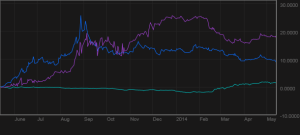
INR blue - IDR purple - CNH light blue 1 yr - bloomberg 

INR – Blue, IDR – Purple, CNY – Light Blue                       Source: Bloomberg

These currencies have now stabilised but at lower levels thanH1 2013, however, Emerging and Developed Asia is the region of strongest forecast economic growth according to most commentators. The IMF 2014 forecasts for the region have changed little in the past year: –

Country Jul-13 Oct-13 Jan-14 Apr-14
World 3.8 3.6 3.7 3.6
Dev Asia 7 6.5 6.8 6.8
China 7.7 7.3 7.5 7.5
India 6.2 5.1 5.4 5.4
Asean 5* 5.7 5.4 5.1 4.9
* Includes Indonesia, Thailand, Malaysia, Philippines and Vietnam

Source: IMF

The latest IMF – World Economic Outlook – April 2014 is entitled “Recovery Strengthens, Remains Uneven”. Here is how they sum up the prospects for Emerging Markets:-

First, if growth in advanced economies strengthens as expected in the current WEO baseline forecasts, this, by itself, should entail net gains for emerging markets, despite the attendant higher global interest rates. Stronger growth in advanced economies will improve emerging market economies’ external demand both directly and by boosting their terms of trade. Conversely, if downside risks to growth prospects in some major advanced economies were to materialize, the adverse spillovers to emerging market growth would be large. The payoffs from higher growth in advanced economies will be relatively higher for economies that are more open to advanced economies in trade and lower for economies that are financially very open.

Second, if external financing conditions tighten by more than what advanced economy growth can account for, as seen in recent bouts of sharp increases in sovereign bond yields for some emerging market economies, their growth will decline. Mounting external financing pressure without any improvement in global economic growth will harm emerging markets’ growth as they attempt to stem capital outflows with higher domestic interest rates, although exchange rate flexibility will provide a buffer. Economies that are naturally prone to greater capital flow volatility and those with relatively limited policy space are likely to be affected most.

Third, China’s transition into a slower, if more sustainable, pace of growth will also reduce growth in many other emerging market economies, at least temporarily. The analysis also suggests that external shocks have relatively lasting effects on emerging market economies, implying that their trend growth can be affected by the ongoing external developments as well.

Finally, although external factors have typically played an important role in emerging markets’ growth, the extent to which growth has been affected has also depended on their domestic policy responses and internal factors. More recently, the influence of these internal factors in determining changes in growth has risen. However, these factors are currently more of a challenge than a boon for a number of economies. The persistence of the dampening effects of these internal factors suggests that trend growth is affected as well. Therefore, policymakers in these economies need to better understand why these factors are suppressing growth and whether growth can be strengthened without inducing imbalances. At the same time, the global economy will need to be prepared for the ripple effects from the medium-term growth transitions in these emerging markets.

 As China reforms and rebalances its economy towards domestic consumption, how will the other countries of Emerging Asia perform and what will this mean for their financial markets?

The table below highlights some aspects of these markets. They are arranged in GDP size order: –


Country GDP 2014 f/c* 2015 f/c Base Rate 10yr Bond** Inflation Unemploy Gov Budget Debt/GDP C/A
India 4.7 5.8 6.5 8 8.78 8.31 3.8 -4.9 68 -4.6
Indonesia 5.7 5.3 5.5 7.5 8.02 7.25 6.25 -2.2 26 -3.2
Thailand 0.6 4.5 5 2 3.39 2.45 0.62 -2.5 45 -0.4
Malaysia 5.1 4.8 4.9 3 4 3.5 3.2 -3.9 55 4.7
Philippines 6.5 6.5 7.1 3.5 4.31 3.9 7.5 -1.4 38 3.5
* Forecasts World Bank – GEP – January 2014
** Source: Investing.com (15/5/2014)

The World Bank GDP forecasts differ slightly from those of the IMF but not materially. All the countries are saddled with budget deficits but Malaysia and the Philippines are running current account surpluses. Indonesia’s Debt to GDP ratio is the lowest of the five nations but their debt is heavily US$ denominated whereas Thailand is principally a domestic borrower.

Below I’ve picked out some details from the IMF – World Economic Outlook:-

1. Deviation from Trend GDP

India is running around 3.5% below trend and Thailand 2% below, Malaysia is fairly neutral but Indonesia is already around 1.5% above trend and the Philippines nearly 2.5% above.

2. Responsiveness to US GDP shock

India is most sensitive at +/- 2%, followed by Malaysia 1.5%. The Philippines moves one for one and in the first year Thailand barely reacts, although in year two its sensitivity increases to +/- 0.6%.

3. Trade Openness (Exports plus Imports as a % of GDP)

Malaysia comes top at 175%, followed by Thailand at around 130%, then the Philippines at 80%, Indonesia at 60% and finally India at 45%

4.Trade exposure to advanced economies (Exports to US and EU as % of GDP)

Malaysia leads once again with 28%, followed by Thailand at 17%. The Philippines are hot on their heels at 15% whilst Indonesia and India languish at 8% and 5% respectively.

5. Foreign Capital flow volatility

Malaysia is most sensitive at 5%, followed by Thailand at 4.5%. Indonesian volatility is around 3% whilst the Philippines is only 2%. India has the least sensitivity at 1.8%.

India 

After China, India is the largest economy in Emerging Asia. With 1.2 bln people it is blessed with the most favourable demographics of the BRIC economies. It should overtake China to become the most populous country on earth between 2020 and 2025. In the nearer term Indian voters have just elected a new BJP government with a strong reform agenda. I’m not sure that “Toilets not Temples” is the greatest campaign slogan but it clearly resonated with the masses.

India suffered from capital flight in 2013 with the INR declining by 17% against the US$. After the initial Federal Reserve tapering announcement on 3rd September 2013 capital outflows totalled $13.4bln and RBI reserves were depleted to the tune of $17bln. The RBI responded by raising the Marginal Standing Facility by 2%. They then reduced it by 150bp as the short term effect of capital flight subsided. Rates were then increased by 75bp as inflation concerned increased.

The RBI – Macro and Monetary Developments April 2014 report shows how the Indian economy has recovered over the last few months. It goes on to identify risks and opportunities looking ahead: –

 The Indian economy is set on a disinflationary path, but more efforts may be needed to secure recovery

I.6 While the global environment remains challenging, policy action in India has rebuilt buffers to cushion it against possible spillovers. These buffers effectively bulwarked the Indian economy against the two recent occasions of spillovers to EMDEs — the first, when the US Fed started the withdrawal of its large scale asset purchase programme and the second, which followed escalation of the Ukraine crisis. On both these occasions, Indian markets were less volatile than most of its emerging market peers. With the narrowing of the twin deficits – both current account and fiscal – as well as the replenishment of foreign exchange reserves, adjustment of the rupee exchange rate, and more importantly, setting in motion disinflationary impulses, the risks of near-term macro instability have diminished. However, this in itself constitutes only a necessary, but not a sufficient, condition for ensuring economic recovery. Much more efforts in terms of removing structural impediments, building business confidence and creating fiscal space to support investments will be needed to secure growth.

I.7 Annual average CPI inflation has touched double digits or stayed just below for the last six years. This has had a debilitating effect on macro-financial stability through several channels and has resulted in a rise in inflation expectations and contributed to financial disintermediation, lower financial and overall savings, a wider current account gap and a weaker currency. A weaker currency was an inevitable outcome given the large inflation differential with not just the AEs, but also EMDEs. High inflation also had adverse consequences for growth. With the benefit of hindsight, it appears that the monetary policy tightening cycle started somewhat late in March 2010 and was blunted by a series of supply-side disruptions that raised inflation expectations and resulted in its persistence. Also, the withdrawal of the fiscal stimulus following the global financial crisis was delayed considerably longer than necessary and may have contributed to structural increases in wage inflation through inadequately targeted subsidies and safety net programmes.

I.8 Since H2 of 2012-13, demand management through monetary and fiscal policies has been brought in better sync with each other with deficit targets being largely met. Monetary policy had effectively raised operational policy rates by 525 basis points (bps) during March 2010 to October 2011. Thereafter, pausing till April 2012, the Reserve Bank cut policy rates by 75 bps during April 2012 and May 2013 for supporting growth. Delayed fiscal adjustment materialised only in H2 of 2012-13, by which time the current account deficit (CAD) had widened considerably.

The easing course of monetary policy was disrupted by ‘tapering’ fears in May 2013 that caused capital outflows and exchange rate pressures amid unsustainable CAD, as also renewed inflationary pressures on the back of the rupee depreciation and a vegetable price shock. The Reserve Bank resorted to exceptional policy measures for further tightening the monetary policy. As a first line of defence, short-term interest rates were raised by increasing the marginal standing facility (MSF) rate by 200 bps and curtailing liquidity available under the liquidity adjustment facility (LAF) since July 2013. As orderly conditions were restored in the currency market by September 2013, the Reserve Bank quickly moved to normalise the exceptional liquidity and monetary measures by lowering the MSF rate by 150 bps in three steps. However, with a view to containing inflation that was once again rising, the policy repo rate was hiked by 75 bps in three steps.

I.9 Recent tightening, especially the last round of hike in January 2014, was aimed at containing the second round effects of the food price pressures felt during June-November 2013. Since then, inflation expectations have somewhat moderated and the temporary relative price shock from higher vegetable prices has substantially corrected along with a seasonal fall in these prices, without further escalation in ex-food and fuel CPI inflation. While headline CPI inflation receded over the last three months from 11.2 per cent in November 2013 to 8.1 per cent in February 2014, the persistence of ex-food and fuel CPI inflation at around 8 per cent for the last 20 months poses difficult challenges to monetary policy.

I.10 Against this background there are three important considerations for the monetary policy ahead. First, the disinflationary process is already underway with the headline inflation trending down in line with the glide path envisaged by the Urjit Patel Committee, though inflation stays well above comfort levels.

Second, growth concerns remain significant with GDP growth staying sub-5 per cent for seven successive quarters and index of industrial production (IIP) growth stagnating for two successive years. Third, though a negative output gap has prevailed for long, there is clear evidence that potential growth has fallen considerably with high inflation and low growth. This means that monetary policy needs to be conscious of the impact of supply-side constraints on long-run growth, recognising that the negative output gap may be minimal at this stage.

What does this mean for the INR, Indian stocks and Indian Bonds?

The Sensex Index is already trading on a P/E of 17. This is expensive when compared to the EM average of 12. Therefore they do not offer exceptional value, however, Indian equities are making new highs, the uncertainty of the elections is behind them and world equity markets continue higher – stay long!

Indian Bonds are not easy for international investors to access and offer a real yield of only 0.47%. The Indian yield curve is positive to the tune of 0.78% but inflation expectations are falling. Whilst there are better real yields and steeper yield curves in Emerging Asia, Indian Bonds should perform well as the new government embarks on economic reform.

The USD/INR hit its low point in August 2013 at 69.25 but has since rallied to 58.38 this month; this is still in the lower end of its post 2009 range and well below 2005-2009 levels. I expect the INR to appreciate as the Modi government gets to work. This may dampen the rise of the Sensex.

The Sensex Index has rallied by more than 40% since its low in August 2013, taking out previous highs. The INR has also performed strongly but is still well below its 2010/2011 level of sub 50 vs USD. Indian 10yr bonds by contrast have seen yields increase from 7.2% in June 2013 to hit their highs at 9.17% in December last year. Since then they have increased slowly to their current yield of 8.78%. Technically they look uninteresting but fundamentally they should perform well – this is one of the highest yields in emerging markets.

Indonesia

Indonesia suffered from similar issues to India as the latest Bank Indonesia – Monetary Policy Review – April 2014 explains:-

At the Bank Indonesia Board of Governors’ Meeting held on 8th April 2014, it was decided to maintain the BI rate at 7.50%, with the Lending Facility rate and Deposit Facility rate held respectively at 7.50% and 5.75%. This policy is consistentwith ongoing efforts to steer inflation back towards its target corridor of 4.5±1% in 2014and 4.0±1% in 2015, as well as reduce the current account deficit to a more sustainablelevel. Bank Indonesia considers recent developments in the economy of Indonesia asfavourable and in line with previous projections, marked by lower inflation and a balance oftrade that has returned to record a surplus. Looking ahead, Bank Indonesia will continue toremain vigilant of a variety of risks, globally and domestically, as well as implement anticipatory measures to ensure economic stability is preserved and stimulate the economy in a more balanced direction, thereby buoying current account performance. To this end, Bank Indonesia will continue strengthening the monetary and macroprudential policy mix as well as enhancing coordination with the Government to control the rate of inflation and reduce the current account deficit, including policy to bolster the structure of the economy and manage external debt, in particular private external debt.

…Bank Indonesia expects the ongoing episode of domestic economic moderation to continue, leading to a more balanced and sound economic structure. Externaldemand is improving and substituting moderating domestic demand as a source ofeconomic growth. Several latest indicators and leading indicators demonstrate thathousehold consumption surged in the first quarter of 2014 in the run up to the 2014General Election, among others. Exports are also following a more favourable trend on theback of exports from the manufacturing sector in harmony with the economic recoveriesreported in advanced countries. Meanwhile, private investment growth during the firstquarter of 2014 remained limited and is not expected to pick up until the second semester.As a whole, economic growth in Indonesia for 2014 remains in the range projected previously by Bank Indonesia at around 5.5-5.9%.

More balanced economic growth is further buttressed by improvements in the external sector from the standpoint of the trade balance and the financial account. The balance of trade of Indonesia in February 2014 rebounded to record a surplus of US$0.79 billion, bolstered by a burgeoning surplus in the non-oil/gas trade account. Thegrowing surplus in the non-oil/gas account stemmed from a contraction in non-oil/gas imports in line with moderating domestic demand along with a surge in non-oil/gasexports, primarily from the manufacturing sector as the economies of advanced countriescontinue to recover. The trade surplus also emanated from reductions in the oil and gastrade deficit as a result of rising oil and gas exports due to increased oil lifting as well as adecline in oil and gas imports in accordance with the mandatory use of biodiesel as fuel inthe transportation sector and the electricity sector. In terms of the financial account,foreign capital inflows continued unabated in March 2014, thus foreign portfolio inflows tofinancial markets in Indonesia reached US$ 5.8 billion accumulatively in the first quarter of2014. Against this auspicious backdrop, foreign exchange reserves held in Indonesia at theend of march 2014 topped US$ 102.6 billion, equivalent to 5.9 months of imports or 5.7months of imports and servicing external debt, which is well above international adequacystandards of around three months of imports. Looking forward, Bank Indonesia expectsimprovements in the external sector to continue, underpinned by a current account deficitin 2014 that can be brought down to below 3.0% of GDP and a deluge of foreign capitalinflows. To this end, Bank Indonesia will continue to monitor a plethora of risks, global anddomestic, which could undermine external sector resilience and its pertinent response,including the performance of external debt, in particular private eternal debt.

The rate of inflation continued a downward trend in March 2014, which further  supports the prospect of achieving the inflation target of 4.5±1% in 2014. The rateof headline inflation was low in March 2014 at 0.08% (mtm) or 7.32% (yoy), down on thatposted in February 2014 at 0.26% (mtm) or 7.75% (yoy). Furthermore, inflation in Marchwas also lower than the average rate over the past six years. Inflationary pressures eased as a result of lower core inflation, which dropped in line with exchange rate appreciation, moderating domestic demand and well-anchored inflation expectations. Furthermore, food prices also experienced deflation due to greater supply of several food commodities at the onset of the harvest season.


An overall moderation in growth and inflation but an increasing trade surplus due to improved export demand. This, together with inward capital flows has supported Indonesian stocks, bonds and the IDR.

Another major factor for Indonesia is the forthcoming presidential elections, scheduled for July. The lead candidate, Jokowi, appears to be a reformer but details of his policies are only beginning to take shape as this Lowy Institute article describes.

The IDX Index made its recent lows in August 2013 – a 27% fall from its May 2013 highs. Since then the market has recovered. This month it came within 2.7% of the May 2013 high. If long: stay long. If not, wait for a close above 5,231.

Indonesian Bonds have shown little significant strength. As recently as February 2014 they made new highs at 9.24%. This is a significant increase on their low point of 5.08% in January 2013. Technically they look neutral. Since the 2008 crisis when they briefly touched 21.10% they have risen substantially. After a brief decline to test 9.96% in January 2011 they have been driven by international capital flows. With a lower yield than India and a more volatile history during the 2008/2009 crisis I’m inclined to wait for confirmation – going long on a break below the October 2013 low of 6.92% or short, if you can secure the repo, above the February 2014 high of 9.24%.

During the 2008/2009 crisis the IDR declined from 9000 to 12500 vs US$. It then recovered to pre-crisis levels and only began the recent depreciation in 2012. The precipitous deterioration began in July 2013 when it broke through 10000. The low point occurred in January of this year at 12200. Since then the IDR has regained some ground but the recovery still appears tentative.

The relative weakness of the IDR will aid Indonesia’s export competitiveness. Many investors choose to purchase US$ denominated Indonesian bonds so foreign capital is most likely to flow into the Indonesian stocks. 

Thailand

Thailand has seen rapidly slowing growth, prompting the Bank of Thailand to cut interest rates again in March. The Bank of Thailand – Monetary Policy Report – March 2014 elaborates: –

 The Thai economy appeared poised to slowdown in 2014 due to weaker domestic demand during the first half of the year. This was due to the political situation in Thailand which dented consumer and investor confidence. Meanwhile, exports gradually recovered in line with improved trading partners’ economies. Nevertheless, should the political situation subside by mid-2014, domestic demand was expected to pick up and would be the driver of economic growth together with exports. As a consequence, the Thai economy would resume growing close to its normal pace in 2015. Meanwhile, inflationary pressure edged up mainly from the pass-through of LPG cost to food prices, while demand pressure softened in line with economic conditions.

In the past three meetings, the MPC voted to reduce the policy rate by 0.25 percent in the first meeting, hold the policy rate at 2.25 percent per annum in the following meeting and then voted to reduce the policy rate by another 0.25 percent to stand at 2.00 percent per annum in the latest meeting. The MPC deemed that there was room for monetary policy to ease in order to lend more support to the economy during the recovery period, while inflationary pressure was not yet a concern.

The slowing of the Thai economy is also reflected in the weak performance of the USD/THB. From its recent high at 29.48 it sank to a low point of 33.15 in January this year – it has failed to stage much of a recovery since then.

Thai Bonds made a recent high in May 2013 at 3.29%. During the capital repatriation, yields backed up to 4.50% but have since fallen back to 3.39% – testament to the weakness of economic conditions.

The SET Index, by contrast has followed the global trend since making a low in January. It remains some distance below its May 2013 high. If the THB remains weak then the SET Index should benefit but the continued political unrest is likely to sap international enthusiasm for investment. This Bloomberg Business Week article may be useful by way of background.

 Malaysia

Those who remember the Asian crisis of 1997 will recall that Malaysia took the decision to impose foreign exchange controls. At the time many market participants forecast the demise of the Malaysian economy. They were proved incorrect, however, the risk that an investment cannot be liquidated and the proceeds repatriated, still hangs over Malaysian financial markets. This is a double-edged sword; volatility in MYR remains significantly lower than for IDR or INR. According to the IMF Malaysia has the greatest sensitivity to Capital Flows of the Emerging Asia countries. The price action of the past few years suggests this may no longer be the case.

After the removal of exchange controls in 2005 the MYR quickly appreciated from USD/MYR 3.8 to around 3.20 by mid-2008. The crisis saw the currency fall briefly to 3.70. By mid-2011 it was touching 3.00. The 2013 “tapering-tantrum” took the rate back to 3.46 in January 2014 but this year it has followed the other Asian currencies, recovering its composure.

But what are the prospects for the Malaysian economy? This monthsBank Negara Malaysia – Monetary Policy Statement – May 2014 provides a good overview: – 

Global growth moderated in the first quarter with several key economies affected by weather-related and policy-induced factors. Looking ahead, the global economy is expected to remain on a path of gradual recovery. In Asia, the better external environment provides further support to growth amid continued expansion in domestic demand. Conditions in the international financial markets have also improved following gradual and orderly policy adjustments in the major advanced economies while the impact from geopolitical developments remains contained.

For Malaysia, latest indicators suggest that the domestic economy continued to register favourable performance in the first quarter. Going forward, growth will remain anchored by domestic demand with additional support from the improved external environment. Exports will continue to benefit from the recovery in the advanced economies and regional demand. Private sector spending is expected to remain robust. Investment activity is supported by broad-based capital spending, particularly in the manufacturing and services sectors. Private consumption will be underpinned by stable income growth and favourable labour market conditions. The prospects are therefore for the growth momentum to be sustained.

Inflation has stabilised in recent months amid the more favourable weather conditions and as the impact of the price adjustments for utilities and energy moderate. Going forward, inflation is, however, expected to remain above its long-run average due to the higher domestic cost factors.

Amid the firm growth prospects and inflation remaining above its long-run average, there are signs of the continued build-up of financial imbalances. While the macro and micro prudential measures have had a moderating impact on the growth of household indebtedness, the current monetary and financial conditions could lead to a broader build up in economic and financial imbalances. Going forward, the degree of monetary accommodation may need to be adjusted to ensure that the risks arising from the accumulation of these imbalances would not undermine the growth prospects of the Malaysian economy.

Moderate growth, stable, but above target, inflation and risks of further inflationary pressure ahead; not the most compelling grounds for investment. This doesn’t appear to have dampened enthusiasm for Malaysian stocks. The KLCI Index has barely looked back since the 2008/2009 crisis. It witnessed a small correction in the fall of 2011 and an even smaller one during the summer of 2013. This month it took out the December 2013 highs. From a technical perspective one should remain long and be adding to that exposure. The Bank Negara report, however, prompts some caution.

Malaysian Bonds also reflect the central bank’s cautious tone. Having made post crisis lows at 3.06% in May 2013 the bond market fell during the second half of 2013 to peak at 4.31% in January. Since then the yield has fallen moderately. At the current yield (4%) even with a 1% positive yield curve I don’t perceive much attraction at this level.

Philippines

The Philippines suffered an appalling natural disaster last year when Typhoon Haiyan unleashed its wrath. It caused an estimated $770mln of damage but I don’t believe this was enough to derail what looks to be a strong growth story. According to the IMF it is above its trend growth rate, but inflation seems under control and the political will to reform the underperforming aspects of the economy seem to be in place. The Bangko Sentral ng Pilipinas – Q1 2014 Inflation Report takes up the story:-

Headline inflation rises on higher food and nonfood inflation. y) headline inflation ‐s inflation target range of 1.0 ppt for 2014. The uptick in headline inflation could be attributed to higher food inflation as the prices of most food commodities increased owing to some tightness in the domestic supply conditions. Similarly, higher electricity rates and domestic petroleum prices contributed to food inflation. The official core inflation along with two out of three alternative measures of core inflation estimated by the BSP likewise rose in Q1 2014 relative to the rates registered in the previous quarter. The official core inflation was slightly higher at 3.0 percent during the review quarter from 2.9 percent in Q4 2013. The number of items with inflation rates greater than the threshold of 5.0 percent also increased and accounted for a higher proportion of the CPI basket.

Domestic demand conditions remain buoyant. The Philippine economy continued to expand at an year 2013 GDP growth to 7.0 percent for the year. Output growth was driven by robust household spending, exports, and capital formation (particularly durable equipment) on the expenditure side; and by solid gains in the services sector on the production side. At frequency demand indicators continued to show positive readings in the first quarter. Vehicle sales posted strong growth during the quarter, buoyed by brisk consumer demand and attractive financing options offered by industry players. Energy sales also continued to rise, albeit at a slower pace, on account of increased consumption by the industrial and commercial sectors, while capacity utilization in manufacturing is steady above 80 percent. The composite Philippine Purchasing expansion threshold at 58.2 in Q4 2013 levels. Similarly, the outlook of businesses and consumers for the following quarter turned more favorable, supporting the continued strength of aggregate demand in the coming months amid sustained credit growth and ample liquidity in the financial system.

…Local financial markets experience bouts of volatility but regain some stability. s tapering of its quantitative easing (QE) measures and potential abrupt adjustments in its policy stance as recovery in the US firms up. Indications of a further economic slowdown in China likewise quarter owing to positive domestic economic reports suggesting sustained resiliency of Philippine macroeconomic fundamentals along with expectations of continued strong corporate earnings. The US Fed pronouncement to scale back stimulus in measured steps further propelled optimism in the local s average, while the spread on Philippine credit default swaps (CDS) continued to trade lower relative to those of our neighbors in the region. The Philippine Stock Exchange index (PSEi) also began to recover gains lost in bill auctions during preference bills. However, the peso recorded moderate depreciation relative to previous quarter on lingering uncertainty on the external front.

Inflation expectations continue to support the withintarget inflation outlook. s target 2015. Analysts expect inflation to rise going forward due largely to factors such as pending electricity rate adjustments, weakening peso, and possible increases in food and oil prices. Results of the March 2014 Consensus Economics inflation forecast survey for the country also showed a higher mean inflation projection for 2014.

The BSP maintains key policy rates but adjusts the reserve requirement ratio. The BSP decided to keep its policy interest rates steady during its 3 February and 27 March 2014 monetary policy meetings on the assessment that the future inflation path was likely to stay within the target ranges of 1.0 ppt for 2015. At the same time, the MB decided to increase the reserve requirement by one ppt effective on 11 April 2014 to help guard against potential risks to financial stability that could arise from the recent rapid growth in domestic liquidity.

Prevailing monetary conditions and inflation dynamics suggest that the space to keep monetary policy settings unchanged is narrowing. Latest baseline projections continue to show average headlineinflation settling within the target ranges for 2014 and 2015. However, current assessment of the priceenvironment over the policy horizon indicates that the balance of risks to the inflation outlook remainstilted to the upside, with potential price pressures emanating from pending petitions for adjustments inutility rates and from possible increases in food and oil prices. At the same time, while inflation expectations are still within target, they have trended higher and are moving near the upper end of the target range for 2015. Firm growth dynamics arising from the broad buoyancy of domestic demand also suggest that the economy can accommodate measured adjustments in monetary conditions. trust account placements in the SDA facility in November with more loanable funds deployed to support domestic economic activity as evident by the robust growth in bank lending. The continued strong liquidity up of financial stability risks. On the whole, the BSP continues to have monetary policy space to address the challenges that could threaten the inflation objective and stability of the Philippine financial system.

Going forward, the BSP will remain guided by its primary objective of maintaining price stability along with safeguarding the resilience of the financial system, and stands ready to deploy appropriate measures as needed to ensure sustainable, non‐inflationary, and inclusive economic growth.

The USD/PHP exchange rate remains weak but the overall decline in the PHP was less dramatic than for some of its Emerging Asia neighbours. From a March 2013 high of 40.40 it weakened to just above 46 by March this year. It is currently around 43.60. This should benefit the Philippine equity market.

The PSEI Index, however, has some way to go before breaching its May 2013 high at 7403. The technical picture looks similar to Thailand and Malaysia but the economic fundamentals are more supportive. At 6900 the index still presents a buying opportunity.

The Philippine Bond market doesn’t present such an obvious opportunity. After making highs this time last year at 3.04% yields had risen to 4.63% by March of this year. Now at 4.31% they offer the lowest real yield of the group.

Conclusion

International capital is flowing back into emerging Asia. A World Bank study earlier this year found that 60% of the investment in emerging markets between 2009 and 2013 has been due to quantitative easing and related policies of developed country central banks. The Bank of Japan continue with the Three Arrows – I hear rumours of more radical policies to come. The Fed is still adding $55bln per month. The ECB may be ready to do there bit for European growth. The Basel III rules are being gradually diluted – which, through the multiplier effect, may eclipse any reduction of QE by the Fed. In this environment Emerging Asia should benefit from inward capital flows and growth in exports to the recovering economies of the US, UK and even some parts of Europe. China will continue to rebalance toward consumption but its neighbours should benefit longer-term; I would anticipate an increase in capital expenditure by Asian companies in expectation of greater consumer demand from China.

My favoured equity market is the Philippines followed by India. My favoured bond market is India on the grounds that it offers the highest nominal yield in this group of emerging markets. As for the top currency, again I choose India. The INR and IDR will both benefit from the carry trade, but India is a larger and more balanced economy. It is therefore more insulated from concerns about a commodity collapse as China’s economy slows.

Canada – Australia – New Zealand – Commodities vs Housing


400dpiLogo

Macro Letter – No 11 – 09-05-2014

Canada – Australia – New Zealand – Commodities vs Housing

  • Commodity prices continue to decline due to slowing Chinese growth
  • Rising real estate prices in Canada, Australia and New Zealand ignore commodity demand
  • What does this mean for their stock, bond and currency markets?

Since the initial recovery in 2010 the price of Iron Ore and Coking Coal has declined due to lower demand from China. Australian Coking Coal hit a six year low in April. This downturn in demand has also been evident in the price of Copper and other industrial metals. Last year grain prices also tumbled adding to the pressure on commodity exporting countries: although prices for New Zealand’s Dairy Products remained firm.

Since Australia and New Zealand have similar major trading partners, and are geographically close when compared to Canada, they tend to be considered together whilst Canada is grouped with other NAFTA countries. I want to review these three countries together. To begin I’ve constructed a table which highlights some of the similarities and differences between these “commodity” countries.

Country Main Exports Export Markets
Canada Oil, Wood Products, Chemicals USA (73%) EU (5%) UK (4%)
Australia Coal, Iron, Wheat, Aluminium China (30%) Japan (19%) S. Korea (8%)
New Zealand Dairy Products, Meat, Wool Australia (21%) China (15%) USA (9%) Japan (7%)


During the decline in commodity prices the currency markets have reflected these dynamics quite accurately. The CAD and AUD have been steadily falling vs the US$  – although these trends may be starting to reverse. The NZD by contrast has continued to appreciate not only against the US$ but also against its “commodity cousins”.

The chart below shows the NZD Trade-weighted index up to mid 2013 – it has continued to appreciate since then.

NZD TWI - source ricardianambivalence.com

Source: ricardianambivalance.com

The AUD Trade-weighted index chart is updated to the beginning of 2014 – it continued to weaken until last month.

AUD TWI - source FXstreet.com

Source: fxstreet.com

The third chart is of the CAD effective exchange rate – it also shows foreign capital flows.

CAD effective exchange rate and capital flows

Source: Business in Canada

Plus ça change, plus c’est la même chose

The currency markets reflect Canada and Australia’s reaction to the weakness of Chinese demand, the rising NZD points to other factors. Before I delve into the real estate market I thought the table below might be useful, it looks at a number of economic indicators across the three countries. In many respects these economies are quite similar.
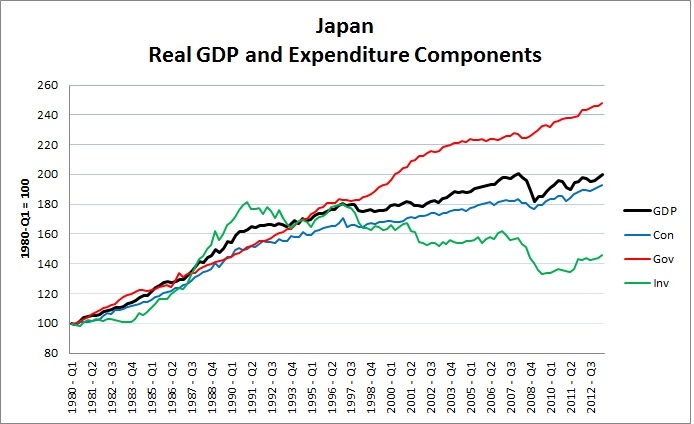
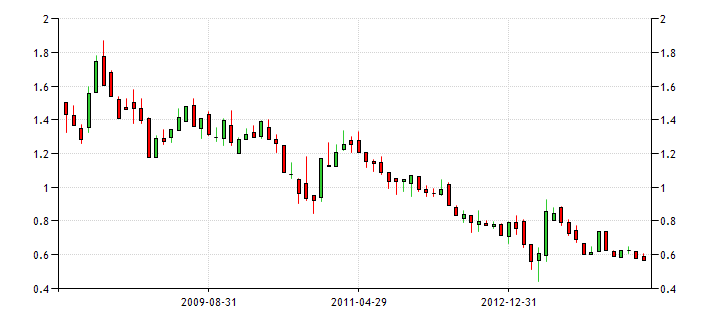
Country GDP Unemploy CPI Current A/C Budget Base Rate 10 yr Debt/GDP
Canada 2.7 6.9 1.5 -3.2 -1 1 2.35 89.1
Australia 2.8 5.8 2.9 -2.9 -1.2 2.5 3.82 20.5
New Zealand 3.1 6 1.5 -3.4 -2.1 3 4.31 35.9


New Zealand is delivering the strongest GDP growth with the highest real interest rates, but all three countries are suffering from twin budget and current account deficits. Considering the weakness of commodity markets and their reliance on those export markets it is clear that other factors are driving growth.

A quick review of the central bank policy reports reveals another common theme – real estate.

Bank of Canada – Monetary Policy Report – April 2014

Inflation in Canada remains low. Core inflation is expected to stay well below 2 per cent this year due to the effects of economic slack and heightened retail competition, and these effects will persist until early 2016. Total CPI inflation is forecast to be closer to 2 per cent over the coming quarters and remain close to target thereafter.

The global economic expansion is expected to strengthen over the next three years, as headwinds that have been restraining activity dissipate.

In Canada, the fundamental determinants of growth and inflation continue to strengthen gradually, as anticipated.

The Bank continues to expect Canada’s real GDP growth to average about 2 1/2 per cent in 2014 and 2015 before easing to around the 2 per cent growth rate of the economy’s potential in 2016.

No mention of concern about an overheated real estate market in the highlights, however later in the summary they do state: –

Recent developments are in line with the Bank’s expectation of a soft landing in the housing market and stabilizing debt-to-income ratios for households. Still, household imbalances remain elevated and would pose a significant risk should economic conditions deteriorate.

Perhaps the BoC don’t believe it’s their job to reign in the housing market. The Canadian government has imposed several rule changes to curtail the allure of property but, whilst price rises have slowed the correction has yet to materialise. March 2014 house prices were unchanged for the first time in 15 years – it’s too early to predict the top just yet.

The Economist picked up on real estate earlier this month. They pointed out that Canadian household debt has increased from 76% of GDP in Q3 2007 to 93% in Q3 2013. On their measure Canadian property is 76% above its long-term average and on a rent to income basis, 31% overvalued.

The BoC summary also ignores a dichotomy within Canada. Since the crisis of 2008 the populous manufacturing heartlands, Ontario and Quebec (60% of Canada’s population) have seen little economic recovery. The commodity exporting Western states, by contrast, have rebounded – although they are now slowing in response to weaker Chinese demand. Government energy policy remains focussed on supplying the Chinese and Japanese markets with Oil and LNG. China has also been a major investor in Canadian energy companies both directly and indirectly. Since 2007 China is estimated to have invested C$119bln in this sector according to a recent Jamestown Foundation report.

A sustained US economic recovery may insure that Canadian economic growth becomes more balanced over the next couple of years – after all, 73% of Canadian exports are to the US – however, the Canadian government has a gaping budget deficit to plug. In 2008 they were in surplus – they hope to balance the books once more by 2015/2016. This may be a tall order; at the provincial level Ontario has the largest debt of any Canadian state and a debt to GDP ratio of 37.5% – the outstanding amount, C$267.5bln, is significantly larger than the debt of California. Quebec, not to be eclipsed, boasts the largest debt to GDP ratio at 49%, although its total is lower. The Fraser Institute forecast that this will rise to 57% of GDP by 2022/2023 if they continue with their current policies.

Canadian real estate prices are also a concern for the international markets since six Canadian financial institutions dominate the domestic mortgage market. They have combined financial assets equivalent to five times Canada’s GDP – unlike the US Canada has a “Too big to bail” problem.

Reserve Bank of Australia – Monetary Policy Committee Minutes – April 2014

Recent indicators for the global economy suggested that activity in Australia’s major trading partners in the early part of 2014 had expanded at around its average pace…

…In China, data for the first few months of 2014 had suggested a continuation of the easing in economic growth that had started in the latter part of 2013…The targets for inflation and money growth in China were also unchanged for 2014.

Recent data for the United States were consistent with further moderate growth in the economy…

In Japan, domestic demand growth had remained strong, with activity picking up prior to the consumption tax increase at the beginning of April…In the rest of east Asia, growth had continued at around the average of the past decade, while economic conditions in India remained subdued…

Global commodity prices had declined since the previous Board meeting. The spot price for iron ore had been volatile over recent weeks, while steel prices in China had declined and spot prices for coking and thermal coal were well below current contract levels. The fall in the price of steel in China over recent weeks was consistent with a softening in demand. At the same time, the supply of steel appeared to have been constrained by a tightening in credit conditions reflecting the Chinese authorities’ concerns about pollution. Base metals prices had also declined, though rural commodity prices were a little higher.

Domestic Economic Conditions

Members began their discussion of the domestic economy with the labour market, which remained weak despite a strong rise in employment in February and an upward revision to employment in January…Meanwhile, a range of indicators of labour demand suggested a modest improvement in prospects for employment, although the unemployment rate was still expected to edge higher for a time.

The national accounts, which had been released the day after the March Board meeting, reported that average earnings growth over the year to the December quarter 2013 had remained subdued. With measured growth in labour productivity around the average rate of the past two decades, nominal unit labour costs were unchanged over 2013.

Members recalled that the national accounts reported that GDP rose by 0.8 per cent in the December quarter and by 2.8 per cent over the year, which was a little stronger than had been expected. In the quarter, there had been further strong growth of resource exports, while growth in consumption and dwelling investment picked up a little and business investment declined. Public demand had made a surprisingly strong contribution to growth, but planned fiscal consolidation at state and federal levels was likely to weigh on public demand for some time…

Retail sales had increased by 1.2 per cent in January, continuing the pick-up in momentum that began in mid 2013. The Bank’s liaison with firms suggested that, more recently, retail sales growth may have eased from this strong rate. Motor vehicle sales declined further in February, as had measures of consumer confidence over recent months, but the latter were still around their long-run averages.

Housing market conditions remained strong, with housing prices rising in March to be 10½ per cent higher over the year on a nationwide basis. Members noted that dwelling investment had increased moderately in the December quarter, with a pick-up in renovation activity, and that the high level of dwelling approvals in recent months foreshadowed a strong expansion in dwelling investment…

Business investment fell in the December quarter, driven by a large decline in machinery and equipment investment and falls in engineering and non-residential building construction. While much of the decline appeared to have been driven by mining investment, non-mining business investment was also estimated to have declined in the quarter. More recently, non-residential building approvals had increased in January and, in trend terms, were at their highest level since 2008, with increases evident across a range of categories, including the office, industrial and ‘other commercial’ sectors…

Conditions were not sufficiently robust to prompt a change in monetary policy. Perhaps this is because the markets are focussed on next week’s deficit busting budget. What is clear is that manufacturing continues to struggle. According to a report from the Boston Consulting Group, Australia has the highest manufacturing cost of the top 25 largest exporting nations. This poor performance is reinforced by a report from the Productivity Commission pointing to a -0.8% fall in Multi-Factor Productivity (MFP).

The biennial IMF Fiscal monitor – published last month – placed Australia at the top of the list of developed countries with the fastest deteriorating economies relative to forecast. They focussed on the government budget deficit – currently the third largest of all developed nations, behind Japan and Norway. They urged the Australian government to take draconian measures to bring Debt to GDP ratio down toward 70% by 2020.

There has been much discussion of potential changes to the tax treatment of mortgages which could puncture the buy to let market, where “negative gearing” has been prevalent.  The RBA acknowledged that housing construction is now “Strong” vs “Solid” at its March meeting. The Australian Bureau of Statistics – Trends in Household Debt  was released this month showing household debt is at the highest level in real term for 25 years. The Household debt to Income ratio is currently the highest in the developed world at 180%, though Canada isn’t far behind at 165%.

Before you rush to sell your second home down-under it is worth noting that on the basis of Mortgage Interest to Income Australian property is not that expensive. The current ratio is 7% down from 12% in 2008 – although still above the 50 year average of 5%, it reflects today’s benign inflation and lower interest rate environment.

Longer term commodities are still a major source of economic growth, but Australia is ranked 79 in terms of Economic Complexity, with New Zealand at 48 and Canada at 41. All three countries have falling productivity; Australia’s average is -1.3, New Zealand -1.2 and Canada -1.1. In the shorter term, it seems that real estate is the main driver of growth and that growth is based on leveraged household debt.

Reserve Bank of New Zealand – Monetary Policy Statement – March 2014

The Reserve Bank today increased the OCR by 25 basis points to 2.75 percent.

New Zealand’s economic expansion has considerable momentum, and growth is becoming more broad-based.

GDP is estimated to have grown by 3.3 percent in the year to March…

Prices for New Zealand’s export commodities remain very high, and especially for dairy. Domestically, the extended period of low interest rates and continued strong growth in construction sector activity have supported recovery. A rapid increase in net immigration over the past 18 months has also boosted housing and consumer demand. Confidence is very high among consumers and businesses, and hiring and investment intentions continue to increase.

Growth in demand has been absorbing spare capacity, and inflationary pressures are becoming apparent, especially in the non-tradables sector. In the tradables sector, weak import price inflation and the high exchange rate have held down inflation. The high exchange rate remains a headwind to the tradables sector. The Bank does not believe the current level of the exchange rate is sustainable in the long run.

There has been some moderation in the housing market. Restrictions on high loan-to-value ratio mortgage lending are starting to ease pressure, and rising interest rates will have a further moderating influence. However, the increase in net immigration flows will remain an offsetting influence.

While headline inflation has been moderate, inflationary pressures are increasing and are expected to continue doing so over the next two years. In this environment it is important that inflation expectations remain contained. To achieve this it is necessary to raise interest rates towards a level at which they are no longer adding to demand. The Bank is commencing this adjustment today. The speed and extent to which the OCR will be raised will depend on economic data and our continuing assessment of emerging inflationary pressures.

By increasing the OCR as needed to keep future average inflation near the 2 percent target mid-point, the Bank is seeking to ensure that the economic expansion can be sustained.

I have always been impressed by the hawkish credentials of the RBNZ, governor Graeme Wheeler is taking a proactive approach to potential inflationary pressure. However, since these minutes were published the RBNZ has announced that it will intervene on the foreign exchanges to stem any excessive rise in the value of the NZD. The New Zealand currency is near to a 40 year high. Rather than keeping interest rates artificially low to reduce the attraction of NZD as a destination for foreign capital flows, they have chosen to intervene. Governor Wheeler identifies four economics risks which might presage a reversal in NZD strength: –

  1. Weakening of US growth
  2. Fall in dairy prices
  3. Fall in Chinese growth
  4. Increase in financial market volatility leading to a “Risk-Off” environment

The RBNZ has also been courageous in articulating another problem with the current New Zealand policy mix in relation to the “High Immigration Policy”. Board member, Michael Reddel’s working paper – The long-term level “misalignment” of the exchange rate – discusses this subject, it  observes that immigration does not guarantee rising living standards for everyone. He goes on to suggest that “Capital Deepening” from immigration has failed to show up improved MFP. The undesirable side-effects of the policy, however, can be seen in rising land and property prices due to finite supply and increased demand from immigrants, together with foreign capital inflows which have supported the NZD. This has led to a reduction in real incomes and an increase in real interest rates.

The New Zealand government has established a housing affordability target of four time income – this being the long-run average. The current level in Auckland is seven times.

It is worth noting that Australia has similar policies on immigration and similar problems with housing affordability.  The foreign buyers are often Chinese – as the Chinese real estate bubble implodes, one has to wonder how long this will continue.

Real Estate, Currency, Bonds or Stocks

The real estate markets in Canada, Australia and New Zealand are all at or near all time highs, their levels of household debt are similarly extended. Given the illiquid nature of real estate as an asset class now is not the time to buy. The trend is still upward, but when markets reverse those with poor liquidity “gap” lower; the risks in real estate look asymmetric, now is a good time to reallocate to more liquid assets.

I’ve already reviewed the relative merits of the three currencies but, to reiterate, I continue to favour NZD over CAD and, because Canada has a more balanced economy in terms of export markets and economic complexity, I favour CAD over AUD – although CAD/AUD is not a compelling trade in itself.

Canadian 10 yr bonds made their highs in July 2012 yielding 1.56%, by September 2013 they had followed US Treasuries lower to yield 2.83%. Now at 2.4% they are in a neutral range.

By contrast the TSX Index has made new highs this month. Momentum is slowing but the trend remains firmly in tact – remain long but be tentative if establishing new positions. The BoC are not expecting a dramatic increase in growth in 2015/2016 – thereafter they expect growth to slow towards 2%.

Australian 10 yr bonds also hit their highs in July 2012 at 2.68%. In line with the weakness of US Treasuries they declined until yields reached 4.50% in December 2013. Since then they have rallied to 3.83%. The beginning of an up trend is in place, supported by expectations of an extended period of unchanged policy from the RBA. The Australian governments decision to freeze fuel taxes last month means they have an additional A$5bln shortfall in income – the fiscal tightening required to balance the budget is likely to stay the RBAs hand for some time to come – of the three countries, this is my favoured bond market.

With fiscal tightening on the cards it was surprising to see the ASX Index making new highs in April. The momentum is stronger than in Canada and the trend is quite clear. Once the terms of the budget are announced next week it may be easier to consider establishing new longs; I would prefer to see the market make new highs by way of confirmation; if Canberra bites the bullet, Australian stocks might bite the dust.

New Zealand 10 yr bonds made their highs in May 2013 at 3.17%, by December 2013 they had fallen to 4.88%. In line with most other bond markets they have rallied this year to a current yield of 4.31%. The recovery looks weak and the recent interest rate hike by the RBNZ, together with their more up-beat assessment of potential growth and inflation, makes NZ bonds the least attractive of the three bond markets. The three markets have almost identical yield curve shapes (1.30/1.35 bp positive) but, starting with structurally higher rates, I believe the New Zealand curve should be steeper at this stage in the cycle. I’ve tried to trade the Kiwi yield curve in the past and been burnt by the pro-active policies of the RBNZ – please don’t regard this as a recommendation.

The NZ 50 Index, along with the Canadian and Australian indices, has made new highs in the past month. The momentum is stronger than in the TSX or ASX, which is justified by the fundamental assessment of the RBNZ. The negative impact of a strengthening currency should be tempered by RBNZ intervention. This will also encourage capital flows into stocks, since the “carry trade” is capped. RBNZ tightening in expectation of inflation is likely to encourage liquidation of bond holdings, again favouring stocks.

The only cloud on an otherwise rosy horizon is the liquidity risk associated with New Zealand markets in general. In the latest survey of GDP growth by The World Bank, Canada was ranked 11th,Australia 12th whilst New Zealand came in at 55th. As RBNZ governor Wheeler pointed out, one of the risks to the New Zealand economy is a reversal of foreign capital flows if financial market volatility increases. Barring a return of the “Risk-Off” trade, I favour New Zealand Equities; hedged, but only if you really need to, by a short position in New Zealand bonds.