Rising yields and rising correlation in major bond markets – end of cycle or correction?

400dpiLogo

Macro Letter – No 36 – 22-05-2015

Rising yields and rising correlation in major bond markets – end of cycle or correction?

  • European bond yields have risen following the lead of US treasuries
  • Yield curves are steepening despite minimal inflation
  • A return to the natural rate of interest seems unlikely
  • Over-indebtedness will stifle GDP growth and yields will fall

Since the beginning of 2015 the world’s largest bond markets have witnessed increasing yields. In the aftermath of the Great Financial Crisis many economies decoupled and their government bond markets followed suit. Now correlations are rising once more. The table below, which is a snapshot of prices on Tuesday morning 19th May, looks at a broad range of developed bond markets:-

Bond & Maturity Yield Low Date Change CPI Real yield 10yr-2yr
Australia 2Y 2.035
Australia 5Y 2.305
Australia 10Y 2.92 2.236 March 0.684 1.3 1.62 0.885
Canada 2Y 0.646
Canada 5Y 1.006
Canada 10Y 1.711 1.23 February 0.481 1.2 0.511 1.065
Denmark 2Y -0.299
Denmark 5Y 0.088
Denmark 10Y 0.786 0.075 February 0.711 0.5 0.286 1.085
France 2Y -0.162
France 5Y 0.182
France 10Y 0.832 0.332 April 0.5 0.1 0.732 0.994
Germany 2Y -0.21
Germany 5Y 0.026
Germany 10Y 0.563 0.049 April 0.514 0.5 0.063 0.773
Italy 2Y 0.108
Italy 5Y 0.697
Italy 10Y 1.753 1.041 March 0.712 -0.1 1.853 1.645
Japan 2Y -0.002
Japan 5Y 0.103
Japan 10Y 0.388 0.199 January 0.189 2.3 -1.912 0.39
New Zealand 2Y 3.09
New Zealand 5Y 3.25
New Zealand 10Y 3.74 3.085 January 0.655 0.1 3.64 0.65
Norway 2Y 0.857
Norway 5Y 1.035
Norway 10Y 1.676 1.202 February 0.474 2 -0.324 0.819
Sweden 2Y -0.331
Sweden 5Y 0.169
Sweden 10Y 0.691 0.216 April 0.475 -0.2 0.891 1.022
Switzerland 2Y -0.839
Switzerland 5Y -0.48
Switzerland 10Y -0.003 -0.28 January 0.281 -1.1 1.097 0.836
UK 2Y Yield 0.537
UK 5Y Yield 1.39
UK 10Y Yield 1.892 1.337 January 0.555 -0.1 1.992 1.355
US 2Y Yield 0.565
US 5Y Yield 1.506
US 10Y Yield 2.193 1.63 January 0.563 -0.1 2.293 1.628

Source: Investing.com and Trading Economics

I’ve highlighted some of the data. The highest real 10yr yield is to be found in New Zealand (3.64%) but US T-Bonds lie second. The lowest real yield is evident in Japanese Government Bonds (JGBs) however, a quick glance at the shape of the Japanese yield curve suggests that inflation, or perhaps I should say deflation, expectations are firmly anchored at near zero, despite repeated bouts of Abenomic stimulus. Japan has the flattest yield curve. The US curve is second steepest, behind Italy, where the spread between 2yr and 10yr is 164.5bp. Italy has also seen the largest rise in yields since its low back in March, although Danish yields have risen to a similar degree as its non-Euro “safe haven” status has waned.

A number of factors have driven yields higher. In the Eurozone (EZ) concern about a Greek exit initially stimulated a “flight to safety” in government securities – other than Greek government bonds – this spilled over into Swiss Confederation bonds. Switzerland remains the ultimate “safe haven”. As yields in the EZ declined to record lows, capital also flowed into EZ stocks. At the same time economic data began to turn more positive, prompted further flows into equities. The last EZ bond markets to turn lower were France and Germany, last month.

Outside the EZ, the US economy has seen mixed data but GDP growth remains steady. Expectations of Federal Reserve rate increases, whilst still some way off (current consensus January 2016) weigh on the T-Bond market. A rebound in crude oil and weakening of the US$ TWI since its highs in early March have also seen an unwinding of bullish US$ and US Treasury exposures.

Stock markets have so far paid little heed to the bond markets. The S&P500 made new highs this week. Canada, Japan, Germany and the UK all made highs in April whilst the Australian ASX retouched its March highs during the month. Even New Zealand, with the second flattest yield curve and structurally higher real interest rate curve, is less than 4% off its all-time highs.

Inflation expectations and real returns

Earlier this week saw the publication of this first part of a two part article about inflation expectations from the NY Fed – FRBNY DSGE Model Forecast–April 2015:-

The top panel in the chart below presents quarterly forecasts for real output growth and the core PCE inflation rate over the 2014-17 horizon. These forecasts were produced on April 9 using data released through 2014:Q4, augmented for 2015:Q1 with a “nowcast” for GDP growth, core PCE inflation, and growth in total hours, and 2015:Q1 observations for financial variables. The reason for using nowcasts is that the model is estimated on National Income and Product Accounts data, which are only available with a lag. Nowcasts incorporate up-to-date information, and this tends to improve short-run forecasts, as shown here. The black line represents released data, the red line is the forecast, and the shaded areas mark the uncertainty associated with our forecasts at 50, 60, 70, 80, and 90 percent probability intervals. Output growth and inflation are expressed in quarter-to-quarter percentage annualized rates. 

NY Fed PCE GDP forecasts

Source: NY Fed

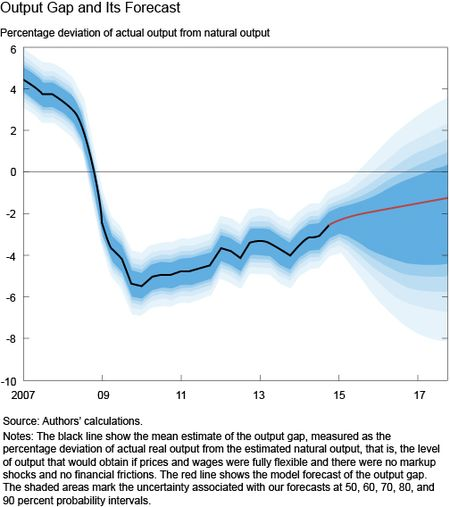
The FRBNY DSGE forecast for output growth is slightly stronger than it was in our earlier blog post which used data ending in July 2014. This difference is highlighted in the bottom left panel of the chart, which compares current (solid line) and September (dashed line) forecasts. The model projects the economy to grow 1.9 percent in 2015 (Q4/Q4), 2.1 percent in 2016 and 2.2 percent in 2017. The headwinds that slowed down the economy in the aftermath of the financial crisis are finally abating. This is reflected in the model-implied “natural” level of output and the “natural” rate of interest, which are defined as the counterfactual level of output and interest rate that would obtain in an ideal economy where nominal rigidities, markup (or cost-push) shocks, and financial frictions are absent. Estimates of the recent natural level of output show a more rapid growth as the headwinds facing the economy are fading. As we will discuss at length in our next post, the natural rate of interest is finally increasing toward positive ranges, after having been negative for the entire post-Great Recession period.  The recovery has been relatively slow, however, with economic activity remaining below its natural level since the end of 2008 and projected to remain so throughout the forecast horizon. The model thus predicts a very gradual closing of the output gap, measured as the percentage deviation of actual output from natural output (although there is much uncertainty about the gap forecast). This output gap, along with its forecast, is shown in the next chart. 

NY Fed Output Gap

Source: NY Fed

…In conclusion, the FRBNY DSGE model continues to predict a gradual recovery in economic activity with a slow return of inflation toward the FOMC’s long-run target of 2 percent, as the negative effect of the Great Recession dissipates. This forecast remains surrounded by significant uncertainty, with the risks slightly skewed to the downside for output growth because of the constraint on policy imposed by the zero lower bound. 

The Peterson Institute – Quantity Theory of Money Redux? Will Inflation Be the Legacy of Quantitative Easing? Examines the classical monetarist argument that QE will eventually lead to inflation, this is their conclusion:-

On balance, the risk of severe inflation resulting from the buildup of the balance sheet of the Federal Reserve in association with quantitative easing seems low. To begin with, the US economy has not experienced inflation driven by excessive money expansion since at least the mid-1980s. Indeed, the rising demand for money, as the opportunity cost of holding money fell with lower inflation, has meant that over the past three decades there has been a tendency for faster money growth(relative to real GDP) to be associated with lower rather than higher inflation. The supply-focused quantity theory of money broke down. The pattern associating rapid money growth with low inflation since the mid-1980s would require a sharp reversal for money supply to become the proximate cause of inflation. In the meantime, it seems fair to say that in the United States inflation is determined by labor market and product market tightness (in the Phillips curve tradition), and that the opposing proposition that “inflation is always and everywhere a monetary phenomenon” (Friedman’s summary of the quantity theory) does not hold in a narrow sense relating to money supply.

A second important phenomenon is that inflation has remained low despite a large buildup in the Fed’s balance sheet not because the velocity of broad money has collapsed, but because the money multiplier has done so. Because of a large increase in excess bank reserves equal to nearly three-fourths of the increase in the Federal Reserve’s total assets, the usual money multiplier (inverse of the reserve requirement ratio) no longer holds. Broad money was 14 times the money base in 2007; by end-2014 it was only 4 times the money base.

A third observation is that arguably this same phenomenon could pose a risk of inflationary money expansion when and if banks start to draw down excess reserves.

Fourth, the principal implication for policy purposes is that the Federal Reserve will need to be particularly adept in avoiding any inflationary pressures that might develop from the unwinding of large excess bank reserves as more normal monetary conditions return. The Fed has clearly given considerable attention to this task and at present plans to use higher interest rates on excess reserves as needed to control such pressures. Indeed, the authority to pay interest on reserves is what will enable the Fed to raise rates when necessary, because otherwise an incipient rise in the short-term interest rate would quickly be choked off as banks ran down excess reserves to take advantage of the higher interest rates.

Fifth, because quantitative easing constitutes navigating in uncharted waters, there is some non-zero probability that inflation could nevertheless still be the consequence of potential money supply expansion resulting from QE.

The key element in their assessment is the “multiplier effect”, bank reserve requirements have increased globally since 2008, QE has merely offset the tightening of credit conditions, but in the process it has crowded out the private sector – which is where real-GDP growth is generated.

A more deflationary view of the current environment is provided in the quarterly letter from Hoisington Asset Management, here are Lacy Hunt’s six characteristics of highly over-indebted nations:-

1. Transitory upturns in economic growth, inflation and high-grade bond yields cannot be sustained because debt is too much of a constraint on economic activity.

2. Due to inherently weak aggregate demand, economies are subject to structural downturns without the typical cyclical pressures such as rising interest rates, inflation and exhaustion of pent-up demand.

3. Deterioration in productivity is not inflationary but just another symptom of the controlling debt influence.

4. Monetary policy is ineffectual, if not a net negative.

5. Inflation falls dramatically, increasing the risk of deflation.

6. Treasury bond yields fall to extremely low levels.

…Many assume that economies can only contract in response to cyclical pressures like rising interest rates and inflation, fiscal restraint, over-accumulation of inventories, or the stock of consumer and corporate capital goods. This idea is valid when debt levels are normal but becomes problematic when debt is excessively high.

Large parts of Europe contracted last year for the third time in the past four years as interest rates and inflation plummeted. The Japanese economy has turned down numerous times over the past twenty years while interest rates were low. Indeed, this has happened so often that nominal GDP in Japan is currently unchanged for the past twenty-three years. This is confirmation that after a prolonged period of taking on excessive debt additional debt becomes counterproductive.

…Falling productivity does not cause faster inflation. The weaker output per hour is a consequence of the over-indebtedness as much as the other five characteristics mentioned above. Productivity is a complex variable impacted by many cyclical and structural influences. Productivity declines during recessions and declines sharply in deep ones.

…Monetary policy impacts the overall economy in two areas – price effects and quantity effects. Price effects, or changes in short-term interest rates, are no longer available because rates are near the zero bound. This is a result of repeated quantitative easing by central banks. It is an attempt to lift overly indebted economies by encouraging more borrowing via low interest rates, thus causing even greater indebtedness.

Quantity effects also don’t work when debt levels are excessive. In a non-debt constrained economy, central banks have the capacity, with lags, to exercise control over money and velocity. However, when the debt overhang is excessive, they lose control over both money and velocity. Central banks can expand the monetary base, but this has little or no impact on money growth.

…In periods of extreme over-indebtedness Treasury bond yields can fall to exceptionally low levels and remain there for extended periods. This pattern is consistent with the Fisher equation that states the nominal risk-free bond yield equals the real yield plus expected inflation (i=r+E*). Expected inflation may be slow to adjust to reality, but the historical record indicates that the adjustment inevitably occurs.

The Fisher equation can be rearranged algebraically so that the real yield is equal to the nominal yield minus expected inflation (r=i–E*). Understanding this is critical in determining how unleveraged investors fare. Suppose that this process ultimately reduces the bond yield to 1.5% and expected inflation falls to -1%. In this situation the real yield would be 2.5%. The investor would receive the 1.5% coupon but the coupon income would be supplemented since the dollars received will have a greater purchasing power. A 1.5% nominal yield with real income lift might turn out to be an excellent return in a deflationary environment. Contrarily, earnings growth is problematic in deflation. Businesses must cut expenses faster than the prices of goods or services fall.

Hunt goes on to predict that yields may rise but this presents an opportunity to buy rather than signalling the end of the bond bull market.

A slightly contrasting view is expressed by Bill Gross in Janus Capital – Investment Outlook:-

Because of this stunted growth, zero based interest rates, and our difficulty in escaping an ongoing debt crisis, the “sense of an ending” could not be much clearer for asset markets. Where can a negative yielding Euroland bond market go once it reaches (–25) basis points? Minus 50? Perhaps, but then at some point, common sense must acknowledge that savers will no longer be willing to exchange cash Euros for bonds and investment will wither. Funny how bonds were labeled “certificates of confiscation” back in the early 1980’s when yields were 14%. What should we call them now? Likewise, all other financial asset prices are inextricably linked to global yields which discount future cash flows, resulting in an Everest asset price peak which has been successfully scaled, but allows for little additional climbing. Look at it this way: If 3 trillion dollars of negatively yielding Euroland bonds are used as the basis for discounting future earnings streams, then how much higher can Euroland (Japanese, UK, U.S) P/E’s go? Once an investor has discounted all future cash flows at 0% nominal and perhaps (–2%) real, the only way to climb up a yet undiscovered Everest is for earnings growth to accelerate above historical norms. Get down off this peak, that F. Scott Fitzgerald once described as a “Mountain as big as the Ritz.” Maybe not to sea level, but get down. Credit based oxygen is running out.

But what should this rational investor do? Breathe deeply as the noose is tightened at the top of the gallows? Well no, asset prices may be past 70 in “market years”, but savoring the remaining choices in terms of reward / risk remains essential. Yet if yields are too low, credit spreads too tight, and P/E ratios too high, what portfolio or set of ideas can lead to a restful, unconscious evening ‘twixt 9 and 5 AM? That is where an unconstrained portfolio and an unconstrained mindset comes in handy. 35 years of an asset bull market tends to ingrain a certain way of doing things in almost all asset managers. Since capital gains have dominated historical returns, investment managers tend to focus on areas where capital gains seem most probable. They fail to consider that mildly levered income as opposed to capital gains will likely be the favored risk / reward alternative. They forget that Sharpe / information ratios which have long served as the report card for an investor’s alpha generating skills were partially just a function of asset bull markets. Active asset managers as well, conveniently forget that their (my) industry has failed to reduce fees as a percentage of assets which have multiplied by at least a factor of 20 since 1981. They believe therefore, that they and their industry deserve to be 20 times richer because of their skill or better yet, their introduction of confusing and sometimes destructive quantitative technologies and derivatives that led to Lehman and the Great Recession.

Hogwash. This is all ending. The successful portfolio manager for the next 35 years will be one that refocuses on the possibility of periodic negative annual returns and miniscule Sharpe ratios and who employs defensive choices that can be mildly levered to exceed cash returns, if only by 300 to 400 basis points. My recent view of a German Bund short is one such example. At 0%, the cost of carry is just that, and the inevitable return to 1 or 2% yields becomes a high probability, which will lead to a 15% “capital gain” over an uncertain period of time. I wish to still be active in say 2020 to see how this ends. As it is, in 2015, I merely have a sense of an ending, a secular bull market ending with a whimper, not a bang. But if so, like death, only the timing is in doubt. Because of this sense, however, I have unrest, increasingly a great unrest. You should as well.

I believe the world’s major central banks still have the capacity to provide support, should the bond and stock markets collapse, by the effective “quasi-nationalisation” of assets – both equity and fixed income, but I foresee a point where there is a public challenge to the legality of this activity as it crowds out the private sector. I also expect that investors will eventually realise that income generating assets must offer a real-return regardless of potential capital appreciation.

In aggregate, trading is a zero-sum game – except for the broker – investing, by contrast, is about generating long-term income. In a deflationary environment a government bond, should it prove to be risk-free, may offer good value even at next to the zero bound, but, for less fortunate bond holders, default risk needs to be compensated. What is a fair price for lending money to a grateful government? The Minneapolis Fed – Sovereign Default: The Role of Expectations takes a fresh approach to some of these issues. Thomas Piketty – Capital in the 21st Century suggests 5% is the long-term average return on investment, based on his extensive historical research – the link is to a Pdf presentation from 2014, which is easier than reading the 700 page book. Given developed nation governments propensity to run budget deficits, this seems a reasonable return. The only government offering close to 5% is New Zealand at 3.74%. Ironically, their Debt to GDP ratio is only 36% and they have run a small budget surplus for most of the last 40 years.

If risk premia are not permitted to return towards their long-run average, I envisage liquidity disappearing from bond and stock markets as public institutions – namely central banks – acquire the majority of bond issues and the free-float in “strategically important” stocks. Crowdfunding and microfinance may fill some of the gap and capital will flow to growing economies as the world order changes, but liquidity in the world’s largest capital markets may be in short supply. Fortunately, this somewhat apocalyptic view is a while away.

Bond yields may rise, but not significantly above 5%, at which juncture their respective economies will stall due to over-indebtedness – in reality I think it unlikely they will get anywhere near this level until pricing power in product markets returns. The FRBSF – Mortgaging the Future? Investigates the extraordinary expansion in credit since WWII and among their conclusions is the observation that the real estate sector has far greater impact on the economy than in the past. Of course the absolute return to savers is likely to remain pitiful, as this video, from the March conference of the Global Interdependence Centre – Policies for the Post Crisis Era, makes clear; Chris Whalen’s presentation starts around 4 minutes in and lasts for 10 minutes. It’s well worth considering his opinion that, for the world economy to function properly, interest rates need to rise and credit formation to rebound, lest the “wheel of circulation” – as originally described by Adam Smith – grind to an inexorable halt.

For most of the major Central banks, intervention will be undertaken if yield increases are deemed to be detrimental to the mortgage market, and, as bond yields then trend lower, stocks will rise.

At what rate will they intervene? The NY Fed recently commented on “the natural rate of interest” is this article – Why Are Interest Rates So Low?:-

In conclusion, the low level of interest rates experienced since 2008 is largely attributable to a reduction in the natural rate of interest, which reflects cautious behavior on the part of households and firms. Monetary policy has largely accommodated the decline in the natural rate of interest, in order to mitigate the adverse effects of the crisis, but the zero lower bound on interest rates has imposed a constraint on the ability of interest rate policy to stabilize the economy. Looking ahead, we expect these headwinds to continue to abate, and the natural rate of interest to return closer to historical levels.

This is somewhat at odds with thier DSGE forecast. Consensus indicates the natural rate of interest to be around 3% which equates to a nominal rate of 5% assuming an inflation target of 2%. The original concept of the natural rate of interest was introduced in 1898 by Knut Wicksell, it’s a slippery customer:-

…it is not a high or low rate of interest in the absolute sense which must be regarded as influencing the demand for raw materials, labour, and land or other productive resources, and so indirectly as determining the movement of prices. The causality factor is the current rate of interest on loans as compared to [the natural rate].

In the shorter term I do not believe bond investors will suffer too catastrophically. I’m indebted to Garth Friesen – III Capital Management –for the excellent charts below:-
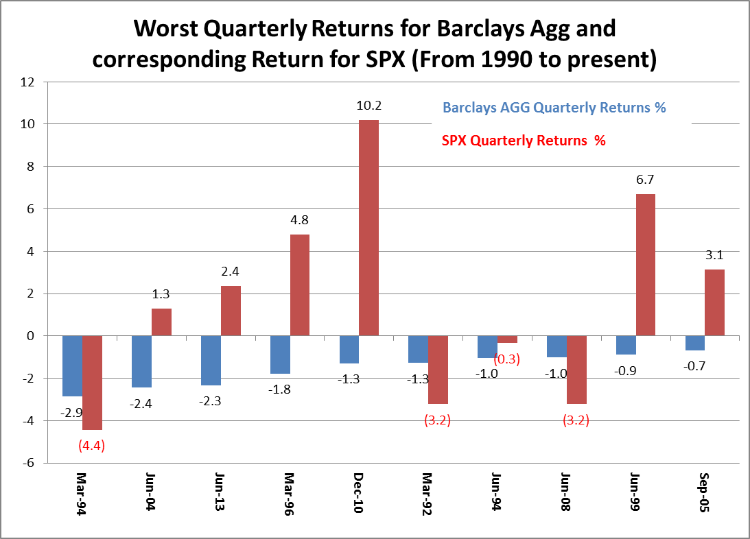
Barclay bond index vs SandP - III Capital Management

Source: III Capital Management

You can read his assessment of the current situation in this article – Silencing the Roar of the Bond Bear. In the past 25 years the largest negative quarterly return from the Barclays bond index was -2.9%, that was back in 1994 when the Fed tightened interest rates abruptly, causing stocks and bonds to collapse in tandem. The next chart highlights the benefits of diversification, generally bonds flip when stocks flop:-
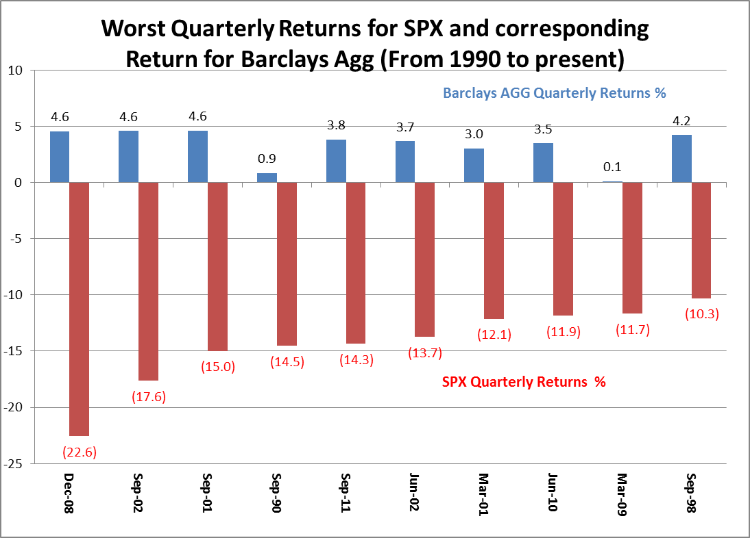
SandP vs Barclays Bond index 25 yr -III Cap Man

Source: III Capital Management

Conclusion and investment opportunities

If inflation is likely to remain subdued due to the excessive debt overhang, then the recent rise in bond prices is simply a correction. How far will this correction go or has it already run its course?

I could analyse each market, apply an array of technical analysis and establish a set of individual forecasts but I believe it is better to view these markets through the lens of the JGB market. Japan has been struggling with bouts of deflation since the 1990’s. Whilst most other nations – Switzerland being a notable exception – have only recently witnessed widespread falling prices, the evolution of inflation expectations are likely to follow a similar course.
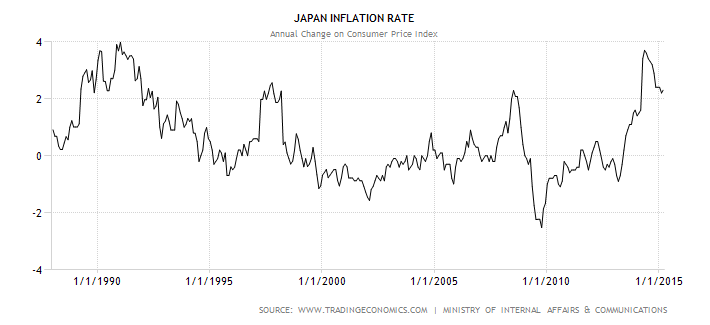
japan-inflation-cpi

Source: Trading Economics and Japanese Ministry of Internal Affairs
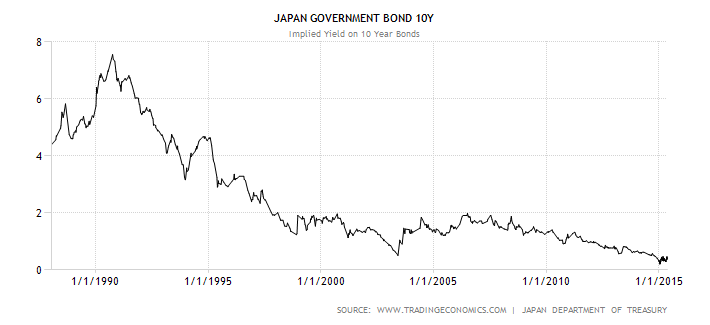
japan-government-bond-yield

Source: Trading Economics and Japanese Treasury
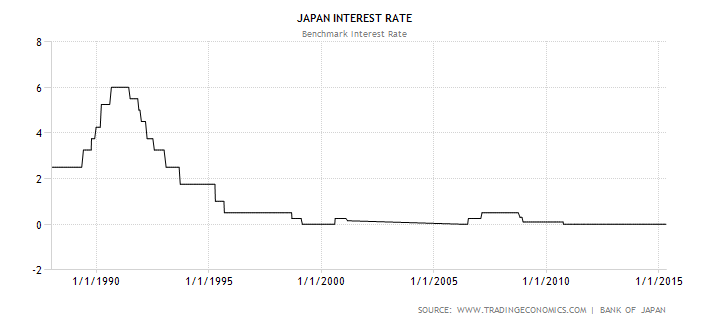
japan-interest-rate

Source: Trading Economics and Bank of Japan

As the Japanese stock market collapsed after 1989 inflation declined rapidly. JGBs, influenced by the rate tightening of the US Fed, suffered a rise in yields in 1994 but then declined once more – after all, the price index was now negative. Inflation witnessed a brief rebound ahead of the Asian Financial Crisis of 1998. The Bank of Japan (BoJ) left short term interest rates on hold and JGB yields declined again as the Asian Crisis gathered momentum.

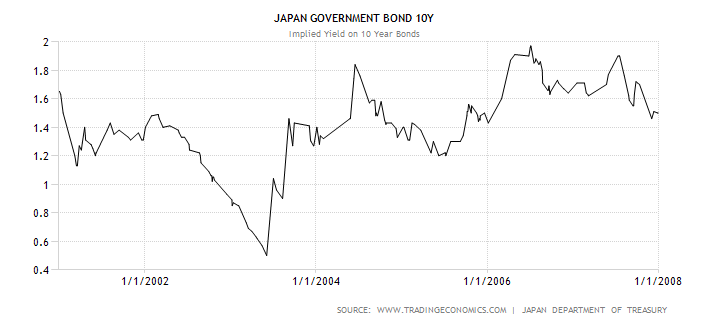
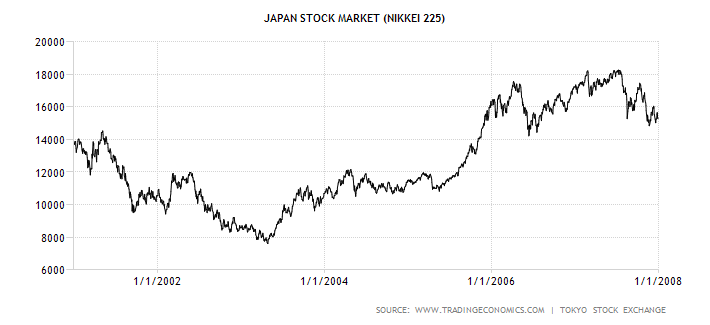
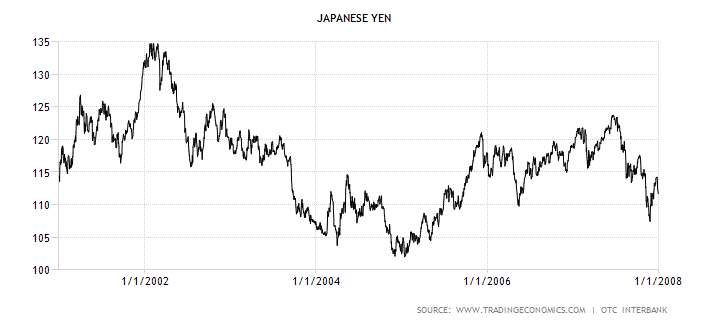
Between 2000 and 2005 Japan struggled with mild deflation, despite expansionary monetary and fiscal policies. At the risk of being vilified for wild generalisation, this is the point where the other bond markets are now. The charts below cover the period 2001-2007, after the bursting of the US Technology Bubble and prior to the Sub-Prime collapse:-
japan-government-bond-yield 2001-2007

Source: Trading Economics and Japanese Treasury
japan-stock-market 2001-2007

Source: Trading Economics and Tokyo Stock Exchange
japan-currency 2001-2007

Source: Trading Economics

The table below extrapolates the corrections and counter-corrections of the JGB in the chart above and compares them to the German Bund and the US Treasury 10 year maturities:-

JGB 10yr Rise/Fall Change Bund 10yr Rise/Fall   Change US T-Bond 10yr Rise/Fall   Change
Range in bp BP % Equivalent bp BP % Equivalent bp BP %
55 – 185* 130* 236* 5 – 80* 75* 1500* 138 – 304* 166* 120*
185 – 120* -65* -35* 80 – 52 -28 35 304 – 163* -141* -46*
120 – 195* 75* 63* 52 – 85 33 63 163 – 266 103 63
195 – 160* -35* -18* 85 – 70 -15 -18 266 – 218 -48 -18
160 – 190* 30* 19* 70 – 83 13 19 218 –   259 41 19

*These figures are actual outcomes

Source: Investing.com and Tokyo Stock Exchange

I am taking the US T-Bond low (1.38%) of July 2012 to be the current nadir. It may now be embarking on a third corrective wave, if you believe in Elliott Wave theory, which could see yields rise toward 3% once more. The Bund correction, from 80bp to 55bp by 19th May, was probably too swift, meaning the market may break above 0.80% before yields decline again.

The price cycles in each of these markets are unlikely to tally either in duration or magnitude, but, after a capitulation in Europe, in which 10yr Bund yield almost turned negative, even the most ardent fixed income protagonists have been unable to justify remaining fully invested – we have now entered a corrective period. A 130bp rebound would take Bunds just above the 61.8% retracement of the recent decline (1.35%). This scale of correction would clear out the majority of weak hands.

Without inflation, growth prospects for the EZ will continue to rely on the benevolence of the ECB who announced additional QE measures earlier this week. Benoît Cœuré, Member of the Executive Board of the ECB, gave this speech on Monday – How binding is the zero lower bound?

Since 2007 JGB yields had marched steadily lower until this January; without some form of resolution of the over indebtedness of developed nations, yields will remain well below what used to be regarded as the natural rate of interest. 3% is likely to cap yields on 10yr US T-Bonds, Bunds will struggle to get above 2%. JGBs are more difficult to predict, but attempts at reflation are likely to fail whilst debt remains so high relative to GDP. The Japanese government cannot afford a doubling or tripling of its interest bill.

For the trader there is plenty of opportunity with yields ranges of 200 to 300bp, but beware of the void of liquidity that results from the absence of free-float. Rising bond correlation, rising yields and the lack of a “dealer of last resort” create dangers of their own.
Broken BRICs – Can Brazil and Russia rebound?

400dpiLogo

Macro Letter – No 35 – 08-05-2015

Broken BRICs – Can Brazil and Russia rebound?

  • The economies of Brazil and Russia will contract in 2015
  • Their divergence with China and India is structural
  • Economic reform is needed to stimulate long term growth
  • Stocks and bonds will continue to benefit from currency depreciation

When Jim O’Neill, then CIO of GSAM, coined the BRIC collective in 2001, to describe the largest of the emerging market economies, each country was growing strongly, however, O’Neill was the first to acknowledge the significant differences between these disparate countries in terms of their character. Since the Great Recession the economic fortunes of each country has been mixed, but, whilst the relative strength of China and India has continued, Brazil and Russia might be accused of imitating Icarus.

Economic Backdrop

In order to evaluate the prospects for Brazil and Russia it is worth reviewing the unique aspects of, and differences between, each economy.

According to the IMF April 2015 WEO, Brazil is ranked eighth largest by GDP and seventh largest by GDP adjusted for purchasing power parity. Russia was ranked tenth and sixth respectively. Between 2000 and 2012 Brazilian economic growth averaged 5%, yet this year, according to the IMF, the economy is forecast to contract by 1%. The forecast for Latin America combined is +0.6%. For Russia the commodity boom helped GDP rise 7% per annum between 2000 and 2008, but with international sanctions continuing to bite, this year’s GDP is expected to be 3.8% lower.

Brazil’s service sector is the largest component of GDP at 67%, followed by the industry,27% and agriculture, 5.5%. The labour force is around 101mln, of which 10% is engaged in agriculture, 19% in industry and 71% in services. Russia by contrast is more reliant on energy and other natural resources. In 2012[update] oil and gas accounted for 16% of GDP, 52% of federal budget revenues and more than 70% of total exports. As of 2012 agriculture accounted for 4.4% of GDP, industry 37.6% and services 58%. The labour force is somewhat smaller at 76mln (2015).

The Harvard Atlas of Economic Complexity 2012 ranks Brazil 56th and Russia 47th. The table below shows the divergence in IMF forecasts since January. During the period October 2014 and February 2015 the Rouble (RUB) declined by 30% whilst the Brazilian Real (BRL) fell only 9%:-

Country GDP GDP Forecast Forecast Jan-14 Jan-14
2013 2014 2015 2016 2015 2016
Brazil 2.7 0.1 -1 1 -1.3 -0.5
Russia 1.3 0.6 -3.8 -1.1 -0.8 -0.1

Source: IMF WEO April 2015

On March 14th the Bank of Russia published its three year economic forecast: it was decidedly rosy. This was how the Peterson Institute – The Incredibly Rosy Forecast of Russia’s Central Bank described it:-

…the Bank of Russia argues that the huge devaluation of the ruble that took place between October 2014 and February 2015 has a minor effect on economic growth. This claim neglects much empirical evidence that sharp devaluations retard investment activity, for two reasons. First, investment technology from abroad becomes more expensive—nearly 80 percent more expensive in the case of Russia. Second, devaluations increase uncertainty in business planning and hence slow down investment in domestic technology as well. Both effects work to depress economic activity in the short term.

…2017 is presented as the year of a strong rebound, as a result of cyclical macroeconomic forces. In particular, says the Bank of Russia, growth will reach 5.5 to 6.3 percent that year. It is true that the economy was already slowing down in 2012, before last year’s sanctions and devaluation. It is also true that the average business cycle globally has historically lasted about six years. But this is no ordinary cycle—sanctions are likely to play a bigger role than the Bank of Russia cares to admit. The main reason is their effect on the banking sector, where credit activity is already substantially curtailed, and may be curtailed even further once corporate eurobonds start coming due later this year. The devaluation has exacerbated the credit crunch as interest rates spiked in early 2015 to over 20 to 25 percent for business loans. These effects point in one direction: a prolonged recession.

Finally, the Russian government is reducing public investment in infrastructure in this year’s budget to try and cut overall expenditure by about 10 percent. This cutback is going to dampen growth because the multiplier on infrastructure investment is highest among all public expenditures. The Bank of Russia seems to have forgotten to account for this elementary fact of life.

Overall, the economic picture may end up being quite different from what the Bank of Russia forecasts. Instead of economic growth of –3.5 to –4 percent in 2015, –1 to –1.6 percent in 2016, and 5.5 to 6.3 percent in 2017, it may be closer to –6 to –7 percent in 2015, –3 to –4 percent in 2016, and zero growth in 2017. This scenario is worth contemplating, as it would mean that the reserve fund that the government uses to finance its deficit may be fully depleted in this period. What then?

The table below compares a range of other indicators for the two economies:-

Indicator Brazil     Russia    
  Last Reference Previous Last Reference Previous
Interest Rate 13.25% Apr-15 12.75 12.50% Apr-15 14
Government Bond 10Y 12.90% May-15 10.71% May-15
Stock Market YTD* 14.70% May-15 23.20% May-15
GDP per capita $5,823 Dec-13 5730 $6,923 Dec-13 6849
Unemployment Rate 6.20% Mar-15 5.9 5.90% Mar-15 5.8
Inflation Rate – Annual 8.13% Mar-15 7.7 16.90% Mar-15 16.7
PPI – Annual 2.27% Jan-15 2.15 13% Mar-15 9.5
Balance of Trade $491mln Apr-15 458 $13,600mln Mar-15 13597
Current Account -$5,736mln Mar-15 -6879 $23,542mln Feb-15 15389
Current Account/GDP -4.17% Dec-14 -3.66 1.56% Dec-13 3.6
External Debt $348bln Nov-14 338 $559bln Feb-15 597
FDI $4,263mln Mar-15 2769 -$1,144mln Aug-14 12131
Capital Flows $7,570mln Feb-15 10826 -$43,071mln Nov-14 -10260
Gold Reserves 67.2t Nov-14 67.2 1,208t Nov-14 1150
Crude Oil Output ,000’s 2,497bpd Dec-14 2358 10,197bpd Dec-14 10173
Government Debt/GDP 58.91% Dec-14 56.8 13.41% Dec-13 12.74
Industrial Production -9.10% Feb-15 -5.2 -0.60% Mar-15 -1.6
Capacity Utilization 79.70% Feb-15 80.9 59.85% Mar-15 62.04
Consumer Confidence** 99 Apr-15 100 -32 Feb-15 -18
Retail Sales YoY -3.10% Feb-15 0.5 -8.70% Mar-15 -7.7
Gasoline Prices $1.04/litre Mar-15 1.16 $0.68/litre Apr-15 0.61
Corporate Tax Rate 34% Jan-14 34 20% Jan-15 20
Income Tax Rate 27.50% Jan-14 27.5 13% Jan-15 13
Sales Tax Rate 19% Jan-14 19 18% Jan-15 18
*Bovespa = Brazil
*Micex = Russia
** Consumer confidence in Brazil – 100 = neutral, Consumer confidence in Russia – 0 = neutral

Source: Trading Economics and Investing.com

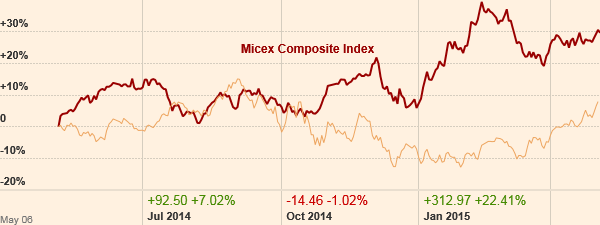
From this table it is worth highlighting a number of factors; firstly interest rates. Rates continue to rise in Brazil despite the relatively benign inflation rate. The rise in the Russian, Micex stock index has been much stronger than that of the Brazilian, Bovespa, partly this is due to the larger fall in the value of the RUB and partly due to the recent recovery in the oil price. PPI inflation in Brazil remains broadly benign, especially in comparison with 2014, whilst in Russia it is stubbornly high – making last week’s rate cut all the more surprising.

Brazilian industrial production continues to decline, a trend it has been struggling to reverse, yet capacity utilisation remains relatively high. Russian industrial production never rebounded as swiftly from the 2008 crisis but has remained in positive territory for the last few years despite the geo-political situation. Remembering that one of Russia’s largest industries is arms manufacture – the country ranks third by military expenditure globally behind China and US – this may not be entirely surprising.

Of more concern for Brazil, is the structural nature of its current account deficit, since the advent of the Great Recession. This combination of deficit and inflation prompted Morgan Stanley, back in 2013, to label Brazil one of the “Fragile Five” alone side India, Indonesia, South Africa and Turkey. Russia, by contrast, has run a surplus for almost the entire period since the Asian crisis of 1998.

The Government debt to GDP ratio in Russia has risen slightly but the experience of the Asian crisis appears to have been taken on board. Added to which, the sanctions regime means Russia is cut off from international capital markets. In Brazil the ratio is not high in comparison with many developed nations but the ratio has been rising since 2011 and looks set to match the 2010 high of 60.9 next year if spending is not curtailed.

A final observation concerns gold reserves. Brazil has relatively little, although they did increase in January 2013 after a prolonged period at very low levels. Russia has taken a different approach, since 2008 its reserves have tripled from less than 400t to more than 1,200t today. There have been suggestions that this is a prelude to Russia adopting a “hard currency” standard in the face of continuous debasement of fiat currencies by developed nation central banks, but that is beyond the remit of this essay.

Are the BRICs broken?

In an article published in July 2014 by Bruegal – Is the BRIC rise over? Jim O’Neill discusses the future with reference to the establishment of a joint development bank:-

Some observers believed that the whole notion of a grouping of Brazil, Russia, India and China never made any sound sense because beyond having a lot of people, they didn’t share anything else in common. In particular, two are democracies, and two are not, obviously, China and Russia.  Similarly, two are major commodity producers, Brazil and Russia, the other two, not. And their levels of wealth are quite different, with Brazil and Russia well above $10,000, China around $ 7-8 k, and India less than $ 2k per head.  And the sceptic would follow all of this by saying, the only reason why Brazil and Russia grew so well in the past decade was simply due to a persistent boom in commodity prices, and once that finished, as appears to be the case now, then their economies would lose their shine, as indeed appears to be the case.  Throw in that China would inevitably be caught by its own significant challenges at some point, which the doubters would say, is now, then all is left is India, and if it weren’t for the election of Modi recently, there has not been a lot to justify structural optimism about that country recently.

…I do believe each of Brazil and Russia have got some challenges to face, that they are not yet confronting, which at the core is to reduce their dependency to the commodity cycle, and while there are many differences between them, they do both need to become more competitive and entrepreneurial outside of commodities and to boost private sector investment.

The development has caused much political jawboning but I suspect its impact will be small in the near-term.

Looking again at the figures for capital flows, Brazil appeared to be in better shape, but Russian FDI has been positive in every quarter since 2008 until the most recent outflow in Q3 2014.

Consumer confidence in Brazil has remained more robust, possibly this is due to innate Latin optimism but it may be partly in expectation of the forthcoming Olympics. The games will take place in Rio, reminding us of the high urbanisation rates in Brazil, 85.4%. This is not dissimilar to Russia at 73.9% but substantially higher than China 54.4% and India 32.4%. Interestingly US urbanisation is 81.4% – but US GDP per capita is significantly higher.

Russia

The Peterson Institute – Russia’s Economic Situation Is Worse than It May Appear from early December 2014 painted a gloomy picture of the prospects:-

The Russian economy suffers from three severe blows: ever worsening structural policies, financial sanctions from the West, and a falling oil price. 

…Russia is experiencing large capital outflows, expected to reach $120 billion. Because of Western financial sanctions, they are set to continue. The large outflows erupted in March as investors anticipated financial sanctions, which hit in July and in effect have closed financial markets to Russia. No significant international financial institution dares to take the legal risk of lending Russia money today. 

Not wishing to be left out of the rhetoric on Russia’s demise, in late December the ECFR – What will be the consequences of the Russian currency crisis?:-

The watershed moment was the imposition of the third round of Western sanctions, which cut Russian companies off from the world’s financial markets. Along with falling oil prices (a key market factor), this caused market players to reassess the risks. Before the introduction of sanctions, the ratio of external debt to foreign exchange reserves (at 1.4) was not particularly worrying. But the fact that companies could no longer refinance their debt on external markets necessitated a rethink. It became clear that, with export revenues falling because of lower oil prices, companies would accumulate excess currency in their accounts. The supply of currency in the market from exporters (many of whom also had large debts) declined sharply, while demand from the debtor companies increased.

In October 2014 the Central Bank was forced to spend another $26 billion to support the rouble. After that, preserving the country’s reserves became the priority, so in November, the bank’s intervention fell to $10 billion. So everything was in place for a currency crisis and this is why the Russian Minister for the Economy called it “the perfect storm”. The storm was only halted by a sharp increase in the Central Bank’s interest rate and by informal pressure on companies that brought about a speedy decline in foreign exchange trading.

…So the double devaluation of the rouble will be felt in rising price and shrinking consumption. According to the Gaidar Institute for Economic Policy, this will add at least 10–12 percentage points to normal inflation, which will reach 15-20 percent. Import substitution options are relatively limited: large-scale import substitution would require significant investment and, at the moment, the resources for this are not there. And a fall in consumption (as a result of the falling purchasing power of households) will cause a decline in production.

According to the Central Bank’s December forecast, GDP in 2015 may fall by 4.5–4.8 percent. This is what the bank calls a “stress scenario”, and it assumes that the oil price will stay at $60 a barrel and Western sanctions will remain in place. In fact, this scenario seems to be the most realistic; any other scenario would involve either the lifting of sanctions or a rise in the oil price to $80 or even $100.

The dismal theme was inevitably taken up by CFR – The Russian Crisis: Early Days in early January:-

The most likely trigger for a future crisis resides in the financial sector. December’s $2 billion bailout of Trust Bank, coupled with news of large and potentially open-ended support for VTB Bank and Gazprombank, highlight the rapidly escalating costs of the crisis for the financial sector as state banks and energy companies face high dollar-denominated debt payments and falling revenues. Rising bad loans, falling equity values, and soaring foreign-currency debt are devastating balance sheets. As foreign banks pull back their support, the combination of sanctions, oil prices, and rising nonperforming loans is creating a toxic mix for Russian banks. So far, a crisis has been deferred by the belief that the central bank can and will fully stand behind the banking system. If any doubt creeps in about the strength of that commitment, a run will quickly materialize.

…Sanctions are a force multiplier. Western sanctions have taken away the usual buffers—such as foreign borrowing and expanding trade—that Russia relies on to insulate its economy from an oil shock. Over the past several months, Western banks have cut their relationships and pulled back on lending, creating severe domestic market pressures. The financial system has fragmented. Meanwhile, trade and investment have dropped sharply. These forces limit the capacity of the Russian economy to adjust to any shock. Russia could have weathered an oil shock or sanctions alone, but not both together.

…Measured by the severity of recent market moves, Russia is in crisis. But from a broader perspective, a comprehensive economic and financial crisis would cause a far greater degree of financial distress for the Russian people. Companies would find working capital unavailable; interest rates of 17 percent (or higher) and exchange rate depreciation would cause a spike in import prices; and capital expenditure would crater. All this would generate sharp increases in unemployment and a far greater fall in gross domestic product (GDP) than we have seen so far.

Chatham House – Troubled Times Stagnation, Sanctions and the Prospects for Economic Reform in Russia – published at the end of February, goes into more depth, concluding:-

Over the past three decades, a precipitous drop in oil prices (and a concomitant sharp reduction in rents) has resulted in economic reforms being undertaken in Russia. Mikhail Gorbachev’s perestroika emerged after the fall in oil prices in 1986. Putin’s earlier, more liberal economic policies were carried out after oil dropped to close to $10 a barrel in 1999. And Dmitri Medvedev’s modernization agenda was strongest in the aftermath of the global recession of 2008–09.

Unfortunately, the prospects for a similar surge in economic reform in Russia today are less good. The unfavourable geopolitical environment threatens to change the trajectory of political and economic development in Russia for the worse. By boosting factions within Russia’s policy elite who favour increased state control and less integration with the global economy, poor relations with the West threaten to reduce the prospects for a market-oriented turn in economic policy. As a result, the prevailing system of political economy that is in such urgent need of transformation may in fact be preserved in a more ossified form. Instead of responding to adversity through openness, Russia may take the historically well-trodden path of using a threatening international environment to justify centralization and international isolation in order to strengthen the existing ruling elite.

Thus, while Western sanctions were not necessarily intended to strengthen statist factions within Russia and force the country away from the global economy, this may prove to be an unintended but important outcome. Consequently, Russia appears to be locked into a path of economic policy inertia, as powerful constituencies that benefit from the existing system are strengthened by the showdown with the West. While Russia may have ‘won’ Crimea, and may even succeed in ensuring that Ukraine is not ‘won’ by the West, the price of victory may be a deterioration in long-term prospects for socioeconomic development.

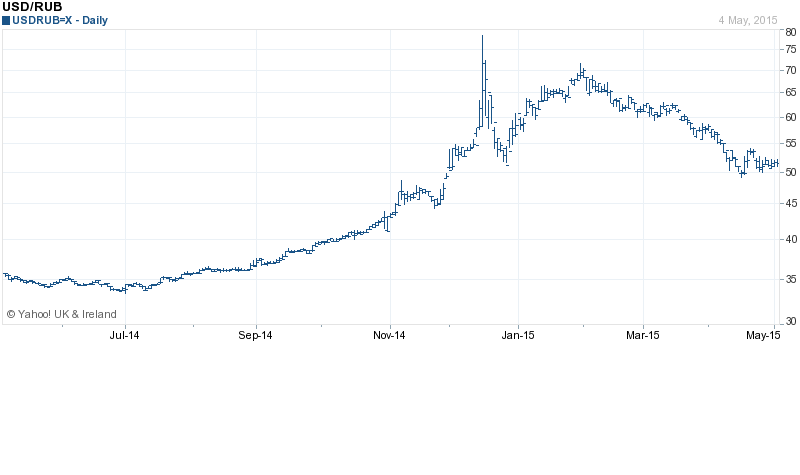
This is how the USDRUB has performed during the last 12 months, the first interest rate cut (from 17% to 15% took place on 30th January, the RUB fell 3% on the day to around USDRUB 70, since then the RUB has appreciated to around USDRUB 55-55:-

USDRUB 1yr

Source: Yahoo Finance

What caused the RUB to return from the brink was a recovery in the oil price and a slight improvement in the politics of the Ukraine. The Minsk II Agreement, whilst only partially observed, has curtailed an escalation of the Ukrainian civil war. Capital outflows which were $77bln in Q4 2014 slowed to $32bln in Q1 2015. Ironically, the rebound in the currency and appreciation in the Micex index will probably delay the necessary structural reforms which are needed to reinvigorate the economy.

Brazil

At the end of February the Economist – Brazil – In a quagmiredescribed the challenges facing President Rousseff’s weak government:-

Brazil’s economy is in a mess, with far bigger problems than the government will admit or investors seem to register. The torpid stagnation into which it fell in 2013 is becoming a full-blown—and probably prolonged—recession, as high inflation squeezes wages and consumers’ debt payments rise (see article). Investment, already down by 8% from a year ago, could fall much further. A vast corruption scandal at Petrobras, the state-controlled oil giant, has ensnared several of the country’s biggest construction firms and paralysed capital spending in swathes of the economy, at least until the prosecutors and auditors have done their work. The real has fallen by 30% against the dollar since May 2013: a necessary shift, but one that adds to the burden of the $40 billion in foreign debt owed by Brazilian companies that falls due this year.

…Ideally, Brazil would offset this fiscal squeeze with looser monetary policy. But because of the country’s hyperinflationary past, as well as more recent mistakes—the Central Bank bent to the president’s will, ignored its inflation target and foolishly slashed its benchmark rate in 2011-12—the room for manoeuvre today is limited. With inflation still above its target, the Central Bank cannot cut its benchmark rate from today’s level of 12.25% without risking further loss of credibility and sapping investor confidence. A fiscal squeeze and high interest rates spell pain for Brazilian firms and households and a slower return to growth.

Yet the president’s weakness is also an opportunity—and for Mr Levy in particular. He is now indispensable. He should build bridges to Mr Cunha, while making it clear that if Congress tries to extract a budgetary price for its support, that will lead to cuts elsewhere. The recovery of fiscal responsibility must be lasting for business confidence and investment to return. But the sooner the fiscal adjustment sticks, the sooner the Central Bank can start cutting interest rates.

More is needed for Brazil to return to rapid and sustained growth. It may be too much to expect Ms Rousseff to overhaul the archaic labour laws that have helped to throttle productivity, but she should at least try to simplify taxes and cut mindless red tape. There are tentative signs that the government will scale back industrial policy and encourage more international trade in what remains an over-protected economy.

Brazil is not the only member of the BRICS quintet of large emerging economies to be in trouble. Russia’s economy, in particular, has been battered by war, sanctions and dependence on oil. For all its problems, Brazil is not in as big a mess as Russia. It has a large and diversified private sector and robust democratic institutions. But its woes go deeper than many realise. The time to put them right is now.

Earlier this week the Peterson Institute – The Rescue of Brazil summed up the current situation:-

The Brazilian economy has all the characteristics of a country under the tutelage of an International Monetary Fund (IMF) program. The list of its economic imbalances is endless: a rampant current account deficit in excess of 4 percent of GDP, an exchange rate that has long been overvalued but that has collapsed in just a few months, a public debt ratio to GDP in a rapid upward trend, a fiscal deficit of over 6 percent of GDP despite a high tax burden, an annual inflation rate of nearly 8 percent that has unanchored inflation expectations, an accelerated growth of wages well above their very low productivity. The scandal of the oil company Petrobras, the latest in a long series of political corruption scandals, is the straw that could break the back of investors’ patience, the tolerance of Brazilian citizens, and the stamina of the world’s seventh largest economy. The Petrobras scandal has far-reaching ramifications throughout the economy and society, paralyzing activity and collapsing both business and consumer confidence to unprecedented levels. The mass street demonstrations of recent weeks are the most graphic example of this dissatisfaction.

In another Op-ed Peterson – Brazil’s Investment: A Maze in One’s Own Navel the authors point to the relatively closed nature of the Brazilian economy for the lack of international investment:-

Consider the most common explanations for why Brazil’s investment rate shows persistent apathy: Excessive taxes levied on businesses discourage fixed capital formation; poor infrastructure—including ongoing problems in the energy sector—increases production costs; high wages relative to worker productivity weigh on firms, hampering investment; an opaque business environment characterized by obsolete and excessive licensing requirements reduce firms’ incentives to invest; an institutional environment marked by subsidized lending that favors certain firms over others misallocates scarce domestic savings; “state capitalism” and excessive government intervention crowd out the private sector. Evidently, all of these reasons have a role in explaining investment inertia. But, importantly, they are all homegrown.

Perhaps Brazil’s sclerotic investment has something to do with its long-standing lack of openness. It is no mystery that Brazil is one of the most closed economies in the world according to any metric that one chooses to gauge the degree of openness. It is no coincidence that this is also the most striking difference between Brazil and its emerging-market peers: Brazil is more closed than Mexico, Colombia, Peru, and Chile; all members of the Pacific Alliance, their growth rates are higher than Brazil’s. Brazil is also less open than India, China, Turkey, and South Africa.

There is an extensive academic and empirical literature on the relationship between investment and openness (see, for example, the Peterson Institute’s video on trade and investment). Several research papers show that the more open an economy is to international trade, the more foreign direct investment it receives. The more foreign direct investment it receives, the greater the availability of resources for domestic investment. Competition is also crucial: Economies that are more open induce greater competition between local and foreign firms, creating incentives for innovation and investment by domestic companies.

Unfortunately, Brazil is still fairly close-minded when it comes to these issues. Fears of losing market share and the old litany of “selling the country to foreigners” still dominate the national debate.

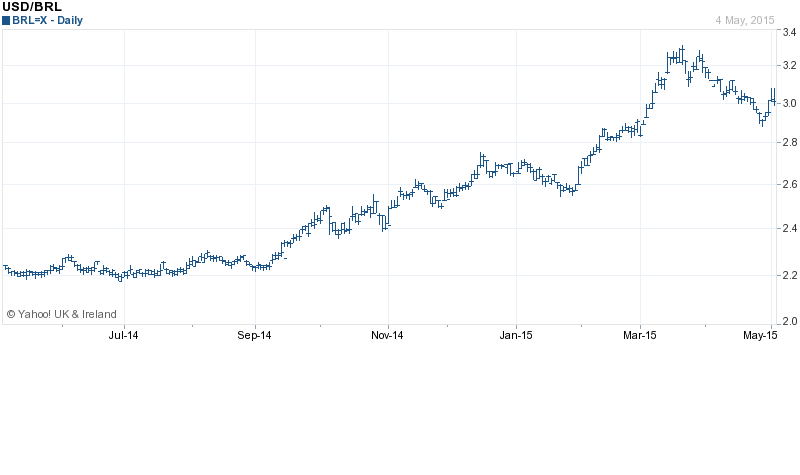
The weakening of the BRL has continued for rather longer than the decline in the RUB, perhaps as a result of the Petrobras “Car Wash” scandal, but a modicum of stability has been regained since early April, as the chart below shows:-

USDBRL 1yr

Source: Yahoo Finance

Commodity correlation

Both Brazil and Russia are large commodity exporters. The table below is for 2011 but a clear picture emerges:-

Commodity Russia Brazil
Oil & Products $190bln $22bln
Iron Ore & Products $19bln $54bln

Source: CIA Factbook

Platts reported that Iron Ore prices (62% Fe Iron Ore Index) had risen since the end of April to $57.75/dmt CFR North China, up $2.25 on 4th May. It is probably too soon to confirm that Iron Ore prices have bottomed but with oil prices now significantly higher ($60/bbl) since their lows ($45/bbl) seen in March. Copper has also begun to rise – perhaps in response to the performance of the Chinese stock market – rising from lows of less than $2.50/lb in January to $2.94/lb this week.

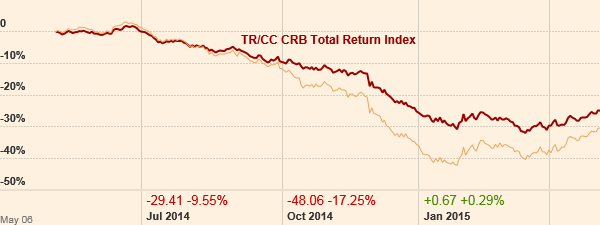
The chart below shows the relative performance of the CRB Index and the GSCI Index which has a heavier weighting to energy:-

GSCI and CRB 1 yr

Source: FT

The general recovery in commodity prices is still nascent but it is supportive for both Brazil and Russia in the near term. Both countries have benefitted from devaluation relative to their export partners as this table illustrates:-

Russia Exports Brazil Exports
Netherlands 10.70% China 17%
Germany 8.20% United States 11.10%
China 6.80% Argentina 7.40%
Italy 5.50% Netherlands 6.20%
Ukraine 5%
Turkey 4.90%
Belarus 4.10%
Japan 4.00%

Source: CIA Factbook

Asset prices and investment opportunities

Real Estate

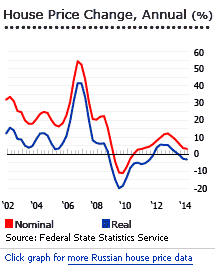
Russian real estate prices have been subdued during the last few years, but the underlying market has been active. The lack of price appreciation is due to a massive increase in house building. 912,000 new homes were built in 2013 – the highest number since 1989. Prices are lower in 10 out 46 regions, however, this new supply should be viewed in the context of the housing bubble which drove prices higher by 436% between 2000 and 2007:-

russia-house-prices-2

Source: Global Property Guide

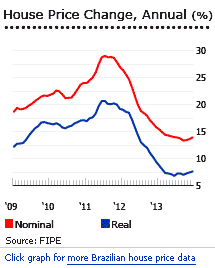
Brazilian property, by contrast, has risen in price. In inflation adjusted terms, prices increased 7.6% in 2013, although these increases are less than those seen during 2011/2012. Rio continues to outperform (+15.2% vs +13.9% nationally) and the forthcoming Olympics should support prices into 2016:-

brazil-house-prices-1

Source: Global Property Guide

Neither of these markets present obvious opportunities. Brazilian prices are likely to moderate in response to higher interest rates whilst increased Russian supply will hang over the market for the foreseeable future. The rental yields in the table are somewhat out of date but clearly offer a less attractive income than government bonds:-

BRAZIL November 16th 2013
SAO PAULO – Apartments
Property Size Yield
80 sq. m. 5.68%
120 sq. m. 4.71%
200 sq. m. 6.15%
350 sq. m. 6.23%
RIO DE JANEIRO -Apartments
60 sq. m. 4.40%
90 sq. m. 3.82%
120 sq. m. 3.91%
200 sq. m. 4.89%
RUSSIA June 24th 2014
MOSCOW – Apartments
Property Size Yield
75 sq. m. 3.84%
120 sq. m. 3.22%
160 sq. m. 3.07%
275 sq. m. 3.42%
ST. PETERSBURG – Apartments
60 sq. m. 6.20%
120 sq. m. 4.36%
175 sq. m. 3.46%

Source: Global Property Guide

Stocks

The chart below compares the performance of Micex and the Bovespa indices over the past year. The devaluation of the RUB has been greater than that of the BRL – this accounts for the majority of the divergence:-

MICEX vs BOVESPA 1yr

Source: FT

Looking more closely at the components of the two indices there is a marked energy and commodity bias, the table below looks at the largest stocks, representing roughly 80% of each index:-

Ticker Stock Weight Sector Free-float
GAZP GAZPROM 15 Energy 46%
SBER Sberbank 14.01 Financial Services 48%
LKOH ОАО “LUKOIL” 13.97 Energy 57%
ROSN Rosneft 5.84 Energy 15%
URKA Uralkali 5.19 Commodity 45%
GMKN “OJSC “MMC “NORILSK NICKEL” 4.79 Commodity 24%
NVTK JSC “NOVATEK” 3.93 Energy 18%
SNGS Surgutneftegas 3.49 Energy 25%
RTKM Rostelecom 3.03 Telecomm 43%
TATN TATNEFT 3.01 Energy 32%
VTBR JSC VTB Bank 2.97 Financial Services 25%
MGNT OJSC “Magnit” 2.22 Commodity 24%
TRNFP Transneft, Pref 2.21 Energy 100%
TOTAL WEIGHTING 79.66
Ticker Stock Weight Sector
ITUB4 ITAUUNIBANCO 10.764 Financial Services
BBDC4 BRADESCO 8.2 Financial Services
ABEV3 AMBEV S/A 7.368 Brewing
PETR4 PETROBRAS 6.045 Energy
PETR3 PETROBRAS 4.416 Energy
VALE5 VALE 3.971 Commodity
BRFS3 BRF SA 3.741 Commodity
VALE3 VALE 3.558 Commodity
ITSA4 ITAUSA 3.433 Financial Services
CIEL3 CIELO 3.37 Financial Services
JBSS3 JBS 2.705 Commodity
UGPA3 ULTRAPAR 2.487 Energy
BBSE3 BBSEGURIDADE 2.47 Financial Services
BVMF3 BMFBOVESPA 2.393 Financial Services
BBAS3 BRASIL 2.344 Financial Services
EMBR3 EMBRAER 1.823 Aerospace
VIVT4 TELEF BRASIL 1.733 Telecomm
PCAR4 P.ACUCAR-CBD 1.663 Retail
KROT3 KROTON 1.49 Support Services
CCRO3 CCR SA 1.48 Transport
BBDC3 BRADESCO 1.445 Financial Services
LREN3 LOJAS RENNER 1.364 Retail
CMIG4 CEMIG 1.207 Energy
CRUZ3 SOUZA CRUZ 1.027 Tobacco
TOTAL WEIGHTING 80.497

Source: Moscow Exchange and BMF Bovespa

The Russian index is clearly more exposed to energy, 48% and commodities, 12%, than the Brazilian index, where the weightings are 14 % each for energy and commodities. It is important to note that the Bovespa index adjusts for the “free-float” for each stock whilst Micex does not, however under Micex rules no stock may account for more than 15% of the index. The free-float adjusted weight of energy and commodities is therefore 18% and 4% respectively.

On the basis of this analysis, currency fluctuation has been the predominant influence on stock market returns, followed by energy and commodity prices. The PE ratios of Micex and Bovespa at roughly 8 times, are undemanding but neither the economic nor the political situation in either country is conducive to long term growth. I expect both markets to continue to recover, although Micex will probably fair best. Longer term, economic reform is required to raise the structural rate of growth.

Although not mentioned in any of the articles quoted above, Russian demographics are unfavourable as this article from Yale University – Russian Demographics: The Perfect Storm – makes clear:-

One measure of an economically secure homeland is women’s willingness to raise children with the expectation of opportunities for good health, education and livelihoods. On that front, Russia confronts a perfect storm – as fertility rates plummeted to 1.2 births per women in the late 1990s and now stand at 1.7 births per women. “Russia’s population will most likely decline in the coming decades, perhaps reaching an eventual size in 2100 that’s similar to its 1950 level of around 100 million,” write demographers Joseph Chamie and Barry Mirkin. The country has high mortality rates due to elevated rates of smoking, alcohol consumption and obesity. Investment on healthcare is low. Over the next decade, Russia’s labor force is expected to shrink by about 15 percent. Other countries with low fertility rates turn to immigration to pick up the slack. While immigrants make up about 8 percent of Russia’s population, the nation has a reputation for nationalism and xenophobia, and fertility rates are even lower in neighboring Belarus, Ukraine and Lithuania, all possible sources of immigration.

Brazil has better demographic prospects in the near term, but its population growth is now not much above the world average and by 2050 it too will be entering a demographic “Götterdämmerung” of declining population. A freer, more open economy is the most efficient method of deflecting the effects of the long term demographic deficits – stock markets reflect this in their risk premiums.

Bonds

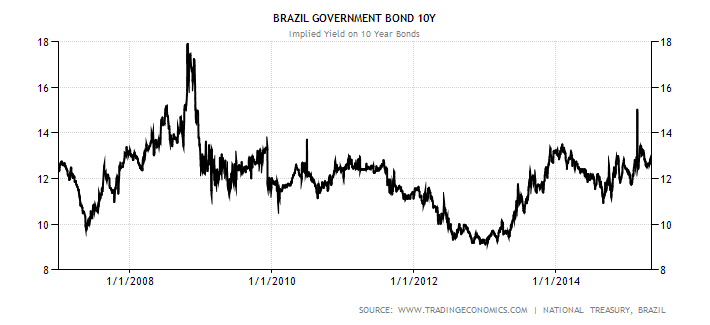
Brazilian government bonds offer a real return after adjusting for inflation (10 yr real-yield 4.77%) however, as this March 2015 article from Forbes – With Currency In Gutter And Bad News Galore, Brazil Bonds A Buy makes clear, there are significant risks:-

…the major headwinds against Brazil are domestic. The fact that China is slowing down is no longer a fright factor. What keeps investors up at night is the possibility of Brazil losing its investment grade.  But last month, Standard & Poor’s credit analysts were in Brasilia and left saying that a downgrade to junk was unlikely.

There is the risk of impeachment and the resignation of Finance Minister Joaquim Levy, but that is already priced into the market with local interest rate futures trading over 14.35% compared to the actual benchmark rate of 12.75%.  Moreover, the impeachment of Dilma Rousseff and the resignation of Levy are worse case scenarios with low probabilities. Worries over energy rationing have subsided.

I believe Brazilian bonds offer good value, even at these levels, the central banks has taken a draconian approach to inflation and the BRL has recovered some of the ground it lost during the last year. Exports to the US should improve and signs of a recovery in European growth will benefit the BRL further.

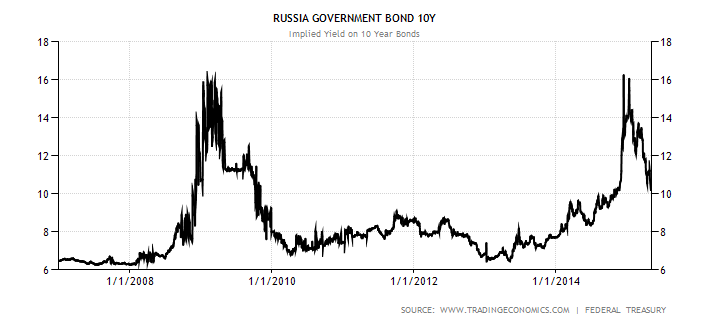
Russian government bonds look less compelling – with headline inflation at 16.9% and 10 yr yields of only 10.71% one might be inclined to avoid them on the grounds on negative real yield – but a case can be made for lower inflation and a resurgence in the value of the RUB as this article from RT – Russia’s ‘junk’ bonds paying off handsomely suggests:-

“It’s very simple advice. Bonds are much more attractive than a year ago. Risks related to the ruble have subsided, inflation is likely to moderate, the BoP (Balance of Payments) and budget situation look reasonably strong and that is why the outlook is quite favorable,” Vladimir Kolychev, Chief Economist for Russia at VTB Capital

“Unless geopolitics interferes, we forecast Russian rates are likely to repeat Hungary’s three-year bull market run in the years ahead,” Bank of America’s head of emerging EMEA economics David Hauner

In a March 11 note, Russia’s Goldman Sachs analysts wrote “Russian bonds are both cyclically and structurally under-priced,” in a big part due devaluation expectations of the ruble stabilizing.

I remain less convinced about the value of Russian bonds but with a low debt to GDP ratio they may perform well.

Here are the recent price charts for 10 year maturities:-

russia-government-bond-yield

Source: Trading Economics

brazil-government-bond-yield

Source: Trading Economics

As inflation declines in both countries their bond markets will continue to rise in expectation of further central bank rate cuts. This will also support stocks but bonds will lead the rally, especially if future growth in Brazil or Russia should disappoint.